zenpundit.com » politics

Archive for the ‘politics’ Category

Book Mini-Reviews to Clear a Boundless Bibliographic Backlog!

Friday, December 10th, 2010

I have too many books that I have read that I would like to review that, realistically, I will never get to post on in conventional fashion. A fair number belong with Summer Series which seems ridiculous as it is two weeks to Christmas! Therefore, brace yourselves, as I commence the first, and hopefully only, Mini-Reviews post:

Play: How It Shapes the Brain, Opens the Imagination, and Invigorates the Soul by Stuart Brown, MD

Dr. Stuart Brown, scientist and psychiatrist, has written a short tome on the nature and cognitive value of play. While there is plenty of child social development information and “pop”self-helpish type chapters, ZP readers wil gravitate to the chapters on play’s vital role in creaivity and innovation ( which are not the same thing), scientific discovery and work. Also of interest are the spectrum of “play personalities” and the “dark side of play”. Not an academic book but a reasonable read on a deceptively complex subject.

The Collapse of Complex Societies by Joseph Tainter

A superb academic book, previously featured and reviewed in the blogosphere by John Robb and Joseph Fouche, The Collapse of Complex Societies embarks upon a critical examination and partial de-bunking of theories that purport to explain the “sudden” fall of great empires, such as Rome or the vanishing of the Mayans. With caveats, Tainter settles on declining marginal returns from increasing societal investment in complexity as a rough proximate cause capable of subsuming a ” significant range of human behavior, and a number of social theories” under it’s rubric. Highly recommended.


The Bin Ladens: An Arabian Family in the American Century by Steve Coll

A biography of the Bin Laden family, this book does not come close to matching the impact or importance of Coll’s previous instant classic, Ghost Wars. There are many interesting trivialities about the divergences between the “religious and the hard Rock Cafe wings” of the Bin Laden families, and intriguing nuggets about political matters such as the 1979 takeover of the Grand Mosque and the connections between the Bin Ladens and elite figures inside the beltway but anyone looking for insight into Osama bin Laden will be disappointed. The most infamous member of Saudi Arabia’s dominant non-royal business clan is a subdued figure in this biography. Coll’s superior skills as a wordsmith and reporter manage to make the book a pleasant page turner.

The Death and Life of the Great American School System: How Testing and Choice Are Undermining Education by Diane Ravitch

Conservative education scholar and historian Diane Ravitch lays out the demise of the movement for high curricular standards in public education that she once championed and it’s transmogrification under NCLB into a punitive system that is slowly imposing an unprecedentedly narrow and dumbed down national curriculum focusing on basic math and reading skills, featuring gamed  test results, highly paid lawyer-consultant insiders and perverse incentives for public and charter schools alike. A depressing but important read.
More Books!

Friday, November 26th, 2010

Just picked up a few new reads…..


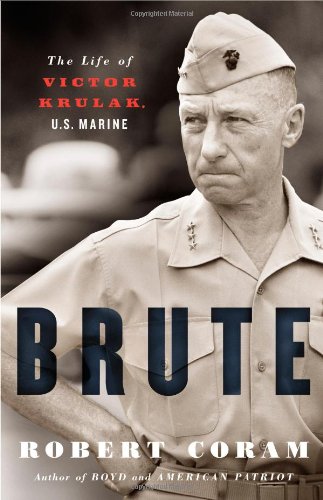
Brute: The Life of Victor Krulak, U.S. Marine by Robert Coram

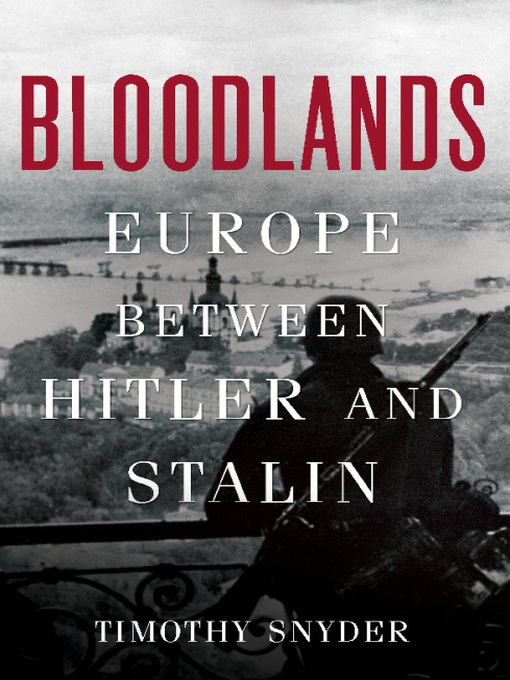
Bloodlands: Europe Between Hitler and Stalin by Timothy Snyder

Robert Coram, whom I had the pleasure of meeting at Boyd ’07, has a new biography of the legendary military visionary and Marine Lt. General Victor “Brute” Krulak, reviewed here by Max Boot and here by Tony Perry (Hat tip to Dr. Chet Richards). Having thumbed a few pages, Krulak appears a complicated man – gifted, dauntless and extremely driven but also possessed of a mean streak, edging at times toward petty cruelty.

Bloodlands I intend to read in a “Hitler-Stalin/Nazi-Soviet Comparison” series along with Richard Overy’s The Dictators: Hitler’s Germany, Stalin’s Russia, Robert Gellately’s Lenin, Stalin, and Hitler: The Age of Social Catastrophe , Richard J. Evans’ The Third Reich at War and Alan Bullock’s classic dual biography Hitler and Stalin: Parallel Lives.  I’d also recommend, for those with the stomach for historiographic commentary, Robert Conquest’s Reflections on a Ravaged Century and John Lukac’s The Hitler of History

CURRENTLY READING:

Human Face of War by Jim Storr

After reading approxmately a third of The Human Face of War by  Dr. Jim Storr, a retired Lt. Colonel, King’s Regiment and an instructor at the UK Defence Academy, I will say that if you are going to read only one book on modern military thought this year, it should be The Human Face of War. It’s that good.

Aside from a reflexive hostility toward John Boyd’s OODA Loop ( though not, strangely enough, toward the substantive epistemology advocated by Boyd that the diagram represented), Storr’s tome is an epistle of intellectual clarity on military theory that deserves to be widely read.

ADDENDUM:

NDU Press recommends, and I concur, this review of The Human Face of War by Col. Colonel Clinton J. Ancker III. Ancker, like Storr, is an expert on military doctrine, so it is a well-informed review by a professional peer.

Book Review: Magic and Mayhem by Derek Leebaert

Monday, November 22nd, 2010

Magic and Mayhem: The Delusions of American Foreign Policy From Korea to Afghanistan by Derek Leebaert

As I mentioned previously, I enjoyed Derek Leebaert’s earlier Cold War history, The Fifty Year Wound, so I was pleased to be sent a courtesy review copy of his latest work, Magic and Mayhem:The Delusions of American Foreign Policy from Korea to Afghanistan. Leebaert, a professor of government who teaches foreign policy at Georgetown university, does not disapoint; Magic and Mayhem is a lively and highly provocative excoriation of of the dysfunctional political culture of making foreign and national security policy in America.  While I found many fine points of disagreement with Leebaert in Magic and Mayhem, his broad themes constitute a healthy challenge to a dolorous status quo in Washington.

In Leebaert’s view, American foreign policy suffers from being crafted under two related evils: a culture of “magical thinking” and a cadre of professional alarmists, the “Emergency Men” who constitute a kind of self-appointed, adrenalin-addicted, national security ecclesia who exploit the magical thinking of the public and labor under its delusions themselves. It is this dual embrace of ends without a priori examination of means or ways and a lust for action that leads our foreign policy elite to embrace all manner of costumed charlatans with polished English language skills who are allegedly willing and able to be America’s “partner” in dangerous neignorhoods. From South Korean autocrats to African kleptocrats to figures of a more recent vintage. Leebaert writes:

Afghan president Hamid Karzai, with his Western-style technocrats and talk of democracy, was immensely appealing to Washington after the Taliban was ousted.  For more than seven years, reports the Times Dexter Filkins, Karzai was a “White House favorite – a celebrity in a flowing cape and dark grey fez” a dramatic outfit that he had designed himself but that had no origin in Afghani dress…..

….”We thought we had found a miracle man” moaned one diplomat. On closer inspection, the sorcerer proved unconvincing as the opium trade and corruption flourished.

I have always wondered where the hell that cape came from.

Leebaert takes aim at a wide variety of targets. I definitely do not agree with his assessments of everything and everyone who has caught his ire, but it is a list that is breathtaking in expanse; a parade of names and terms that includes, but is not limited to:

George Kennan
Douglas MacArthur
Paul Nitze
Detente
Robert McNamara
McGeorge Bundy
Peter Rodman
Brinkmanship
Donald Rumsfeld
COIN
Richard Holbrooke
Henry Kissinger
The CIA
NSC-68
John McCain
Arms Control
John F. Kennedy

Richard Nixon
Curtis LeMay
Defense intellectuals
Lyndon Johnson
Maxwell Taylor
Dick Cheney
Cyrus Vance
George W. Bush
Neocons
Oliver North
Revolution in military affairs
Richard Perle
Crisis management
MAD theory
Strategic/Security Studies
Walt Rostow
Wiliam Westmoreland
Robert Kennedy
Bernard Lewis
Thomas P.M. Barnett
Lawrence Summers
George Tenet
Robert Kaplan
Samuel Huntington
John Abizaid
Stan McChrystal
Barack Obama
David Ignatius
Thomas Friedman
David Brooks
US Public Diplomacy
Jimmy Carter
Michael O’Hanlon

That, by the way, was not comprehensive.

It would be a much shorter list to cite those statesmen of whom Leebaert approved – men like Henry Stimson, Dean Acheson, Matthew Ridgway, Omar Bradley, George Marshall, Dwight Eisenhower, George Schultz and Ronald Reagan. The book is not flawless. There are minor factual errors. Not every person or doctrine in Magic and Mayhem is considered in depth.  At times, Leebaert comes across as glib or superficial in his criticism, but predominantly, as with the cases of Kissinger or Rumsfeld, his bitter jeremiads are skewering their targets.

Leebaert argues for a considered retreat from policy alarmism and the cult of emergency, and for a reduction of ambitious American policy grandiosity that would flow from recognizing and respecting the agency of other nation’s leaders and peoples. Implicitly, a call not so much for isolationism, as for restraint and a sense of proportion, coupled with a dimunition of status and power for national security “celebrities” and the cottage industry of think tank consultancy for which they stand.

Magic and Mayhem is a book that was written to demystify shibboleths and smash idols.

Sinophilia

Thursday, November 18th, 2010


Historyguy99, who has a lot of “in-country” experience, offers up a nice blog round-up and commentary on China.

Impeach Napolitano

Tuesday, November 16th, 2010

Would DHS Secretary Janet Napolitano ever tolerate Border Patrol agents using the TSA “security” procedures on arrested illegal aliens that she demands American citizens submit to in order to catch a plane?

The woman really thinks she’s a central committee secretary of a small Eastern Bloc country circa 1982. Perhaps her view of ordinary Americans as dangerous security threats will change somewhat if she leaves office to become one of them again.

Then we can get a DHS Secretary who will take notice of the giant failed state to our South imploding under the attack of a rapidly expanding narco-insurgency instead of making it a top priority to get Mexican officials to use naked scanners at their airports. WTF?

What planet does she live on?

ADDENDUM:

Apparently it is “Planet Oligarchy”.

Former DHS Secretary Chertoff has a lot of business riding on the USG enforcing the use of scanners on an unwilling public, which explains the TSA’s militant but politically inept position on scanning and groping. One of the bigwigs is trading on his government service and expects to feed at the public trough, so the bureaucrats are going to “hang tough”. Who the hell are we to dare to complain anyway?


Switch to our mobile site