I was going to comment on the death of the famed historian who was the Soviet Union’s most venerable and shameless apologist, but I was beaten to it in a brilliant piece by British blogger and fellow Chicago Boyz member, Helen Szamuely:
On my way to and from Manchester yesterday and today I read Anne Applebaum’s latest book Iron Curtain about the subjugation of Eastern Europe between 1944 and 1956. Ms Applebaum’s knowledge and understanding of the European Union is not quite what it ought to be, given that she usually appears in the guise of one of our leading political commentators but she does know the history of Communism and what it did to the countries and peoples who, for various reasons, found themselves under its rule. The first few chapters describe in some detail the brutality, violence, whole scale looting and widespread rapine that marked the Red Army’s route across Eastern and Central Europe, regardless of whether they were in enemy or friendly countries, with soldiers or civilians, men or women, adults or children, friend or foe. And then came the NKVD and the organized violence and looting. How many people know, for instance, that several of the Nazi camps, Auschwitz and Buchenwald included, were reopened by the Soviets for their own purposes? Not a few of the people they imprisoned there had been liberated only a few weeks previously.
As I was reading this horrible tale I got a text message from somebody who saw on the news that Professor Eric Hobsbawm, the best known apologist for Stalin and denier of Communist crimes, has died. We are entering a period of unrestrained mourning for this man who has on various occasions been described as the greatest living historian and one of the most influential ones. Sadly, the last part of it is true. He has been influential.
While Holocaust deniers are rightly excoriated Professor Hobsbawm has been treated in life and will be in death with the greatest adulation. Channel 4 lists some of the misguided souls who are pronouncing sorrowfully on the demise of this supposedly great man and asks rather disingenuously whether he was an apologist for tyranny.
As of August 2012 this is the best non-fiction book I’ve read this year. Professor Sumida brings a potentially dry topic to life making Alfred Thayer Mahan relevant in the process; as indeed, he should. At a mere 117 pages of moderately footnoted text, Sumida provides the reader a grand tour of Mahan’s life work, not just The Influence of Sea Power 1660-1983. Sumida includes the major works of Alfred Thayer Mahan’s (ATM) father Dennis Hart Mahan, as he introduces ATM’s major works, lesser works, biographies, essays, and criticisms.
Sumida begins his chapters with quotes, and weaves his recounting of ATM’s work with musical performance, Zen enlightenment, and naval command; which is quite a combination, but convincing. Of ATM’s “approach to naval grand strategy” he writes:
Mahan believed the security of a large and expanding system of international trade in the twentieth century would depend upon the creation of a transnational consortium of naval power. His handling of the art and science of command, on the other hand, was difficult, complex, and elusive. It is helpful, therefore, to achieve an introductory sense of its liminal character by means of analogy.
This is where musical performance and Zen enlightenment become relevant and instructive. Sumida writes on musical performance:
Teaching musical performance…poses three challenges: improving art, developing technique, and attending to their interaction.
Sumida goes on to illustrate the parallels between learning musical performance and naval command/strategy and the common thread is performing or, “doing it.” He writes that most musical instruction is through the understudy watching demonstrations by the master, but the higher purpose of replicating the master’s work is “to gain a sense of the expressive nature of an act that represents authentically a human persona.” In other words, the development of relevant tacit knowledge, or as I have come to refer to this as “tacit insight.”
Sumida continues with six short chapters that pack a powerful punch and a good introduction to the trajectory of Mahan’s work from the beginning to end. My favorite was Chapter Six, The Uses of History and Theory. In this chapter Sumida deals with complexity, contingency, change, and contradiction, naval supremacy in the Twentieth Century, Jomini, Clausewitz, and command and history. Quite a line-up, but a convincing inventory of Mahan’s influences and how his work remains relevant today. Sumida writes:
Mahan’s role as a pioneer and extender of the work of others has been widely misunderstood and thus either ignored or misused. The general failure to engage his thought accurately is in large part attributable to the complexity of his exposition, the difficulties inherent in his methods of dealing with several forms of contingency, changes in his position on certain major issues, and his contradictory predictions about the future and application of strategic principles…His chief goal, however, was to address difficult questions that were not susceptible to convincing elucidation through simple reasoning by analogy. He thus viewed history less as a ready-made instructor than a medium that had to be worked by the appropriate intellectual tools.. Mahan’s analytical instruments of choice were five kinds of argument: political, political-economic, governmental, strategic, and professional.
The first three were used in grand naval strategy, the latter two with the “art and science of command.” The section of Command and History is particularly relevant given two recent posts, one at the USNI Blog, The Wisdom of a King, by CDR Salamander, and the other in a September 2012 Proceedings article by LCDR B.J.Armstrong, Leadership & Command. Here’s why: Sumida quotes Admiral Arleigh Burke, who latter became Chief of Naval Operations, during WWII. Of “Decentraliztion,” Burke wrote:
…means we offer officers the opportunity to rise to positions of responsibility, of decision, of identity and stature—if they want it, and as soon as they can take it.
We believe in command, not staff. We believe we have “real” things to do. The Navy believes in putting a man in a position with a job to do, and let him do it—give him hell if he does not perform—but be a man in his own name. We decentralize and capitalize on the capabilities of our individual people rather than centralize and make automatons of them. This builds that essential element of pride of service and sense of accomplishment.
The U.S. Navy could do worse than return to this “father” of naval strategy and give his ideas more attention; Professor Sumida’s little book would be a good place to start.
Strongest recommendation—particularly to active duty Navy personnel.
This is an older book, but important. A few weeks ago I was having lunch with a good friend, Bruce. Bruce is a Vietnam veteran and since both of us are readers many of our lunch conversations revolve around the books we have read, and this meeting was no exception. Bruce enthusiastically recommended The First Battle and No ShiningArmor, both by Lt.Col. Lehrack, and Last Men Out, by Bob Drury and Tom Clavin. He said Lehracks first twenty pages of The First Battle was the best description of the situation that led the United States to become involved in Vietnam. Since my knowledge of Vietnam is embarrassingly meager, I ordered all three when I returned home from lunch. Given Bruce’s descriptions, The First Battle was first up. Lehrack begins the first chapter, Inching Towards the Abyss, with a profound first sentence:
The United States came to this pass in baby steps, characterized more by Cold War fears, hubris, and inattention than by level-headed policy examination.
(Sounds familiar doesn’t it?)
The result of Lehrack’s effort is a readable and powerfully inspiring story of the first battle of the Vietnam War fought only by Americans, specifically, the United States Marine Corps. Code named, Operation Starlite, this “first battle” was a coordinated air, sea, and land attack, but to the green, untested Marines fighting battle-hardened Viet Cong troops nothing about this first encounter was typical or routine.
Lahreck, drawing on interviews with warriors from both sides, provides the reader an up-close view of the savagery and the valor of this battle that resulted in two Americans receiving the Congressional Medal of Honor. The prose is fast paced and detailed, but not so detailed one with no experience/knowledge of Marine Corps jargon can’t keep up. Lehrack includes a fairly exhaustive glossary of the unique terms used, so the military/USMC novice will have a ready guide close-by.
The book is divided in three parts. Part 1 describes general attitudes of the American public, politicians, and military personnel with respect to Vietnam. Part 1 also provides a description of the planning process for the battle and the rationale. Also included is an assessment by the Viet Cong of their American opponents, dated 3 July 1965 (about a month prior to Operation Starlite):
American strong points
The have reached the training level of an expeditionary force.
Armed with modern weapons, lighter than French expeditionary forces, they have quick transportation, quick movement, have capability of quick reinforcement, thanks to vehicles, aircraft, boats.
Usually concentrated in groups.
Weak points compared with French
No spirit of combat; afraid of guerillas; always rely on modern weapons, so they lose initiative and self-confidence (when in contact, they call fire for support and reinforcement); sometimes artillery must conduct fire support for the whole period of operation.
Lack of combat experience, just know combat in theory only (through field manuals). Moreover, on a strange terrain, they usually walk in the open, bewildered like ducks (we say that American troops are most opportune targets for guerrillas).
Much effort required for messing; and water. Food must be supplied for each meal by helicopters. When moving to any place they must use helicopters and artillery fire support, so objective will always be disclosed, brining good opportunity for guerrilla follow up.
Cannot undergo long and hard operations. When operating far from base, about seven kilometers, must use vehicles.
Not able to bear local weather and climate, so troops will fall ill.
Defensive positions sometimes well organized but they are slow to get that way. In one instance it took ten days to organize defenses and thirty to install mines.
They do not know the terrain well.
They run slowly.
(This list is offered for those readers who have insight into whether these weaknesses persist in our military—I do not know.)
In Part 2, Lehrack describes the battle, and the aims of the American commander “to isolate, and then destroy the enemy.” Lehrack follows individuals and units through the battle, and spares no detail in the hardships, risks, and depravations endured by the participants. He offers a gripping and realistic description of the “fog of war:”
The Marines quickly learned a practical lesson that all warriors have known since ancient times. Theoretically, one is supposed to line up in an assault or other planned formation and fight that way. But once battle is joined the formation rapidly degenerates into a series of isolated small actions. In Starlite, as in most battles, it seemed that the fights generally meant that four or five men on one side would be heavily engaged with a similar number on the opposite side. Each combatant became so preoccupied with taking care of his situation that he often had little knowledge of and didn’t really care what was going on a few yards away. Throw in the sounds, the smells, and the fear and you have the notorious “fog of war” that explains why such widely differing accounts describe the same battle.
Perhaps the most important reason for the so-so result was that the Viet Cong had gained an enormous appreciation of the Marines’ ability to project power from the sea as a result of Starlite. Never again in the course of the war did they permit their units to tarry on the coastal plain. When they had a job to do near the water, they came in and did it, and then they fled inland again. Although they developed good antiaircraft techniques and weaponry during the war they had neither the ordnance nor the expertise to thwart an amphibious landing force.
Part 3 is titled The Blood Debt. As eloquently as Lehrack introduced the reader the to attitudes and assumptions of most Americans in his opening chapter, so he concludes. Fifty-four Americans died and an estimated six hundred of the enemy perished in Operation Starlite. By the numbers and a “body count” mentality, we “won” the battle, but in 1965 the Vietnam War was just getting started, and we know how it ended. Lehrack writes:
America spent another ten years, and more than 56,000 additional lives, to follow a failed policy. Like gamblers who have already lost their gambling money, and then the rent money, and the car payment, and then the grocery money, and then borrowed or stole in the hope of changing their luck, the Johnson and Nixon administrations kept signing markers to America for a debt in gore that they hoped a reversal of fortune would justify.
The criminal portion of this gut wrenching conclusion is that American political leaders had no confidence in a military solution in Vietnam. Lehrack quotes President Johnson speaking with a senator, “They hope they will wear us out. And I really believe they’ll last longer than we do.” Eventually, and thankfully, the American public said, “no more.” Amazingly, Lehrack citing Hugh M. Arnold‘s examination found that of an official justification of the war there “were a total of twenty-two separate American rationales: From 1949 to 1962, the emphasis was on resisting communist agression; from 1962 to 1968, it was on counter-insurgency; after 1968, it was on preserving the integrity of American commitments.”
Lehrack correctly laments American unfamiliarity with Vietnamese culture and their visceral attitude towards foreign invaders. We were making the world safe for democracy, and the Vietnamese fell back on nationalism as a recruiting tool and justification for feeding over a million people into the maw of war. Lehrack also points out that Marine leadership knew early on “that Vietnam was more a political war than military.” The Marines had the Small Wars Manual derived from their actions in the Philippines, Nicaragua, and Haiti while the U.S. Army had four pages in their Field Regulations on guerilla warfare. Lehrack speculates a pacification effort, something the Marines knew well, may have been successful if properly applied to good governance on the part of the South Vietnamese government.
Of course these speculations are just that, and there is little evidence given our current predicament in Afghanistan that we learned our lessons. The shelf-life of hubris is eternal.
Bruce was right; this is a powerful little book, and comes with my highest recommendation.
Addendum: LCDR B.J. Armstrong has an enlightening essay on rotary aircraft, which includes Operation Starlite here.
It appears that the Pentagon no longer intends to educate the most talented members of the officer corps to think strategically.
I say this because the status of the premier professional military education institutions – the war colleges and NDU – have been devalued, their leadership slots demoted and their educational mission degraded. As a guest columnist for Tom Ricks noted back in June:
….The new uniformed leadership of the Armed Forces, i.e., General Dempsey and his staff, apparently intend to prune NDU back to where it was a few decades ago. There will be some modest resource savings, but since the entire university budget doesn’t amount to the cost of a single joint strike fighter, one has to wonder what is motivating all of what is happening here. In the cuts that have been discussed, Dempsey’s deputy, Marine Lt. Gen. George J. Flynn has wielded the meat axe, often with the aid of micromanaging action officers. No one here in the rank-and-file is sure if the urbane chairman is on board with the details of all of this. (Ironically, both the chairman and J-7 are NDU graduates with advanced degrees.)
This set of changes took place in stages. First, while very few general or flag officer slots were cut in the armed forces, the three-star president of the university slot was downgraded to two, and the school commandants, downgraded from two to one star. No big deal, one might say, but one would be wrong, very wrong. A three star in Washington can go head-to-head with a principal on the joint staff or a senior OSD bureaucrat to protect the university. To compound the problem, the last three star president was retired in the spring and the university was left for a few months under the command of a senior foreign service officer, a former ambassador, a woman of great diplomatic talent and experience with no clout in the Pentagon. The new commandant — a highly regarded Army two-star — will not report until deep into June, when all or most of the cuts have been set in concrete. (Interesting question: can an employee of the State Department legally or even virtually assume command of a DoD organization?)
….A new “charter” was subsequently published by the Chairman. It focused the university on joint professional military education and training, which in itself, is a good thing. Immediately, however, the research and outreach activities of the university, often more focused on national strategy than military affairs, came under intense scrutiny. These outfits had grown way beyond their original charters and had become effective and highly regarded servants of a wider interagency community. Much of their work was not done for the joint staff but for OSD Policy, and some of that in conjunction with civilian think-tanks. The research arm of the university was productive, even if not always useful in a practical way to the joint staff. It also was helpful to the colleges in a much more proximate and direct fashion than other think tanks, like RAND.
….The research, gaming, and publications arms of the university — a major part of the big-think, future concepts and policy business here — will be cut to somewhere between half and a third of their original sizes. To make things worse, many of the specific cuts appear to have been crafted in the Pentagon, and nasty emails have come down from on high, about how the university is bankrupt and going into receivership, which was never the judgment of the military and civilian accrediting officials, who inspect us regularly and have generally given the university high marks.
If it would be impressive if some of our senior generals had been as effective on the battlefield as they are in the bureaucracy.
Uncreative destruction of intellectual seed corn is a bureaucrat’s way of telling everyone to shut up, don’t question and get in line. There’s nothing wrong with having excellence at joint operations as an educational goal for most future brigadiers and major generals but our future theater commanders, combatant commanders, service chiefs and their respective staff officers need something more – they need strategy. More importantly, the Secretary of Defense, the President, the Congress and the American people need the DoD to have an in-house capacity to generate deeply thought strategic alternatives, question assumptions and red-team any self-aggrandizing options the services or bureaucracy feel like offering up in a crisis.
The motivation here is simple, really. If you put out all the strategic eyes of the Pentagon, then the one-eyed men can be King. Or he can always contract out his strategic thinking to highly paid friends to tell him what he wishes to hear.
Naturally, this will have bad effects downstream in a superpower whose civilian leadership seldom has as good a grasp of geopolitics and the fundamentals of classical strategy as they do of law or the partisan politics of running for office. They will be in need of sound strategic advice from uniformed military leaders and they will be much less likely to get it. Instead, they will have senior officers who are less likely to balk when the President’s back-home fixer turned “adviser” or superstar academic with delusions of grandeur pushes a half-baked plan at an NSC meeting to “do something”. When that happens, the jackasses kicking down this particular barn will have long-since retired and cashed out with consultancies and sinecures on boards of directors.
While a lack of strategic thinking can undermine even a lavishly funded and well-trained military, the reverse is also true; strategic leadership can revive an army that is but a half-dead corpse.
A brief illustration:
After WWI the two states that made the most extreme cuts in military power were defeated Germany and the victorious United States. Germany was forced to do so by Versailles, but responded by opting under General von Seeckt to reduce to 100,000 men by making the Reichswehr a qualitatively superior nucleus of a future expanded German Army. Prohibited from having mass, the Germans opted for class with every long-serving recruit being considered officer material and being superbly trained (even to the extent of covert training and weapons testing jointly with the Red Army deep inside the Soviet Union to evade Allied inspections). Von Seeckt also instituted a shadow general staff office that thought deeply about tactical lessons, operations and strategy for the next war. Without the Reichswehr being what it was it is highly dubious that Hitler could have so rapidly expanded the Wehrmacht into a world-class land fighting force in so few years time.
.
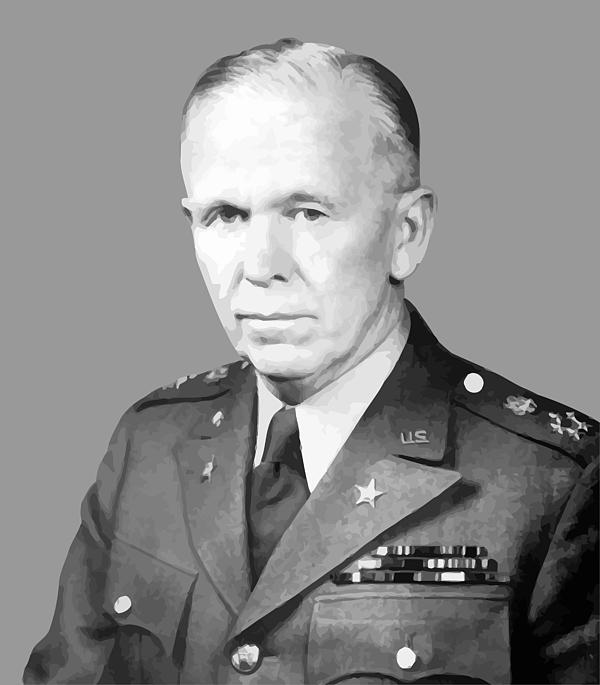
In contrast, the United States radically reduced the size of the regular Army and starved it of weapons, ammunition, gasoline, training and basic supplies. Promotions slowed to a crawl where ancient colonels and elderly majors lingered on active duty and future four and five star generals like Eisenhower, Patton, and Marshall all despaired and contemplated leaving the service. The Army’s – and to extent, America’s – salvation was in the fact that George Marshall persevered as a major and colonel in keeping a little black book of talented, forward thinking, officers and thought deeply and reflectively about building armies, helping enact “the Fort Benning Revolution” in military training. When FDR placed the power in Marshall’s hands as Chief of Staff he knew exactly what to do because he had a well-conceived vision of where the US Army needed to go to meet the national emergency of WWII. He was the American von Seeckt, except that Marshall was an infinite improvement morally, strategically and politically on his German counterpart. We were extremely fortunate to have had him.
Kay Larson, Where the Heart Beats: John Cage, Zen Buddhism, and the Inner Life of Artists, Penguin, $29.95
.
Dropping silence into a concert turns things upside down: it brings the solo performer or group of performers into the position of audience, makes listeners of them – and makes keener listeners of the audience — perhaps with a touch of unease or self-consciousness, but with an unusual attentiveness, too.
Dropping John Cage‘s piece of silent music into a book right around the beginning… well, it has a similar impact. And that’s what Kay Larson‘s book Where the Heart Beats does, on the page numbered xiii so you’ll know the book hasn’t even started properly yet. Larsen points you, without giving you the URL, to YouTube, where you can find Cage’s most shocking, and thus his most famous piece, 4’33”, performed by the London Symphony at the Barbican, in three movements, all silent as demanded by the composer’s score – with breaks in between the movements for the usual coughing and fidgeting.
And how to say this? During the silence, you could have heard a pin drop? Or you could hear, as Tom Service said on the BBC, the “very distinct high hum” of the Barbican’s electrical system, and the occasional cough too – “you could cut the atmosphere with a knife, and every cough, every tiny noise was absolutely amplified, made into a massive musical event”.
Listen:
You can tell the audience was delighted – self-satisfied perhaps, too? – from the hearty applause, and they had listened, had presumably taken onboard the idea that pauses – silences – are as much a part of music as sounds.
But what if I said that wine was just as much a part of drinking as glasses, and poured wine for my guests with no glasses to contain it?
The thing about John Cage’s 4’33” is that it straddles the line between the emperor having and not having clothes, between group assent and dissent, between “either” and “or” -– if it turns us from self-obsessed self-expressives into attentive listeners, it has reached into us musicically and carried us beyond the limits of music. And if it’s a bunch of boring minutes while an orchestra gets paid to SFU, it’s plain idiotic.
Which means that John Cage composed it right at the tipping point between the stupid and the profound.
I want to express it that way, and not tell you that Cage composes where the mind is fresh and inspiration flows, because it is stupid as well as fresh and profound.
As Hitler might have said, if he’d been asked…
And we haven’t really begun the book yet.
**
There are three stories here:
There’s the rigorous thread of western classical music, from its origins in the mist via Jewish cantillation and Gregorian chant into Polyphony and the Baroque, Classicism proper, Romanticism and the Modern. The music of Cage is the culmination, here, of this theme.
There’s the circling yet nonexistent circle, drawn as it were on glass with an ink brush dipped in water, of Zen, a “rebirth with neither beginning nor end”…
And there’s the world of the contemporary arts, centering in New York, with Cage a leading light.
They comes together when various characters have what Larson calls “life altering moments” — Larson herself, John Cage, Gary Snyder, Allen Ginsberg, Jack Kerouac in the first few pages alone, with the two Suzukis, DT Suzuki and Shunryu Suzuki Roshi and their experiences hovering in the background.
Zen is the pond, the emptiness, the silence, the stillness waiting into which like so many varied pebbles, the themes are character off the book will drop, in which their ripples will intersect…
Or to put that another way: silence, the stillness, is the pond into which Cage’s life and influence is dipped, and music and the arts the shingle on the beach from which the pebbles are dropped.
**
And Cage played in that shingle, sent notes from “prepared piano” and other instruments… formal and informal… skipping across the silence.
Cage not only invited silence into the concert hall, he also theorized it at length. I’d like to quote here a celebrated passage from his book, aptly named Silence: Lectures and Writings:
What happens to a piece of music when it is purposelessly made? What happens, for instance to silence? That is, how does the mind’s perception of it change?… Silence becomes something else — not silence at all, but sounds, the ambient sounds… Where ears are in connection with a mind that has nothing to do, that mind is free to enter into the act of listening, hearing each sound as it is, not as a phenomenon more or less approximating a preconception.
**
Zen is the simplest thing, it’s human nature. It is also the most difficult — it’s what we instinctively shy away from. And it can take all our resources, as those who “sit while going round in circles” well know — to break from the “boredom” of silence into listening, to dip into the sound stream, to hear the stillness.
Somehow, I’m hoping to nudge you into that kind of awareness, so that you can understand from within the taste of silence, the importance of Cage’s life, and of Kay Larson’s book.
Here’s another nudge, from a different angle — the Scottish poet Edwin Morgan‘s poem in homage to one of John Cage’s sayings:
Opening the Cage: 14 Variations on 14 Words “I have nothing to say and I am saying it and that is poetry.” — John Cage
I have to say poetry and is that nothing and am I saying it I am and I have poetry to say and is that nothing saying it I am nothing and I have poetry to say and that is saying it I that am saying poetry have nothing and it is I and to say And I say that I am to have poetry and saying it is nothing I am poetry and nothing and saying it is to say that I have To have nothing is poetry and I am saying that and I say it Poetry is saying I have nothing and I am to say that and it Saying nothing I am poetry and I have to say that and it is It is and I am and I have poetry saying say that to nothing It is saying poetry to nothing and I say I have and am that Poetry is saying I have it and I am nothing and to say that And that nothing is poetry I am saying and I have to say it Saying poetry is nothing and to that I say I am and have it
— Edwin Morgan, The Second Life Edinburgh University Press, 1968
**
In a follow up post on Monday or Tuesday, I shall describe Larson’s book in more conventional terms, and offer you some details from Cage’s intricate life and extraordinary network of friends..
For now, I just want to give you again that taste of silence from which this whole endeavor springs. Here is the pianist David Tudor, for whom the piece was written, playing 4’33”:
Zenpundit is a blog dedicated to exploring the intersections of foreign policy, history, military theory, national security,strategic thinking, futurism, cognition and a number of other esoteric pursuits.