zenpundit.com » blogosphere

Archive for the ‘blogosphere’ Category

GMTA?

Tuesday, February 22nd, 2011

[ by Charles Cameron ]

It’s not exactly news —

Napoleon supposedly said “Even in war moral power is to physical as three parts out of four” — and these two quotes say pretty much the same thing, translated and updated, don’t they?

quogmta.gif

Kudos to my blog-friend Christopher Anzalone, who keeps the rest of us current on digital Taliban offerings, AQ graphics and more. His Views from the Occident: Twitter Specials blog is my source for the interview with Abdul Sattar Maiwand, web-master of the official Islamic Emirate [ie “Afghan Taliban “] site, while David Betz blogged on Gaming Social Networks for Influence and Propaganda at Kings of War (Department of War Studies, King’s College London).

The interview with Maiwand gets into detail that will interest students of information operations and/or contemporary uses of technology — here’s a taste of something close to my good (and frequently prophetic) friend Howard Rheingold‘s notion of wireless quilts:

The news that is posted on the website is converted to SMS messages and sent to a number of people, who send it to other people. Each of them sends it to his acquaintances inside and outside Afghanistan and so a chain of dissemination begins. Each ones tries to spread the news more and more. We have seen many people requesting their friends and relatives to forward the news they receive to at least 20 other people, etc…and so this news becomes widely circulated in popular circles. Through the grace of Allah, we have seen many among the general populace rejoice when news reaches them of the victories of the Mujahideen over their enemies.

But you might like to read the whole thing…

COL Pat Lang on Twitter

Wednesday, February 16th, 2011

[ by Charles Cameron ]

Excellent news!  COL Patrick Lang has now signed up on Twitter, so a quick and easy way to know when he’s posted at Sic Semper Tyrranis is to follow him @pat_lang. I hope he’ll post the occasional quick comment on — or pointer to — breaking news there, too.

*

Okay, that’s the main message here — but there’s also an amusing aside to be made.

I tend to pride myself (I’m afraid that’s probably the right word) on my humility — so you can imagine how I felt when I discovered earlier today that Twitter was doing my humility for me:

humility-by-twitter.jpg

That’s right: as a follower of COL Lang, I rate precisely zero.

Humility by twitter — is our technology getting wise to us at last?

A Recommended Blog for Metacognition

Sunday, January 30th, 2011

A while back, I added Ribbonfarm to the blogroll, which is written by Dr. Venkat Rao, a corporate scientist typeafter John Hagel featured in his twitterstream an old but amusing post by Rao analyzing sociopathology in corporate life via characters from The Office. Clever. I thought I would blogroll him and check in periodically.

Later, I noticed that Rao makes frequent references to Clausewitz in his posts and that he is writing Tempo, a book on decision making that will be of great personal and professional interest to many readers here. At this juncture, I’m intrigued.
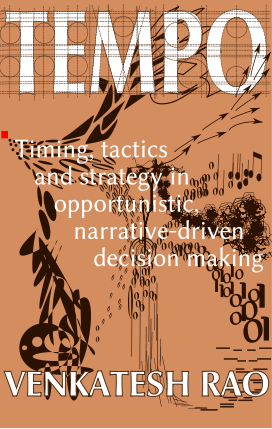
Then last week, Rao featured a lengthy post on metacognition where he made some excellent points. Here’s a few of them, but as I can only put up a small selection, you should go read the full post:

Boundary Condition Thinking:

 ….To build mathematical models, you start by observing and brain-dumping everything you know about the problem, including key unknowns, onto paper.  This brain-dump is basically an unstructured take on what’s going on. There’s a big word for it: phenomenology. When I do a phenomenology-dumping brainstorm, I use a mix of qualitative notes, quotes, questions, little pictures, mind maps, fragments of equations, fragments of pseudo-code, made-up graphs, and so forth.

You then sort out three types of model building blocks in the phenomenology: dynamics, constraints and boundary conditions (technically all three are varieties of constraints, but never mind that).

Dynamics refers to how things change, and the laws govern those changes. Dynamics are front and center in mathematical thought. Insights come relatively easily when you are thinking about dynamics, and sudden changes in dynamics are usually very visible.  Dynamics is about things like the swinging behavior of pendulums.

Constraints are a little harder. It takes some practice and technical peripheral vision to learn to work elegantly with constraints. When constraints are created, destroyed, loosened or tightened, the changes are usually harder to notice, and the effects are often delayed or obscured. If I were to suddenly pinch the middle of the string of a swinging string-and-weight pendulum, it would start oscillating faster. But if you are paying attention only to the swinging dynamics, you may not notice that the actual noteworthy event is the introduction of a new constraint. You might start thinking, “there must be a new force that is pushing things along faster” and go hunting for that mysterious force.

This is a trivial example, but in more complex cases, you can waste a lot of time thinking unproductively about dynamics (even building whole separate dynamic models) when you should just be watching for changes in the pattern of constraints.

….Historians are a great example. The best historians tend to have an intuitive grasp of this approach to building models using these three building blocks.  Here is how you can sort these three kinds of pieces out in your own thinking. It involves asking a set of questions when you begin to think about a complicated problem.

  1. What are the patterns of change here? What happens when I do various things? What’s the simplest explanation here? (dynamics)
  2. What can I not change, where are the limits? What can break if things get extreme? (constraints)
  3. What are the raw numbers and facts that I need to actually do some detective work to get at, and cannot simply infer from what I already know? (boundary conditions).

Besides historians, trend analysts and fashionistas also seem to think this way. Notice something? Most of the action is in the third question. That’s why historians spend so much time organizing their facts and numbers.

Nice. There’s a multitude of places here to jump off and generate further epistemic analysis, and I am sure that some of the admirers of Boyd, Polanyi, Wohlstetter, Feynman, Kahn and Clausewitz in the ZP readership might do so in the comments. Or my co-blogger Charles might weigh in from the imaginative/mythic/visual domain. We’ll see.

Regardless, I think if you are following blogs like Metamodern, Thomas P.M. Barnett,  Open the Future, Global Guerrillas, John Hagel’s Edge Perspectives, Eide Neurolearning Blog or liked the old Kent’s Imperative (suddenly live again after being dormant for 2 years), you’ll want to consider adding Ribbonfarm to your RSS feed or blogroll.

ADDENDUM:

Ed at Project White Horse, another fine site for your blogroll, is also blogging on boundary conditions:

Stall, Spin, Crash, Burn and Die – Boundary Conditions for 2011

….You can’t fix things without some understanding, real understanding of the problem – nor can there be real leadership without actionable understanding. That’s where establishing boundary conditions as a vehicle to frame the problem – and therefore garner greater insight – become important.

Drilling for oil at a depth of 5000ft and in open ocean – Deepwater Horizon – should have been/should be seen as a “crisis” in waiting no matter the historical track record. Proper understanding would have meant that the National decision making level immediately recognized the high potential for the initial crisis migrating into a severely complex catastrophe after the explosion and acted, not waiting to see if BP’s response plans would work. Activities in “Blue Water”/open ocean are not a linear extrapolation from “inshore,” nor is 5000 ft a linear extrapolation from 200ft or 500ft. depths.  BP’s plans might have been up to the problem, but the shear nature of the environment, if scrutinized in context of “unconventional” as described below, should have been a trigger to initiate intermediate action.  Rather, the declaration of an Event of National Significance was 30+ days in coming??? A significant point, I believe, is the problem generated by not recognizing the nature or even acknowledging the existence of a different kind of  problem, one potentially very complex or stochastic in nature – an “unconventional crisis.”

Off-Base

Thursday, January 27th, 2011

Dr.David Ucko at the excellent Kings of War blog has his story and he is sticking to it:

The Weather Underground: a different approach to political violence

I recently watched The Weather Underground, a 2002 documentary on the eponymous radical organisation active within the United States during the 1970s. The film may be of interest to those studying radicalisation, insurgency and political violence, as it effectively explores the rise, evolution and demise of a revolutionary organisation. It also raises some semantic/ethical questions about ‘who is a terrorist’.

….The use of violence for political messaging may be viewed as ‘terrorism’, and this is typically how the Weather Underground is understood. But is this accurate? Terrorist groups deliberately target civilians to scare or terrorise wider populations into a certain political behaviour. The WUO refrained from such action: they used violence against buildings rather than people, to symbolise their discontent with specific policies and actions, but without killing those held responsible. It was ‘propaganda of the deed’, but without the bloodshed. Accordingly, none of WUO’s attacks resulted in casualties (the one exception has not been definitively linked to the group), and for this reason alone, it is difficult to call WUO a ‘terrorist’ organisation.

Uh, no it isn’t. As the commenters at KoW are busy trying to inform Ucko, this narrative does not fit the facts of the history of the Weathermen.

David, I suspect, is not trying to romanticize the Weathermen here so much as force-fit them into his theoretical model of terrorism, possibly influenced by a tactical turn that was undertaken by the IRA to drive up financial costs for the British government while minimizing the bad press that and damage to their public image that had been growing from earlier, bloody, IRA bombings.

Cameron Guest Posts at Jihadology

Monday, January 24th, 2011

Charles Cameron ventures forth to conquer new blogworlds:

GUEST POST: Hitting the Blind-Spot- A Review of Jean-Pierre Filiu’s “Apocalypse in Islam”

Jean-Pierre Filiu’s book, Apocalypse in Islam (University of California Press, 2011) makes a crucially important contribution to our understanding of current events – it illuminates not just one but a cluster of closely-related blind-spots in our current thinking, and it does so with scholarship and verve.

Al-Qaida’s interest in acquiring nuclear weapons – and Iran’s – and the safety of Pakistan’s nuclear materiel – and the situation in Jerusalem – depending how you count ‘em, there are a half dozen or so glaring world problems where one spark in the Mahdist underbrush might transform a critical situation. And yet as Ali Allawi put it in his talk to the Jamestown Foundation on Mahdism in Iraq a few years back, Mahdists ferments still tend to be “below our radar”.

People are always talking about unintended consequences: might I suggest that blind-spots are where unintended consequences come from – and offer some background on apocalyptic, before proceeding to discuss Filiu’s contribution?

We already have a tendency to dismiss religious drivers in considering current events, having concluded in many cases that religion is passé for the serious-minded types who populate diplomatic, military and governmental bureaucracies world-wide – and we are even more reluctant to focus on anyone who talks about the Last Days and Final Judgment, despite the presence of both in the faith statements and scriptures of both Islam and Christianity. We think vaguely of cartoons of bearded and bedraggled men with sandwich boards declaring The End is Nigh, and move along to something more easily understood, something conveniently quantitative like the number of centrifuges unaffected by Stuxnet in Iran, or purely hypothetical, like the association of Taliban and Al Qaida in Afghanistan.


Switch to our mobile site

