New Atlanticist
Friday, July 17th, 2009Is running my Nexus of Education and Grand Strategy post. Nice!
Is running my Nexus of Education and Grand Strategy post. Nice!
Novelist Steven Pressfield invited me to do a guest-post at his new blog giving my take on the polarized debate regarding his high profile, vblogging, presentation on tribalism. Here is a small snippet:
….There was enthusiastic praise for ‘Tribes”, naturally, but the criticism was equally as strong because Pressfield’s theme of tribalism as a general explanatory model is a powerfully attractive one. Too attractive, in the view of subject matter experts (SME) who drill down to a very granular level of detail and see all of the particularistic caveats or limitations of tribalism that exist in a given society. Tribalism among the ancient Gauls was not a carbon copy of 21st century Afghanistan, the artificial kinship network of the Yakuza or Shaka Zulu’s Impi formations. Yet, some similarities or congruencies remain even among such historically diverse examples because a tribe is a durable social network. In terms of resilience, a tribe may be the most adaptive and secure social structure of all.
Read the rest here.
RESPONSE to NATHAN of REGISTAN:
Nathan Hamm, the founder of Registan.net asked some critical questions of me at It’s the Tribes Stupid! and for whatever reason, I have tried multiple times to post a reply and my comment does not appear. Therefore, I emailed it to Nathan and I am replying here so those interested in following the discussion can see it. My apologies for the inconvenience. Here’s the reply, Nathan’s questions are in bold text:
Hi Nathan,
Alexander’s armies had quite a few Persians…..but they were probably shiny, moreso than the Macedonians toward the end.
Good to have you here. For Steve’s readers who may not be familiar with Mr. Hamm or Registan, Nathan has been an important voice on Central Asian affairs in the blogosphere for years on a number of respected regional sites and has extensive experience living in the region.
Let me try to address your concerns in reverse order:
“Mark, so what? This is a huge pet peeve of mine. I know I fall into that category, but from where I sit, I see neither interest nor inclination to engage or respond to these criticisms”.
The latter statement has to be addressed by Steven Pressfield rather than me. On the other part, as a learning aspect, when SME are writing to the uninitiated, there’s often a too large assumption about what the laymen know and a tendency to bring an overloading amount of complexity to the discussion. I am guilty of this myself at times when teaching or writing about my research interests. Pressfield is probably not writing for a typical reader at Registan but his readers may become interested enough in Afghanistan or tribalism that they may start reading articles, books and sites like yours as a result. Where you see a static end-state, I see a gateway or a hook.
“Coincidentally, some colleagues and I were recently trying to turn up academics who specialize in Afghanistan who say that tribe is the critical or even very useful factor for understanding how Afghan society organizes and behaves”
Richard Tapper has written on the negotiation of identity, with one of the major components being “qaum”, which if I recall has (or can have) a loose “tribal” meaning. I’m not qualified to rate experts in your field Nathan, but Nojumi describes the Parcham-Khalq Communists in Kabul thinking the tribes were important enough to warrant sending out the meddling Marxist officials to their villages ( incidentally, the Soviet advisers had cautioned the Taraki regime against it). Flipping through Ewans’ Afghanistan: A Short history, the tribes are present as at least a background political factor from Ahmed Shah Durrani to the fall of the Taliban. Here’s an analysis of warlordism and tribes in Afghanistan by Antonio Giustozzi and Noor Ullah (2006):
http://66.102.1.104/scholar?q=cache:_-hFB7AFp5gJ:scholar.google.com/&hl=en
I suppose point in the argument hinges on what you mean by “critical” or “useful”. That Afghanistan (or any society) is far more complex than one variable, is something I’ll agree with but for an “unimportant” factor, tribal structures in Afghanistan seem to enjoy considerable longevity.
“If we say in COIN theory that we should know the population, we shouldn’t stop halfway with a nice theory that doesn’t have sufficient predictive or explanatory power because of an aversion to academic particularism”
First I am not suggesting we stop halfway. I think that you and Josh fear that will happen with some readers. It will happen with some of them, you’re right. I’m more interested in those readers who are inspired to go further and keep learning.
I think also, on a methodological point regarding Social Science. “Predictive” is a high bar more suitable for hard science that can have appropriate experimental controls. For SS, I’d use “descriptive”, “speculative” and perhaps at best “probabilistic” analysis.
“At best, I understand this to be a descriptive model, and one that is hopelessly broad…and that “tribe” probably describes informal networks all humans create to deal with insecurity and uncertainty and that there is probably an inverse relationship between security in society outside the netowrk and the strength of bonds in these networks”
Tribes are a type of network structure and they can be artificial (social, legal, political) as well as being based on lineage. Most historical lineage tribes had provisions for adopting new members who were unrelated by means other than marriage ( though that was the most convenient device). Within sufficiently large tribes you can have both weak and strong ties or even other kinds of network structures present ( modular, hierarchy, scale-free etc). Network analysis is a useful tool for examining how people seek security and advantage within a group.
Being a long time advocate of horizontal thinking, I like broad comparisons and recognition of patterns and congruencies. They give us data that compartmentalizing, isolating and drilling down often does not ( those are useful tools as well. Granularity is a good thing -it is just not the only thing).
RESPONSE to JOSH FOUST of REGISTAN:
Hi Josh,
Regarding Tapper, in my view, he seems to be very interested in the construction and negotiation of identity and critical of how previous generations of scholars categorized peoples in ethnographic studies. I believe you that he wrote tribes were not important in understanding Afghanistan because his analysis of identity in Afghanistan used three categories including sect and “qaum” sort of a familial/traditional designation which are understood in a fluid sense. Well, ok but for a guy who dismisses tribalism as a variable, the existence of tribes seems to run through Tapper’s academic work on Afghanistan and Iran. Which makes me wonder if Tapper’s framing of identity and downgrading of the tribe is not in part an intellectual reaction to what is and is not acceptable in the modern academic culture of his field? If they are unimportant, why have the tribes of Afghanistan not faded into historical memory? Endurance as a social structure is incompatible with arguing that they do not matter in terms of identity – they seem to matter to some Afghans or they would have all gladly joined the Communist Party or become urban bourgeoisie or cab drivers or emigres or whatever.
Regarding tribal identity being only one part of a whole identity though, I agree with you on that. The level of nuances are often complex with people who move between traditional and modern roles as many Afghans do. However, jumping into that sort of high level complexity and minute detail right off of the bat is a sure-fire guarantee to go over the heads of most people approaching the subject for the first time and makes it probable that they may never come back to the subject a second time. A basic category, be it ethnicity, tribe, language or religion is a good starting point for a novice. Not a stopping point but a place to begin
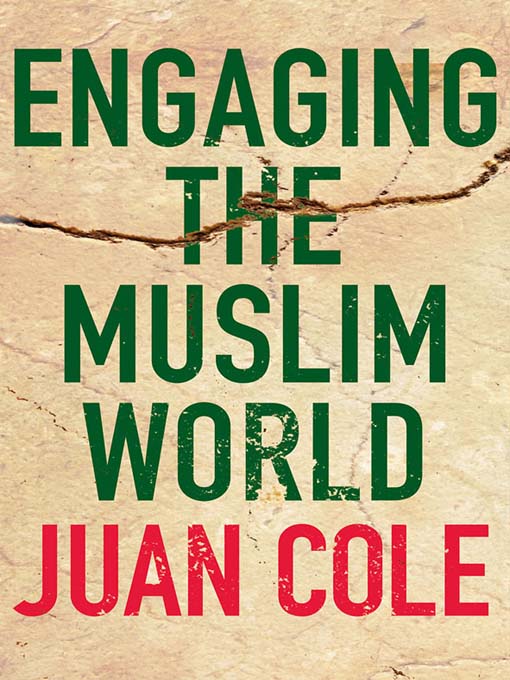
Engaging the Muslim World
I recently finished reading Engaging the Muslim World by Juan Cole, the influential academic, well known liberal-left blogger of Informed Comment, past president of the Middle East Studies Association and occasional media talking head. Cole has written an intriguing book on contemporary foreign policy that is of special interest to those readers concerned with public diplomacy, the Muslim world, terrorism and the domestic politics of American foreign policy, particularly the war in Iraq. I will state straight off that there are arguments in this book presented by Cole that I profoundly disagree with, or, national security related assertions that I consider questionable; but in other instances, when Cole is concentrating on the nuances of the Arab-Muslim world’s political-cultural lens, he is an illuminating and insightful analyst from whom I have learned new things.
Engaging the Muslim World is…well….engaging. I found Cole’s prose flowed smoothly, as if the author was talking to the reader across a table, and I had a hard time putting the book down, albeit I was frequently scribbling furiously in the margins. This is a polemical -policy book written by an academic for a lay audience and the reader’s reaction to Engaging the Muslim World will depend in part on their  own worldview. Liberals will cheer more than they disagree with Cole, while conservatives and supporters of Israel are likely to reject many of the book’s normative assumptions long before they read the conclusions – but Cole also offers some prescriptive advice that center-right COIN and public diplomacy advocates will warmly embrace.
The book is divided into six chapters. The first, “The Struggle for Islamic Oil:The Truth About Energy Independence” which deals with energy markets, the Cold War history of the Mideast, global warming, environmental policy, alternative fuel technologies and globalization, is a necessary effort to concisely account for the geoeconomic importance of Muslim oil producing states and the future of fossil fuel economies. Cole argues – correctly, I suspect – that there will be no short or medium term substitutes for oil and gas until solar power technology is cost-efficient enough (and efficient in a physics sense) to compete with fossil fuels in the marketplace. Not being a scientist or an expert in energy market issues, I am poorly placed by professional background to evaluate Cole’s claims in these areas and will leave those to others.
That said, chapter one remains the odd man out. It smacks of having been compacted by an editor out of two or more chapters and consequently has disparate issues jumbled together with insufficient explanation; as a whole, chapter one fits uncomfortably with the subsequent chapters which flow together naturally and thematically. On the other hand, the topic of oil can hardly be dispensed with either in a geopolitical discussion of the Mideast, so Cole was right to tackle it and the primary problem is really one of sequence, not subject matter.
Chapters two through six are the heart of Engaging the Muslim World, where Juan Cole articulates a theme of “Islam anxiety” permeating Western, particularly American, media and public opinion. Poorly informed about even the most basic information regarding the Muslim world, such as the differences between Shia and Sunnis, secular Baathist nationalists and Islamist radicals, quietists and the politically militant, Arabs and non-Arabs, Cole asserts that Westerners tend to lump Muslims of all shades of political belief, religiousity and nationality into a homogenous, vaguely mysterious but ever dangerous entity. Cole cites as one example, Egypt’s Sunni Muslim Brotherhood, which has foresworn violence and has members who sit in Egypt’s legislature, being lumped uncritically by American commentators with al Qaida and Hezbollah (which is a radical Shiite group).
A better way to understand violent Islamist extremists in relation to normal Muslims, in Cole’s view, would be to see them as analogous to our homegrown, violent, far-Right, white racist underground that produced Timothy McVeigh, who carried out the Oklahoma City bombing or as cult-like movements. While smaller in size than Islamist radicalism, the racist Right shares with violent Islamists the trappings of a fringe, ostracized, quasi-religious, political cult with a conspiratorial worldview that diverges sharply from the nation’s mainstream religious life. Violent Islamists often make themeslves as unpopular with their co-religioinists as do neo-Nazi extremists here, through actions that horrify society, such as the bloody massacre of Western tourists and Egyptian workers at Luxor, Egypt.
Cole’s analogy with cults and racial extremists I think is a useful one. Radical Islamists are difficult to classify on a traditional political spectrum as their political behavior has definite similarities with those of the fascist and communist totalitarians of the 20th century, but will not fit smoothly with either, given Islamist religious extremism and the fanatical atheism or at least radically secular nature of the Bolsheviks and Nazis. The psychological overlap however is certain, something akin to the 19th century Anarchist-terrorists or what Eric Hoffer captured in his classic work, The True Believer
On Israel and Iran, Cole bends over backwards, like a circus sideshow contortionist, to try and explain the lunacy (and Cole admits it is, at best, a crackpot worldview) of Ahmadinejad’s violently antisemitic statements about the Holocaust and Iran’s generally defiant behavior toward the international community while giving Israel no similar benefit of the doubt. Cole argues that Ahmadinejad’s oft-stated “wipe Israel off of the map” is a deliberate mistranslation by the Western media. Ok, possibly so. I do not speak Farsi, so I’ll take Cole’s word here. If it is the case though, Ahmadinejad is well aware of how his repeated statement is being mistranslated by Reuters and AP, yet he keeps using it. Again and again. That is an ominous statement in itself.
This uneveness regarding Iran and Israel will no doubt enrage conservatives and delight progressives, but in fairness to Juan, I must say that despite his partiality toward Iran in his book, as a blogger he was very quick to denounce the obvious stealing of the recent election by Khameini-Ahmadinejad-IRGC and my perception is that Cole views the apocalyptic Mahdist tendency in Twelver Shiism that Ahmadinejad embraces as a kooky deviation from mainstream Shiism. That not just Ahmadinejad holds this belief dear, but also many influential figures in the Iranian security apparatus as well, is in my view, a cause for alarm.
Despite his politics, Cole concludes Engaging the Muslim World with a very pragmatic prescription for American public diplomacy for engaging Arabs and Muslims in a more effective manner than in the past eight or eighteen or eighty years. If I do not agree with every aspect, it is a good deal better than what the State Department and the rest of the USG is doing now:
Once I saw an Iraqi tribal leader interviewed on al-Jazeera. He said. “There is good and bad in America”. I was struck by how pragmatic and realistic his response was, and how different it was from so much of the fundamentalist vigilantee propaganda about the United States posted on radical internet bulletin boards. If Washington could reach out to all Muslims and bring them around to a more nuanced -and clear-view, in which America was not simply demonized, it would be a major accomplishment. The point is not that they should see the West through rose colored glasses, but that they should be willing to see the good and bad.
That would represent a step up by an order of magnitude.
Busy today with some personal matters, but I wanted to draw attention to some blogfriends who are extending the discussion of recent posts:
Josephfouche of The Committee of Public Safety, analyzing the the 1913 debate and providing an excellent, explanatory, graphic to boot:
Strategy and the Race to the Sea
….The logic of disarmament runs counter to the logic of strategy. Strategy seeks to pit strength against weakness. If that isn’t available, it seeks to pit strength against strength. The least palatable option is to pit weakness against strength. A tie between two opposing wavelengths of equal strength on two opposing spectra of power is better than nothing. In the case of the most extreme end of the spectrum of power, annihilation, there is currently a tie between the nuclear armed Great Powers. That section of the spectrum has been taken off the table. To reopen the annihilation wavelengths will merely tempt others to seek advantage where the bravely virtuous have renounced their warheads and beat them into flower pots.
An “evolved sensibility” will not save you where sensibility is not backed by effective counter force. Evolved sensibility is merely the glove hiding the iron fist. Conflict, as Clausewitz explained, is a trial of moral power through the medium of physical power. Morality can only constrain where the correlation of forces is favorable. If the correlation of forces shift, every thing becomes a repeat of the Race to the Sea.
Adam Elkus at Red Team Journal, continuing the robust argument over Grand Strategy started by Smitten Eagle ( I have been working on a post, on and off, to respond to SE’s original post. As many other voices have joined this debate in the past week, I’m still tweaking mine) and added to recently by FLG of Fear and Loathing in Georgetown.
….Of course, FLG is correct that we haven’t suffered as much from our poverty of grand strategy as, say, Philip II of Hapsburg Spain. But I would argue that in this case America’s compelling enemy is not so much a looming adversary as the entirely human tendency states have to make poor decisions regarding the use of force, the expenditure of resources, and our strategic elites’ perception of political, economic, and cultural trends. This doesn’t necessarily mean that we need a hegemonic concept like containment-I felt that Joseph Fouche did a good job of arguing that a nation is better served by multiple grand strategies. But states do need larger guidance as to how they use resources-both human and material-to achieve strategic ends.
Check’em out.
ADDENDUM:
Fabius Maximus has a large number of posts related to grand strategy at the Military and strategic theory section of the FM site. One example:
Primal Strategies
We often see something like a grand strategy in the early years of some societies, when the people have a single-minded commitment to a goal, often just a drive to grow. A primal strategy is an expression of this people’s core beliefs. It is non-intellectual, with no need for theories and plans.
- Rome conquered the Mediterranean world, driven by self-confident belief in their fitness to rule others.
- Men like Pizzaro and Cortes conquered much of the world for Spain and Christ.
- The British Empire was built by men like Robert Clive and Warren Hastings, whose acquisitive drive and energy brought India into the British Empire – often without instructions or even against their government’s wishes.
- Nineteenth century Americans felt it was their manifest destiny to extend America from ocean to ocean.
We can describe these as “grand strategies”, but to do so has an element of falsity. Such intellectual analysis, based on theory, had no place in the hearts of these peoples. History also suggests than leaders cannot manufacture a primal strategy. You either have it, or you do not.
Ok, things are quiet here because I am overdue on a chapter for Nimble Books on Fifth Generation Warfare, edited by Dan of tdaxp. I am also currently brain dead from work and other responsibilities, so I thought it might be time for something that was both viral and almost completely pointless. 🙂
First, there was Thomas P.M. Barnett:

Then there was Dave Dilegge:

And then there’s me:

I propose a “Tournament of Home Offices” where those tagged must reveal the heart of their tiny blogging empire and in turn, tag 5-7 fellow bloggers to participate in this time-wasting charade, as well as linking back to the person who tagged them originally. Only one photo counts as an entry but additional pics may be posted. A winning home office is recognized by informal consensus and the winner receives as a prize absolutely nothing. Multiple winners may be possible and, most likely, are expected as the tournament progresses. Spouses are free to enter their blogger without their prior permission in the interest of general mockery.
I hereby tag the following:
And now a bonus pic from a bookshelf….


Zenpundit is a blog dedicated to exploring the intersections of foreign policy, history, military theory, national security,strategic thinking, futurism, cognition and a number of other esoteric pursuits.
Customized Web Site & Blog Design

