zenpundit.com » economics

Archive for the ‘economics’ Category

Innovating Institutional Cultures

Monday, January 11th, 2010

John Hagel is in a small category of thinkers who manage to routinely be thinking ahead of the curve ( he calls his blog, where he features longer but more infrequent posts than is typical,  Edge Perspectives). I want to draw attention to the core conclusion of his latest:

Challenging Mindsets: From Reverse Innovation to Innovation Blowback

Innovation blowback

Five years ago, John Seely Brown and I wrote an article for the McKinsey Quarterly entitled “Innovation Blowback: Disruptive Management Practices from Asia.” In that article, we described a series of innovations emerging in Asia that were much more fundamental than isolated product or service innovations. We drew attention to a different form of innovation – institutional innovation. In arenas as diverse as motorcycles, apparel, turbine engines and consumer electronics, we detected a much more disruptive form of innovation.

In these very diverse industries, we saw entrepreneurs re-thinking institutional arrangements across very large numbers of enterprises, offering all participants an opportunity to learn faster and innovate more effectively by working together. While Western companies were lured into various forms of financial leverage, these entrepreneurs were developing sophisticated approaches to capability leverage in scalable business networks that could generate not just one product innovation, but an accelerating stream of product and service innovations.

…. Institutional innovation is different – it defines new ways of working together, ways that can scale much more effectively across large numbers of very diverse enterprises. It provides ways to flexibly reconfigure capability while at the same time building long-term trust based relationships that help participants to learn faster. That’s a key breakthrough – arrangements that support scalable trust building, flexibility and learning at the same time. Yet this breakthrough is occurring largely under the radar of most Western executives, prisoners of mindsets that prevent them from seeing these radical changes.

Read the whole thing here.

Hagel is describing a mindset that is decentralized and adaptive with a minimum of barriers to entry that block participation or information flow. One that should be very familiar to readers who are aware of John Boyd’s OODA Loop, the stochastic/stigmergic innovation model of John Robb’s Open Source Warfare, Don Vandergriff’s Adaptive Leadership methodology and so on. It’s a vital paradigm to grasp in order to navigate and thrive in the 21st century.

Western executives (think CEO) may be having difficulty grasping the changes that Hagel describes because they run counter to cultural trends emerging among this generation of transnational elites ( not just big business). Increasingly, formerly quasi-meritocratic and democratic Western elites in their late thirties to early sixties are quietly embracing oligarchic social stratification and use political or institutional power to “lock in” the comparative advantages they currently enjoy by crafting double standards through opaque, unaccountable authorities issuing complex and contradictory regulations, special exemptions and insulating ( isolating) themselves socially and physically from the rest of society. It’s a careerism on steroids reminiscient of the corrupt nomenklatura of the late Soviet period.

As the elite cream off resources and access for themselves they are increasingly cutting off the middle-class from the tools of social mobility and legal equality through policies that drive up barriers to entry and participation in the system. Such a worldview is inherently zero-sum and cannot be expected to notice or value non-zero sum innovations.

In all probability, as an emergent class of rentiers, they fear such innovations when they recognize them. If allowed to solidify their position into a permanent, transnational, governing class, they will take Western society in a terminal downward spiral.

Vive la France!

Thursday, December 31st, 2009

The French equivalent of the Supreme Court reveals the extent to which global warming alarmism was always intended as a justification for a sophisticated tax-farming rip-off of normal people by oligarchical elites:

….The tax, which would have started on Jan. 1, was set at 17 euros ($24.38) per ton of carbon-dioxide emissions, President Nicolas Sarkozy said in September. To make the tax more palatable, he partially or fully exempted power plants, public transport, airlines, farming and fishing, as well as 1,018 older cement, steel and glass factories.

In all, 93 percent of all industrial carbon emissions in France would have avoided paying the full tax, the constitutional court said in a decision published on its Web site. The tax would have fallen disproportionately on fuel for heating and cars, it said.

Emphasis mine. 

Jesus, 93 %? Was anybody with connections paying the tax?  Warmer, colder, who cares?  Just so long as widows, hotel maids and slum dwellers are paying through the nose in carbon taxes while Total S.A. skates! That is to say, the burden is on the ignorant peasantry who did not go to Ecole Nationale d’Administration.

Or on our side of the pond, Harvard.

ADDENDUM:

Science Daily No Rise of Atmospheric Carbon Dioxide Fraction in Past 160 Years, New Research Finds

Still too Busy to Blog Properly….But Hey, Look What I’m Reading!

Tuesday, November 24th, 2009

Were it not for guest posts, November would have seemed like I went on hiatus 🙂  Normal blogging will resume in a few weeks.

I did find time to pick up a few new books to read in the late hours of the night, one of which will be the subject of a book review by a new guest poster.


The Genius of the Beast: A Radical Re-Vision of Capitalism by Howard Bloom

The Shia Revival: How Conflicts within Islam Will Shape the Future by Vali Nasr

Nixonland: The Rise of a President and the Fracturing of America  by Rick Perlstein

The only thing these three tomes have in common is that the authors have a penchant for contradicting conventional wisdom, at least to a degree. 

Howard Bloom is an offbeat, pop science to pop culture master of horizontal thinking whose earlier work, Global Brain, I very much enjoyed and highly recommend. Bloom’s intellectual reach is first rate and he is one of the few writers who can take very difficult concepts from wildly disparate fields and tie them together for a lay audience with comprehensible analogies and anecdotes .

I put Vali Nasr’s The Shia Revival on my list back after the high praise Thomas P.M. Barnett gave Nasr in his book, Great Powers – in my experience, Tom does not hand out comments of “brilliant” all that often ( Great Powers, BTW, is also a “must read” book for those interested in strategy and geoeconomics). I am approximately 80 pages in to The Shia Revival and I will say that as a writer, Nasr does not waste time getting to key points in explaining his subject – concise but not simplified.

Rick Perlstein, while far to the Left, has the uncommon quality among leftwingers of working very, very hard at the scholarship of attempting to understand conservatism and leading conservatives ( must be a legacy of attending the University of Chicago). Much like Orangemen in Ulster, eavesdropping on a Catholic mass, I suspect the essence of conservatism eludes Perlstein, but at least he takes the ideas seriously.  That Richard Nixon is Perlstein’s subject is an added draw, since Nixon’s foreign policy was an area of historical research for me. Very interested to see how Perlstein’s take on Richard Nixon compares to that of Robert Dallek and Richard Reeves.

“Let me make one thing perfectly clear….”

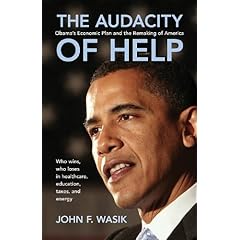
Book Review: The Audacity of Help

Monday, September 14th, 2009

The Audacity of Help: Obama’s Economic Plan and the Remaking of America by John F. Wasik

Initially, I was reluctant to accept a review copy of The Audacity of Help because I blog primarily on military and national security issues and straight domestic politics posts tends to attract tiresome, angry, commenters who type in caps ( I do not want traffic, I want influential readers). Nor am I an expert on business or finance issues, Wasik’s forte as a journalist and an area best judged from a position of extensive personal experience, which I do not have. John Wasik though, after I checked him out, impressed me as an evenhanded and experienced reporter, so I accepted.

If you are a “political blogger”, Left or Right, order a copy of The Audacity of Help today, it’s an invaluable, factual “scorecard” on the domestic agenda of the administration of President Barack Obama, especially the outcome stimulus package and the positions of all the players, executive vs. legislative, promises vs. reality and Democrat vs. Republican.  The appendix and bibliographic resources alone will be fodder for many a blog post. Wasik offers a theme of “cui bono” from policy status quo or change that is refreshing and informative (and I say this as someone who would much rather write about Bernard Fall, the Haqqani Network or Herodotus than how Obamacare will impact senior citizens or the elections in 2010) accompanied by various textual, factoid, “asides” that extend each chapter.

Here are the chapters of The Audacity of Help, which runs 202 pages:

1. First Aid and Income Boosters

2. Rebuilding Infrastructure, Creating Jobs,

3. Bottom Up Economics: Small-Business Benefits

4. Job Creators and the Green Collar Bonus

5. Get Smarter

6. Borrowing Wisely

7. Restoring Home Ownership: Keeping the Dream Alive

8. Health Care Reform

9. Unifinished Business: Long Range Goals in Entitlement Reform

10. The Road Ahead

I don’t agree with everything Wasik has to say in terms of policy but Wasik is measured in his praise and criticism on all parties and is ultimately, a fiscal realist (“How will all this money be paid back?”). He gives a fair hearing before offering his own opinions and policy recommendations toward the conclusion of the chapters which allows me to give Wasik the ultimate compliment to a writer of non-fiction:

The Audacty of Help is useful.

Gunnar Peterson interviews Thomas P.M. Barnett

Friday, July 31st, 2009

Cybersecurity expert and blogfriend Gunnar Peterson of 1 Raindrop snagged a multi-part interview with grand strategist and blogfriend Dr. Thomas P.M. Barnett, author of Great Powers. Peterson is doing a superb job at elicitation with his questions:

Tom Barnett Interview

GP: ….It seems that the emerging middle class is the main factor that separates the developing countries’ past and future, they always had some very rich people and many very poor people, but now depending on how you measure it, India’s middle class is 200 million people. What trends should we watch as the global middle class emerges? What milestones will mark key events along the progression?

TB: The one of greatest interest is when per capita income gets in the range of $5,000 per year.  Somewhere between $5,000 and $10,000 is where you see previously authoritarian, single-party-dominated states move into the process of increasingly pluralism, typically started when a reformist faction breaks off from, and begins to challenge, the dominant party.Obviously, India is already blessed in that regard, so China is the one to watch there.  Until China reaches such a level of development, all talk about authoritarian capitalism being superior to democratic capitalism is historically premature.  Authoritarian regimes do well with extensive growth (simply adding in more resources) but then tap out when it comes to shifting into innovation-based, intensive growth….

Tom Barnett Interview Part 2 »

TB:….At initial glance, China’s route has higher risks concerning its political system (all those unruly and increasingly assertive urban laborers can go all Marxist on Beijing’s allegedly “communist” ruling party), but India has higher risks concerning its economic trajectory (you point about scaling out badly).  It’s just easier to imagine-for me at least-China having to change politically than India somehow avoiding industrialization and the social tumult/reformatting it will cause the country’s rural life.  China’s got a lot of that already under its belt (although its rural impoverished population remains vast, there are plenty of opportunities for village employment or migration to the cities), and its government seems willing to do whatever it takes to encourage and accommodate the migration from rural areas to cities.  But India moving far more tepidly in this direction, the result being that, what rural-to-urban migration does occur, often results in rather scary urbanization scenarios (more slumdog than millionaire).  

Tom Barnett Interview Part 3

GP: Many security writers and thinkers are obsessed with threats, they throw a dart a connected systems, extrapolate worse case scenario and everything goes “boom!”; your work is different, it accounts for system perturbation from threats but has more focus on the system resiliency to deal with events over the long haul. I find this system thinking lacking in many of your peers, and have never understood how worst case threat extrapolation can automatically lead to a parasite that takes over its host. Can you explain why its different to think of security in terms of resiliency rather than simply threats? What insights fall out of this distinction?

TB: Worst-case thinking obviously has its uses in the national security realm.  I just think we got into very odd, extreme tendencies during the Cold War, when the threat of nuclear conflict distorted our thinking unduly.  We’re just beginning to see thinkers and analysts and strategists emerge from a post-Cold War educational environment, like my nephew Brendan who’s studying Russian and International Relations (as I once did) at my alma mater, Wisconsin.  The problem is, the field of international relations, as Brendan will attest, is still obsessed with game theory and all sorts of artificial schools and still tends to be way too insular (economics still needs to embraced far more, not in some antiseptic academic sense but more in a keen understanding of how international business works).  But the key thing is, Brendan and others of his generation won’t be held to the extreme fears that my generation was, despite the constant hyping of the threat of nuclear proliferation, so they’re forced to cast their nets wider and that’s a good thing.

Tom is pointing to the “higher level of play” that leaders need to operate at if their foreign policies and national security strategies are to be based upon sound assumptions ( I would also throw in accounting for greater systemic instability or probability of Black Swan   system perturbations)

An old saw is that amateurs study tactics while professionals study logistics. Strategists study geoeconomics because the structural economic shifts within and between countries and regions are not only predictive of where strife is likely to occur or never materialize but they set the framework or parameters on how effectively states are able to exercise “hard” forms of power. Interdependence wrought by globalization multiplies your leverage but it also constrains it’s uses.

For a great power, it’s a very short step in statecraft these days between “zen master” or as a “pitiful, helpless, giant”.


Switch to our mobile site