zenpundit.com » military reform

Archive for the ‘military reform’ Category

Tools vs. Strategies: Or, Why “An” Alternative to COIN is Not “THE” Alternative

Friday, February 12th, 2010

Dr. Bernard I. Finel has an important and provocative article in AFJ challenging the current operational primacy of COIN in Afghanistan and Iraq that has stirred a great deal of backchannel and listserv discussion, but not nearly enough open commentary in the blogosphere. I checked an unscientific sampling of COIN blogs and did not find much discussion of Dr. Finel’s article, except one comment at SWJ Blog by respected SWC member Ken White, who called it  a “well stated and logical essay” with a “valid premise”. Finel’s article merits greater attention and debate:

An alternative to COIN

The U.S. military is a dominant fighting force, capable of rapid global power projection and able to defeat state adversaries quickly and at relatively low cost in American lives and treasure. Unfortunately, American leaders are increasingly trying to transform this force into one optimized for counterinsurgency missions and long-term military occupations. A fundamental problem with the adoption of population-centric counterinsurgency (COIN) doctrine as an organizing principle for American military operations is that it systematically fails to take advantage of the real strengths of the U.S. military.

It is true that not all political goals are achievable through the use of conventional military capabilities. However, “victory” in war is not dichotomous, and the cases of Iraq and Afghanistan – often seen as proving the necessity for COIN-capable forces as well as a commitment to nation-building – demonstrate in reality that the vast majority of goals can be accomplished through quick, decisive military operations. Not all political goals are achievable this way, but most are and those that cannot be achieved through conventional operations likely cannot be achieved by the application of even the most sophisticated counterinsurgency doctrine either.

As a consequence, I believe the U.S. should adopt a national military strategy that heavily leverages the core capability to break states and target and destroy fixed assets, iteratively if necessary. Such a strategy – which might loosely be termed “repetitive raiding” – could defeat and disrupt most potential threats the U.S. faces. While America’s adversaries may prefer to engage the U.S. using asymmetric strategies, there is no reason that the U.S. should agree to fight on these terms.

This essay argues the U.S. can largely defeat threats using conventional capabilities, and that what encourages a desire to engage in long-drawn-out asymmetric conflicts is not the elimination of threats, but rather the unattainable goal of trying to prevent threats from emerging in the future.

Read the rest here.

First, I have some sympathy with Finel’s position that COIN operations generally do not maximize the utility of America’s military comparative advantages and extended nation-building via COIN is a costly investment. Dr. Finel is correct here. I’m certain even David Kilcullen would agree with Finel that America trying to do heavy footprint, pop-centric COIN everywhere and anywhere is unwise and too expensive. We need to sync our military might with our political will as well as our wallet.

Secondly, I have no problem with punitive expeditions, or what Finel euphemistically calls “repetitive raiding”. Such “Perdicaris Alive or Raisuli Dead!” tinged operations are as old as warfare itself and a state’s demonstrated willingness to carry them out serves a useful deterrent purpose. William Lind has been advocating a combination of punitive expeditions and containment/isolation for years in his writings on 4GW. This is an option we should definitely consider first in a cost-benefit fashion prior to committing sizable deployments of troops to a long-term nation building adventure.

That said, exchanging one operatiuonal emphasis (COIN) for another (punitive expeditions) does not change our strategic situation much, it just represents a different kind of hammer, a mallet instead of a ball peen. Under Finel’s prospective doctrine, the US military will be greenlighted to fight only the wars it likes best because some foes are more targetable than others, resembling a drunkard looking for his car keys under a street lamp because that is where the light is good. If we can just convince all of our enemies to oblige us by becoming states with flags, armies and capitols, then I’d say junk COIN.

Unfortunately, they won’t and the days when only states can cause damage are long past. A well-trained, paramilitary, insurgency can wreck one hell of a lot of damage, especially when it is striking first with the element of surprise. This is why, even in the state-centric days of the Cold War, that the Soviet Union invested heavily in SPETSNAZ, OSNAZ and various GRU sleeper units to wreck havoc behind NATO lines with terrorism, assassination and sabotage in the run up to WWIII. The Soviets expected at least major tactical, if not strategic, results from such units.

Operational tools are not strategies. This was my prior complaint about COIN being oversold in Afghanistan and punitive expeditions likewise do not fit every geopolitical situation and work best with particular circumstances. The fact is, where we have a real national interest in friendly states with legitimate governments beating back insurgents, COIN is a better choice. Many problems will require a response that is altogether different from either. The enemy, when there is an enemy, has to be dealt with as they are and not as we’d really like them to be in our ten year procurement schedule. We have to select the tools that best fit operational conditions, our policy objectives and our resources.

Strategy must conform to reality and not the reverse.

The Post-COIN Era is Here

Monday, January 25th, 2010

Learning to Eat Soup with a Spoon Again……

There has been, for years, an ongoing debate in the defense and national security community over the proper place of COIN doctrine in the repertoire of the United States military and in our national strategy. While a sizable number of serious scholars, strategists, journalists and officers have been deeply involved, the bitter discussion characterized as “COINdinista vs. Big War crowd” debate  is epitomized by the exchanges between two antagonists, both lieutenant colonels with PhD’s, John Nagl, a leading figure behind the U.S. Army/Marine Corps Counterinsurgency Field Manual and now president of the powerhouse think tank CNAS , and Gian Gentile, professor of history at West Point and COIN’s most infamous arch-critic.

In terms of policy and influence, the COINdinistas ultimately carried the day. COIN advocates moved from a marginalized mafia of military intellectuals who in 2004 were just trying to get a hearing from an  indifferent Rumsfeld Pentagon, to policy conquerors as the public’s perceptions of the “Surge” in Iraq (masterminded by General David Petraeus, Dr. Frederick Kagan, General Jack Keane and a small number of collaborators) allowed the evolution of a COIN-centric, operationally oriented, “Kilcullen Doctrine” to emerge across two very different administrations.

Critics like Colonel Gentile and Andrew Bacevich began to warn, along with dovish liberal pundits – and with some exaggeration – that COIN theory was acheiving a “cult” status that was usurping the time, money, talent and attention that the military should be devoting to traditional near peer rival threats. And furthermore, ominously, COIN fixation was threatening to cause the U.S. political class (especially Democrats) to be inclined to embark upon a host of half-baked, interventionist “crusades“in Third world quagmires.

Informed readers who follow defense community issues knew that many COIN expert-advocates such as Nagl, Col. David Kilcullen, Andrew Exum and others had painstakingly framed the future application of COIN by the United States in both minimalist and “population-centric” terms, averse to all but the most restrictive uses of “hard” counterterrorism tactics like the use of predator drones for the “targeted assassinations” of al Qaida figures hiding in Pakistan.

Unfortunately for the COINdinistas, as George Kennan discovered to his dismay, to father a doctrine does not mean that you can control how others interpret and make use of it. As the new Obama administration and its new commander in Afghanistan, General Stanley McChrystal conducted its internally contentious review of “AfPak” policy in 2009 on what seemed a geological time scale, the administration’s most restless foreign policy bigwig, the Talleyrand of Dayton, proposed using COIN as nation-building on steroids to re-create Hamid Karzai’s Afghanistan as the secure, centralized, state that it has never been.  Public reaction to this trial balloon was poor and the administration ultimately pared down General McChrystal’s troop request to 30,000 men, hedging a COIN based strategy toward policy suggestions made by Vice-President Biden.

So, COIN still reigns supreme, albeit with trimmed sails?

No.

We are forgetting something important about the ascendancy of COIN. It was not accepted by a reluctant Pentagon and the Bush administration because COIN is a very effective operational tool in the right strategic context – although that is certainly true. Nor was it because the advocates of COIN were brilliant policy architects and advocates – though most of them are. COIN became the order of the day for three reasons:

1) The  “Big Army, fire the artillery, fly B-52’s and Search & Destroy=counterinsurgency” approach proved to be tactically and strategically bankrupt in Iraq. It failed in Mesopotamia as it failed in the Mekong Delta under Westmoreland – except worse and faster. Period.

2) The loudest other alternative to COIN at the time, the antiwar demand, mostly from Leftwing extremists, of immediately bugging-out of Iraq, damn the consequences, was not politically palatable even for moderately liberal Democrats, to say nothing of Republicans.

3) The 2006 election results were a political earthquake that forced the Bush administration to change policy in Iraq for its’ own sheer political survival. COIN was accepted only because it represented a life preserver for the Bush administration.

We have just had another such political earthquake. The administration is now but one more electoral debacle away from having the president be chased in Benny Hill fashion all over the White House lawn by enraged Democratic officeholders scared out of their wits of losing their seats next November.

Republican Scott Brown, the winner in a stunning upset in Massachusett’s special election for Senator, certainly had no intention of undermining President Obama’s commitment to Afghanistan. To the contrary, he is for it in a far more muscular manner than was his hapless Democratic opponent. But that’s irrelevant. What matters is that in all the recent elections, Democrats have been clobbered by a “Revolt of the Moderates” – socially liberal, fiscally conservative, independent voters who came out in 2008 for Obama and are now shifting radically away from him. For the next year, politicians of both parties will be  competing hard for this bloc which means “deficit hawks” will soar higher than defense hawks.

America’s nine year drunken sailor spending spree is officially over.

Defense experts have long known that the post-9/11, record DoD budget expenditures were not going to be politically sustainable forever and that either a drawdown of combat operations or cancellation of very big, very complicated and supremely expensive weapons platforms or some combination of both would eventually be needed. That eventuality is here and will increase in intensity over the next five years, barring an unexpected economic boom. Spending $60 billion annually on Afghanistan, a nation with a GDP of roughly $ 20 billion, for the next 7 years, is not going to be in the cards. Not at a time of 10 % unemployment, when the Congress will be forced to cut Medicare, education, veteran’s benefits, eliminate COLA’s on Social Security or raise the retirement age and income taxes. Who is going to want to “own” an ambitious “nation-building” program at election time?

There is a silver lining here. Really.

COIN is an excellent operational tool, brought back by John Nagl & co. from the dark oblivion that Big Army partisans consigned it to cover up their own strategic failures in Vietnam. As good as COIN is though, it is not something akin to magic with which to work policy miracles or to substitute for America not having a cohesive and realistic grand strategy. Remaking Afghanistan into France or Japan on the Hindu Kush is beyond the scope of what COIN can accomplish. Or any policy. Or any president. Never mind Obama, Superman, Winston Churchill and Abe Lincoln rolled into one could not make that happen.

Association with grandiosely maximalist goals would only serve to politically discredit COIN when the benchmarks to paradise ultimately proved unreachable. Austerity will scale them back to the bounds of reality and perhaps a more modest, decentralized, emphasis. COIN will then become a normal component of military capabilities and training instead of alternating between pariah and rock star status inside the DoD.

Austerity may also force – finally – the USG to get serious about thinking in terms of comprehensive and coherent DIME-integrated national strategy (Ok – this is more of a hope on my part). Instead of having every agency and service going off in its own direction with strategic nuclear arms reductions being proposed out of context from our conventional military obligations and urgent security threats we might stop and look at how the two fit together. And how these should be in sync with our fiscal and monetary policies and our need to deeply invest in and improve our unsteady economic position in a very competitive, globalized world. The latter is of much greater strategic importance to national security than Afghanistan or whether or not Israel and Hezbollah fight another mini-war.

We are all COINdinistas now. Instead of being controversial, COIN having a secure place in our operational arsenal of ideas has become the new “conventional” wisdom; it is past time to look at some of the other serious challenges America has ahead.

ADDENDUM I:

First, I wanted to thank everyone for their lively responses, both comments as well as email. The critiques are very helpful, as are the large number of PDFs and links to related material. I am trying to catch up on my replies but first, I wanted to feature a link to Andrew Exum ‘s related but inside baseball article up at Boston Review:

The Conflict in Central Asia will likely mark the end of the current era of Counterinsurgency 

 ….Whether or not the United States and its allies are successful in Afghanistan, the conflict in Central Asia will likely mark the end of the Third Counterinsurgency Era. Counterinsurgency warfare has its roots in the colonial experiences of France and the United Kingdom as well as the pseudo-colonial experiences of the United States in the Philippines and Latin America. In the First Counterinsurgency Era, nineteenth-century French colonial military commanders such as Hubert Lyautey, Thomas-Robert Bugeaud, and Joseph Gallieni devised rudimentary “hearts and minds” campaigns that were—though often just as brutal as the conventional warfare of the time—at odds with then-contemporary thought on the employment of military force. 

….Michael Semple —with two decades experience working in Afghanistan and Pakistan—believes that it is, and that the Taliban and its allies cannot win. The balance of power, he argues, has shifted toward the Taliban’s natural enemies, and the Taliban hides this reality by dressing their civil war in the clothes of an insurgency being fought against Western powers. If this assessment is right, there may yet be hope for U.S. and allied efforts in Afghanistan. Because President Obama has pledged to begin a withdrawal from Afghanistan in eighteen months, time may be too short to execute a comprehensive counterinsurgency campaign. But there may be sufficient time to build up key Afghan institutions and allow Afghans to fight a civil war that will no doubt continue after the United States and its allies begin to withdraw.

ADDENDUM II – LINKS To This Post:

Most of these bloggers have extended the discussion into new dimensions or aspects. I will put a short, explanatory tag next to each where warranted.

RBO (Pundita)The cavalry has arrived: Mark Safranski takes on COIN; Pundita takes on Pakistan  Extensive examination of Pakistan

In Harmonium (Dr. Marc Tyrell)Is the post-COIN era here?  The conceptual-perceptual-cognitive implications of this debate

Shlok VaidyaZen is right  Constraints and innovation….and a great post title!

Newshoggers (Dave Anderson)COIN’s coins; political constraints on COIN  COIN = Clausewitzian disconnect

Wings Over IraqLink of the morning is here…  And the bonus Nagl/Gentile mash-up graphic!

SWJ BlogThe Post-COIN Era is Here  Comments on link excerpt have begun……

Elkus on Science, Defense and Strategy

Friday, January 8th, 2010

My amigo Adam Elkus has an excellently constructed and well researched article up at OpenSecurity where he advances a Boydian critique for what ails us:

Science, defence and strategy

…Contemporary American strategic problems flow from the fact that we cannot adjust the ossified thinking of Washington D.C. to the constantly shifting observed reality of the outside world. A failure to match concepts to observed reality has amplified the already formidable entropy of the American political system. The corresponding failure to make strategy results in a search further inward towards the “science” of war.  Better strategy will come about only when the process by which strategy is made becomes supple, flexible, and less dominated by sacred cows and special interests.

Critics of American foreign policy often undermine their own case with conspiracy theorizing about the “military-industrial complex.” The real problem, however, is not James Bond villain-style secret plans and hidden agendas but basic human frailty. A largely homogenous group of people is not going to have all the answers to questions of war and peace because they are necessarily limited by their experience, specialization, and biases.

Nice work by Adam, read the whole thing here.

We face a number of problems when it comes to formulating strategy and grand strategy. Not least is that, whatever the shortcomings on that score within America’s officer corps, there is a yawning gap of comprehension between the senior brass and most of the civilian “influencer” elite in and out of government. Most of the latter tend to think in terms of a few simple paradigms into which they force-fit each new foreign policy problem – generally, everything is conceived either as appeasement at Munich or the quagmire of Vietnam. This tiresome dichotomy is the strategizing of simpletons.

The arch-Clausewitzians in the national security community fall down here. It is not enough to think of strategy in purely military terms. America is not Sparta or even the Roman Republic where politicians vied for a chance field command. The civilians here are masters of policy and the military are its servants – and are but one kind of servant among many in the DIME spectrum. Statesmen and general officers need to be speaking with a common vocabulary and have a shared understanding of what strategy is if we are to formulate effective ones.

There is a deficit of knowledge among the class of officials and staff members with the authority to make or not make the most critical decisions in matters of peace and war. It cannot be remediated by an uncertain and unhealthy dependency on the Pentagon’s advice and a frustrating dialogue where civilian and soldier talk past one another.

ADDENDUM:

Adam gets a nod from our friends on the Left at Newshoggers.com

Fouche on “Libeling Boyd”

Sunday, December 27th, 2009

Joseph Fouche blasts eminent scholar Dr. Colin S. Gray for doing to strategic theorist John Boyd what Gray’s fellow Clausewitzians complain that Martin van Creveld does to Carl von Clausewitz:

Libeling Boyd

Contrast this passage with two passages from Gray’s Another Bloody Century, published seven years later:

Air Force Colonel John Boyd touted a tactical insight derived from personal experience from aerial combat as a general theory  of conflict. His OODA loop, standing for Observation, Orientation, Decision, and Action, is revered by many as summarizing the wisdom of the ages on how to win. The core notion is that success rewards the warrior who can operate within the decision cycle of the enemy. It is a sound idea, but as the philosopher’s stone for victory for victory at all levels of warfare it is distinctly sub-Clausewitzian. A major problem with the OODA loop is that its devotees assume that a tactical insight, even principle, will be no less valid at the operational and strategic levels of warfare. It is fairly clear this is not the case.

…and…

As we noted earlier, Colonel John Boyd, USAF fighter pilot turned guru, applied his tactical knowledge of air combat to warfare at all levels  by means of his simple formula of the ‘OODA loop’. Unmatched speed in the sequence of observation, orientation, decision, and action is held to be the key to victory. This insight, banal statement of the obvious, or panacea-take your choice-is probably the most important concept undergirding the current US programme of long-term military transformation. The OODA loop is a formula for decisive success in a manoeuvering style of warfare. American technology, particularly in the realm of the real-time gathering, processing, and diffusion of information, enables US forces to act effectively with a speed that leaves their enemies gasping in their wake. At least, that is the theory.

This is like reading from Baby’s First Boyd Briefing and reflects a child’s understanding of Boyd’s theory. Dr. Gray, a distinguished strategist of the ultra-Clausewitzian school, often complains about the van Creveld School’s shallow (or, in my opinion, actively duplicitious) reading of Clausewitz. Keegan and van Crevald get taken out back for a well deserved whipping for their mis-characterization of Clausewitz and somehow John Boyd gets taken along in the same sordid ranks. Gray sees this:

Faster! FASTER!

Faster! FASTER!

and reduces Boyd to a child who runs along side a children’s carousel shouting “Faster! FASTER!”. If the carousel spins fast enough, victory is at hand. If it slows down, defeat is inevitable. This is the vulgar version of Boyd’s theory, the one that the marketing directors of defense contractors can understand and spout. If Dr. Gray is, as he frequently claims to be, a professional strategist, he should be able to see that Boyd’s OODA loop, inasmuch as it really is….

Much more here.

Outstanding post.

“Libeling Boyd” seems to me to be an accurate call by Joseph Fouche. I find it difficult to believe that a defense intellectual of Dr. Gray’s caliber does not know the difference between the ideas of John Boyd and Art Cebrowski. Or that there are Soviet antecedents of the Pentagon’s RMA. Or that Boyd’s history as an anti-defense contractor Pentagon gadfly is unknown to him. Or that Gray was too lazy to look up easily available material on the OODA Loop. If it would help, I’d be happy to send Gray a copy of Col. Frans Osinga’s Science, Strategy and War: The Strategic Theory of John Boyd .

Whether it would help though, is debatable.

Stocking Stuffers……

Saturday, December 12th, 2009

In a burst of raw self-interest – and also a little love for my blogfriends – these books make nifty gifts for any war nerd or deep thinker on your Christmas list:

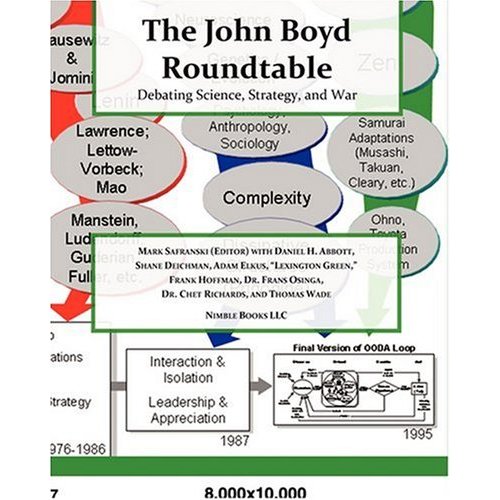
The John Boyd Roundtable: Debating Science, Strategy, and War – Mark Safranski (Ed.)


Threats in the Age of Obama – Michael Tanji (Ed.)

Great Powers: America and the World After Bush – Thomas P.M. Barnett

Brave New War: The Next Stage of Terrorism and the End of Globalization – John Robb

Science, Strategy and War: The Strategic Theory of John Boyd – Frans Osinga


The Genius of the Beast: A Radical Re-Vision of Capitalism  by Howard Bloom

Intelligence and How to Get It: Why Schools and Cultures Count  by Richard Nisbett

Inside Cyber Warfare: Mapping the Cyber Underworld  by Jeffrey Carr

This Is for the Mara Salvatrucha: Inside the MS-13, America’s Most Violent Gang  by Samuel Logan

Full Disclosure:

In copmpliance with new Federal regulations of dubious Constitutional merit, I hearby declare ZP does not accept money for publishing reviews or any paid advertising. Courtesy review copies were extended to me by authors or publishers acting on behalf of Sam Logan, Tom Barnett and Jeff Carr. I edited the first book in this post and was a contributing author to the second one. All of the books, with the exception of Cyber Warfare have been the subject of prior reviews or posts at ZP.


Switch to our mobile site