zenpundit.com » psychology

Archive for the ‘psychology’ Category

Fire walking and the intensity of apocalyptic arousal

Monday, April 22nd, 2013

[ by Charles Cameron — in response to Steve Engel ]
.

Phpto credit: MDeeDubroff

.

My friend Steve Engel wrote regarding the Boston bombers and my elucidation of a Mahdist video that Tamerlan Tsarnaev had seen and “liked”:

Thank you, Charles, for your close examination of nuances that may underlie the actions of people who envision themselves as warriors for the sake of ancient prophecy. Those among us who feel that they dwell in meaningless sorrow make likely customers for purveyors of self-hypnosis–whether of this brand or some other flag-waving, self-justifying cruelty.

I’ve been pondering how to express my reasons for paying particular attention to religious and a fortiori eschatological motives for terror for some time now. The varieties of end times thinking have been an interest of mine for decades, to be sure, and both religion and its specifically end times variants tend IMO to be easily ignored in our so rational post-Enlightenment and high-tech times — so I have both personal and analytic reasons to be keenly interested. But there’s more, and I believe StevE’s comment may be just the thing to pry loose a better explanation than I have given up till now.

I’ll use the well-worn phrase, “work expands to fill the time available” as my starting point.

**

Turning to StevE’s point about potential recruits to terrorism or other crimes…

It’s easy, it seems to me, to think that just any old ideology would do, that the disgruntled simply pick one and use it as a cover or rationalization — but I suspect that emotions can “intensify to fill the ideology available” to paraphrase the other phrase, and that certain ideologies have structural features equivalent to high ceilings in an architectural space, so that “intensifying to fill the ideology available” can have a certain fierce purity when the ideology is a religious one and pious self-dedication a possibility — even more so when “martyrdom” can be aspired to — and yet more so again where one perceives oneself under divine sanction in the culminating battle of all time, immediately prior to judgment.

I’ve been to two “fire walkings” in my life — the first at Mt Takao, where crowds gather for a yearly ceremony in which one writes one’s sins on a sliver of wood and cast it into the fire, the coals of which which the Yamabushi mountain monks then walk across (see image above), followed by intrepid amateur ascetics…

The second — ah, the second was pitched as an occasion where you could “prove the power of mind over matter” for yourself, and come away from the experience “knowing you had achieved the impossible”. And when the instructor went around the room afterwards and asked people, “Now you know you can do the impossible, what’s next for you?” he got answers like, “I’ll have the courage to ask my boss for a $25 a month raise…”

Times are hard for many of us, and I don’t want to knock either the courage it takes to ask or the value of a $25 monthly raise — but if you’ve just “done the impossible”, is this the most you can ask?

Apocalyptic arousal hopes for more than $25 a month — in most cases it longs for the sudden and immediate reversal of all the good fortune that appears to befall “bad” people right now, and the no less sudden reapportionment of all those blessings on the heads of the “good” people — oneself prominent among them. It shakes the world to its foundations, and it cleanses it.

**

I’ll let Richard Landes give you a sense of how believing oneself a participant in apocalypse can make the everyday moment deeply significant, and give the “end times we live in” importance beyond measure — with an excerpt from his great book, Heaven on Earth: The Varieties of the Millennial Experience:

For people who have entered apocalyptic time, everything quickens, enlivens, coheres. They become semiotically aroused — everything has meaning, patterns. The smallest incident can have immense importance and open the way to an entirely new vision of the world, one in which forces unseen by other mortals operate. If the warrior lives with death at his shoulder, then apocalyptic warriors live with cosmic salvation before them, just beyond their grasp.

**

Image source:

http://www.weirdasianews.com/2009/08/27/firewalking-festival-hot-japanese-ritual/

Thanks again to Steve Engel for prompting these reflections.

Octavian Manea interviews MIT’s Roger D. Peterson

Friday, April 19th, 2013

Another installment of Octavian Manea’s excellent COIN interview series at SWJ. This one focuses on social science and varieties of insurgency:

Breaking Down “Hearts and Minds”: The Power of Individual Causal Mechanisms in an Insurgency 

….OM: In your research you pointed out to a spectrum of conceivable individual roles in an insurgency. What is the methodology behind this typology?

RDP: This methodology comes from my 2001 book (Resistance and Rebellion: Lessons from Eastern Europe) which focused on Lithuanian resistance to Soviets in the 1940’s. Insurgency is a complex phenomenon, especially in how violent organization and networks are created and sustained, and the methodology of that book involved breaking down this complexity into component parts and then building back up into a coherent whole. At the base of this process is the way individuals position themselves relative to the dramatic and violent events of insurgency. Most people may wish to remain neutral and just take care of their families but events push significant numbers of individuals into roles of unarmed support of insurgents, or local armed position of a militia, membership in a mobile non-local organization, or equivalent positions in support of the government.  Furthermore, individuals may move back and forth along this spectrum of roles. If one is skeptical of broad and vague theories at a high level of aggregation, as I am, then you need to get down and observe dynamics at a basic level. Observing movement along this spectrum of roles is one way to do that. 

…..Is it FM 3-24 and the whole contemporary Western COIN discourse too narrow, too much focused on rational, cost/benefit models of decision-making? Is it too restrictive when making this inventory of driving motivations or causal mechanisms?

RDP: I think there is a tendency in the Western academic analysis to focus on rational theories. Those theories are straightforward.  But they also might be too straightforward, too simple.  In Iraq, the coalition did not plan on the emotion of resentment stemming from a status reversal affecting Sunni calculations in the beginning stages of the conflict. We did not understand the revenge norms that exist in some of the places. We did not fully understand the social norms that helped to produce the tribal militias in Anbar province.  We did not understand the psychological mechanisms underlying the Sunni view of the new world they were living in. 

The last part is a curious lacuna.

The incompetence of the planning for the occupation of Iraq has been amply recorded – the high level disdain of General Tommy Franks and Secretary Rumsfeld for what befell the day after victory, the keeping of professional Arabists at arms length in preference for Beltway contractors and college kids with AEI connections, the haplessness of Jay Garner and the political obtuseness of Paul Bremer ad so on. This is not what I mean about lacuna.

I mean something more fundamental, in terms of understanding human nature as the root of political behavior and therefore political violence. We are all familiar with the Clausewitzian trinity (or should be) but less attention is paid to the motivational factors that make men decide to stand, fight and die or stand aside. Thucydides also had a trinity that did not attempt to capture the nature of war but rather explain why wars happened and it seems to me to be of particular use for evaluating the decision in small wars to pick up a gun or not, to side with the government or join the rebellion:

“Surely, Lacedaemonians, neither by the patriotism that we displayed at that crisis, nor by the wisdom of our counsels, do we merit our extreme unpopularity with the Hellenes, not at least unpopularity for our empire. That empire we acquired by no violent means, but because you were unwilling to prosecute to its conclusion the war against the barbarian, and because the allies attached themselves to us and spontaneously asked us to assume the command. And the nature of the case first compelled us to advance our empire to its present height; fear being our principal motive, though honour and interest afterwards came in. And at last, when almost all hated us, when some had already revolted and had been subdued, when you had ceased to be the friends that you once were, and had become objects of suspicion and dislike, it appeared no longer safe to give up our empire; especially as all who left us would fall to you. And no one can quarrel with a people for making, in matters of tremendous risk, the best provision that it can for its interest. 

Fear, honor and interest are ever present in “calculation” both by men and by the political communities they compose and the factions that threaten to tear them apart. All the more so in a defeated and broken country divided by ethnicity and sect where all parties were uneasily eyeing the conqueror. No special knowledge of Arab culture should have been required to anticipate that Iraqi men, if made desperate by uncertainty and circumstance, might have at least seen it in their interest to achieve some measure of security with the gun and to enact policies of carrots and sticks a priori to discourage that, before the insurgency gained critical mass.

Awareness of the universality of the Thucydidean trinity would not have in itself guaranteed success in Iraq but knowing it is a rudimentary minimum of political competence upon which you can at least build.

New Books

Monday, March 11th, 2013


Out of our Minds: Learning to be Creative by Sir Ken Robinson 

Wild Bill Donovan by Douglas Waller  

I am about half finished with the first book by creativity in education guru Sir Ken Robinson, who also has a new book out called, The Element. Technically, I have been reading a large volume of books, articles and research regarding creativity and creative thinking lately for a project, but most of those are academic in nature while Robinson is writing for mainstream audiences. I may or may not review it here, but it is clearly argued and Robinson is an effective popularizer.

The biography of Wild Bill Donovan is timely. If the idiosyncratic and at times improvisational OSS, staffed by gifted amateurs, eccentric adventurers and white-shoe, unapologetically elite WASPS, was something that would be impossible to exist in today’s rancid political climate, there are elements in that legacy that are in short supply in today’s modern and highly technological IC.

Ironically, many of the pioneers in creativity research that developed that field within cognitve psychology in America were themselves disproportionately veterans of the OSS.

“The Galula Doctrine”

Wednesday, January 23rd, 2013

Small Wars Journal has published another edition of the excellent COIN interview series conducted by Octavian Manea. Here he interviews A.A. Cohen, author of Galula: The Life and Writings of the French Officer who Defined the Art of Counterinsurgency 

The Galula Doctrine: An Interview with Galula’s Biographer A.A. Cohen

OM: Which were the role of Mao and the exposure to Chinese civil war in Galula’s story? It seems to be his decisive formative lab experience like Russia was for George Kennan.

AAC: Unquestionably, of all the influences exerted on Galula’s treatise, Mao and the Chinese Civil were the greatest. Galula had a strong intellectual admiration for Maoist revolutionaries, despite being very opposed to what they stood for. Before the Chinese Civil War, Galula had no interest in insurgency or counterinsurgency. He had not fought as a Partisan during WW2; he had no experience or interest in these fields until he was exposed to China as of late 1945, in the thick of its civil war. There, his analytical penchant led him to see himself as the decipherer of Mao, intent on getting to the bottom of what the revolutionaries were fundamentally about. Galula cut through the egalitarian propaganda and all that surrounding the People’s revolution. Above all, he wanted to understand why these guys were gaining momentum as they were despite the unfavorable odds. When he figured it out, he reverse-engineered their methods to arrive at a counter-process to revolution and insurgency. His embrace of Chinese dialectics, and with these, the notion of unity of opposites or yin and yang, was helpful in achieving this.

Is counterinsurgency to Galula more of a strategy or  more of a technique and a methodology?

What Galula offers, first and foremost, is a doctrine – not a strategy. His doctrine is underpinned by an important theory about people and what motivates them to take up arms, or to side with those who do. The theory goes that in times of danger (war), the majority of people will be motivated primarily by a fundamental need for security. Galula is adamant about this. But he also recognizes that there will be a minority of people – the instigators at the core of a movement – that will be ideologically, or even fanatically motivated. These are the true believers. He makes no qualms about prescribing that this is the group that the counterinsurgent or counterterrorist will need to find and neutralize, while protecting the rest of the population that aspires to a normal, if not better life. If you buy into this theory, Galula’s doctrine offers a multi-step framework for operations; in other words, a method to counterinsurgency. His famous eight steps are there to provide some logical linearity to what is otherwise a very nonlinear form of warfare. Within that framework, you have the flexibility to formulate your strategy and to conduct your operations to achieve your objectives.

Read the rest here.

I agree that Galula was not offering a strategy. Even more strongly, I think Cohen is correct about the historical importance of China’s long period of disorder, from the overthrow of the Q’ing dynasty to Mao ZeDong’s declaration of the People’s Republic, for Galula. However, not just for him but for anyone interested in questions of war and statecraft where insurgency, warlordism, state failure, state-building, foreign intervention, balance-of-power politics, ideological mass-movements, 4GW, revolution and total war coexisted and co-evolved.

The best comparison in our lifetime to China in this period would have been Lebanon  in the 1980’s, except that China’s polycentric conflict was even more complex and on an epic scale.

Fair and balanced, eh?

Monday, January 21st, 2013

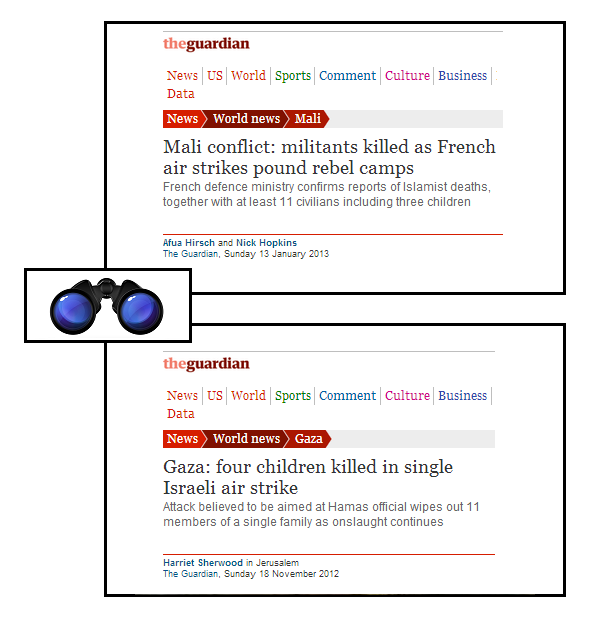
[ by Charles Cameron — Guardian reporting on Gaza and Mali, weighed in the balance and found wanting? — with Fox News for company ]
.

.

I frankly don’t for a moment buy that Fox News is fair and balanced, but then I don’t know if any news source is, so let me try to be a little even-handed here myself, and take a gander at a couple of recent Guardian headlines, using my SPECS format to display them:

I’m not the first one to juxtapose these two headers — there’s a site called CiF Watch that monitors the Guardian (specifically) for signs of “antisemitism, and the assault on Israel’s legitimacy” and it brought these two Guardian posts together with the comments:

The contrasts in language, tone and narrative focus between a report by Harriet Sherwood on Israel’s November conflict with Hamas and a recent Guardian report on the French war against Islamists in Mali represent an exquisite illustration of the paper’s egregious double standards. …

In Sherwood’s report, the deaths of Palestinian children represent the overwhelming narrative focus. The fact that the IDF was attempting to target Hamas terrorists is only mentioned in the strap line, and even then is qualified with the word “believed”.

In the report by Hirsch and Hopkins, on the other hand, we are informed via the headline that militants are killed, while the deaths of Mali children are only noted at the end of the strap line.

On the one hand, I appreciate this kind of close reading as an analytic technique, while on the other I can’t really expect editors to check previous possibly comparable events to make sure their treatment of breaking news is immune from this kind of criticism.

That’s a quandary, IMO — but not yet a quagmire.

**

Forget the question of whether Fox News is more or less biased than the Guardian — or should I call them Faux News and the Grauniad? — and just think again about our passions, about how they can blind us, and about how that blindness can manifest in emphases, in choice of words or images — in so many conscious and unconscious ways.

We need to deploy considerable mindfulness if we are to explore, read, filter, balance and comprehend the world around us — with anything like the nuance required for making wise (rather than lop-sided) choices…

**

Sources:

  • Mali conflict: militants killed as French air strikes pound rebel camps, Jan. 13, 3012
  • Gaza: four children killed in single Israeli air strike, Nov. 18, 2012

  • Switch to our mobile site