[by J. Scott Shipman]
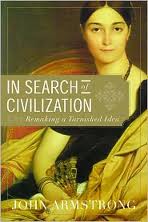
In Search of Civilization, by John Armstrong
In Search of Civilization is a refreshing and erudite examination of civilization, how it developed in the past, negative present day connotations, and why it remains importance and relevant today. What follows is a detailed overview of Part One, and with any luck, the teaser will be enough to convince you to read this important book. For me, this is a truncated review. Normally, I would provide a 1200-1500 hundred word overview, but like Zen, I’ve been busy and wanted to share what I had with you. This books makes a nice foil for John Gray’s Black Mass, which I read recently but probably will not review.
Also, some books have wonderful finds in the bibliography. Back in the early 80’s I chased footnotes for about two years—and have no memory of what the original book was, but I went from one reference to another. Going forward, I’ll provide the titles from the bibliography that piqued my interest, which may also provide the you a little more insight on the works that influenced the author. Please let me know if this is or is not useful to you.
Part One Civilization as Belonging
Armstrong’s quest to define civilization began as he was reading a bedtime story to his son, and he advances that “with the possible exception of God, civilization is the grandest, most ambitious idea that humanity has devised.” From that introduction, Armstrong makes a compelling case for civilization. He notes that it is difficult to get one’s mind around the concept since “civilization” touches everything. As a result, he offers that our ideas about “civilization tend to be rather messy and muddled.”
Armstrong goes on to frame civilization as “a way of living,” a level of political and economic development, “the sophisticated pursuit of pleasure,” and finally, “a high level of intellectual and artistic excellence.” Separately each of these, what I’ll call working definitions, made sense. But Armstrong rightly attempts to define, frame, contextualize civilization, not from historical perspective, but rather the philosophical in a way that is relevant to our times.
The actual word “civilization” is, according to Armstrong, not “fashionable” in our globalized world, particularly among those one would expect to be the “defenders.” He offers that civilization carries a “moral implication” whereby one society is somehow better than another, “fully human” or “superior.” And nations often advance the idea that they are better, more civilized, etc. Those defenders (in the arts and humanities) mentioned above have become “wary and negative” with respect to civilization. I’ll call this standard-less ambivalence based primarily on fear. Fear of “what,” you may ask. Fear of offending. Harvey Mansfield in City Journal made an excellent point with respect to political correctness:
“When there is no basis for what we agree to, it becomes mandatory that we agree. The very fragility of change as a principle makes us hold on to it with insistence and tenacity. Having nothing to conform to, we conform to conformism—hence political correctness. Political correctness makes a moral principle of opposing, and excluding, those of us who believe in principles that don’t change.”
Principles are a big part of civilization.A brief review of Samuel P. Huntington’s classic The Clash of Civilizations follows. Armstrong reminds of Huntington’s words: “In coping with an identity crisis, what counts for people are blood and belief, faith and family.” Armstrong recounts Huntington’s view of civilization a sense of “loyalty” and “shared identity.” Armstrong calls this an “organic conception of civilization;” witness the identity politics of the in the aftermath of 9/11 where it seemed the US, for once, stood as one. The phenomena can be found around the world, regardless race, religion, or ethnicity. If there is a community of people, chances are there will be shared identities, but is this “sharing” civilization?
One of the strongest parts of the book is the emphasis he places on the “quality of relationships.” With the aforementioned “sharing” and “loyalty” Armstrong rightly asks about the quality of individual relationships and the impact on civilization. He compares the loyalty of religious believers to their faith to their loyalty to their civilization. Armstrong believes, and I agree, we share much more in common than one might, on first glance imagine. He says, “The rich achievements of any civilization are not in violent conflict, and in fact are on the same side in a clash between cultivated intelligence and barbarism. The irony is that such barbarism too often goes under the name of loyalty to a civilization.” Armstrong believes that a “true civilization is constituted by high-quality relationships to ideas, objects, and people.” In high quality relationships there is love and Armstrong sees civilization as “the life-support system for high-quality relationships.” Civilization sustains love; I like the implications.
The cultivation of high quality relationships tends to bring out the best in people. He goes on to discuss the paradox of freedom—as we in the West live in cultural democracies. He asserts that vulgarity is “triumphant” because of our democratic ideals; the majority rules. Freedom comes with great responsibilities, greater responsibilities than living in a coercive state. At the level of the individual we make choices, satisfy appetites. “The civilizing mission is to make what is genuinely good more readily available and to awaken an appetite for it.”
Part Two Civilization as Material Progress, Part Three: Civilization as the Art of Living, Part Four: Civilization as Spiritual Prosperity
References you may find of interest:
F.R. Leavis, The Great Tradition
C.P. Snow, a lecture “The Two Cultures and the Scientific Revolution”
Matthew Arnold, Culture and Anarchy A free online copy here.
Kenneth Clark’s BBC television series Civilization
Bernard Berenson, The Florentine Painters of the Renaissance (1896)
T.S. Elliot, an essay called “Tradition and the Individual Talent”


 :
: