zenpundit.com » metacognition

Archive for the ‘metacognition’ Category

DoubleQuotes and Questions

Friday, January 28th, 2011

[ by Charles Cameron ]

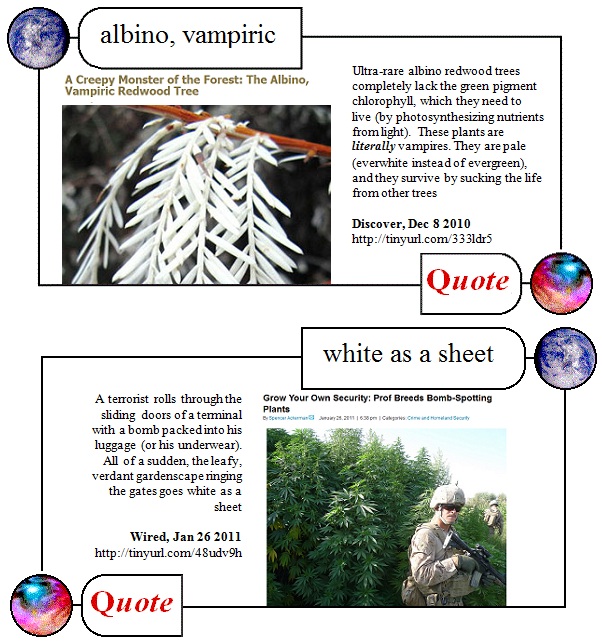
You know, I really enjoy building my DoubleQuotes. They can be entirely frivolous, as is this one, for instance:

with its touch of gothic — a taste I share with my friend Bryan Alexander.

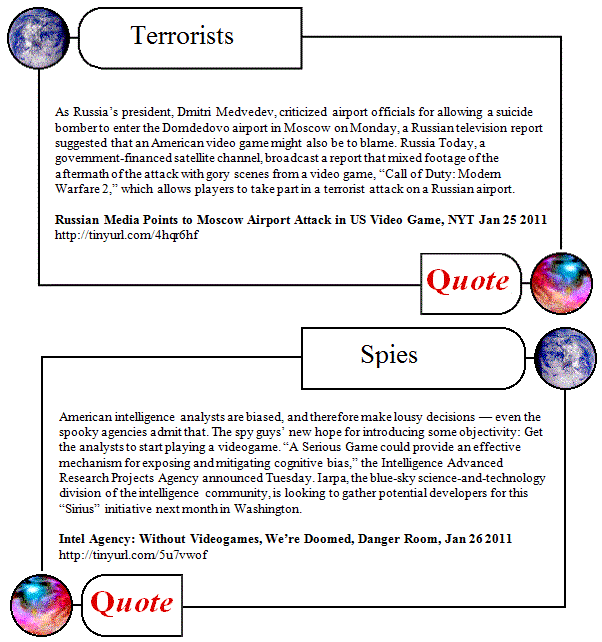
Or they can work like a Necker cube, offering opposite framings with which to view a single topic — in this case, video games.

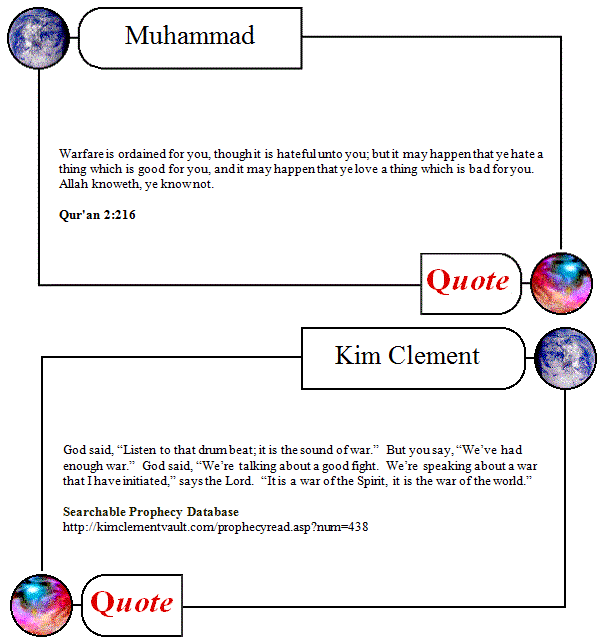
They can also work like Rorschach blots — this one compares two prophecies, one from the Quran and one from a contemporary Christian prophet (if I’m not mistaken, President Obama quoted him recently) —

— but it is left up to the reader to determine the value of each…

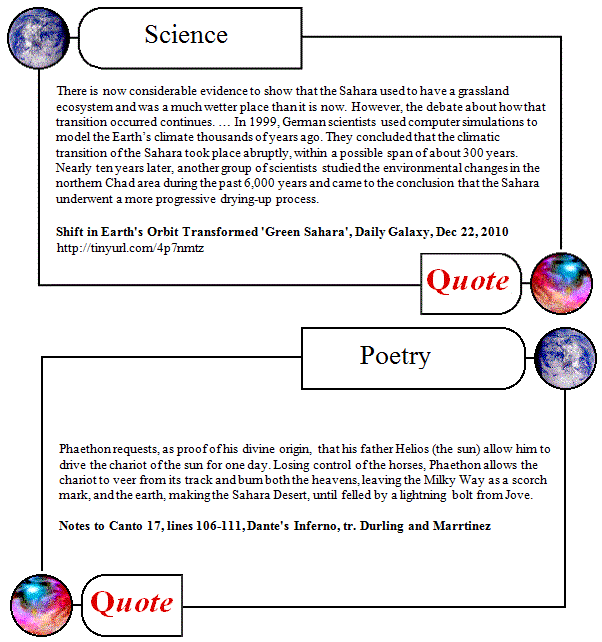
And they can also pose fundamental questions of preference:

Has science simply replaced myth, d’you think? or is science for the facts, perhaps, and the mind — while poetry and myth are for the heart, and truth?

Quantum COIN

Tuesday, January 18th, 2011


With quantum mechanics being used as a metaphor.

The New Physics: Key to Strengthening COIN by  A. Lawrence Chickering

….At the present time, most of what is being done for COIN is driven by old physics concepts, while many things we ought to be doing are understandable more in terms of the new physics.

One can see the difference between these two concepts in terms of the distinction between helping and empowering.3 The importance of this distinction is implicit in the widely quoted statement that T.E. Lawrence made in 1917 about the importance of empowering people and giving them ownership by letting them do things. -Do not try to do too much with your own hands,? Lawrence wrote.4 -Better the Arabs do it tolerably than that you do it perfectly. . . .?5 Helping is a powerful example of simple, Newtonian causation; it produces -concrete, measurable results,? which are the central concern of most philanthropy and donor programs. Unfortunately, the concrete results it produces are far weaker than the outcomes that result from empowerment and ownership.

Helping? is Newtonian and objective. You build a well, and the -measurable result? is a well. -Empowering? and -ownership? are post-Newtonian and subjective. You cannot -see? empowerment or ownership. These concepts have power when they are felt by people. Following Lawrence‘s statement, empowering and ownership are the key in COIN.

Empowering people, encouraging them to do things for themselves, shows the importance of non-local causation and results based only on probabilities. When a local community becomes empowered, there is no certainty what it will do. They will do things people care about-things they value. If you work in 100 communities, you cannot say what each village will do, but you can predict that some percentage will build wells, and some other percentage will build schools-and so on.

You know that empowering will not produce the -concrete, measurable results? you can get if the -helper? does the work, but when the helper does the work, there will be no community ownership and no sense of responsibility for security or maintenance of the -improvement?. With empowerment and ownership, people will protect a well or school and will maintain it. That explains why the well built by -an Arab? (Lawrence‘s phrase) is worth so much more than one built by -us? (the helpers).

The author has a solid point about top-down, outsider-controlled, hierarchically-organized aid activities cultivating an attitude of dependency, passivity or fatalism in populations that COIN forces are attempting to win over.

If we see symptoms of “welfare dependency” and disengagement from civil society in American neighborhoods with minimal levels of employment, high levels of violent crime and atomized social structures, as partly the product of intervention by social workers, police, state court systems and Federal programs, how much more so is this the case with third-country COIN? With bad people running around with RPG’s and AK-47’s? What would you, the impoverished and unarmed farmer of the village do? Stick out your neck? Or keep your head down?

Broke Down and Bought

Wednesday, January 12th, 2011

Grand Strategies: Literature, Statecraft, and World Order by Charles Hill

Heard way too many good things about this book from regular commenters like Scott Shipman (read his review here) to ignore it. The blurbs on the dust jacket are from some genuine heavyweights (and provoked an amusing academic political tantrum masquerading as a review  in FP.com from some minor departmental nemesis of Hill’s at Yale, where Hill is one of the founding lecturers of their Grand Strategy Program).

I will upjump this in my antilibrary queue to be read after I finish with Luttwak.

An Iridology of the Sciences?

Tuesday, January 4th, 2011

[ by Charles Cameron ]

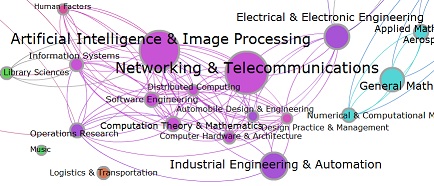
I for one am delighted to know that we can now play around with the iridology of the sciences, using the software available on the Science-Metrix Ontology Explorer site to view which fields have journals which cross-link to journals in other fields…
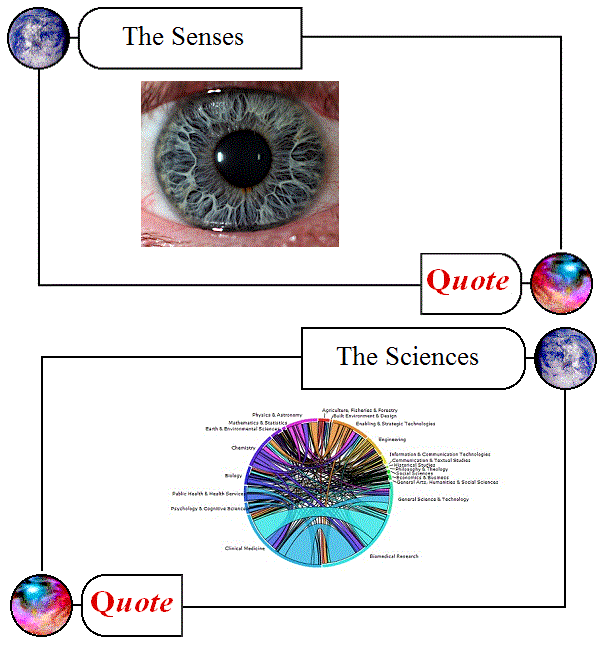
Seriously — that lower image is of the Field Citation Wheel that you can find, suitably enlarged for easy viewing, on that site.

*

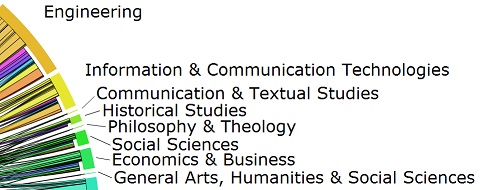
And it’s heartening for me to know, for instance — taking a closer look at the segment of that image that’s roughly east north-east — that scientific journals do have some links on their pages to works of theology or philosophy:

Engineering
, you’ll notice, has more links than history, philosophy, theology, the social sciences (even counting them twice), economics, business, the arts and humanities combined.

My own field, theology, has to share its thin segment with philosophy, and you can guess how small the number of links to articles on Islamic apocalyptic probably are…

Which is, in part, why I wonder whether a project like the ETH’s Living Earth Simulator will really manage to map such things as, well, a possible outbreak of global jihadist Mahdism and its consequences.

*

But then I look at another gorgeous graphic from the same source, focusing in on a part of the network of knowledge that interests me, and I can just faintly make out, lower left, entirely isolated, the field of music

What splendid isolation! That’s all of Bach, mind you – and all the Beatles, too.

*

Seriously, though:

  • It’s fascinating to be able to see how the various branches of knowledge cross-reference each other.
  • Visual data representation is a gorgeous, fantastic, field.
  • Mapping the all-of-everything is an irresistable lure for keen minds
  • I’m betting the humanities will prove to be at least as good at it as the sciences.
  • And I recall, not without a pang of regret, the time when my beloved Theology was Queen of the Sciences, and one might converse with Abelard on the streets of Paris…
Analogy as the Core of Cognition

Tuesday, December 28th, 2010


Switch to our mobile site