zenpundit.com » cultural intelligence

Archive for the ‘cultural intelligence’ Category

Book Review: Grand Strategies by Charles Hill

Monday, March 21st, 2011

Grand Strategies by Charles Hill

Charles Hill, senior Cold War diplomat, Hoover Institution fellow and a co-founder of Yale’s popular Grand Strategy Program that amounts to a crash course in the kind of classical liberal education that universities once imparted to undergraduates but today pride themselves in doing so no longer. The popularity of Hill’s program,  therefore, is with the students moreso than campus activists or the faculty:

…Despite whispers of words like “elitist,” “conservative,” and “cult”-words considered synonyms by many at Yale-The Grand Strategy seminar, only a few years old, has become one of the university’s marquee classes. Grand Strategy, like Professor Hill, has its own myth. The liberals on campus call the class Grand Fascism. They are kidding, but only in part. Many Yale students and faculty are suspicious of the program. Students awed or repelled by Grand Strategy are the same ones who are awed or repelled by Professor Hill, and for the same reasons: the aura of power, the whiff of elitism, the promise of an answer to life’s messiest questions.

If the Grand strategy Course at Yale is a distillation of classical liberal education, Grand Strategies: Literature, Statecraft and World Order is Hill’s reification of the course as an education for the reader on how the evolution of the Western civilizational worldview makes possible grand strategy. The book is an intellectual tour de force by Hill, at some times an idiosyncratic one and at all times an interesting one. I have read many, though very far from all, of the classic texts that Hill critiques and uses to shape his argument but having a large library under your belt is not a prerequisite from understanding Grand Strategies. Far from it, one suspects Hill wrote the book with his seminar students in mind.

Hill examines the protean and mythopoetic relationship between cultural foundations and expressions of power and political wills in conflict represented by diplomacy and war, both navigated by grand strategy constructed from cultural vision. A recurring theme in Grand Strategies is the heroic structure of the epic tale, with the descent into the Underworld and revelation of the heroic destiny by the shades and an ascent (not always successful or as ideally envisioned) to a creative, transformative new order. The reader meets Achilles in many guises, marches upcountry with Xenophon, is cast out of Heaven by Milton, confronts Hobbes‘ Leviathan, defies Rosseau’s general will and exorcises the evil represented in Dostoyevskii’s The Possessed. And this only is a tenth of the narrative.

While I frequently found myself in agreement with Hill’s discernments of the texts, some of them struck me as strained or highly debatable, such as Hill’s reading of Plato as a wry ironist ( Hill borrows from Leo Strauss here but goes further, if I recall correctly, than Strauss did), something that Carroll Quigley, Karl Popper or many classicists would have disputed. Hill’s final chapter, “The Writer and the State” is entertaining and contains a laudatory anecdote about Hill’s former boss, the impressive SECSTATE George Schultz , but it lacked some of the gravity of earlier chapters.

Erudite and visionary, Grand Strategies is a grand synthesis by Charles Hill with lessons to learn on every page.

(Special hat tip to J. Scott Shipman who pushed me to read and review this book)

Shibuya Eggman Epiphany

Wednesday, March 16th, 2011

[ by Charles Cameron — cross-posted from SmartMobs ]

*

An Easter Egg, according to one online definition, is an “undocumented function hidden in software that may or may not be sanctioned by management”. All sorts of media can in fact have Easter Eggs hidden in them, and the same definition goes on to mention occurrences in “video games, movies, TV commercials, DVDs, CDs, CD-ROMs and every so often in hardware.”

Well, okay. As of now, they can also be found on Fox News. Someone just sneaked the name of a Japanese rock club into the list of Japanese nuclear power plants:

quo-i-am-the-eggman

The definition of Easter Egg is from Your Dictionary.
The Fox News screen-grab is from Business Insider.
The image of the young rocker is from the Shibuya Eggman club website.
The song the young man is singing is undoubtedly I am the Walrus.
The hat-tip goes to Daveed Gartenstein-Ross, @DaveedGR, who pointed me to another Faux-pas, this one involving Pakistan and padded bras.

The divine comedy is that we can still find humor in the teeth of tragedy.
The triple tragedy is that Japan is reeling from quake, tsunami and nuclear plant failure.

One of the key chapters in my friend Howard Rheingold‘s book, SmartMobs, is titled Shibuya Epiphany. And that’s my epiphany for today.

Honor killings

Monday, March 7th, 2011

[ by Charles Cameron — cross-posted from ChicagoBoyz ]

*

I had occasion today to give myself a quick refresher course on honor killings, one form of which is already present in the Torah as of Leviticus 21.9:

And the daughter of any priest, if she profane herself by playing the whore, she profaneth her father: she shall be burnt with fire.

and found myself once again noting that there is a substantial swathe of regions of the world where honor killings are found, and that where it is found (including in immigrant communities from those parts of the world) the practice is not confined to any one religious group.

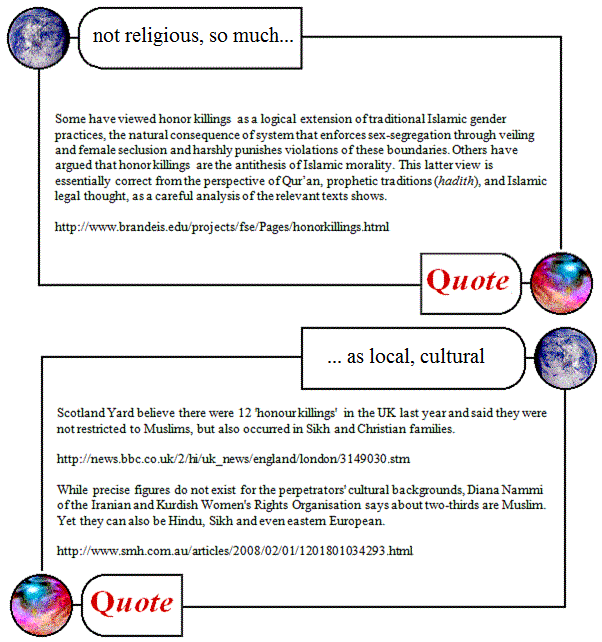
Hence this DoubleQuote:

I think it is appropriate to consider honor killing a form of religious violence when the claim is made by those who do the killing that they are acting in the name of their religion — but that it is also important to distinguish such acts committed in a cultural context in which they are practiced across religions from acts that are the exclusive province of one religious tradition.

There are examples of honor killings which are performed in the name of Islam, and/or advocated by Islamic scholars — and the same could no doubt be said of other religious traditions — but honor killing as a genre is fundamentally more cultural than religious.

Sources: Brandeis studyBBCSydney Morning Herald

The analytic point:

From my point of view as an analyst, it is important to note and compare both religious and cultural drivers — neither avoiding mention of the one out of “correctness” — nor overlooking the other for lack of comparative data.

The Sociobiological Origins of Beauty

Sunday, March 6th, 2011


Great multidisciplinary talk by Dr. Denis Dutton on the possible evolutionary origins on culturally universal concepts of aesthetic beauty.

Two courtyards, two hundred camels

Sunday, March 6th, 2011

a light-hearted canon in two voices

[ by Charles Cameron ]

*

I’d been doing some research for a follow-up post on story-telling in Afghanistan to go with Scott‘s account of his day at DARPA’s recent STORyNET conference, and one of the interlocutors on the list we’re both on posted a question about the impact of drug use as a consideration in narrative.

Baudelaire and Cocteau both have writings on drug use — hashish and opium respectively — but it was Afghan or more generally Islamic story-telling that I was after, and it occurred to me that the four stories in Paul Bowles‘ collection, A Hundred Camels in the Courtyard, were easily accessible examples of the kind of story-telling that Moroccans are prone to under the influence of hashish.  Bowles describes their mental processes thus:

Moroccan kif-smokers like to speak of the “two worlds,” the one ruled by inexorable natural laws, and the other, the kif world, in which each person perceives “reality” according to the projections of his own essence, the state of consciousness in which the elements of the physical universe are automatically rearranged by cannabis to suit the requirements of the individual. These distorted variations in themselves generally are of scant interest to anyone but the subject at the time he is experiencing them. An intelligent smoker, nevertheless, can aid in directing the process of deformation in such a way that the results will have value to him in his daily life. If he has faith in the accuracy of his interpretations, he will accept them as decisive, and use them to determine a subsequent plan of action. Thus, for a dedicated smoker, the passage to the “other world” is often a pilgrimage undertaken for the express purpose of oracular consultation.

The title of Bowles’ little collection, by the way, comes from the Moroccan proverb which is gives me the first of my two quotes, two courtyards, two intoxicants and two hundred camels below…

I wasn’t entirely satisfied, though, which a Moroccan account of hash-flavored narrative when DARPA was looking for an understanding of narrative that would apply in Afghanistan, so I thought I’d look up some of Idries Shah‘s writings, and Kara Kush in particular, to see if perhaps I could find an Afghan equivalent of Bowles’ stories there…

I already had Bowles’ one courtyard and one hundred camels in mind, so you’ll understand how pleased I was to stumble upon another slightly obscure but interesting writer — Peter Lamborn Wilson, aka Hakim Bey, who gave use the concept of the TAZ or Temporary Autonomous Zone — writing about Afghanistan rather than Morocco, opium rather than hashish, and a second courtyard, with a second hundred camels:

quo-100-camels.jpg

Two terrific writers: Paul Bowles and Peter Lamborn Wilson.

Sources: BowlesWilson

Courtyards with a hundred camels in them are popping up all over.


Switch to our mobile site