zenpundit.com » leadership

Archive for the ‘leadership’ Category

Debating a Failure of Generalship and Leadership

Tuesday, October 18th, 2011

A fascinating online discussion between US Army intellectuals Colonel Gian Gentile, Colonel Paul Yingling and journalist and Iraq War veteran Carl Prine:

Paul Yingling  A Failure in Generalship  –AFJ

….Having spent a decade preparing to fight the wrong war, America’s generals then miscalculated both the means and ways necessary to succeed in Iraq. The most fundamental military miscalculation in Iraq has been the failure to commit sufficient forces to provide security to Iraq’s population. U.S. Central Command (CENTCOM) estimated in its 1998 war plan that 380,000 troops would be necessary for an invasion of Iraq. Using operations in Bosnia and Kosovo as a model for predicting troop requirements, one Army study estimated a need for 470,000 troops. Alone among America’s generals, Army Chief of Staff General Eric Shinseki publicly stated that “several hundred thousand soldiers” would be necessary to stabilize post-Saddam Iraq. Prior to the war, President Bush promised to give field commanders everything necessary for victory. Privately, many senior general officers both active and retired expressed serious misgivings about the insufficiency of forces for Iraq. These leaders would later express their concerns in tell-all books such as “Fiasco” and “Cobra II.” However, when the U.S. went to war in Iraq with less than half the strength required to win, these leaders did not make their objections public.

Gian Gentile A Few Questions for Colonel Paul Yingling on Failures in GeneralshipSmall Wars Journal

….Perhaps you see it differently, but the failure that I see in American generalship in both wars in Iraq and Afghanistan (with precedence in Vietnam) is the idea that tactical and operational excellence through a certain brand of counterinsurgency (or any other form of tactical innovation) can rescue wars that ultimately are failures of strategy, or as Schlesinger more harshly puts it “national stupidity.”

In light of how you respond to these questions might you consider writing “A Failure of Generalship, Version 2” for Afghanistan?

If not, might you spell out the differences between what you saw as the failure of American generalship in Iraq from 2003-2006 with the past two years plus in Afghanistan.  In other words, how has American generalship been a failure in Iraq and not in Afghanistan?

Paul Yingling The Gentile-Yingling Dialogue: ISAF Exit Strategy – Neither International nor an Exit nor a Strategy – Small Wars Journal

….Those of us charged with strategic thinking ought to heed this example.  Imagine a failed Pakistan that results in a terrorist organization acquiring one or more nuclear weapons.  What would our response be in the aftermath of such a crisis?  What intelligence capabilities do we need to locate compromised nuclear materials?  What civil security and law enforcement measures might disrupt or minimize the impacts of such a threat?  What counter-proliferation capabilities are required to seize and render safe compromised nuclear weapons or materials?  Imagine further the capabilities required to avoid such a crisis.  What diplomatic measures might change the Pakistani strategic calculus that lends support to extremism?  What broader engagement with Pakistani civil society might render this troubled country less amenable to radical ideology?  Now imagine still further back to the institutional arrangements that generate national security capabilities.  Do we have the right priorities?  Are we buying the right equipment?  Are we selecting the right leaders?  Are we making the best use of increasingly scarce tax payer dollars?

Too often, what passes for strategic thought in the United States is actually a struggle among self-interested elites seeking political, commercial or bureaucratic advantage.  Such behavior is the privilege of a country that is both rich and safe.  However, a pattern of such behavior is self-correcting: no country that behaves this way will stay rich or safe for long.

Carl Prine A Colonel of Truth – Line of Departure

….Gentile and I agreed nevertheless that Yingling failed to seal the deal by naming names, something that would’ve allowed readers the chance to test empirically whether the LTC’s overall thesis had merit.  Here’s Yingling’s nutgraf, words scribbled during the worst days in Iraq when Gentile commanded a cavalry squadron in Baghdad and I was stuck in Anbar as a lowly infantry SPC:

These debacles are not attributable to individual failures, but rather to a crisis in an entire institution: America’s general officer corps. America’s generals have failed to prepare our armed forces for war and advise civilian authorities on the application of force to achieve the aims of policy. The argument that follows consists of three elements. First, generals have a responsibility to society to provide policymakers with a correct estimate of strategic probabilities. Second, America’s generals in Vietnam and Iraq failed to perform this responsibility. Third, remedying the crisis in American generalship requires the intervention of Congress.

….Perhaps because it was so brief, Yingling’s essay lacked subtlety.  It’s not true that America’s generals in Vietnam saw the conflict merely in terms of conventional warfare, although some surely did.  He spun a dubious bit of scholarship on Malaya by John Nagl into a larger argument about Cold War generals choosing to orient American arms toward highly kinetic campaigns – as if the threat of Soviet arms in Europe had nothing to do with that.  And he peppered his analysis with bromides that remain unproven, perhaps my favorite being the chestnut that “?opulation security is the most important measure of effectiveness in counterinsurgency.”

That read better in 2007 than it does today. But Yingling’s larger point held true:  America’s generals failed to adapt our shrinking forces to how policymakers might direct their use, even if there was a re-emphasis on operations other than conventional war both in practice (Kurdistan, Bangladesh, Haiti, Somalia, Kovoso, Bosnia, Timor, Cambodia) and theory.

This is an important discussion because the failure of generalship is merely part of a larger paradigm of leadership by abdication and moral evasion that is corroding the fabric of American society to a degree not seen since the 1970’s. Or perhaps since the 1870’s. Colonel John Boyd once chided his brother officers for being willing to take a bullet for their country but not willing to risk their careers for their country. How much worse then is an elite civilian political class that grabs the largesse of government contracts with great gusto but is chronically unable to do the hard work of providing strategic leadership when in office?

Truman’s famous desk sign that indicated the buck stopped at his desk. To update the sign to fit the spirit of the times would require replacing it with a dead fish rotting from the head.

Elkus on Wikileaks and Sovereignty

Sunday, September 4th, 2011

Adam Elkus has a smart piece up at Rethinking Security that deserves wider readership:

WikiLeaks and Sovereignty

….WikiLeaks represents the idea that states have no inherent authority to hold onto vital national secrets. Because information is fundamentally boundless and unlimited by the “oldthink” of national borders and politics, state control over proprietary information is irrelevant. WikiLeaks and other radical transparency advocates believe that they-an unelected, transnational elite-can pick and choose which states are good and bad and whose secrets deserve exposure. And if information deserves to be free-and the only people who would keep it from being so are those with something to hide-then it is fine for non-state networks to arrogate themselves the right to receive and expose state secrets.

….While WikiLeaks is often positioned as a champion of digital democracy, it is actually wholly anti-democratic. It transfers power and security from national governments and their publics to unelected international activist organizations and bureaucrats. While this may seem like a harsh interpretation, there is no check on the likes of Julian Assange. Governments-even autocratic ones-still must contend on a day-to-day basis with the people. Even China had to face a reckoning after the Wenzhou train crash. WikiLeaks and other radical transparency organizations mean to replace one group of elites-which at least nominally can be called to court-with another who are accountable only to their own consciences.

Read the whole thing here.

Let me add a few comments to Adam’s excellent analysis.

Wikileaks and Julian Assange were not and have never been, lone wolves or information-must-be-free martyrs. They are allied with important institutions and individuals within the Western progressive elite, not least major media heavyweights like The New York Times, The Guardian and Der Spiegel, but also sympathizers within Western governments. Unless you think that Pvt. Bradley Manning was a hacker wunderkind with an intuitive grasp of which files that could be swept up to further a sophisticated political agenda, the man had some inside help from further up the food chain.

Adam is correct to describe these political factions as anti-democratic because they are and while leaking has been going on as long as there have been governments, we now have the emergence of a transnational generational clique that see themselves as entitled to rule and impose policies that comport with their social prejudices, economic self-aggrandizement and ideological fetishes, whether the people support them or not. A vanguard attitude, if not an organizational vanguard.

Wikileaks and other devices operating in shadowy undercurrents are their form of liberum veto against the rest of us in the instances where they are not completely in control, thus migrating political power from responsible state institutions to the social class that currently fills most of the offices and appointments. So far, their actions have been largely cost-free because their peers in government, however irritated they may be at the effects of Wikileaks, are loath to cross the Rubicon and hammer these influential conspirators with whom they went to school, intermarry, do business, live amongst and look out for the careers of each other’s children the way they have hammered Bradley Manning.

The same oligarchical class indulgence is seen in the financial crisis where almost none of the people responsible for massive criminal fraud in the banking and investment  sectors that melted the global economy have faced prosecution, unlike previous financial scandals like the S&L crisis or BCCI where even iconic figures faced grand juries. Instead of indictments, the new class received subsidies, bonuses and sweetheart, secret deals from their alumni chums running central banks and national governments. 

Carl Prinecommenting on a much narrower and wholly American slice of this corrupt camarilla, described this new class very well:

Let me be blunt.  A late Baby Boomer generation of politicians, bankers, reporters and generals has formed into a cancer inside this democracy, and their tumorous leadership won’t be kind to your future.

Unfortunately, this cancer is not limited to our democracy, it is the root of the decline of the West.

Descent into Barbarism

Wednesday, August 10th, 2011

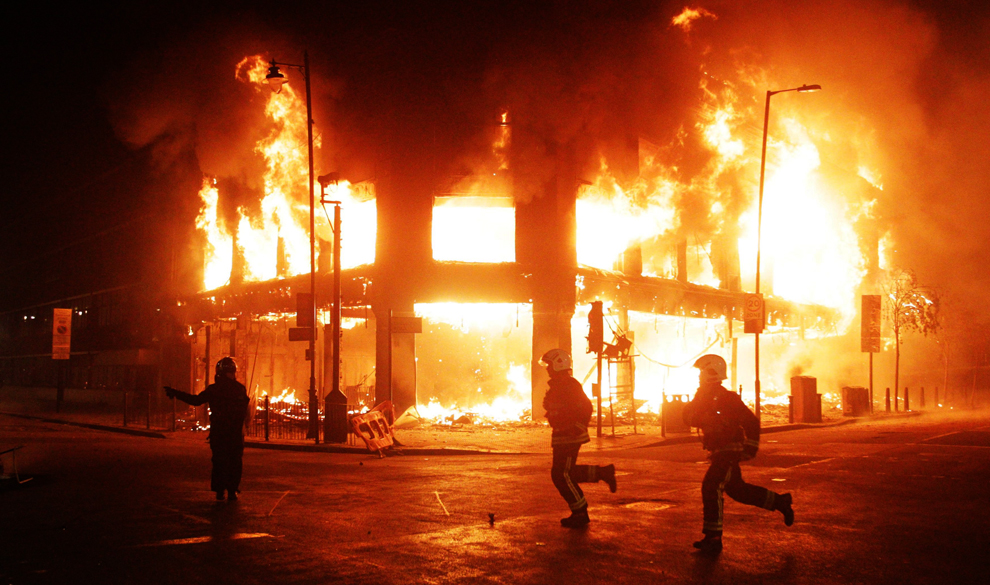
London burns for four days as UK authorities dealt timidly and uncertainly with semi-organized swarms of brazen thugs, causing rioting to spread to other cities. What have we seen so far?

* The British government and police acted with moral uncertainty in the face of violent challenge from swarming tactics by “underclass youth” rioters.  The BBC was filled with interviews of victimized citizens complaining about how police were unwilling to intervene to stop acts of looting, assault and arson. Police behavior fed the cycle of rioting and encouraged fence-sitters to join in and swell the ranks of the mob, as did early talking head comments in the British media that argued that the rioters were “justified”

* The British government was politically paralyzed by the crisis and needed three days and a Cabinet meeting to begin to organize an effective anti-riot strategy, distribute proper equipment, summon additional manpower, change police ROE and marshal a rhetorical narrative against the rioters.  All the halmarks of excessive top-down control by out of touch technocrats and politicians.

 John Robb summed up this kind of anti-leadership beautifully in his review of Rebecca Solnit’s A Paradise Built in Hell  :

…In contrast to the people on the ground, she shows that the only people that actually do panic during disasters are the elites — from those with wealth to those running the government’s response (I’m not talking about the first responders actually on the ground doing good work).  They panic over the loss of control a disaster brings.  This often results in extreme actions that only serve to make things worse: from martial law authorized to use deadly force against looters (often just people trying to survive the situation) to arbitrarily hearding people into locations that aren’t able to support large groups of people.  

What This Means

The lesson here is that during an extreme disaster, the people you may most need to fear are those in charge, particularly if their motives are focused on protecting elite interests put at risk by the disaster

* The Cameron government’s legitimacy is at risk, being currently blamed for everything connected to the riot from the underlying “root causes”, to their initial total lack of interest in defending ordinary Britons to the bad impression made of having senior ministers being on vacation while the capitol of the UK was ablaze. Earnest and repeated assertions by government officials that no political or racial motives were behind the rioting conflicted with the reality being broadcast live by the government’s own news service in the first hours and days of the riot.

Handling a riot properly is state power 101. The Prime Minister has about two days to turn this situation and the political perceptions created around or he will begin an irreversible downward spiral to an early retirement.

Bing West on COIN and Afghanistan Strategy

Tuesday, August 2nd, 2011

From SWJ Blog:

Where we have been. According to US counterinsurgency doctrine, our soldiers and marines were expected to be “nation-builders.” Afghanistan, however, was the wrong war for that strategy of democratic nation building – for three reasons.

First, a foreign power cannot build a democratic nation, while having no control over that nation’s authoritarian leaders. In 2002, the US and the UN handed full sovereignty to Afghan leaders who proved to be venal and selfish. We conceded all leverage over Afghan leadership. That was a fatal mistake.

Second, a duplicitous Pakistan has maintained a 1500-mile long sanctuary. The recent decision to give Pakistan money only on a transactional basis – do this if you want to be paid – is commendable. It will influence behavior, because Pakistani officials cannot maintain their comfortable life styles without American money.

Third, our benign counterinsurgency strategy did not win the commitment of the people. In Iraq, the Sunni tribes did eventually reject the insurgency. In Afghanistan, the Pashtun tribes have not done so. Most Pashtun villagers survive by being chameleons; they expect the Taliban to return.

By giving away $18 billion over ten years, we created a culture of entitlement. Afghans from President Karzai down to village elders came to expect that we would fight for them and give them money. The US military alone undertook 16,000 economic projects, as if its mission was that of a giant Peace Corps. This money resulted in no change in the war; however, it did weaken the willingness of Afghans to rely upon themselves. When you give something for nothing, you receive nothing in return…

Read the rest here:

Carl Prine’s Rebuttal to “Be honest: Who actually read FM 3-24?”

Wednesday, July 13th, 2011

My amigo and SWJ News co-columinst Crispin Burke recently put forth a very interesting and provocative jeremiad “Be honest: Who actually read FM 3-24?” and one of his targets, journalist and Iraq war veteran Carl Prine, has been duly provoked, Prine has responded in great detail yesterday at Line of Departure:

Starbuck is wrong

Starbuck is wrong.

And in his drive to keep getting it wrong, he’s trying to rewrite FM 3-24, the military’s chief doctrinal publication on counterinsurgency.

But that just makes him more wrong.

He’s wrong about me.  He’s wrong about what I believe.  He’s wrong about the literature that informs FM 3-24.  He’s wrong about what the manual says and he’s wrong about what it left out.  He’s wrong about historiography.  He’s wrong about how a caste of top officers and diplomats came to understand “strategy” in the wake of the occupation of Iraq.

Let’s help get him right.  Or, at least, less wrong.  He’s a good man.  We need to turn him and ensure he quits taking shots at me I don’t deserve!

….The problem to anyone who studies Malaya, however, is that since the publication of the memoirs of exiled communist leader Chin Peng a dozen years ago, we now know that the civic, military and political policies under the British “hearts and minds” approach didn’t defeat the revolution.

Instead, the revolt was irreparably broken by brutal operations against the guerrillas, then a most coercive “screwing down the people” phase that dispossessed or killed thousands of Chinese, followed by draconian “population control” measures that, as Peng put it, starved the guerrillas in the bush because they snapped their rat lines and cut off their rice.

The “hearts and minds” initiatives designed to bring medical care, education, social welfare and other aid to the resettled Chinese and woo them to the colonial government’s side from 1952 – 1954 didn’t crack the back of the insurgency, a point now pretty much beyond dispute.

Why?  Because the previous “hearts and minds” claptrap as the cause of pacification in Malaya was contradicted by the Malayan Chinese, most especially those guerrillas who took up arms against the British regime!

You know, the people targeted by a population-centric counterinsurgency.  The people most counter-insurgents in their pop-centric fantasies almost never discuss except as abstractions, the human yarn wefted and warped by their long needles of war.

One finds “Hearts and Minds” prominently mentioned 11 times in Dr John Nagl’s valentine to Templer and colonial Malaya, Eating Soup with a Knife; to Nagl it’s the stuff of police services and economic development and whatnot with the psychology of the people being the center of gravity those reforms are meant to snatch.

And Nagl would like the best burglar of hearts and minds to be a learning, nimble and evolving military-political institution such as the U.S. Army.  It’s no small wonder, then, that Nagl became a dominant voice in FM 3-24 and that many of this thoughts in Eating Soup came to dominate the manual, too.

Or, as the introduction to FM 3-24 echoes soupily, “by focusing on efforts to secure the safety and support of the local populace, and through a concerted effort to truly function as learning organizations, the Army and Marine Corps can defeat their insurgent enemies.”

This is mere euphemism and wasn’t worth the ink that it cost taxpayers to print it.  But it sets the stage for the rest of FM 3-24, which follows a hearts and minds template that Starbuck doesn’t apparently realize is borrowed from mid-century….

Ouch. Note to self: if I ever decide to square off against Carl, I will make sure to do my homework. Read the rest here.

First, I would point out to readers here for whom some of this in both essays is inside baseball, that the tone is less harsh and the substantive distance between Burke and Prine less great in  the comments sections of both blogs than it first appears in reading their posts. It is a healthy, no-holds barred exchange and not a flame war.

Secondly, it is an important exchange, tying together COIN disputes over theory, historiography, empirical evidence, operational and tactical “lessons learned”, strategy, policy (Clausewitzian sense), politics (colloquial sense) and personalities that have raged for five years across military journals, think tanks, the media, the bureaucracy and the blogosphere. In some ways, these essays can serve as a summative of the debate. I say “some ways”, because what is the most important element or effect of America’s romance with COIN will differ markedly depending on whom has the floor. My own beef is not with doing COIN, it is with not doing strategy.

As Crispin and Carl’s vignette about General Creighton Abrams demonstrated, American historians are still having savagely bitter arguments about the war in Vietnam. For that matter, everyone who lived through the era did and still does. It is a wound that never seems to heal and has crippled our politics to this day, even as the veterans of Vietnam now turn to gray.

The 21st century COIN wars have not ripped American society apart down to the soul the way Vietnam did. As with the Korean War, the soldiers and marines in Afghanistan and Iraq fought bravely, at times desperately, to a general and mild approbation back home that sometimes looked a lot like indifference. Even the anti-war protestors mostly made a point of stating they were not against the troops, the venemous public malice of the 1960’s New Left radicals in the 2000’s was a property only of the lunatic fringe.

But COIN itself will be a historical argument without end.


Switch to our mobile site
