zenpundit.com » Epistemology

Archive for the ‘Epistemology’ Category

Guest Post:A Hipbone Approach to Analysis III.

Saturday, October 30th, 2010


Charles Cameron is the regular guest-blogger at Zenpundit, and has also posted at Small Wars Journal, All Things Counterterrorism, for the Chicago Boyz Afghanistan 2050 roundtable and elsewhere.  Charles read Theology at Christ Church, Oxford, under AE Harvey, and was at one time a Principal Researcher with Boston University’s Center for Millennial Studies and the Senior Analyst with the Arlington Institute:

A Hipbone Approach to Analysis III.

by Charles Cameron

I’ve been slowly prepping this series of pieces about my analytic approach — and the mysterious business of “connecting the dots” — for a while, but.. Jeff Jonas, whose work I only recently ran across, has given me “another piece of the puzzle” and a slew of new dots to connect, so here’s a quick impression of some new (for me) terrain that connects with other areas I have long been familiar with.

1

What it comes down to in my post today is this: I would like to reconcile “connecting the dots” with “putting together the pieces of the puzzle”.

Both metaphors have to do with “seeing the big picture”, and one of them (“connecting the dots”) has to do directly with nodes and edges, i.e. with those systems we call graphs and networks, while the other suggests a far subtler set of connections.

Consider this: n+1 is the next dot in the series of integers after n, with “+1” being the only link necessary — you can represent that on a graph with two nodes and an edge. But if you had the sky of the northern hemisphere in one hand (hey, this is a thought experiment) and five square miles of landscape around Winchester Cathedral in the other, finding just where to fit the cathedral (and the surrounding, branching, leafy trees nearby) snugly into the sky would be a far trickier business, and the links between air and leaf and stone molecules would be very many — we should be grateful for the ease with which the sky accommodates itself in reality to the cathedral and the trees (and the cathedral and the trees to the sky) — and for the ease with which a painter like Turner can capture the effect…
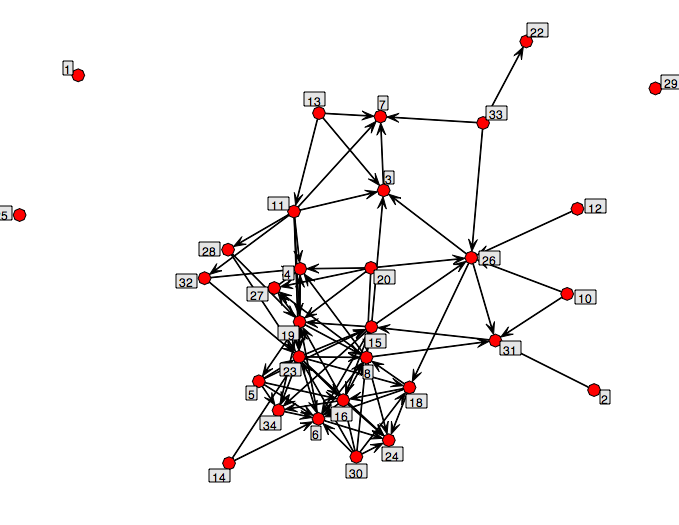
Two puzzle pieces, I mean, may have to fit along many aspects of their intersection, while dots can be connected by a single common thread.

2

I’ve only recently “met” the mind of Jeff Jonas, but he has some remarkable things to say about puzzles — for one thing, he writes about the levels of, well, computation involved in solving a jigsaw puzzle:

The first piece you take out of the box and place on the work surface requires very little computational effort. The second and third pieces require almost equally insignificant mental effort. Then as the number of pieces on the table grows the effort to determine where the next piece goes increases as well. But there is a tipping point where the effort to determine where to place the next piece gets easier and easier … despite the fact the number of puzzle pieces on the table continues to grow.

That in itself is a fascinating thought to dwell on, in fact it’s the sort of piece of the puzzle that gives me an epiphany — Jonas talks about puzzle pieces that provoke epiphanies, too:

Some pieces produce remarkable epiphanies. You grab the next piece, which appears to be just some chunk of grass – obviously no big deal. But wait … you discover this innocuous piece connects the windmill scene to the alligator scene! This innocent little new piece turned out to be the glue.

I’m processing this as a theologian / philosopher / poet, and Jonas has just given me a new angle on the theme of the intersection of frames of reference that Arthur Koestler in The Act of Creation takes to be the fundamental element in insights ranging all the way from casual jokes about rabbis to — let me give you a more powerful example — the Taniyama-Shimura Conjecture which, if I’ve understood the layman’s version correctly, began as a hunch that the otherwise entirely distinct mathematical zones known as “elliptic curves” and “modular forms” could be mapped onto each other – and wound up once proven, successfully bridging algebra with analysis.

Now, I am no no no no mathematician — but I am a student of conceptual bridges, so if I’ve phrased myself poorly here, please bear with me. The point is to think freshly about how one idea connects with another.

Koestler’s insight at the intersection between two fields (for this is essentially a matter of multiple-frame, and thus cross-disciplinary, thinking) is, I’d suggest, Jonas’ epiphanic piece of the puzzle.

Awesome.

3

But as we are trying to figure out the puzzle pieces — and this applies to “what is the meaning of life?” as much as to “what threat should be uppermost in our concern?” — Jonas has more to throw at us:

There may be more than one puzzle in the box, some puzzles having nothing to do with others. There may be duplicate pieces, pieces that disagree with each other, and missing pieces. Some pieces may have been shredded and are now unusable. Other pieces are mislabeled and/or are exceptionally well crafted lies.

I would like to add that puzzles may not be the only thing in the (universal) box. There’s a quote that originates somewhere in Heidegger, to the effect that “A puzzle is the unknown, to be solved, while a mystery is the unknowable, to be entered into and dwelt within.” As I say, I’ve only just run into Jonas’ thoughts, but I’d like to integrate that piece of the puzzle in with the ideas he’s providing – why not have a go at the mystery too while we’re about it?

4

So what happens with ideas? How do they connect?

Hermann Hesse, the Nobel laureate in literature who gave us Siddhartha and Steppenwolf and The Journey to the East, won his Nobel for his most ambitious novel, The Glass Bead Game (Das Glasperlenspiel, also known in English as Magister Ludi). It is an amazing piece of work that inspired at least one other book by another Nobel laureate — Manfred Eigen’s Laws of the Game: How the Principles of Nature Govern Chance — gave John Holland (he of genetic algorithms) the ruling metaphor for his life’s work, was an early and profound influence on Christopher Alexander’s thinking about pattern languages, and in general serves as a catalyst for grand scale creativity among a disparate crowd of very bright minds.

It is about a game — a game on the order of the complete works of JS Bach. And the essence of the game is the juxtaposition of thoughts.

It is about “connecting the dots” and “putting together the pieces of the puzzle” on the grand scale, to create not a single link between ideas, not a small “bigger picture” deploying a half-dozen or so insights, but a vast architecture of ideas that encompasses all “deep” human thought and connects all “beautiful” cognizable patterns. Hesse uses the image of an organist playing an organ to describe the play of ideas that composes his Game, writing:

All the insights, noble thoughts, and works of art that the human race has produced in its creative eras, all that subsequent periods of scholarly study have reduced to concepts and converted into intellectual values the Glass Bead Game player plays like the organist on an organ. And this organ has attained an almost unimaginable perfection; its manuals and pedals range over the entire intellectual cosmos; its stops are almost beyond number.

And in Hesse’s central, musical metaphor, the myriad thoughts that comprise what he terms the “hundred-gated cathedral of Mind” are linked one with another by likeness — by identity, isomorphism, homology, symmetry, parallelism, opposition, analogy, metaphor…

5

I’ll have to move us deep into the territory of the arts and humanities here, because Hesse himself was supremely versed in those areas, but in doing so I would remind you that John Holland wrote of his life’s work, “If I could get at all close to producing something like the glass bead game I can’t think of anything that would delight me more.”

Here’s Hesse on the analogical / isomorphic nature of the moves that connect ideas — “only connect!” said EM Forster — in his great Game:

Throughout its history the Game was closely allied with music, and usually proceeded according to musical or mathematical rules. One theme, two themes, or three themes were stated, elaborated, varied, and underwent a development quite similar to that of the theme in a Bach fugue or a concerto movement. A Game, for example, might start from a given astronomical configuration, or from the actual theme of a Bach fugue, or from a sentence out of Leibniz or the Upanishads, and from this theme, depending on the intentions and talents of the player, it could either further explore and elaborate the initial motif or else enrich its expressiveness by allusions to kindred concepts. Beginners learned how to establish parallels, by means of the Game’s symbols, between a piece of classical music and the formula for some law of nature. Experts and Masters of the Game freely wove the initial theme into unlimited combinations. For a long time one school of players favored the technique of stating side by side, developing in counterpoint, and finally harmoniously combining two hostile themes or ideas, such as law and freedom, individual and community. In such a Game the goal was to develop both themes or theses with complete equality and impartiality, to evolve out of thesis and antithesis the purest possible synthesis.

It is Bach, it is Hegel, it is the very essence of creativity, it is the associative, metaphoric nature of mind and brain (and I won’t get more than toe-deep in the “deep problem” of consciousness here).

6

And it does involve combining the understanding of both puzzle and mystery, to return to that distinction from Heidegger:

I suddenly realized that in the language, or at any rate in the spirit of the Glass Bead Game, everything actually was all-meaningful, that every symbol and combination of symbols led not hither and yon, not to single examples, experiments, and proofs, but into the center, the mystery and innermost heart of the world, into primal knowledge. Every transition from major to minor in a sonata, every transformation of a myth or a religious cult, every classical or artistic formulation was, I realized in that flashing moment, if seen with a truly meditative mind, nothing but a direct route into the interior of the cosmic mystery, where in the alternation between inhaling and exhaling, between heaven and earth, between Yin and Yang, holiness is forever being created.

Hesse is proposing his intuition that the world of ideas is a mandala-form array of symmetries with a “vanishing point” in the center.

Well, I have leapt far from my original topic, Jeff Jonas’ comments on piecing together a puzzle, but I hope the bungee-cord I’ve been depending on has held your attention, and now as always, at the far end of the extension there’s a bouncing-back.

7

The human mind “connects the dots” and “pieces together the puzzle” by recognizing likenesses — pattern recognition, if you like.

But just how human analogical thinking functions is not exactly an easy question…
Guest post: A Hipbone Approach to Analysis II.

Friday, October 29th, 2010

 Charles Cameron is the regular guest-blogger at Zenpundit, and has also posted at Small Wars Journal, All Things Counterterrorism, for the Chicago Boyz Afghanistan 2050 roundtable and elsewhere.  Charles read Theology at Christ Church, Oxford, under AE Harvey, and was at one time a Principal Researcher with Boston University’s Center for Millennial Studies and the Senior Analyst with the Arlington Institute:

A Hipbone Approach to Analysis II.

by Charles Cameron

Let’s call this one Hopscotch across the disciplines.

…our intelligence community failed to connect those dots…
        –  President Obama, Remarks on Security Reviews, Jan 05, 2010

I’ve been giving quite some thought over the past fifteen years to this issue of connecting dots.

My internet handle, hipbone, does double duty for me, since it refers to Ezekiel’s apocalyptic prophecy as featured in the lyric, “hip bone connected to you back bone”, in the old spiritual, Dem Bones, Dem Dry Bones. On the one hand it points to apocalyptic, by which I mean the soon expectation of a sudden and complete transformation in world affairs, very possibly accompanied, triggered or accomplished by extreme violence, with the end result being a highly favored “new heaven and new earth” or “new world order” depending on who is doing the expectation. On the other hand, it points directly to the idea of “connecting the dots” itself, since the entire song is about connections. I have been working on both fronts at least since 1995.

1

Connecting the dots is a matter of thinking, and there are two basic strategies of thought available to the human mind: linear thinking, which proceeds via cause and effect along a single track, and which is the major style of thought used within disciplinary silos, and lateral thinking, which skips sideways across silos and disciplines on wings of metaphor and analogy. Machines can crunch numbers and do some of our linear thinking for us: but it’s up to the analysts to cover the lateral front.

2

Let’s go aphoristic:

Expectation is algorithm: there are no algorithms for the unexpected.

I’d like to connect the dots … to blind spots.

Blinds spots are the spots we can’t, or won’t, and in any case don’t see. They fall into the category of the invisible. Visionaries are those who can see the invisible, who peer into our blind spots, into those places where we can’t see the connections between the dots, and can therefore easily be blind-sided. There’s an almost Borgesian thickness to the way things tie into one another here: the unexpected is by definition what we can’t predict, what blunt force thinking can’t predict — but it’s not invisible to those whose practice is to peer into the invisible, to aficionados of the subtler associative / metaphorical strategy…

3

Let’s go mythic.

There are two major strategies in life, two main ways of tackling problems, just as there are two heroes in the ‘Spider Woman” myth, which Joseph Campbell said was the central myth of the Americas. In Navajo terms, these twin heroes are called Monster Slayer and Child Born of Water, and their names may already give us the sense that one represents a brute force approach while the other is cannier, subtler — and able to achieve things his twin could barely imagine.

The Massive Ordnance Penetrator may be able to penetrate 60 feet of concrete, but the Grand Canyon was created by the natural flow of water — and as Lao Tzu said, “Nothing under Heaven is more soft and yielding than water, yet for eroding the hard and strong, nothing can surpass it.”

You can pitch this one-two punch at a variety of levels. The military can be seen as the nation’s Monster Slayer, its intelligence community as the Child Born of Water. You could see Thomas Barnett’s Leviathan as Monster Slayer, his SysAdmin as Child Born of Water. Or within the IC, you could say that software that can “crunch mega amounts of data” takes the Monster Slayer approach — but it requires cognitive skills and insight of a Child Born of Water sort to know when a student’s slightly eccentric interest represents a threat to the lives of three thousand office workers…

4

Let’s go analogic.

I’m thinking of the flight school students who “focused on learning to control the aircraft in flight, but took no interest in takeoffs or landings” — who asked one instructor where they could take lessons on jets without learning to fly smaller planes first, a request he concluded indicated they were “either joking or dreaming”.

In the not-so-terror-conscious atmosphere pre-9/11, a lack of interest in takeoffs and landings might have seemed quirky — but the “connections” weren’t obvious enough for the info to travel all the way up the FBI food-chain to the very top, as it would today. In post-9/11 retrospect, such things look a bit different – but I presume it still took reasoning by analogy for an instructor in a SE Asian diving school to recognize that a student who appeared less interested in the business of avoiding the bends and surfacing safely than in learning underwater swimming might pose a similar threat.

With 20/20 hindsight, this sort of thing seems glaringly obvious: even Monster Slayer could see it.

5

Let’s think about ignorance for a moment.

There’s Rumsfeld’s famous quip about known unknowns and unknown knowns, there are the genres of black swans and unintended consequences, there is what’s obvious and non-obvious, there are blind spots and hidden assumptions — and it’s the non-obvious that blindsides us, right?

We could rephrase the Spider Woman idea to state that Monster Slayer proceeds in terms of the obvious, while Child Born of Water works with the non-obvious. Jami Miscik, at that time Deputy Director for Intelligence at CIA, once remarked, “To truly nurture creativity, you have to cherish your contrarians and give them opportunities to run free”.

Child Born of Water is the contrarian, the maverick, the one whose oblique angle on things provides insight by… making non-obvious connections between the non-visible dots.

Guest Post: Of Weaponry and Flags II.

Wednesday, October 27th, 2010

Charles Cameron is the regular guest-blogger at Zenpundit, and has also posted at Small Wars Journal, All Things Counterterrorism, for the Chicago Boyz Afghanistan 2050 roundtable and elsewhere.  Charles read Theology at Christ Church, Oxford, under AE Harvey, and was at one time a Principal Researcher with Boston University’s Center for Millennial Studies and the Senior Analyst with the Arlington Institute:

[Originally cross-posted at Chicago Boyz]

Of Weaponry and Flags II.

by Charles Cameron

YT in a comment on Zenpundit just pointed me to a quote from Virilio’s War and Cinema, Scott meanwhile suggested I might be interested in Meaning by Michael Polanyi – and between the two of them, I find myself wanting to make a trilogy of quotes that present the symbolic impact of flags from philosophical, psychological and neurological perspectives, thus (I hope) braiding together from somewhat disparate sources a simple, non-dualistic insight. From Michael Polanyi and Harry Prosch, Meaning, pp. 72-73:

The focal object in symbolization, in contrast to the focal object in identification, is of interest to us only because of its symbolic connection with the subsidiary clues through which it became a focal object. What bears upon the flag, as a word bears upon its meaning, is the integration of our whole existence as lived in our country. But this means that the meaning of the flag (the object of our focal attention) is what it is because we have put our whole existence into it. We have surrendered ourselves to that “piece of cloth” (which would be all the flag could be perceived to be were we to try to view it in the indication way of recognizing meaning). It is only by virtue of our surrender to it that this piece of cloth becomes a flag and therefore becomes a symbol of our country. Some of the subsidiaries, then, that bear upon the flag and give it meaning are our nation’s existence and our diffuse and boundless memories of our life in it. These, however, not only bear upon the flag as other subsidiary clues bear upon their focal objects, but they also, in our surrender to the flag, become embodied in it. The flag thus reflects back upon its subsidiaries, fusing our diffuse memories. We cannot use a straight arrow to express this feature in our diagram, since such an arrow pictures only a straight, one-directional bearing-upon. We must make the arrow loop, in symbolization, in order to express the way our perception of the focal object also carries us back toward (and so provides us with a perceptual embodiment of) those diffuse memories of our own lives (i.e., of ourselves) which bore upon the focal object to begin with. This is how the symbol can be said to “carry us away.” In surrendering ourselves, we, as selves, are picked up into the meaning of the symbol.

From Murray Stein, Jung’s map of the soul: an introduction, p 100:

Life itself may be sacrificed for images such as the flag or the cross and for ideas like nationalism, patriotism, and loyalty to one’s religion or country. Crusades and countless other irrational or impractical endeavors have been engaged in because the participants felt, “This makes my life meaningful! This is the most important thing I’ve ever done.” Images and ideas powerfully motivate the ego and generate values and meanings. Cognitions frequently override and dominate instincts. In contrast to the impact of the instincts on the psyche — when one feels driven by a physical need or y — the influence of archetypes leads to being caught up in big ideas and visions. Both affect the ego in a similar way dynamically, in that the ego is taken over, possessed, and driven.

And from Paul Virilio, War and cinema: the logistics of perception, pp. 5-6:

War can never break free from the magical spectacle because its very purpose is to produce that spectacle: to fell the enemy is not so much to capture as to ‘captivate’ him, to instil the fear of death before he actually dies. From Machiavelli to Vauban, from von Moltke to Churchill, at every decisive episode in the history of war, military theorists have underlined this truth: ‘The force of arms is not brute force but spiritual force.’ There is no war, then, without representation, no sophisticated weaponry without psychological mystification. Weapons are tools not just of destruction but also of perception – that is to say, stimulants that make themselves felt through chemical, neurological processes in the sense organs and central nervous system, affecting human reactions and even the perceptual identification and differentiation of objects

Might one identify the “stimulant” aspect (Virilio) as the one that drives those in the battlefield under fire, and thus also their memories and reflections, while strategists, as thinkers, will be more inclined to see the significance of the “archetypal” aspect (Murray, Jung)? Virilio (like Boyd) is concerned with speed — and it seems plausible to me that we have three “speeds of thought” – instinctive, considered and contemplative – corresponding in rough outline to Maslow’s hierarchy, the instinctive being bodily and immediate, the considered being logical and rapid, and the contemplative being symbolic and gradual. But there’s a curious loop at work here, because the symbolic / archetypal may take its time to work its way into conscious awareness – in some cases we refer to the end result as “maturity” or “wisdom” – but it’s also somehow very close to instinct, as Jung suggests in “On the Nature of the Psyche”, Collected Works VIII, para. 415:

Psychologically … the archetype as an image of instinct is a spiritual goal toward which the whole nature of man strives; it is the sea to which all rivers wend their way, the prize which the hero wrests from the fight with the dragon.

If anyone wants to follow up this particular line of thought, I’d recommend Jolande Jacobi’s Complex / Archetype / Symbol in the psychology of C. G. Jung, and for the interweaving of image, archetype and instinct, Andrew Samuels, Jung and the Post-Jungians Chapter 2, pp. 19 ff.

Guest Post: Connecting the Dots: Light on Light

Monday, October 25th, 2010


 Charles Cameron is the regular guest-blogger at Zenpundit, and has also posted at Small Wars Journal, All Things Counterterrorism, for the Chicago Boyz Afghanistan 2050 roundtable and elsewhere.  Charles read Theology at Christ Church, Oxford, under AE Harvey, and was at one time a Principal Researcher with Boston University’s Center for Millennial Studies and the Senior Analyst with the Arlington Institute:

Connecting the Dots: Light on Light

by Charles Cameron 

In a recent blog-post on MahdiWatch, Timothy Furnish draws our attention to an Islamic think tank named Grande Strategy.

1.

Their page of further readings on a future Islamic state includes works by an eclectic bunch – including Sir Muhammad Iqbal, recognized after his death and the foundation of the State as the national poet of Pakistan; Sheikh Taqiuddin An-Nabhani, the founder of the Hizb-ut-tahrir movement; Ali Shariati, the Marx-influenced Shi’ite radical intellectual viewed by some as the ideological force behind the Iranian revolution; Abul A’ala Maududi, Sunni writer and founder of Jamaat-e-Islam; Harun Yahya, also known as Adnan Oktar, a major Islamic creationist writer who holds that “Alawites, Wahabbites, Jafarites, they are all pure Muslims; harboring enmity against them is by no means acceptable”; Sayyid Qutb, Sunni author and Muslim Brotherhood member; and Ayatollah Ruhollah Khomeini, father of the Iranian Revolution.

Let’s just say that if the books of all these worthies were placed on a single bookshelf and given voices, the ensuing hubbub would resemble the House of Commons at Question Time.

2.

One article on the Grande Strategy site – the one that caught Timothy Furnish’s attention – is titled To the Unknown Mujahid, May We Never Forget You. It is interesting, as Furnish notes, because it is yet another sign of Mahdist thinking in the region of Afghanistan / Pakistan. It describes a man seen teaching in a mosque in the Faisal Masjid (presumably in Islamabad):

I have never seen a human spirit glow in this manner. I did not think this was even possible. I checked myself by discretely asking a few other brothers (perhaps it was some deficiency in me), and they too confirmed. Let me intimately describe you this man, he was tall, bearded wore a military camo jacket and in all his manners was as if he had walked out of the 1st century Hijri. He spoke English well enough that you could tell he was well-educated and belonged to a noble family. He was from Kashmir, in fact an elected member of the local government (back then Musharaf was all about devolution of power to press the national parties). Some close relatives of his were also senior officers in the Pakistan Army. He was obviously a mujahid, although in my opinion one that was fighting against India and in Kashmir and had nothing to do with the Afghanistan war.

The writer recounts his experience of this man because, as he puts it…

Because I believe (and Allah knows best) that if he is not the Mahdi himself or one of his men, at the least he is the precursor to the kind of men that would make up the army of the Mahdi. Or for those who do not believe in the Mahdi, he is the category of men that can save us from our present circumstances. A prototype to our success. And Allah knows best. Disclaimer: I don’t want to claim that he is the Mahdi.

3.

There’s also an article on the site about the Black Banners from Khurasan — another marker for Mahdist expectation — that includes quite a mix of sources and resources: commentary, for instance, on the Scofield Reference Bible (a major source of “dispensationalist” end times beliefs) and the “Project for New American Century”, together with some conspiracism about 9/11 specifically and US policy in general:

The US’s War on Terror is a deceptive game and a mind boggling riddle. The term terrorism is itself vague and un-defined and built on repetitive lies upon lies as evident in the case of 9/11. It is almost always blindly used against Muslims. The unilateral, pre-emptive extra-judicial violence by the western powers is always named as wars of democracy and freedom.

— plus for good measure some information about the Jewish origins of the Pashtun / Pathan peoples, and this intriguing statement:

According to Syed Saleem Shehzad of Asia Times Online, Al Qaeda shares this belief with the Taliban that Afghanistan is the promised land of Bilad-e-Khurasan.

— which would mark both as apocalyptic movements (see here and here).

4

On the other hand, one comment from a Shi’ite reader suggests that President Ahmadinejad will be the one who recognizes the Mahdi and brings the victorious army to meet him:

When Shuayb Ibn Saleh (Pres. Ahmedinejad) learns of Al Mehdi (as) emergence he will head towards Syria under three banners each of which has 4,000-5,000 men. It is these banners that are of gaudiance that Allah’s Messenger (saas) spoke of when he mentioned that ‘ when you see this army coming from Khursan, then go and join that army even if you have to crawl over snow, because in that army is the Caliph Al Mehdi[as]’. This holds true because it is Shuayb Ibn Saleh who will consolidate the government of Al Mehdi (as) in Jerusalem within 6yrs (72months).

and:

The Black Flags Coming from Khurasan is not of the Taliban … These Black Flags Belongs To Only Shuayb Ibn Saleh (Pres. Ahmedinejad)

5

But let’s get back to that business about the “Unknown Mujahid”. According to the report Furnish quotes from:

This particular class was being taught by a man, the like of whom I had never seen before, nor since have ever seen again. When you reach a certain level of spiritual enlightenment… sometimes you can “see” or “feel”… the “noor” or “aura” or “spiritual light” of another… This man did not have a glow – it was like a 1000 watt halogen lamp…

I have to say I find that report particularly interesting because, as Dr. Furnish notes, it offers a Sunni parallel to the self-description given by Iran’s Shi’ite President Ahmadinejad — who claimed on video that he’d been told by someone who was there, “When you began with the words ‘in the name of God,’ I saw that you became surrounded by a light until the end [of the speech]”, and commented, “I felt it myself, too. I felt that all of a sudden the atmosphere changed there, and for 27-28 minutes all the leaders did not blink.”

The thing is, this sort of report can also be found on both sides of the Iranian / Israeli aisle.

Gershon Salomon – who as leader of the Temple Mountain Faithful has the twin goals of “the liberation of the Temple Mount from Arab (Islamic) occupation” and “the building of the Third Temple on the Temple Mount in Jerusalem in our lifetime” – wrote a revealing memoir in which he recounted:

I had the privilege to experience the appearance of the G–d of Israel and His angels in one of the critical battles of Israel when I served in the Israeli Army as a young officer and my small unit was attacked by thousands of Syrian Arab soldiers. … It was night but I could see a light covering me from all sides and lighting the dark night. At the same moment, I could see the Syrian soldiers not shooting me but turning and running very fast back to the mountains. I again lost consciousness. I was told later that the Israeli soldiers looking for me in the darkness were only successful in locating me when they saw the light.

6

For what it’s worth, such stories can also be found about the divine or saintly figures of many religions.

Martin Buber tells a legend of the great Hassidic rabbi the Baal Shem Tov, in which a visiting rabbi saw that “the head of the master stood entirely in the white light … The rabbi saw that the master stood entirely in white light.

The Bhagavad Gita describes a moment when Krishna shows his divine form to Arjuna, who describes it thus: “If a thousand suns were to light up the sky all at once, that radiance would equal the radiance of my Lord.”

In the New Testament, Matthew describes how “Jesus taketh Peter, James, and John his brother, and bringeth them up into an high mountain apart, And was transfigured before them: and his face did shine as the sun, and his raiment was white as the light.” (Matt. 17:1-2).

7

If I have points to make, there are several of them:

  • That religious motivations can be powerful drivers at the level of popular morale.
  • That we frequently overlook religious motivations.
  • That reports of apocalyptic signs and miracles are potent amplifiers of religious motives.
  • That when we study religions, we frequently overlook the miraculous and the apocalyptic.
  • That comparative religious studies give context to events that seem extraordinary and affirming within a single religious tradition.
  • That when we study religions, we frequently overlook its comparative aspects.

Oh – and that depth psychology (Freud, Brown, Jung, Hillman) and cultural anthropology (Bateson, Turner, Lansing) also have much to teach us.

8

Connecting dots is not so hard once you can see them — but how do you connect your blind spots?

Guest Post: A Hipbone Approach to Analysis

Saturday, October 23rd, 2010

Charles Cameron is the regular guest-blogger at Zenpundit, and has also posted at Small Wars Journal, All Things Counterterrorism, for the Chicago Boyz Afghanistan 2050 roundtable and elsewhere.  Charles read Theology at Christ Church, Oxford, under AE Harvey, and was at one time a Principal Researcher with Boston University’s Center for Millennial Studies and the Senior Analyst with the Arlington Institute:

A Hipbone Approach to Analysis

by Charles Cameron

I think it’s about time I laid out some of the basic thinking behind the style of analysis that I refer to as the “hipbone” approach.

Seen from one angle, it has to do with Sun Tzu’s double-whammy: “know your enemy, know yourself”.

F Scott Fitzgerald wrote, “The test of a first-rate intelligence is the ability to hold two opposing ideas in mind at the same time and still retain the ability to function.” Let me be blunt about this: if you want to “know yourself” and “know your enemy” as Sun Tzu recommends you should, you’ll need to be able to keep two opposing minds in mind at the same time – and still retain the ability to function.

The hipbone approach uses very simple concept-mapping tools and some fairly subtle insights derived from a lifetime of introspection and the arts to facilitate and annotate that process, and to make the resulting understandings available to others.

But first, let’s get down to the kind of thinking that lies behind this approach.

1

One thing I want to know is: what are the most subtle and complex mini-structures that the human mind can take in, more or less at one swoop. Then I’d like to know what their moving parts are, how — to the extent that they have a “main thrust” — they handle parallelisms and reconcile oppositions to that thrust, and what they do with stuff that’s oblique or orthogonal to it, how they put constraints to use in service of expression, what use they make of decoration, how they handle ignorance, how they reconcile head and heart, certainty and doubt, and how they keep the surface mind occupied while affecting the deeper layers of our being… And I want to know that, viscerally — to feel it in my bones, if you like – because I’d like to be able to do more or less the same thing with regard to complex real-world problems, on a napkin, by myself, or with friends or enemies.

2

I want to know what those things are because (a) they’re the most nourishing things I can feed myself, and I need all the nourishment I can get, and (b) because it turns out that if I can come up with product that has the same formal properties, I’ll be able to explain things both to myself and other people that otherwise leave me stuttering platitudes.

Somewhere right about there, I run into a quotation like this one, from Cornelius Castoriadis in his World in fragments: writings on politics, society, psychoanalysis, and the imagination:

Remember that philosophers almost always start by saying: “I want to see what being is, what reality is. Now, here is a table. What does this table show to me as characteristic of a real being?” No philosopher ever started by saying: “I want to see what being is, what reality is. Now, here is my memory of my dream of last night. What does this show to me as characteristic of a real being?” No philosopher ever starts by saying “Let Mozart’s Requiem be a paradigm of being, let us start from that.” Why could we not start by positing a dream, a poem, a symphony as paradigmatic of the fullness of being and by seeing in the physical world a deficient mode of being, instead of looking at things the other way round, instead of seeing in the imaginary — that is, human — mode of existence, a deficient or secondary mode of being?

What I think I’m hearing here, half-hidden in the words, is that the Mozart Requiem is one of those high-density, subtle and complex mini-structures.

And I agree — in fact I find myself thinking of the arts that way, as the natural places to look for high-density, subtle and complex models of reality.

3

Of course, it would be absurdly neat if nobody else had ever noticed this, and I could take all the credit for myself – but no, the great anthropologist and cybernetician Gregory Bateson makes pretty much the same observation about poetry:

One reason why poetry is important for finding out about the world is because in poetry a set of relationships get mapped onto a level of diversity in us that we don’t ordinarily have access to. We bring it out in poetry. We can give to each other in poetry the access to a set of relationships in the other person and in the world that we are not usually conscious of in ourselves. So we need poetry as knowledge about the world and about ourselves, because of this mapping from complexity to complexity.

Poems are precisely “high-density, subtle and complex mini-structures” – that’s how they manage the “mapping from complexity to complexity” – and so the question comes up, what’s the role of structure in the arts?

4

Let’s take a quick look at musical structure, and at polyphony and counterpoint in particular. Your enemy’s perspective and your own – or the many perspectives of the various stakeholders in a complex, perhaps “sticky” or “wicked” problem – can be compared with the different, often discordant melodies from which a Bach or Mozart or Beethoven weaves a fugue – melodic themes which are not infrequently “inverted” or in “contrary motion”.

So what can the musical structure of counterpoint teach us, who are faced with real-world situations comprised of different needs and ideals — often discordant, often in counterpoint or opposition to one another, often in “contrary motion”?

Here’s Edward Said, discussing the Israeli-Palestinian problem in terms (gasp!) of musical form:

When you think about it, when you think about Jew and Palestinian not separately, but as part of a symphony, there is something magnificently imposing about it. A very rich, also very tragic, also in many ways desperate history of extremes — opposites in the Hegelian sense — that is yet to receive its due. So what you are faced with is a kind of sublime grandeur of a series of tragedies, of losses, of sacrifices, of pain that would take the brain of a Bach to figure out. It would require the imagination of someone like Edmund Burke to fathom.

Like him or leave him, Said in this paragraph is clearly thinking along similar lines to the ones I’m proposing.

Or to move to yet another art, that of theater — what can we learn about the simulation and modeling of complex issues from Shakespeare? Keith Oatley’s Shakespeare’s invention of theatre as simulation that runs on minds is a serious exploration of that possibility.

5

I’m going to return to the arts, and lay out a theory of what an art is and how it works, in a later post in this series – but for now, let me just say that I’ve devised a cognitive mapping tool, or more precisely a family of games and mapping tools, that I call “HipBone Games and Analysis” because they’re all about the way one idea connects with another – just as “the hip-bone’s connected to the thigh-bone” in the song.

And as I commented recently on Zenpundit:

What I’m aiming for is a way of presenting the conflicting human feelings and understandings present in a single individual, or regarding a given topic in a small group, in a conceptual map format, with few enough nodes that the human mind can fairly easily see the major parallelisms and disjunctions, as an alternative to the linear format, always driving to its conclusion, that the white paper represents. Not as big as a book, therefore, let alone as vast as an enormous database that requires complex software like Starlight to graphically represent it, and not solely quantitative… but something you could sketch out on a napkin, showing nodes and connections, in a way that would be easily grasped and get some of the human and contextual side of an issue across.

6.

To balance Sun Tzu’s “know your enemy, know yourself” with which I began, I’ll offer by way of counterpoint Christ’s “But I say unto you which hear, Love your enemies, do good to them which hate you” (Luke 6.27). And now for two of my favorite words: more soon…


Switch to our mobile site

