Geoffrey Pyke, an inventor, war reporter, escaped prisoner, campaigner, father, educator–and all-around misunderstood genius. In his day, he was described as one of the world’s great minds, to rank alongside Einstein, yet he remains virtually unknown today. Pyke was an unlikely hero of both world wars and, among many other things, is seen today as the father of the U.S. Special Forces. He changed the landscape of British pre-school education, earned a fortune on the stock market, wrote a bestseller and in 1942 convinced Winston Churchill to build an aircraft carrier out of reinforced ice. He escaped from a German WWI prison camp, devised an ingenious plan to help the Republicans in the Spanish Civil War, and launched a private attempt to avert the outbreak of the Second World War by sending into Nazi Germany a group of pollsters disguised as golfers.
To truly nurture creativity, you have to cherish your contrarians and give them opportunities to run free. Leaders in the analytic community must avoid trying to make everyone meet a preconceived notion of the intelligence community’s equivalent of the “man in the gray flannel suit.”
And the service can ill-afford to lose creative personnel with a high tolerance for risk.
It’s a sad fact that the folks who are in government, especially in the “elite” services of the CIA and the State Department, aren’t what they used to be. They are, to be blunt, less interesting. There are vastly fewer “characters” -— the unconventional, often infuriating, types who give institutions color and competence.
**
Okay, here’s Geoffrey Pyke in his own capital letters:
EVERYTHING IS IRRELEVANT TILL CORRELATED WITH SOMETHING ELSE
And why does that interest me?
Well first, today it corroborates my comment just now on David Barno and Nora Bensahel and the importance of their suggestion that “The Army should also reinstate the requirement for every career officer to develop skills in two specialties.”
And then second, because I have been saying for a while that:
[ by Charles Cameron — why grokking is an important quality in analysts and diplomats, policy-makers and journos ]
.
Update on the long-running diplomatic snafu between S Korea and Japan:
Welsh imam explains why sex slavery is okay:
**
And here we are in 2016 CE.
I keep, keep, keep saying this: whether we’re dealing with Japan in WWII or ISIS today, we need to understand that worldviews differ, that the differences matter — and that knowing that intellectually is not enough, we need to be able to know it in the holistic, visceral-to-intellectual way Heinlein’s character Valentine Michael Smith in Stranger in a Strange Land called “grokking“.
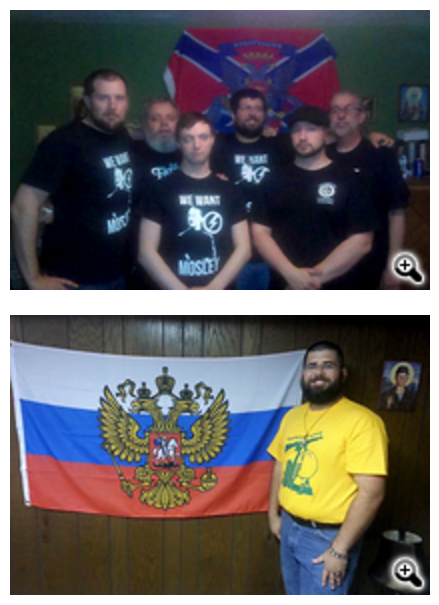
In two photos posted to his personal social media networks, Matthew Heimbach stands with other white nationalists underneath the “Novorossiya” flag in a photo he published in May 2016 to his personal Twitter account (top) and he stands next to a flag used to represent the president of Russia in a photo he published to his personal page on the Russian social media web site VKontakte in August 2015. Heimbach, an American citizen, claims that Russian President Vladimir Putin is the best European leader of the 21st century. (Photos: Matthew Heimbach/VKontakte;Twitter)
**
The double-headed eagle flag in the second image, according to the Appleton Studios heraldry blog, is in fact the “achievement of arms of the Russian Federation: The red shield with St. George on horseback slaying the dragon, the shield on the breast of a double-headed eagle wearing crowns (with a third crown in chief) and holding in its talons the orb and scepter.”
That’s interesting, next to the Oswald Mosley guy — but what’s just as intriguing is ther symbolism of the t-shirt he’s wearing. That’s a Hezbollah t-shirt — and it’s no coincidence, as this next image from his twitter-stream shows:
What’s worth noting here is that the Pokemon GO “gym” (augmented reality contest location) that’s at the center of this kerfuffle is geolocated at the Yasukuni Shrine — which can be seen as the Japanese approximate equivalent of the Arlington National Cemetery in the US — the nation’s most sacred shrine to its war fallen — always bearing in mind this major difference, that the Yasukuni Shrine includes numerous convicted war criminals among those venerated:
The Shrine is a national religious institution in Japan. Since 1869 it has honored the souls of those who have died in the service of Japan. So it mostly contains military men, but also some classes of civilians who’ve died in war-time. These include merchant seamen, and workers in bombed munitions factories, but not people in the general population killed, say, by allied bombing in World War II.
In Shinto religion, the souls become ‘kami,’ or revered spirits. The word can be translated as ‘gods,’ but perhaps the word ‘saints’ is the most appropriate word in the western religious lexicon. So it’s a holy place for millions of Japanese who lost relatives fighting for their country.
Among the 2.4 million souls enshrined and revered in the Yasukuni Shrine are about 1,000 war criminals from World War II. These were men who were convicted and executed by Allied war tribunals, or who died in jail. This is one of the main problems for Japan’s neighbors; that reverence is being paid to those who committed some of history’s most egregious crimes. The shrine wasn’t an issue before they were inducted en masse in a secret ceremony in 1978, after a special new category of eligibility was created for the ‘victims’ of the international war crimes tribunals.
Those crimes were horrendous. The charge sheet at the tribunal included “murdering, maiming and ill-treating prisoners of war (and) civilian internees … forcing them to labor under inhumane conditions … plundering public and private property, wantonly destroying cities, towns and villages beyond any justification of military necessity; (perpetrating) mass murder, rape, pillage, brigandage, torture, and other barbaric cruelties upon the helpless civilian population of the over-run countries.”
That list hardly captures some of the individual horrors. For example, during the “Rape of Nanking” in 1937, two Japanese officers had a contest to see who could kill the most Chinese with their swords. Japanese newspapers covered it as though it was a sporting event, talking about the contest going into an “extra innings” when they both reached 100 at about the same time. Elsewhere, prisoners of war were used for bayonet practice, to toughen up new recruits in the Imperial Japanese Army; while other PoWs and Chinese civilians were staked out at scientific intervals to test the effectiveness of chemical and biological weapons. Chinese cities were deliberately infected with biological agents. Countless young Asian women were forced into sex-slavery to ‘entertain’ the troops.
[ by Charles Cameron — religions taking other religions apart, stone by stone, image by image, song by song ]
.
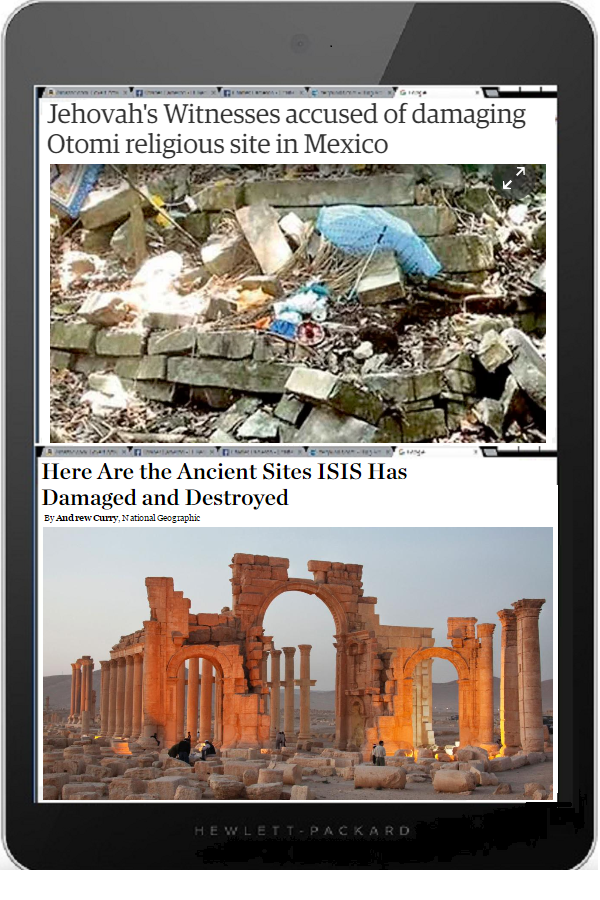
Some recently converted Jehovah’s Witnesses appear to have destroyed the altars of indigenous Otomi people in Mexico, an anthopologist has stated:
Assailants have damaged an ancient Otomi Indian religious site in Mexico, toppling stone structures used as altars, breaking carved stones and scattering offerings of flowers, fruit and paintings at the remote mountain shrine known as Mayonihka or Mexico Chiquito. [ .. ]
“I don’t know what religion they belong to, but they destroyed several images that were there,” said Daniel Garcia, the municipal secretary of the nearby township of San Bartolo Tutotepec. “The thing is, there are some religions that don’t believe in using idols.”
Luis Perez Lugo, a professor at the University of Chapingo, visited the site in May and talked to residents of a nearby hamlet, El Pinal, whose residents said they had carried out the attack.
“I was there, and the Jehovah’s Witnesses said they had done it,” Perez Lugo said, noting some were recent converts to the religion who used to go to the site for Otomi ceremonies.
See upper panel, below:
In the lower panel, above, we see a detail from a National Geographic listing of sites attacked by the Islamic State. Three quick notes:
the JWs, if they were JWs, were recent converts; converts often have a zeal all their own
the IS, like the Taliban at Bamiyan, destroys ancient religious sites even if no longer in use
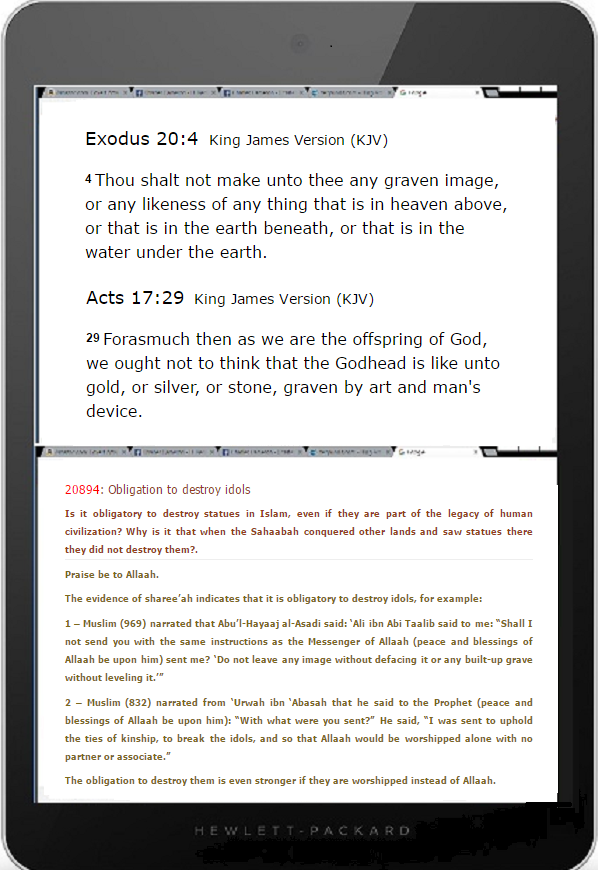
You already know this, but for the record — because Scripture:
In the upper panel, Jewish and Christian scriptures — from the Jewish Ten Commandments in Exodus, and St Paul‘s address to the Athenians, as recounted in the Acts of the Apostles.
In the lower panel — a hard-line contemporary Islamic commentary, citing two ahadith.
**
So it’s Jehovah’s Witnesses and hard-line Muslim literalists who approve of the destruction of monuments to false gods, is that what this means?
They are not alone. In the upper panel, below, recent news of the Chinese — avowed atheists — continuing their attacks on Tibetan Buddhism, this time by mandating the dismantling of Buddhism’s largest monastic university at Larung Gar:
In the lower panel, above, we see some of what remains of the great Abbey of Glastonbury, torn down during the Dissolution of the Monasteries under King Henry VIII.
Glastonbury has strong associations with Arthurian and Christian traditions:
William Blake’s dramatic poem ‘Jerusalem’ familiar nowadays as an inspirational hymn, draws on the myth that Christ himself may have visited Glastonbury with Joseph of Arimathea and ‘walked on England’s mountains green’.
The Gospels record that Joseph of Arimathea was a wealthy follower of Christ who buried Christ’s body in his own tomb after the Crucifixion.
In the Middle Ages Joseph became connected with the Arthurian romances of Britain. He first features in Robert de Boron’s Joseph d’Arimathie, written in the twelfth century, as the Keeper of the Holy Grail. He receives the Grail (the cup used by Christ at the Last Supper) from an apparition of Jesus and sends it with his followers to Britain.
Later Arthurian legends elaborated this story and introduced the idea that Joseph himself travelled to Britain, bringing the Holy Grail with him and then burying it in a secret place, said to have been just below the Tor at the entrance to the underworld. The spring at what is known as Chalice Well is believed to flow from there. In their quests King Arthur and the Knights of the Round Table searched for the Grail.
Glastonbury retains its place in English hearts to this day, albeit in contemporary guise — it is the Yasgur’s Farm of England’s ongoing Woodstock — mud, sex, drugs, rock and all — the yearly Glastonbury Festival —
It is also — in the form of Blake‘s hymn “And did those feet in ancient time” — a part of such ceremonial events as the Last Night of the Proms — and Royal Weddings:
But more on Blake’s poem — known as Jerusalem, and taken from his preface to Milton a Poem — in an upcoming post, Creek willing.
**
Finally, what an exceptionally lovely early DoubleQUote is this, returning us to the topic of sacred places and images and their destruction:
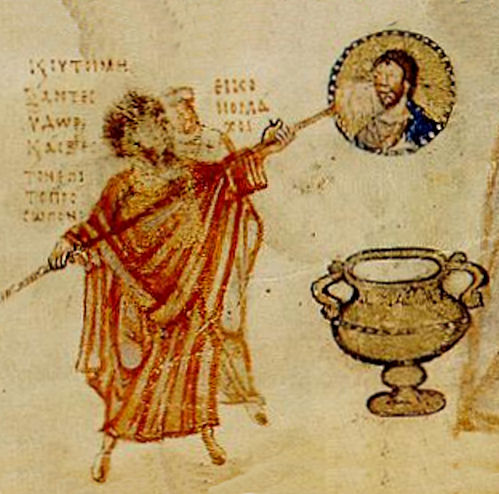
What we have here is a page from the Chludov Psalter — ask Wikipedia for that what means, I only just ran across it in the course of writing this piece — but it’s a 9th century Byzantine prayer book, illuminated with illustrations attacking the iconoclasts — those Christians who wanted to destroy icons and other Christian images for reasons not dissimilar ton those of the Taliban.
In the illustration to the right, the miniaturist illustrated the line “They gave me gall to eat; and when I was thirsty they gave me vinegar to drink” with a picture of a soldier offering Christ vinegar on a sponge attached to a pole. Below is a picture of the last Iconoclast Patriarch of Constantinople, John the Grammarian rubbing out a painting of Christ with a similar sponge attached to a pole.
Let’s take a closer look:
Both verbally and visually, then, we have a direct comparison of the Roman soldier mocking the dying Christ, and the icon-hating Patriarch erasing Christ’s image from a wall.. And they call him the Grammarian!
But let’s proceed:
John is caricatured, here as on other pages, with untidy straight hair sticking out in all directions, which was considered ridiculous by the elegant Byzantines.
No punks, apparently, these Byzantines!
And the coup de grâce? House the sacred book in a state museum..
Nikodim Kondakov hypothesized that the psalter was created in the famous monastery of St John the Studite in Constantinople. Other scholars believe that the liturgical responses it contains were only used in Hagia Sophia, and that it was therefore a product of the Imperial workshops in Constantinople, soon after the return of the Iconophiles to power in 843.
It was kept at Mount Athos until 1847, when a Russian scholar brought it to Moscow. The psalter was then acquired by Aleksey Khludov, whose name it bears today. It passed as part of the Khludov bequest to the Nikolsky Old Believer Monastery and then to the State Historical Museum.
Zenpundit is a blog dedicated to exploring the intersections of foreign policy, history, military theory, national security,strategic thinking, futurism, cognition and a number of other esoteric pursuits.