zenpundit.com » barack obama

Archive for the ‘barack obama’ Category

The Wrath of Kahn

Wednesday, May 13th, 2009


The post title is tongue in cheek. Herman Kahn was anything but wrathful and came across in his day as a remarkably cheerful strategist of the apocalypse and deep futurist. Long time readers have noted my admiration for Kahn’s metacognitive strategies but for those unfamiliar with Herman Kahn, he was one of those polymathic, individuals of the WWII generation who, like Freeman Dyson and Richard Feynman, could jump into high level nuclear physics research without bothering to first acquire a PhD in the field (Feynman later received a doctorate, Dyson and Kahn never did). Kahn was noted for his forthright willingness to consider humanity’s long term prospects despite the worst calamities imaginable – unlike most optimists, he assumed the events most terrible could happen – but life nevertheless would go on. A position that caused many of his critics to go ape, including the editors of Scientific American.

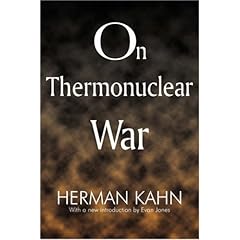
I bring this up because his daughter, Deborah Kahn Cunningham, emailed to say that Kahn’s classic On Thermonuclear War  had been reissued by Transaction Publishing and there would soon be a new edition of On Escalation the latter of which will have a new foreword by the eminent nuclear strategist Thomas Schelling.

This could not come at a better time. The Obama administration is making grandiose gestures with America’s nuclear deterrent based less on a hardheaded and comprehensive strategic analysis than self-serving political showmanship, tailored to mollify a Left-wing base deeply resentful of the COIN strategy the administration is starting to take in Afghanistan. Nuclear weapons affect the strategic calculus across the entire spectrum of potential decisions, they’re not just shiny, anachronistic, bargaining chips but the overwhelming reason that great power war came to an end in 1945. Period.

Human nature has not made much moral progress since the end of the Third Reich but its very worst instinct for total destruction has, so far, been held at bay by the certainty of self-destruction.

We need someone to remind us again of how to think about the unthinkable.

The First 100 Days and Threats in the Age of Obama

Thursday, April 30th, 2009

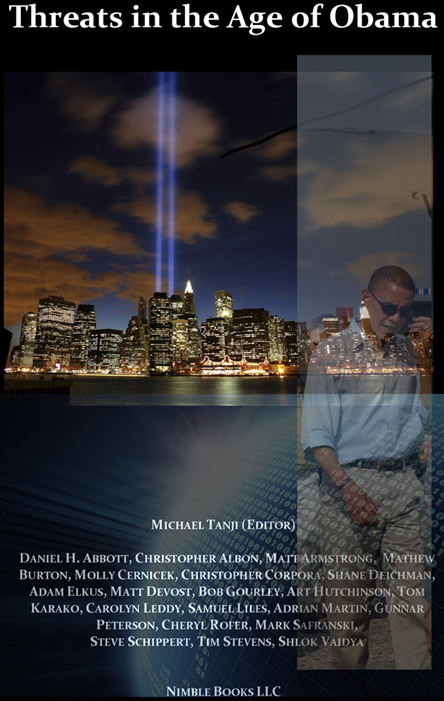
tttaob_cover_cropped.jpg 

Threats in the Age of Obama

Editor:

Michael Tanji.

Authors:

Dan tdaxp, Christopher Albon, Matt Armstrong, Matthew Burton, Molly Cernicek, Christopher Corpora, Shane Deichman, Adam Elkus, Matt Devost, Bob Gourley, Art Hutchinson, Tom Karako, Carolyn Leddy, Samuel Liles, Adrian Martin, Gunnar Peterson, Cheryl Rofer, Mark Safranski, Steve Schippert, Tim Stevens, and Shlok Vaidya

President Barack Obama has hit the 100 day mark which has become a traditional (if unfairly high) bar for measuring a new President of the United States during his “honeymoon” period, ever since the historic “first hundred days” of President Franklin Roosevelt, that ushered in the New Deal. At the time, the United States and the world was on the precipice of financial implosion and the Congress effectively permitted Roosevelt to rule by decree, ratifying his crisis management by passing 15 bills of such sweeping scope that the relationship of the Federal government to the states and the American people was changed forever.

The United States and the world is again in the grip of a great economic crisis, though not quite of the magnitude of the Great Depression, it can be said that only a few presidents in the last century – FDR, Truman, Nixon and Reagan – inherited a similar number of gravely serious problems from their predecessor as did Barack Obama. I was part of the collection of authors of Threats in the Age of Obama above who attempted to discern the major challenges the new administration would face. As a group, we spanned the political spectrum and fields of expertise, many having or had governmental, military or academic backgrounds or significant projects in the private sector and if something united us, it was the 21st century would require new approaches than did the Cold War.

The publisher of Nimble Books, W. F. Zimmerman  suggested that the authors take a moment today and asses what we each got right, what we got wrong and what has surprised us regarding Barack Obama’s first 100 days and where we think we are headed.

This request puts me in an odd position because having the last chapter in the book, I opted for a deep futurist perspective to try to cover the “first one hundred years” of Obama with an essay entitled “A Grand Strategy for a Networked Civilization“. Here is an excerpt:

….The difference between leaders today and those in the past – not only past centuries but as recently as the Cold War – is a certain loss of perspective as to longitudinal scale and societal fundamentals. American politicians think primarily in terms of the present, mentally cycling with the nightly news or   the upcoming elections, which gives more weight to superficial, tactical, objectives than they deserve, and waste time, resources and opportunities.  Not only has the political will to make long term, strategic investments in the national interest faded, it is questionable as to the degree to which they are even considered.  The current economic crisis requires action, naturally, but if the incoming Obama administration wishes to make their mark on history, they should give at least as much thought to 2100 as they do to 2010.

….Moral legitimacy of the state, the nature of the homeland it governs and the political economy that satisfies the needs of the people are the fundamentals of strategic calculation; the longer the time frame to be considered, the more that getting the fundamentals right matters.

It is premature for me, given the nature of my chapter, to make a hard and fast judgment yet about where I went right or wrong. I will say that the Obama administration does seem to be taking “moral legitimacy” seriously, as they understand it from their political perspective. Many of President Obama’s gestures in foreign policy, agree or disagree with them, have been designed to recalibrate the global opinion of America’s moral standing as a world leader without costing too much in terms of concessions or cash.

Changing Bush administration policy on Gitmo, “harsh interrogations” and “no negotiations” with adversarial states is an intentional signal that the Obama administration has a different diplomatic posture. On the other hand, the Obama administration has refused to formally sign onto infinitely expensive, utopian, schemes such as Gordon Brown’s “global new deal”. Unlike the Clinton White House in its early days, the administration has also cleverly avoided trying to hand its conservative opponents an outrageous “bright red line” issue like “Gays in the Military” or “Whitewater”, around which Republican activists could galvanize public support and media attention.

What surprised and pleased me is the degree to which the Obama administration has lined up their national security positions behind the leadership of Secretary of Defense Robert Gates, embracing the “military reform” and “COIN” factions as their own. Secretary of State Hillary Clinton is trying to step up the role of the State Department in shaping policy; this is a long term necessity but State isn’t up to the task without a major cultural and organizational overhaul. If Clinton does not invest the effort early, she will be a “road show Secretary” without the supporting cast to be a success. The NSC, by contrast, is being reorganized to maximize presidential control, perhaps to the point of going overboard with micromanagement, if the Somali pirate incident is a representative example. The only senior figure in the administration who seems both out of political step and out of her depth is the Secretary of Homeland Security, Janet Napolitano.

What worries me, naturally, is the political economy aspect and the profound centralization of power over the economy being ushered in by Obama,  that is accumulating in the hands of very few people as the response to the economic crisis. The inevitable ripple effect, if such a concentration of power were to become the new status quo, would be one of stasis and stagnation. A globalized economy is too complex an “ecosystem” for top-down, ad hoc, hierarchical management to be an efficient or adaptive response. A re-focus on the fundamentals of new growth and not just legacy dinosaurs is in order.

Excess Complexity is the Route to Extinction

Friday, April 10th, 2009


Nassim Nicholas Taleb, author of The Black Swan: The Impact of the Highly Improbable and Fooled by Randomness: The Hidden Role of Chance in Life and in the Markets, had an op-ed in FT.com entitled “Ten principles for a Black Swan-proof world” (Hat tip to John Robb and Pundita). Taleb was addressing the global economic crisis, but I was particularly drawn to Taleb’s fifth principle, which has a more general implication:

5. Counter-balance complexity with simplicity. Complexity from globalisation and highly networked economic life needs to be countered by simplicity in financial products. The complex economy is already a form of leverage: the leverage of efficiency. Such systems survive thanks to slack and redundancy; adding debt produces wild and dangerous gyrations and leaves no room for error. Capitalism cannot avoid fads and bubbles: equity bubbles (as in 2000) have proved to be mild; debt bubbles are vicious.

Taleb has encapsulated many important concepts very well here. Up to a certain point, increasing complexity represents a advantage for an evolving system (biological, financial, physical etc.) by increasing efficiency through adding specialization, interconnection, diversification, redundancy and checks for mitigation of risks. Complexity, in the earlier part of a development curve can add to a system’s overall resiliency – to a point.

Superfluous complexity, that which goes beyond the minimum required for additional gains in systemic efficiency or productivity, is a net drag on the system, an economic waste, a source of friction, a cancer,  a useless eater of resources and the earliest sign of the system’s inevitable decay. Worse, excess complexity represents an increasing probability of systemic failure by multiplying the number of variables involved in the normal process of the system. There are more things that can go wrong and more choke points where a catastrophic failure can occur. Increasing the degree of complexity moves the system away from simplicity and reliability and toward chaos and the creativity of emergent properties, but like an ice skater seeking ever greater range, go too far and the ice will crack under one’s feet.

This is an effect familiar to engineers and scientists but one that appears to escape the majority of politicians, corporate executives and economists. My co-blogger at Chicago Boyz, Shannon Love,  took GE to task for trying to get on the Federal dole by advocating needlessly complicating the nation’s power grid:

If Your Grid Had a Brain

GE is advertising to build political support for Obama’s plan to purchase billions of dollars of GE tech in order to make the power grid “smart”.  After all, who would want a “dumb” anything when they could have a “smart” something? 

The reason we should keep things dumb is that in engineering the word “dumb” has a different connotation. In engineering, “dumb” means simple and reliable. 

Increasing complexity in any networked system increases possible points of failure. Worse, the more interconnected the system, i.e., the more any single component affects any other randomly selected component in the system, the faster point-failures spread to the entire system. Power grids are massively interconnected. Every blackout starts with a seemingly trivial problem that, like a pebble failing on a mountain side, triggers an avalanche of failure. 

In the social and political domain, back in the 1990’s Philip K. Howard wrote a book called The Death of Common Sense: How Law is Suffocating America in which he detailed example after example of how the overlawyering of regulatory systems in America by an emerging and hyper-aggressive legal class was producing neither restraint on government abuses nor fine-tuned social outcomes but instead created a state of paralyzed rigidity, risk aversion, perverse incentives and general dysfunction; in other words, chaos instead of order.

The Obama-ites in the White House are not “socialists” ( at least not most of them) but there is a great love of liberal-minded technocracy there, and a seemingly boundless self-confidence in the ability of high-minded, upper-middle class, progressive, wonks and lawyers from the “good schools” (or investment houses – in some cases, both) to micromanage not just our lives for us, or even the United States of America but the global economy itself. Sort of a Superempowered Oligarchy of Good Feelings.

The ancient Greeks had a word for that: hubris. More importantly, the Obama-ites are wrong here – adding endless amounts of regulatory complexity is not going to give them the kind of granular control or positive returns that they seek to obtain from the system. Counterintuitively, they should be radically simplifying where and to the degree they safely can instead.

A Mexican Standoff with Reality

Sunday, March 29th, 2009

WASHINGTON, DC –  Flanked by the embattled President of Mexico, Felipe Calderon and the Secretary of Homeland Security Janet Napolitano, a weary looking President Barack Obama used a press conference to angrily denounce as “Alarmist and inflammatory” a recent report issued by the conservative Heritage Foundation that declared the massive chain of UN administered Mexican Refugee camps in Arizona, New Mexico and Texas as “a bottomless well for narco-insurgency” and “a threat to the territorial integrity of the United States”. The camps, home to at least 2.5 million Mexican nationals, are dominated by the “Zetas Confederales”, a loose and ultraviolent umbrella militia aligned with the feuding Mexican drug cartels that now control upwards of 80 % of Mexico.

President Obama’s political fortunes have been reeling recently in the wake of high profile incidents that include the kidnapping of his Special Envoy for Transborder Issues, former New Mexico governor Bill Richardson, and the car bombing assassination of popular California Governor Arnold Schwarzenegger that killed 353 people in Sacramento last month. Both events have been tied directly to factions of Zetas “hardliners” who operate with impunity on both sides of the US-Mexican border. President Obama used the conference to point to the “clear and hold” COIN strategy that has recently restored order and even a degree of tourism to Las Vegas, once the scene of bloody street battles between Zetas, local street gangs and  right-wing American paramilitary groups, as a sign of the success for his administration.  Democratic leaders on Capitol Hill remain skeptical and say that it is likely that President Obama will face a primary challenge next year from Senator Jim Webb (D- Va), a former Secretary of the Navy in the Reagan administration, who called the president’s COIN strategy “The right course of action” but ” Two years too late”….

That fictional scenario above is offered as a thought experiment.

Thursday, in a statement that was issued in part for public diplomacy purposes, DNI Adm. Dennis Blair, dismissed any strategic implications regarding the strength of Mexico’s drug cartels that the Mexican government is struggling to suppress:

Mexico is in no danger of becoming a failed state. [Let me] repeat that. Mexico is in no danger of becoming a failed state. The violence we see now is the result of Mexico taking action against the drug cartels. So it is in fact the result of positive moves, which the Mexican government has taken to break the baneful influence that many of these cartels have had on many aspects of Mexican government and Mexican life.

While it might be tempting to ask what the good Admiral is smoking, Blair is neither a naif nor a fool but a very experienced and saavy intelligence manager who is engaged in pushing a political line of the Obama administration, in deference to the wishes of the government of Mexico. The line is being peddled on many fronts; Homeland Security Secretary Janet Napolitano has just declined offers for increased appropriations for improving border security in favor of “surging” Federal agents on a temporary basis (i.e. a political show that will accomplish nothing). Here is SECSTATE Hillary Clinton on the same subject on the same day as Adm. Blair while on an official visit to Mexico:

On Thursday, Mrs. Clinton noted that no official of the Obama administration had ever used the phrase “failed state.” She said Mexico faced a “public safety challenge,” likening it to the surge of drug violence in American cities in the 1980s. And she lavished praise on the Mexican president, Felipe Calderón, for taking strong measures against the drug cartels.

This line that Mexico is fundamentally sound, while helpful to President Calderon’s political standing when expressed in public, is analytically speaking, sheer nonsense, and if enforced in private, counterproductive to having sober USG interagency planning sessions to make certain that worst case scenarios, like the one imagined above, never come close to materializing. Such politicized groupthink also interferes with effective cooperation with Mexico to address a 4GW type problem that has already mestastasized to a dangerous degree into American territory. Earlier, while still free of Mexican diplomatic and political pressure, the U.S. military accurately assessed the potential threat of Mexico devolving into a failed state in this JFCOM planning document (we won’t be seeing anything like this in public again, barring leaks):

In terms of worst-case scenarios for the Joint Force and indeed the world, two large and important states bear consideration for a rapid and sudden collapse: Pakistan and Mexico.

….The Mexican possibility may seem less likely, but the government, its politicians, police, and judicial infrastructure are all under sustained assault and pressure by criminal gangs and drug cartels. How that internal conflict turns out over the next several years will have a major impact on the stability of the Mexican state. Any descent by Mexico into chaos would demand an American response based on the serious implications for homeland security alone.

Banning terminology like “failed state” or admission of adverse data points from Mexico or the Southwestern U.S. (!) into an integrated analytical picture because the self-absorbed and greedy oligarchy that rules Mexico heatedly objects, is a recipe for policy failure and “snowballing” interrelated problems as each new development is inadequately addressed for political reasons. This new eggshell to tread carefully upon is going to be added to our longstanding, politically determined, refusal to contemplate our own drug policy honestly in light of it’s effect on our national security interests (We are turbocharging guerillas, Islamist insurgents, terrorists and criminal networks all over the globe with billions of American narco-dollars and corrupting and demoralizing our own allies in the process).

If the current situation in Mexico existed anywhere else in the world, our national security elite would already be discussing the potential for a mass exodus of refugees at given levels of escalating violence. The United States government conceives of the border in terms of an economic immigration problem not as a political mass-migration problem; such an event, spilling over into the hot deserts of the American border states, would very likely overwhelm the capacity for adequate humanitarian response. A Katrina moment in the cacti.

Recall the difficulties the Carter administration had with the relatively minor refugee influx in 1980 known as the Mariel Boatlift when 120,000 Cubans were permitted by Fidel Castro to flee the Communist paradise for life in the United States, along with imprisoned criminals and mental patients whom Castro deported along with the boatlift. A full blown civil war in Mexico could generate 20 to 30 times that number of refugees, among whom narco-guerillas or terrorists or independent bad actors could operate freely, much as refugee camps elsewhere in the world have been breeding grounds for militias, criminal organizations and terrorists.

SECSTATE Clinton, at least, should know all of this very well. The handling of the Marielitos issue by Jimmy Carter probably cost her husband the governorship in Arkansas and led him later as President to enforce a very tough line against Haitian refugees, fearing a deluge of desperately poor Haitians fleeing dictatorship and internecine political violence. It would be far better to prioritize Mexico as a national security issue today, than let it evolve into a transnational powder keg tomorrow. There are, I must observe, far more Mexicans than Haitians in this hemisphere.

But proper response requires empirical investigation and analytical clarity, followed by sensible and determined policy designed to short-circuit negative trends, not empty political assertions designed to tread water, obfuscate and delay action. We have time, but not unlimited time.

(Special thanks to Morgan, Pundita and John Robb for their insights, concerns and/or suggested links yesterday on this issue which were helpful in clarifying my thoughts).

ADDITIONAL LINKS:

State of Siege: Mexico’s Criminal Insurgency (Full PDF Article)   Stratfor reports on Mexico, news ignored by our mainstream media

Latest Academic Mexico Trip Report    “Mexico: On the Road to a Failed State?”    Mexico’s Instability Is a Real Problem

Mexico – Failed State/Failed Policies?   Among top U.S. fears: A failed Mexican state  Why Vicente Fox is going straight to Hell 

MEXICO’S BAZAAR OF VIOLENCE   What if A State Failed and Nobody Cared?   American Narcotics: $10 Billion In Mexico

Mexico: Growing Terror and Close to Collapse    The effects of our drug war in Mexico

Mexico is not a poor country   Assessing the threat at our southern border    Mexico’s Columbian Exchange    State of War

 Look who’s sneaking into the country using known drug routes   Mexico plagued by myriad interlaced netwars – a TIMN analysis

SWC Thread (Slapout) w/ Links    Mexico’s Struggle with ‘Drugs and Thugs’ (Full PDF Article) 

Sites Linking to this Post:

Soob Top shelf analysis of Mexico’s civil war and the looming cross border nightmare NEW!

Newshoggers.com (Hynd) – Is Mexico A National Security Threat? NEW!

TDAXP Recommended Reading  NEW!

Fausta’s Blog The “Who painted it?” Carnival of Latin America and the Caribbean 

RBO – Zenpundit: A Mexican Standoff with Reality 

MountainRunner It sure is quiet around here… a few links and musings during the silence 

Threatswatch.org (Schippert) – Exposición Perro y Caballo de la Administración Obama 

John Brown’s Public Diplomacy – March 30 

Peace Like a River – Cables, dispatches and memoranda 

SWJ BLog A Mexican Standoff with Reality…

Committe of Public SafetyCartel War Zen

PunditaWashington continues to plays ostrich about Mexico (Riehl World ViewViva la Revolucion ; Wretchard – Our Southern Neighbor)

HG’s WorldZenpundit Channels Orson Wells in War of the Narco-Cartels

Chicago BoyzA Mexican Standoff with Reality

More as they develop….

The Somalia Next Door

Friday, March 13th, 2009

Is it me or is it really weird that we get more media coverage about predator drone kills of Taliban chieftains in Waziristan than the President of the United States openly speculating about putting troops on  our border with Mexico?

 President Obama weighed in Wednesday on the escalating drug war on the U.S.-Mexico border, saying that he was looking at possibly deploying National Guard troops to contain the violence but ruled out any immediate military move.

“We’re going to examine whether and if National Guard deployments would make sense and under what circumstances they would make sense,” Obama said during an interview with journalists for regional papers, including a McClatchy reporter.

“I don’t have a particular tipping point in mind,” he said. “I think it’s unacceptable if you’ve got drug gangs crossing our borders and killing U.S. citizens.”

I’m afraid that we are already at that tipping point.  Perhaps the Department of Justice has better uses for scarce resources than investigating a Sheriff, at the political behest of far leftwing Congressmen, for enforcing U.S. immigration laws. Yeah, I’m sure Sheriff Joe is a media hound and something of an abrasive jerk but he’s enforcing the law and we have far greater security priorities than carrying out the ideological vendettas of New York Democrats. Like tracking down Zeta killer teams operating inside the U.S. ?

Failed State Mexico Links:

State of Siege: Mexico’s Criminal Insurgency (Full PDF Article)   Stratfor reports on Mexico, news ignored by our mainstream media

Latest Academic Mexico Trip Report    “Mexico: On the Road to a Failed State?”    Mexico’s Instability Is a Real Problem

Mexico – Failed State/Failed Policies?   Among top U.S. fears: A failed Mexican state  


Switch to our mobile site