zenpundit.com » Mexico

Archive for the ‘Mexico’ Category

For whom the bell Dengs, it Dengs for Lee

Monday, March 23rd, 2015

[rang by Lynn C. Rees]

Elite mouthpiece Charlie Rose once asked former Singapore Prime Minister Lee “Harry” Kuan Yew which of the many, many, many, many world leaders he’d met in his long, long, long, long career he most admired. Lee chose Chairman of the Central Advisory Commission of the Chinese Communist Party Deng Syauping. Lee especially admired Deng for his world-historic “adaptability”.

Flashback: 1978. Deng makes Deng’s first state visit to Singapore. Deng is flummoxed by Singapore’s prosperity (Deng’s briefings were inadequate). Deng asks Lee how Lee made Singapore prosperous. Lee tells Deng how Singapore climbed the food chain: First, attract foreign direct investment with cheap labor. Second, become subcontractors. Second, became contractors. Third, become competitors. Fourth, learn as you go. Veteran Marxist Deng muses aloud: Singapore’s created an egalitarian society using capitalism. Lee happily seconds Deng’s thought. Deng flies back to China. Deng applies the Lee model to China. Everyone lives happily ever after.

Appian records:

10. It is said that at one of their meetings in the gymnasium Scipio and Hannibal had a conversation on the subject of generalship, in the presence of a number of bystanders, and that Scipio asked Hannibal whom he considered the greatest general, to which the latter replied, “Alexander of Macedonia.”
To this Scipio assented since he also yielded the first place to Alexander. Then he asked Hannibal whom he placed next, and he replied, “Pyrrhus of Epirus,” because he considered boldness the first qualification of a general; “for it would not be possible,” he said, “to find two kings more enterprising than these.”

Scipio was rather nettled by this, but nevertheless he asked Hannibal to whom he would give the third place, expecting that at least the third would be assigned to him; but Hannibal replied, “To myself; for when I was a young man I conquered Spain and crossed the Alps with an army, the first after Hercules. I invaded Italy and struck terror into all of you, laid waste 400 of your towns, and often put your city in extreme peril, all this time receiving neither money nor reinforcements from Carthage.”

As Scipio saw that he was likely to prolong his self-laudation he said, laughing, “Where would you place yourself, Hannibal, if you had not been defeated by me?” Hannibal, now perceiving his jealousy, replied, “In that case I should have put myself before Alexander.” Thus Hannibal continued his self-laudation, but flattered Scipio in a delicate manner by suggesting that he had conquered one who was the superior of Alexander.

Like the great Carthaginian (as framed in Appian’s fable) but with greater circumspection, Lee gives Lee a hearty backslap for the ages here by promoting Deng to virtual Leeness, making Deng almost a Lee Kuan Yew, Jr. Deng is great for”adaptibility”. Translation: Deng is great for “adaptibility” because he adapted by following Lee, who’s also great for “adaptibility”. Deng is great because Lee is great. While Deng did great things, Lee claims, also circumspectly, a greater priority: Lee’s been there, done that, got the T-shirt.

There is merit here. If Lee’s memory was as accurate as it was convenient, Lee was one of the most significant figures of the twentieth century. Deng Syauping stepped out of the way of one fifth of humanity’s rise from absolute poverty to genteel poverty. For that, Deng is one of the most adequate leaders of the twentieth century. If Lee helped Deng rise to adequacy, he deserves his adequate share of significance.

Lee is a frequent candidate for great authoritarian of the late twentieth century, the sort of man that, if they could be produced on demand, would euthanize democracy. That great authoritarians are not produced on demand continues to be a problem. Lee proved resiliently traditional in his attempts to solve the problem: Placeholder minion. Check. Dynastic succession. Check.

Whether history gives Lee as hearty a backslap as Lee (through Deng) gave Lee will depend upon whether Lee’s great authoritarianism continues to be great authoritarianism without its great authoritarian. Cárdenas’perfect dictatorshipendured 54 years. Stalin’s dead cat bounce reached 1991. Mau’s dead cat bounce carried a Deng, a Jyang, a Hu, and now a Syi. And those cabals had some component of rotation of elites built in. Lee’s die is cast with old school hereditary monarchy. His dynastic successor has an heir and two spares (three spares if Singapore doesn’t follow Salic Law). Time will tell if Lee Kuan Yew wins the genetic lottery now that he’s no longer around to play retired emperor.
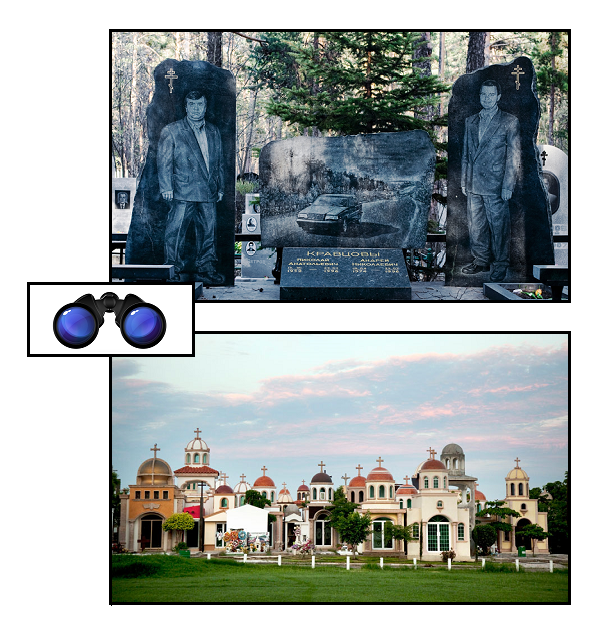
Sunday Saturday surprise: afterlife this side of everlasting

Saturday, February 14th, 2015

[by Charles Cameron — the Michelangelos of mob mortality? ]
.

SPEC DQ russian vs narco tombs
.

Russian mafia memorials are more personal, yes, but far less palatial, than their Mexican narcocultura counterparts.

**

Sources — so you can see bigger images, more of the same ghastly:

  • Guardian, Mob deep: Russian mafia gravestones
  • Financial Times, Deadly splendour
  • Narco-cartels as MBAs Doing 4GW

    Tuesday, January 7th, 2014

    [by Mark Safranski, a.k.a. “zen“]


    Yale organizational behaviorist Rodrigo Canales has an interesting talk on the Narco-insurgency in Mexico ( which he correctly sees as having been as lethal as Syria’s civil war). While this won’t be news to close students of Mexico’s cartel wars, Canales explains how Los Zeta, La Familia, Knights Templar and Sinaloa cartel violence is neither random nor strictly criminal on criminal  violence but is used as part of organizational strategies to create distinctive “franchise brands”, amplify political messaging,  reinforce effects of social service investment in the communities they control and maximize market efficiency of narcotics sales and other contraband. COIN, 4GW and irregular warfare folks will all see familiar elements in Canales management theory driven perspective.

    A useful short tutorial considering the cartels are operating inside the United States and their hyper-violent tactics are eventually going to follow.

    Heavy Metal: When Irregulars Go Armored

    Saturday, November 2nd, 2013

    [by Mark Safranski, a.k.a. “zen“]

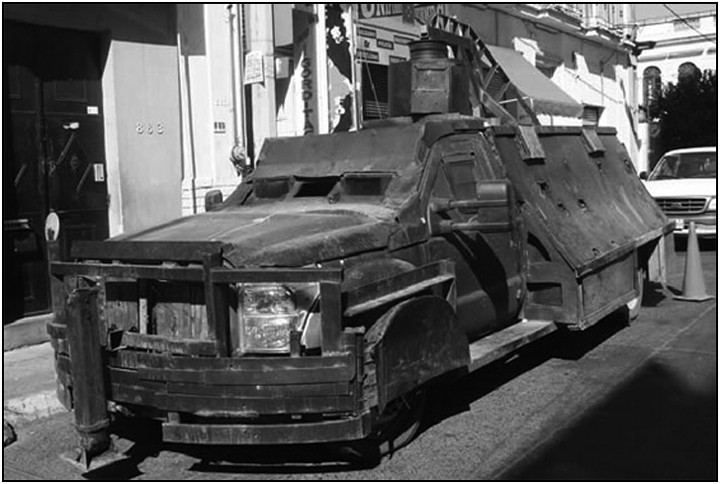
    If the symbol of the 20th century insurgent was the AK-47 and a red banner, his 21st century counterpart may someday be recognized by the suicide belt and the “homemade tank”. Irregular fighters have always used light arms, civilian passenger vehicles and armor captured (or donated by) from conventional armies, but the ability to produce serviceable fighting armored cars is a new wrinkle. They could not stand up to an American or Russian tank company, of course, but they are not meant to do so.

    Most prevalent and evolved in Mexico’s narco-insurgency where cartels use these “monsters” converted from SUVs and various types of light and heavy trucks to battle one another and as “troop carriers” but these DIY armored vehicles have also appeared in the recent Libyan and ongoing Syrian civil wars. Where heavy anti-tank weapons, air power and real tanks are scarce, these narco-tanks are useful additions to irregular combat power and convey an intimidating image to lightly armed police and the public.

    Dr. Robert Bunker and Byron Ramirez, with the support of Small Wars Journal, Borderland Beat.com and the Foreign Military Studies Office at Fort Leavenworth, have a new scholarly compilation on the subject of irregular use of DIY armor in Mexico:

    Narco Armor : Improvised Armored Fighting Vehicles in Mexico

    ….The wave of violence that has left thousands dead began in early 2005, when former Mexican
    president Vicente Fox sent government troops to Tamaulipas to fight the cartels. For the past
    seven years the government has ordered its military to fight the cartels directly, which, in turn,
    has led drug cartels to improvise and develop their own methods of warfare to combat both
    government troops and other competing cartels.

    The extreme rivalry among various Mexican drug cartels for regional control of the drug trade
    market has yielded an arms race. The following collection of articles and images addresses a
    segment of the military technology utilized by violent non-state actors during this period: “narco armor” or, more accurately, improvised armored fighting vehicles (IAFV).

    ….Mexican cartel use of IAFVs and armored sport utility vehicles (ASUV) may yield some
    important lessons for military counter-criminal insurgency efforts. Still, many unanswered
    questions exist concerning the fielding of narco armor in Mexico. Reports of these vehicles
    being fielded span roughly from mid-2010 to the beginning of 2012, with a spike in activity 5
    surrounding them taking place around mid-2011. These vehicles had predominantly been utilized

    in the Mexican state of Tamaulipas in engagements between the Zetas and Gulf cartels and in a
    few other locales (see Map Locations). While it has been said that the Mexican government has
    seized well over one hundred of these vehicles, only about two dozen photographic examples
    exist per our research (see Picture Gallery).

    ….Given the apparent cessation of the fielding of narco armor since early 2012, quite possibly these vehicles have reached an evolutionary dead end, with more emphasis once again placed by the cartels on fielding more stealth-masked armored vehicles, such as armored SUVs, that better blend in with civilian cars and trucks so as to eluded identification and targeting by Mexican federal forces. Still, given the ever changing conflict waging in Mexico among the cartels and against the Mexican government, future resumption of IAFV employment will always remain a potential. 

    Read the rest here.

    During the Russian civil war (1917-1922), armored trains complete with heavy machine guns and artillery were used by both Bolshevik and White armies across the vast expanse of the Eurasian steppe and the armored train subsequently made spotty appearances in civil wars in China and Spain before fading away. This less likely to happen with homemade armor which is smaller and infinitely more mobile and can be created in a sufficiently large garage with time, elbow grease and a supply of scrap metal.

    Moral Degeneration in the Crucible of War

    Wednesday, June 12th, 2013


    The recent post on Is 4GW Dead? stirred a great deal of interest, so I would like to extend the discussion on a point that that is critical not only for those who have responsibility for conducting military campaigns, but for statecraft and policy as well.

    One of more important tenets of 4GW was the importance of “the moral level of war”, drawn from Colonel John Boyd’s thinking on the strategic impact of a combatant’s behavior, immoral  or exemplary, on all observers – belligerents, civilian noncombatants, neutral third parties, the media, the combatant’s own soldiers and citizens back home. Here is Boyd:

    Morally our adversaries isolate themselves when they visibly improve their well being to the detriment of others (allies, the uncommitted), by violating codes of conduct or behavior patterns that they profess to uphold or others expect them to uphold.

    · Morally we interact with others by avoiding mismatches between what we say we are what we are and the world we have to deal with, as well as by abiding by those other cultural codes or standards we are expected to uphold.

    In a Reader’s Digest version of Boyd,  heroic, noble and magnanimous  behavior is admirable and attractive while hypocrisy, cruelty and cowardice are repulsive and antagonizing characteristics. While the former won’t guarantee your victory and the latter, unfortunately, won’t ensure your defeat, they will be a significant factor in ameliorating or generating friction.  The impression given by an army impacts the will of the enemy to fight, the morale and discipline of the soldiers, the restiveness of the civilians, the loyalty of allies and the goodwill of neighbors.

    Boyd developed his thinking about the moral level of war in Patterns of Conflict  all the way up to grand strategy and above. The rub about the moral level  is that war is a crucible that puts every “cultural code” or “standard” to the test, as well as the character of the men fighting it and their leaders upon whom great responsibility rests.  Even with the best of intentions in policy and careful generalship in the field, the horrors of war can erode moral fiber and military discipline in an army, in a company or in the heart of one man. Nor does every army begin with good intentions and effective discipline – some fighting forces are scarcely to be regarded as “armies” at all while others embrace the darkness as a matter of policy.

    In terms of warfare, let us define “moral degeneration” as a degraded state of moral decline where a belligerent has effectively abandoned the operational and tactical restraints on conduct mandated by the Laws of War (i.e. war crimes are SOP) and in some instances, the vestiges of civilization.

    A textbook example of this kind of moral degeneration came to light a few weeks ago when a jihadi lunatic in Syria, a rebel commander Khalid al-Hamad, who goes by the name of “Abu Sakkar”, cut out the heart of a (presumably) dead government soldier and ate it on video. Charles Cameron expounded at length upon this minor atrocity here. I am not, to say the least, a fan of radical, revolutionary, transnational Sunni Islamism but I cannot honestly say that its proponents like Abul Mawdudi , Sayid Qutb, Abdullah Azzam, Osama bin Laden and their ilk ever openly advocated cannibalism. It is much more likely that Mr. al-Hamad’s behavior is explained by the ferocity of the civil war in Syria eroding customary norms of the combatants than  it is by Islamist ideology.

    Moral degeneration in war seems to spring from two directions:

    a) As a calculated act of Policy, from the top down, enforced by the leadership by military discipline and bureaucratic control.

    b) As a spontaneous reaction by soldiers or fighters, appearing from the bottom up, without orders and frequently, in spite of them, possibly due to a breakdown in the chain of command, an erosion of discipline or sheer mutiny for the age-old purpose of reprisal, pillage and rapine.

    The first category often occur with war as a convenient cover rather than a cause of grave crimes against humanity that leaders and  ideologues had long wished to carry out. The Armenian Genocide, as John Keegan wrote, belongs properly to the history of Ottoman imperial policy than it did WWI; in truth, the Genocide was the greatest and worst in a long succession of vicious pogroms that the Ottomans had launched against their Armenian Christian subjects during the reign of Abdul Hamid and the Young Turks. The Holocaust (which had some inspiration in Hitler’s mind, from the fate of the Armenians) was more closely tied to the evolution of  Nazi war policy but once Operation Barbarossa opened up the vast spaces of Soviet Eurasia, “the East” in Nazi parlance, the war itself increasingly took a backseat to expediting Hitler and Himmler’s ghastly and murderous racial priorities. This is a pattern of a priori planning, an escalating ideological radicalization of society that tends to be present with most of the large scale democides and genocides. It is the organizational powers of  coercion utilized by the state, or a mobilized faction of , it that makes the enormous scale of death possible, not the war.

    What is different and also dangerous about moral degeneration from the bottom-up, is that it is cultural evolution driven by the psychological effects of extreme violence at work and, unlike an act of policy, more likely to be diffused widely across society as a permanent change for the worse. Too many German soldiers in WWI, former peasants and artisans and boys from middle-class families, returned from the Western Front morally coarsened and addicted to the adrenalin rush of combat and became in succession Freikorps paramilitaries, Communist streetfighters, Nazi Stormtroopers and SS men. The World War also gave Russia the men of the Cheka, the Red terror and the first Gulags on the Bolshevik Left and brutal and mad warlords on the White Right.

    In more recent two decades, the break-up of Yugoslavia unleashed atavistic passions of ethnic hatred and atrocity, while organized society in Western African states and central Africa broke down entirely in transnational regional civil wars with unrestrained massacres and mass rape. As a result, there is little that is political but much that is primeval, at this juncture, to explain Joseph Kony’s motivations; he resembles nothing so much as a 21st century Kurtz. Mexico too is degenerating from the escalating violence of cartel insurgency and narco-cultas – there is not much tactical or strategic value in pagan death cults or human sacrifice but it is spreading:

    …Our impression is that what is now taking place in Mexico has for some time gone way beyond secular and criminal (economic) activities as defined by traditional organized crime studies.3 In fact, the intensity of change may indeed be increasing. Not only have de facto politicalelements come to the fore-i.e., when a cartel takes over an entire city or town, they have no choice but to take over political functions formerly administered by the local government- but social (narcocultura) and religious/spiritual (narcocultos) characteristics are now making themselves more pronounced. What we are likely witnessing is Mexican society starting to not only unravel but to go to war with itself. The bonds and relationships that hold that society together are fraying, unraveling, and, in some instances, the polarity is reversing itself with trust being replaced by mistrust and suspicion. Traditional Mexican values and competing criminal value systems are engaged in a brutal contest over the ?hearts, minds, and souls‘ of its citizens in a street-by-street, block-by-block, and city-by-city war over the future social and political organization of Mexico. Environmental modification is taking place in some urban centers and rural outposts as deviant norms replace traditional ones and the younger generation fully accepts a criminal value system as their baseline of behavior because they have known no other. The continuing incidents of ever increasing barbarism-some would call this a manifestation of evil even if secularly motivated-and the growing popularity of a death cult are but two examples of this clash of values. Additionally, the early rise of what appears to be cartel holy warriors may now also be taking place. While extreme barbarism, death cults, and possibly now holy warriors found in the Mexican cartel wars are still somewhat the exception rather than the rule, each of these trends is extremely alarming, and will be touched upon in turn.

    The crucible of war either tempers a people or it breaks them.


    Switch to our mobile site

