Through a glass bead game, darkly
Thursday, February 18th, 2016[ by Charles Cameron — Hesse and Hitchcock, two good to pass up ]
.
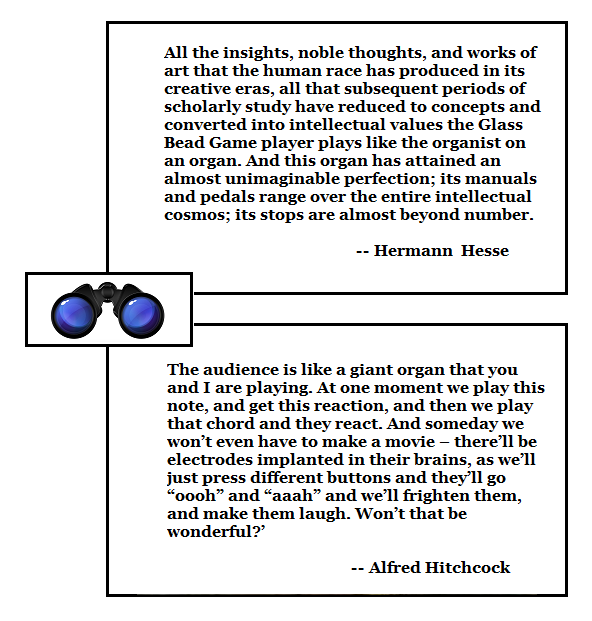
Hitch was discussing his movie North by Northwest.
[ by Charles Cameron — Hesse and Hitchcock, two good to pass up ]
.
Hitch was discussing his movie North by Northwest.
[ by Charles Cameron — background reading for the post which follows ]
.
This is a quick look at node and edge graphs and some of the boards used in HipBone, DoubleQuote, and Sembl Games — a refresher for those who already know, and a quick intro for those who may not…
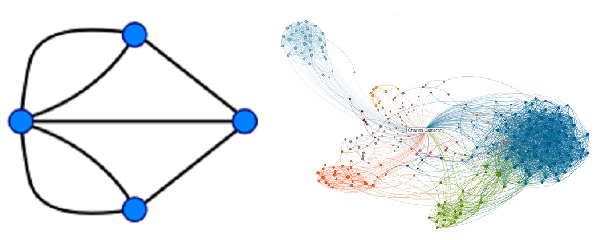
Above, you’ll see two graphs — one very simple and one far more complex. What they have in common is points (known as nodes) and lines connecting them (known as edges). Graphs of this kind are instances of the basic pattern on which much of contemporary understanding of the world rests, as it mostly rested on linear thinking in previous centuries. They are everywhere.
**
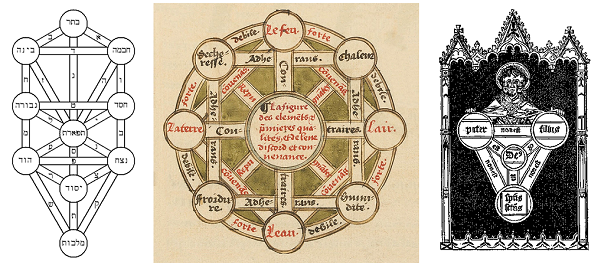
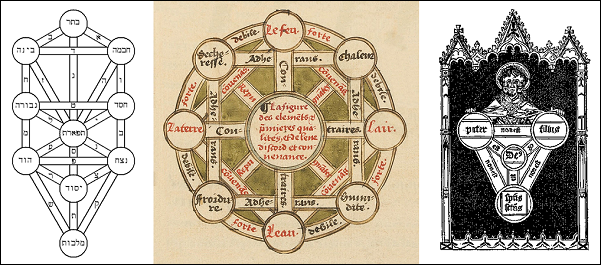
In the next image, however, we see some medieval and renaissance instances of graphs in which concepts and their relations have been assigned to the nodes and their edges — these are also commonly found today, but the early versions here have a beauty all their own..
Left to right: the Sephirotic Tree of classical Jewish Kabbalah; Oronce Fine‘s diagram of the four elements; and a medieval respresentation of the Christian Trinity. It was the Reformation & Counter-Reformation that really put a stop to this kind of graphical thinking, as Ioan Couliano teaches us.
**
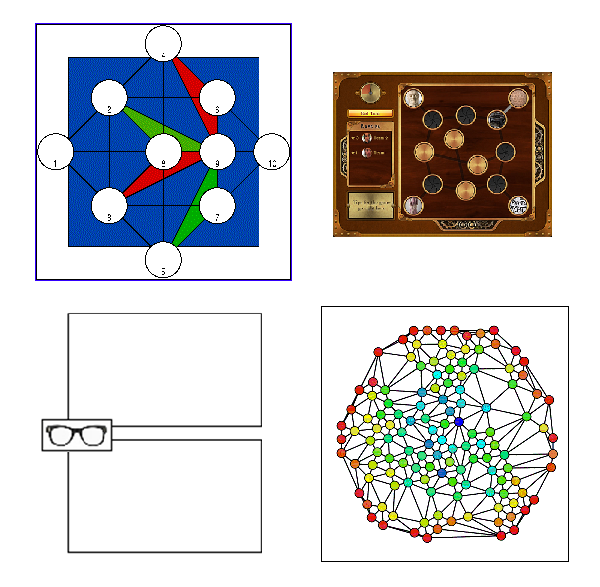
Finally, my HipBone Games and the Museum Game that Cath Styles designed for the National Museum of Australia use graphs as their boards, and the players assign concepts to the various nodes, establishing conceptual links between them:
Upper left, th4 standard WaterBird board for HipBone play; upper right, one of Cath’s boards for the Museum Game; lower left, the DoubleQuotes board, and lower right, a beautiful graph on which I hoped gto play a symphonic Bead Game.
**
That’s the essential background you need to proceed to the next post, Graph-types 2: towards a universal graphical mapping language, where I lay out my hopeful, hopeless scheme for a Grand Unified Map. Onwards.
[ by Charles Cameron — on gaming “living and moral forces” — with a whiff or two of Montaigne ]
.
**
Let’s start with Clausewitz, On War.
He says — and we’d be wise to pay attention — “most of the matters dealt with in this book are composed of equal parts of physical and of moral causes and effects.” Earlier in the paragraph, he’d said, “The effects of physical and psychological factors form an organic whole which, unlike a metal alloy, is inseparable..” — which puts the physical and the moral on equal footing. He then tilts the board decisively in favor of the “moral” factors —
One might say that the physical factors seem little more than the wooden hilt, while the moral factors are the precious metal, the real weapon, the finely-honed blade.
Furthermore, these “moral factors” are “intangible” — or as Michael Handel puts it:
In contrast to the physical forces, which are relatively easy to estimate, the equally important moral forces are more difficult to gauge.
**
Deputy Secretary of Defense Bob Work and Gen. Paul Selva, Revitalizing Wargaming is necessary to be prepared for future wars:
For example, faculty and students at the Naval War College integrated wargaming into their entire course of study, analyzing the then-novel concept of carrier task force operations, the role of submarines in scouting and raiding, and how to provide logistics support to fleet operations spread over the vast Pacific Ocean. Wargames in classrooms at Quantico helped the Marine Corps develop new concepts for amphibious warfare and conceive of new techniques for capturing advanced naval bases. Wargamers at the Army War College explored how to employ tanks and artillery on infantry-dominated battlefields and examined the logistical challenges of fighting a war far from American shores.
and:
Most importantly, players should be able to observe and live with the consequences of their actions (where possible, based on previous rigorous analysis) in the face of a thinking and reacting competitor, and so come to understand dynamic military competition from the perspective of opposing sides. Actions taken by the players on both sides must have tangible consequences that are determined — where possible — by the actual performance of weapons and sensors in the real world, backed by a rigorous adjudication process using the best available analysis and professional judgment.
**
In the first of those paragraphs, we have “carrier task force operations”, “the role of submarines”, “logistics support”, “fleet operations”, “amphibious warfare”, “advanced naval bases”, “tanks and artillery”, infantry-dominated battlefields”, and more “logistical challenges”.
Now admittedly, that’s pre-WWII wargaming — but no mention there of the impact of upcoming psychological forces such as the Nuremberg rallies, Hitler’s obsession with Wagner and Bayreuth, Leni Riefenstahl, Himmler’s occult interests, and so forth — not because they were known or in existence at the time, they weren’t, but because they constituted in the event precisely the sort of intangible morale boost / force multiplier that can tip a battlefield and slide a war, as per Clausewitz.
Nary a mention of psychology, moral, morale, espirt, spirituality, religion, let alone Dempsey’s “apocalyptic, end-of-days strategic vision” which we now face in IS.
And that second paragraph, dealing with the present and near future — the move to consider dynamic interaction is to be lauded, but once again we’rew in the realm of “weapons and sensors in the real world”. I’m led to the suspicion that current wargaming doesn’t know quite how to deal with “tangible consequences” that are not determined “by the actual performance of weapons and sensors” but by, ahem, passion.
**
**
If moral causes and effects are as potent as weapons, or even, as Clausewitz said, are themselves “the real weapon, the finely-honed blade”, games focused not on performances of weapons but on moral causes and effects — games that game passions — must surely have a significant role to play in revitalizing wargaming.
[ by Charles Cameron — it seems — to me at least — that associative memory is at the root of creativity, and that the process, preconscious pattern-recognition, is basically aesthetic in nature ]
.
As stormy winter weather approaches please take care around our coasts. #alwaysoncall #rnliroughweather @RNLI pic.twitter.com/Wk5W0Is2oJ
— RNLI Poole Lifeboats (@PooleLifeboats) November 17, 2015
**
There’s the present moment — in this case, today’s tweet from the RNLI above.
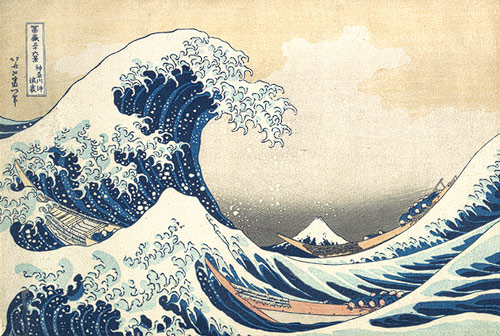
And there’s the memory it elicits — in this case, Hokusai‘s Great Wave at Kanagawa, with its three little boats, tiny Mt Fuji, and towering, breaking wave, from A Series of Thirty-Six Views of Mount Fuji:
**
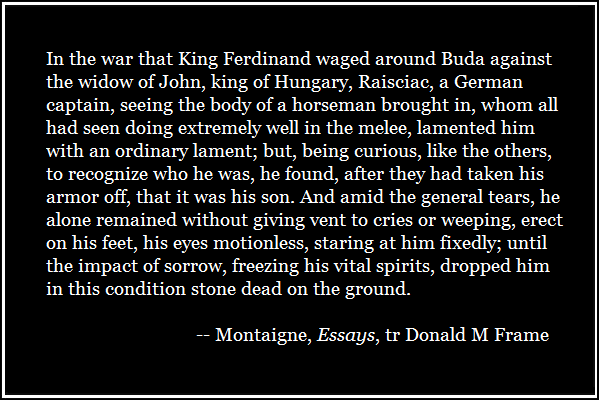
That’s the same process, from perception to memory, that I was thinking of when I wrote DoubleQuoting the French Revolution, and quoted Robert Frost:
The artist must value himself as he snatches a thing from some previous order in time and space into a new order with not so much as a ligature clinging to it of the old place where it was organic.
**
Come to which, and moving by the same process from what’s in front of me to what I remember, here’s a DQ of Hokusai (~1760-1849) — before me now as I write this — and an image deriving from the work of Benoit Mandelbrot (1924-2010) on fractals” — which looking at the Hokusai quickly reminds me of:
**
And as I look at that DoubleQuote, here at the time of writing this post, it reminds me strongly of my earlier DoubleQuote of Van Gogh and Von Kármán:
In each of these two cases, art precedes science.
**
In each case, too, the associative process is the same, with some item perceived in the present calling up a past memory that is related to it — in a manner that can generally be articulated and annotated.
Such is the mechanism of a typical “move” in a DoubleQuote or HipBone game.
[ by Charles Cameron — Hofstadter Langdon Kim — for Gabi Nasemann, & in recognition of Gödel Escher Bach ]
.
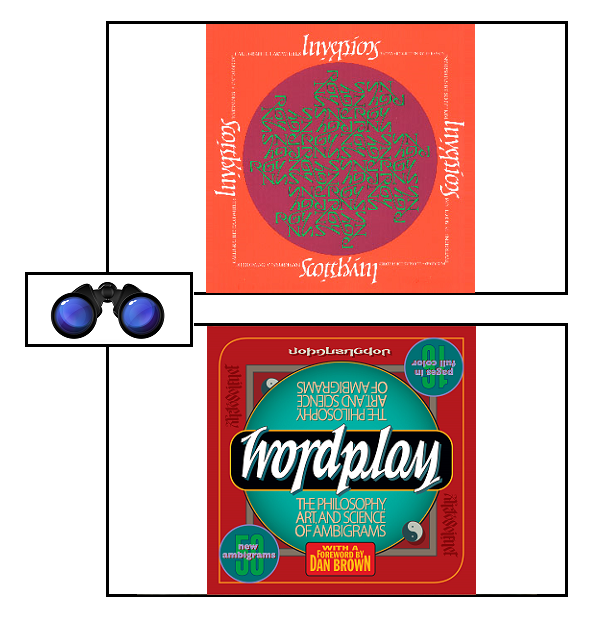
My friend the photographer Gabi Nasemann recently inquired whether I knew John Langdon‘s book, Wordplay, and I responded, DoubleQuote-style, with Scott Kim‘s Inversions:
I had the pleasure of meeting Scott Kim lo these many years past at the Computer Game Developers Conference, and he was kind enough to say of my HipBone Games:
Your game does seem to really call to mind the Bead Game. Almost a divination system, much more metaphorical than most games.
**
Scott Kim and his friend Doug Hofstadter both have a keen interest in Bach, so I thought it might be neat to see Scott’s treatment of the name — an ambigram, lower panel below — and how John Langdon might treat it — upper panel:
Langdon’s Bach I assembled from his own typeface, Biform, which apparently seeped from his grasp into the wider world under the entirely irrelevant name Lampoon.
**
Of all Langdon’s ambigrams, the one that’s no doubt best known — since Dan Brown used it in one of his execrable books — is his square of the four elements, upper panel, below:
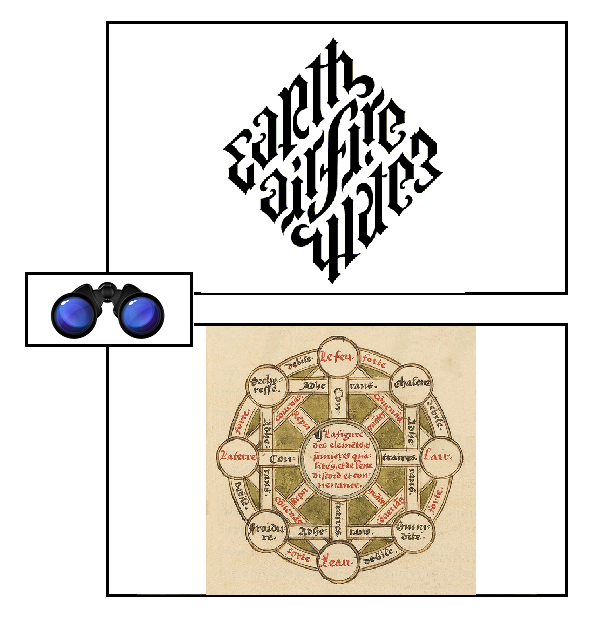
It was a nice touch, though, that Brown offered Langdon an hommage by naming his professor of symbiology after him. No doubt the fictional Robert Langdon would be familiar with the glorious diagram of the elements created by Oronce Fine, which he’d have run across in a 1549 Harvard Houghton Library volume, Le Sphere du Monde, and which I have elsewhere compared with Jewish and Christian diagrams:
Sembl and HipBone gameboards are in the same genre.. being games of linkage that you play with your mind:
**
Sources and further readings:
John Langdon, Ambigrams Scott Kim, Ambigrams on Google Search Scientific American, Remembering Martin Gardner, with Douglas Hofstadter Slate, Can You Really Be a Professor of Symbology? The New Yorker, Harvard_ No Symbology Here Wikipedia, Robert Langdon Random House, The Official Website of Harvard Symbologist Robert Langdon John Langdon, Biform John Langdon, Lampoon Triple Canopy, This is your brain on paper

Zenpundit is a blog dedicated to exploring the intersections of foreign policy, history, military theory, national security,strategic thinking, futurism, cognition and a number of other esoteric pursuits.
Customized Web Site & Blog Design