zenpundit.com » language

Archive for the ‘language’ Category

On getting it right, eh?

Thursday, April 25th, 2013

[ by Charles Cameron — with a little help from the Buddha, fake quotes, self-referential paradox, a pinch of salt, and two tbsps of anthropology ]
.

Over the last ten days we have seen a whole lot of speculation, misinformation, spin and gossip masquerading as analysis and journalism, and that was on my mind when I ran across an alleged Buddha-quote that told me to use my common sense — and since my common sense told me there probably wasn’t a phrase in Pali, the language of the earliest Buddhist texts, that would correspond too closely to the highly idiomatic English usage, common sense, I thought I should check it out with Fake Buddha Quotes, my go-to place for checking what the Buddha is supposed to have said:

I’m pretty sure the Buddha never said “Pretty sure I never said that” too, for much the same reason.

**

But what delights me most about all this is just how self-referential this all is: the Buddha allegedly warns us against trusting what we read even when it’s attributed to him, in what turns out to be a faux quote attributed to him, based on a real quote that reads (in one translation):

Any teaching should not be accepted as true for the following ten reasons: hearsay, tradition, rumor, accepted scriptures, surmise, axiom, logical reasoning, a feeling of affinity for the matter being pondered, the ability or attractiveness of the person offering the teaching, the fact that the teaching is offered by “my” teacher. Rather, the teaching should be accepted as true when one knows by direct experience that such is the case.

**

Fpr what it’s worth, the abbreviated version doesn’t mean the same as the original. From Koun Franz at Sweeping Zen:

his is a very different idea. The original says we need to verify through direct experience; the popular version says that we can stand back from the practice, at a distance, and use reason to determine its authenticity.

Or this, from Bodhipaksa, the Fake Buddha Quotes guy, :

The Buddha of course isn’t saying we should jettison reason and common sense. What he’s implying is that both those things can be misleading and what’s ultimately the arbiter of what’s true is experience. It’s when you “know for yourselves” that something is true through experience that you know it’s true.

**

Another comment on the same page led me to this first comment on cultures and languages —

which in turn reminded me of the second, a long-time favorite of mine from the time when I was some sort of Anthro professor in dreamy Oregon…

**

And, y’lnow, both those quotes in my second pair give you a visceral sense of what today’s SWJ article by Robert R. Greene Sands and Thomas J. Haines, Promoting Cross-Cultural Competence in Intelligence Professionals is very rightly on about, though it’s all phrased in a manner so abstract you might easily miss the point…

Mitigating cognitive, cultural and a host of tradecraft biases is essential for intelligence professionals to navigate through today’s culturally complex environments. Adopting the perspective of contemporary cultural groups, including nation-states, often defies understanding because the intelligence professional is challenged to both appreciate and consequently discern meaning of behavior that is predicated on vastly different beliefs and value systems. Fundamental to this dissonance is a markedly different cultural reality resulting from different histories, traditions and the stasis of culture. The professional’s western and deeply seated worldview impedes either the analysis itself, or is perjured by the cognitive restrictions imposed by the structured analytic strategies used.

The quote about the Wintu — it’s from Dorothy Lee, Linguistic Reflection of Wintu Thought, Chapter 9 in Dennis and Barbara Tedlock‘s Teachings from the American earth: Indian religion and philosophy — goes on to say:

The Wintu relationship with nature is one of intimacy and mutual courtesy. He kills a deer only when he needs it for his livelihood, and utilizes every part of it, hoofs and marrow and hide and sinew and flesh. Waste is abhorrent to him, not because he believes in the intrinsic virtue of thrift, but because the deer had died for him.

Now there‘s “a markedly different cultural reality” for you!

Bouleversé by forgiveness

Tuesday, January 8th, 2013

[ by Charles Cameron — not just “thinking outside the box” — how about upending the whole thing and seeing what shakes out? ]
.

FWIW, this isn't the world, nor is it upside down -- it's just a rather different map, eh?

.

A celebrated stanza by the Indian poet-saint Kabir — beloved of both Hindus and Muslims — asks:

Is there any guru in the world wise enough
to understand the upside-down Veda?

There’s a style of poetry used by Kabir and others to describe experience of the divine called “ulatbamsi” or the “upside down language” — and Linda Hess, Kabir’s great translator, writes of it as a language “of paradoxes and enigmas” — not too dissimilar, perhaps, to the koans or meditation paradoxes often encountered in zen training.

**

Boom! The French have the word “bouleversé” to cover the way we feel when suddenly our whole world seems turned upside down.

Maybe it’s a modern idea? Bob Dylan, I’m delighted to say, no longer belongs to Robert Zimmerman except for purposes of copyright — his songs have entered the cultural bloodstream. Here’s his version:

The battle outside ragin’
Will soon shake your windows
And rattle your walls
For the times they are a-changin’

The world often seems upside down, our values are often quite the reverse of what they might be if we had the kind of clarity that is implied in Samuel Johnson‘s celebrated quote:

Depend upon it, sir, when a man knows he is to be hanged in a fortnight, it concentrates his mind wonderfully.

And then there are those great ones for whom our world is manifestly unjust, manifestly topsy-turvy — or “through the looking-glass”, if you prefer.

I mean, what else can being “in the world, but not of it” be all about, if it’s not about a major shift in perspective?

**

I’m writing about this at such length because I just read one of those paragraphs that turns my own world upside down. It came in the middle of a long piece on “restorative justice” and it focuses on the power of forgiveness.

This particular paragraph describes how an Indian-American woman, Sujatha Baliga, came to see the unexpected power of forgiveness, and for her it occurred in a Buddhist context — but the power itself is beyond the boundaries of specific religions:

Baliga had been in therapy in New York, but while in India she had what she calls “a total breakdown.” She remembers thinking, Oh, my God, I’ve got to fix myself before I start law school. She decided to take a train to Dharamsala, the Himalayan city that is home to a large Tibetan exile community. There she heard Tibetans recount “horrific stories of losing their loved ones as they were trying to escape the invading Chinese Army,” she told me. “Women getting raped, children made to kill their parents — unbelievably awful stuff. And I would ask them, ‘How are you even standing, let alone smiling?’ And everybody would say, ‘Forgiveness.’ And they’re like, ‘What are you so angry about?’ And I told them, and they’d say, ‘That’s actually pretty crazy.’ ”

**

I like the dark blue “sky” and the “clouds” at the top of the map I began this post with — but then, I’m a mostly vertical human who seldom stands on his head, so it looks “natural” to me. But that’s simply a matter of my point of view.

I imagine maps like that one must please our friends “down under”.

**

A hat-tip to Hadar Aviram, whose California Corrections blog first pointed me to the article about Sujatha Baliga.

Sow wind, reap whirlwind

Sunday, December 30th, 2012

[ by Charles Cameron — on blowback, in praise of a Gregory Johnsen post, and literacy ]
.

William Blake, The Lord Answering Job Out of the Whirlwind

.

ED Hirsch and Joseph F Kett‘s New Dictionary of Cultural Literacy doesn’t appear to have an entry for the phrase “For they have sown the wind, and they shall reap the whirlwind” which is straight out of the prophet Hosea and is now something of a proverb in the form “sow the wind, reap the whirlwind”. Hunh.

It’s an elegant phrase. The translators of the King James Bible were masterful in their singular ear for English, and no doubt Hosea‘s original Hebrew (Hosea 8.7) is no less pithy. Seed preceding harvest is about as basic a notion of cause resulting in effect as one can find in the lived world of agriculture, with the actual mechanism through which it comes to pass hidden in the “black box” between them where, as another biblical passage (John 12.24) puts it:

unless a kernel of wheat falls to the ground and dies, it remains only a single seed. But if it dies, it produces many seeds.

**

Sow the wind…

It doesn’t sound like much, does it? Put an airy nothing in the ground…

reap the whirlwind.

If you were within media reach of the devastation that Sandy caused to New York and New Jersey — or Haiti (yet again) for that matter — you know what reaping the whirlwind is about. And the proverb, with the prophet behind it, tells us we get it by sowing the wind.

Blowback.

**

Gregory Johnsen, in a recent Waq-al-Waq post, Sowing the Wind: Three years of strikes in Yemen, pulls together three recent news pieces on Yemen to give us a view from 30,000 feet — in which blowback is clearly visible as the “whirlwind” his title implies we are already beginning to reap.

This sort of “here’s how the weather system looks from above” picture comes from the juxtaposition of key quotes, and since that’s one of my specialties, I’ll present two quotes that Johnsen selected in my own format devised with just that sort of exercise in mind:

That first quote is from Letta Tayler in Foreign Policy, and the second from Sudarsan Raghavan in the Washington Post.

As Johnsen puts it:

This is clear: the US bombs, kills civilians and AQAP sends compensation – ie, helps out the families that have been killed – and takes advantage of the carnage the US has sown to reap more recruits.

This is at once all too sad, and at the same time all too predictable.

**

There’s plenty more in Johnsen’s post, obviously, and being a trawler for religious details, I myself was particularly amused, or maybe alarmed, by this sentence:

That opening strike in the US’ war against AQAP in Yemen was a disaster, a strike so bad that the Pentagon lawyer who authorized it famously said later: “if I were Catholic, I’d have to go to confession.”

Indeed, as I hope to show shortly in a review of his book, The Last Refuge: Yemen, al-Qaeda, and America’s War in Arabia, Johnsen has a great deal to tell us, and he tells it with the added grace of a real appreciation for the language he uses.

Which brings me to the reason why I singled this particular post for commendation, given that I read a number of insightful people on a number of interesting topics each day.

Gregory Johnsen is literate, lettered.

**

I can’t estimate for myself just how many people would know and recognize the Hosea quote, nor how many more would at least know the proverb “sow the wind, reap the whirlwind” well enough to recognize its first half and provide the second half from memory… That’s why I looked it up in Hirsch’s New Dictionary of Cultural Literacy. And when I didn’t find it there, I have to say I wasn’t surprised.

Way back in 19232, was it, TS Eliot was dropping snippets of already obscure (obsolete?) texts in English, Italian, Latin, and French — from Thomas Kyd‘s Spanish Tragedy, Dante‘s Purgatorio, the Pervigilium Veneris, and Gérard de Nerval‘s El Desdichado — into his poem The Waste Land, with the comment “these fragments I have shored against my ruins.”

As Eliot would note later in Burnt Norton, “Words strain, / Crack and sometimes break, under the burden, / Under the tension, slip, slide, perish, / Decay with imprecision, will not stay in place…”… And how much more so the myths, fables and proverbs made of them — myths, fables and proverbs which pass down the embodied wisdom of generations, as this proverb from Hosea passes down embodied wisdom about blowback — or negative positive feedback loops, as a latter-day Hosea might call them.

Johnsen is, precisely in this sense, literate, and in addition to the benefit his analysis brings, it’s a delight to read him for that very reason.

But there’s an even bigger issue here — the one Eliot was on about — the question of what happens when we lose the cultural underpinnings which, I’ll repeat, pass down the embodied wisdom of generations?

Johnsen speaks to the present, to Yemen, to the Yemeni people and to American politics. But in quoting that fragment of a proverb in his title, and expecting us to recognize it, he also speaks to memory, to culture, and to wisdom — wisdom, the capacity to act wisely — to which memory and culture are portals.

**

William Blake painted The Lord Answering Job Out of the Whirlwind, which I’ve placed at the top of this post, and it is said in Job 38.1, “the Lord answered Job out of the whirlwind”.

In a forthcoming post — how often have I posted those words, and how seldom do I manage to fullfil them? — I hope to address the other possibility, the one in which as I Kings 19 has it (verses 11-12):

And, behold, the Lord passed by, and a great and strong wind rent the mountains, and brake in pieces the rocks before the Lord; but the Lord was not in the wind: and after the wind an earthquake; but the Lord was not in the earthquake: And after the earthquake a fire; but the Lord was not in the fire: and after the fire a still small voice.

But the Lord was not in the wind — it might be nice if the evangelists of righteous doom would remember that verse, before they inform us that a hurricane like Sandy is simply God reproving Cuba, Haiti and the eastern seaboard of the United States!

Steven Pinker on Analogy

Thursday, December 6th, 2012

[ by Charles Cameron — importance of analogy as an under-developed cognitive skill ]
.

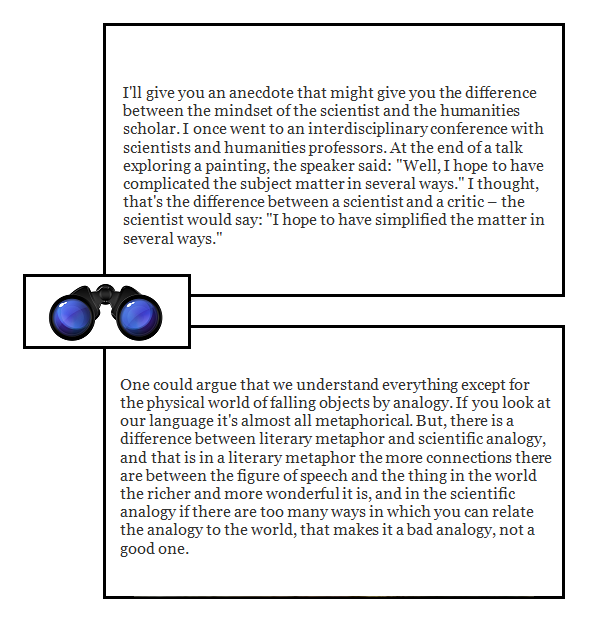
There was a interview with five prominent “science writers” in the Guardian a few days back, titled Science writing: how do you make complex issues accessible and readable? and one of the writers, Steven Pinker, makes two highly interesting observations:

**

There are a couple of things going on here that I’d like to note. One is that without intending to do so specifically, he is in essence formulating a view about a possible, central difference between scientific and religious thinking, since what he says about the humanities in general applies with great specificity to religion and the arts: in both religion and art, the expansive nature of “symbolism” is a key to the experience.

And that in turn prompts me to suggest that perhaps both the arts and religion are geared towards provoking, evoking or invoking an experience — whereas the sciences are geared towards obtaining an understanding.

I’ll have to think about that, and come to some sort of understanding of my own — perhaps expressed via symbolic means.

**

My second point of interest is that there’s an analogy to be made between Pinker’s two remarks: each of them has a form I could portray thus in terms of cause :: effect

science : humanities :: simplicity : complexity

Nobody present — the interviewer, Pinker himself, and four other very bright science writers — picked up on the close correspondence between those two statements at the time. And I find that very interesting.

I find it very interesting because the six of them were more interested in seeing what they could say (of what they already thought) than in saying what they could see (in light of the ongoing, immediate conversation).

I think we all tend to do that — which is why David Bohm‘s approach to dialogue is so important: if brings us to speak more into the moment as it surrounds us, not quite so much from the past as it has informed us.

**

Then there’s the interesting fact that Pinker’s sense of the difference between modes of thought in the humanities and the sciences as expressed in the top quote translates so directly to the difference between uses of analogy in the second — and his fairly emphatic statement:

one could argue that we understand everything except for the physical world of falling objects by analogy.

Analogy is the central device in our mental toolkit, and yet we know far more about trains of logic than we do about analogical leaps. We know so little, in fact, that distinguishing between “literary metaphor” and “scientific analogy” (both of which are based in the recognition of resemblance) on the basis of one looking for multiple, rich connectivity and the other for a single tight connection is something noteworthy enough for Pinker to bother to point it out. It is indeed a provocative and perhaps essential insight. But it is also pretty basic — dividing a field up into significant chunks, the way anthropology got divided into “cultural”, “archaeological”, “linguistic” and “physical anthropology”…

It’s time we learned to understand and use analogic with the same rigor we’ve applied to learning and using logic — and Sembl is just the tool for this.

**

Experience wants to be rich: factual understanding wants to be clear.

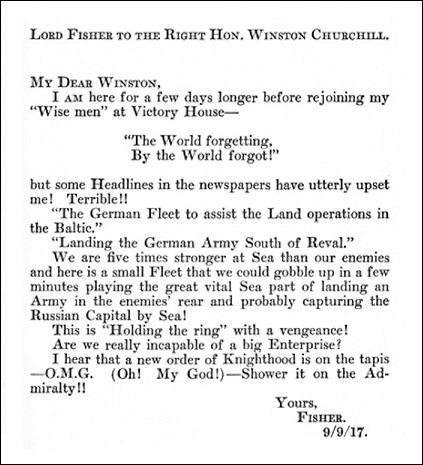
OMG! — Fisher to Churchill, 1917

Thursday, November 29th, 2012

[ by Charles Cameron — for your general amusement ]
.

Is OMG something to write after your name on your official correspondence — one of the orders of British knighthood, perhaps?

**

**

Hat-tip: Smithsonian, via Jeff Gates.


Switch to our mobile site