A Cure for Dystopianism
Sunday, March 25th, 2012Or, at least a palliative. Civilizational progress past and future.
Or, at least a palliative. Civilizational progress past and future.


Iconoclast: A Neuroscientist Reveals How to Think Differently by Gregory Berns
All In: The Education of General David Petraeus by Paula Broadwell, with Vernon Loeb
Two new ones. Finally purchased a copy of All In which I previously discussed here – worth reading is a review by, Col. Joseph Collins at SWJ, and a post from Paula Broadwell at Line of Departure. Will review in the near future.
Iconclast I discovered being highly recommended on my co-blogger Scott Shipman’s new site, To Be or to Do under his To Be or To Do Recommended Reading Installment 2 link. Of Iconoclast, Scott writes:
This may be the best book dealing with brain-function correlated to behavior that I’ve read. Many others have provided lengthy reviews of his thesis which can be summed up as: perception, courage, and social skills with no small dose of youth (where youth is 30ish) help create an iconoclast. I have only two complaints about the book. The last chapter deals with drugs and the attendant effects on our perception, lack of fear, and social abilities. This chapter seemed disjointed and inconsistent with the overall body of the book. The second complaint was Dr. Berns’ drum-beat on youth and iconoclasm. While there may be fMRI studies to back-up much of the data, what are we to make of folks over 30 (and sometimes much older) who become iconoclasts? The question is rhetorical, and the merits of the work out-weigh these minor objections. Highly recommended if you’re curious about the neurology of our behavior.
That was good enough for me, but Iconoclast will have to gestate in my antilibrary for a while. Too many books ahead of it in the queue.
[ by Charles Cameron — a poem of mine, with continuing exploration of Koestler’s notion of creativity at the intersection of fields, showing how three thoughts are braided in a single polyphony ]
.
A Meditation in Time of War
.It is for the artist to see skeleton behind flesh
when depicting war, tho’ beauty too
deserves a hint of her inevitable decay,
flesh being heir to dust and dust its progeny:nothing is so mechanical visioned in paint
as the tubing that supplies a gas mask with air,
yet the throat is no different, constricted
by an urgency to breathe as breath snuffs out:gone, gone, paragon, quintessence of dust, svaha!
.
William Butler Yeats has a well-known poem with the same title, so I am borrowing from, flattering, and wondering whether I might sneak under the same mantle as a member of the illustrious departed here.
And Madhu, friend and friend of this blog, encouraged me some while back to post poems here on occasion, so this one is for her by way of a response.
I also wanted to post this particular poem here, though, because its last line nicely illustrates the same notion of overlapping or juxtaposed elements that Koestler claims lies at the heart of the creative process which I have been exploring in my recent posts on Klimt, on Nancy Fouts, and constellational thinking.
Because yes, I now have a book project under way, and it concerns the development of a new style of multifaceted, complex / simplex thinking.
*
The first lines of my poem were triggered by one of those fleeting glances at a blog logo — in this case, the logo of the Kings of War blog from London, which I’ve shaved down a bit to give you a taste of here:
.

.
It’s impressive, eye-catching — and then you get used to it.
So a couple of nights ago when I glimpsed it, I slowed down enough to take a quick but deliberate look, came away with an impression — not necessarily accurate as to detail, but giving me my emotional response to the piece — and worked and played to get it into words, making this what I believe is technically called an ekphrastic poem, a poem about a painting.
The original painting is a mural — José Clemente Orozco‘s Catharsis (1934), from the Museo Palacio de Bellas Artes in Mexico City.
So that, with a little wandering of the mind, is what gives us the first eight lines. It’s the ninth and last line I want to comment on, here.
*
That last line reads:
gone, gone, paragon, quintessence of dust, svaha!
And what’s happening here that delights me, and that gives the poem either a perplexing close or a powerful one, depending on the associations which the reader brings to bear on it, “happens” as follows:
I am letting two, or you might say three, streams of language that are very dear to me braid together in that last line.
There’s the mantra that sums up the entire Prajnaparamita or Perfection of Wisdom literature — a major strand in Buddhist teachings — at the end of the Heart Sutra:
Gate, gate, paragate, parasamgate, bodhi, svaha!
There’s the English translation of the same, which Thich Nhat Hanh explains thus:
Gate means gone. Gone from suffering to the liberation of suffering. Gone from forgetfulness to mindfulness. Gone from duality into non-duality. Gate gate means gone, gone. Paragate means gone all the way to the other shore. So this mantra is said in a very strong way. Gone, gone, gone all the way over. In Parasamgate sam means everyone, the sangha, the entire community of beings. Everyone gone over to the other shore. Bodhi is the light inside, enlightenment, or awakening. You see it and the vision of reality liberates you. And svaha is a cry of joy or excitement, like “Welcome!” or “Hallelujah!” “Gone, gone, gone all the way over, everyone gone to the other shore, enlightenment, svaha!”
— and which I remember from my days at Oxford in Edward Conze‘s much earlier English version:
Gone, gone, gone beyond, gone altogether beyond…
And there’s this, from Hamlet, Act 2 scene 2:
What a piece of work is a man! how noble in reason! how infinite in faculty! in form and moving how express and admirable! in action how like an angel! in apprehension how like a god! the beauty of the world! the paragon of animals! And yet, to me, what is this quintessence of dust?
*
So “gate, gate, paragate” gives me “gone, gone, paragon…” — and “paragon” brings me to “paragon of animals … quintessence of dust”.
If you have all three of these utterances in mind — and each one of them is memorable the way a passage in Isaiah or Job, or some great Churchillian speech, or phrase in Melville or Dickens can be memorable — they will all three be present, braided together as a single music, a polyphony, a constellation of meanings, in that one last line.
Roll them on your tongue, taste the beauty in each one of them, the nobility, the evanescence of this human life. And now read the poem through again.
[ by Charles Cameron — non-linearity, complexity, “constellational thinking”, a quick spin around the blogosphere, history, Walter Benjamin — following on from Nancy Fouts ]
.
image: Galileo Galilei, Siderius Nuncius (i.e. The Starry Messenger), 1610
.
The novelist Teju Cole has a piece in the Atlantic that’s triggered by the Kony2012 business, and zooms out to touch on much else besides. His piece is titled The White Savior Industrial Complex, and as I was reading it, I came across a phrase that tweaked my keen interest. Cole is talking about Nicholas Kristof, and writes:
His good heart does not always allow him to think constellationally. He does not connect the dots or see the patterns of power behind the isolated “disasters.” All he sees are hungry mouths, and he, in his own advocacy-by-journalism way, is putting food in those mouths as fast as he can. All he sees is need, and he sees no need to reason out the need for the need.
By my lights, “he sees no need to reason out the need for the need” is a powerful tongue-twister, but it’s the phrase “to think constellationally” that interests me here.
Cole returns to a slight variant on the phrase later, this time saying:
Success for Kony 2012 would mean increased militarization of the anti-democratic Yoweri Museveni government, which has been in power in Uganda since 1986 and has played a major role in the world’s deadliest ongoing conflict, the war in the Congo. But those whom privilege allows to deny constellational thinking would enjoy ignoring this fact.
Constellational thinking, then, connects the dots, sees the patterns behind isolated events, sees not just the events themselves but also the circumstances that caused them – and its absence allows us to reduce complexly-interwoven reality to one or more simplistic polarities — better suited to sound bites than to analysis.
*
Cole also points us to Rosebell Kagumire‘s video response to the Kony affair, and she in turn has her own way of addressing the same kind of reduction of complexity to simplicity. She wrote, back on March 8th:
For the last many hours i have followed a campaign by Invisible Children NGO called KONY2012 that has gone viral getting more than 20 million hits on Youtube. I am a story teller and i know the danger of a single story.
So simple, that: I know the danger of a single story.
Remember the Ocean of the Streams of Story diagram in my post almost a week ago, Countering Violent Extremism: variants on a theme? Edward Tufte designed it, to illustrate a paragraph by Salman Rushdie…
The truth of a complex situation lives in the interweaving of many stories, not in a single strand, a single view.
*
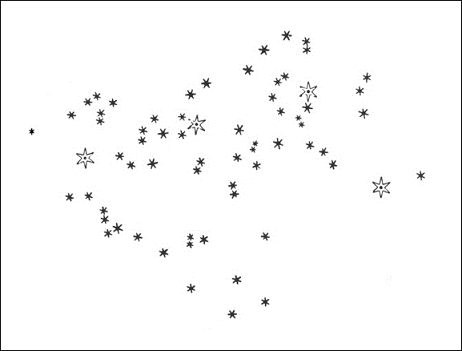
Constellations — of thoughts, of ideas.
image: Eugen Gomringer, Constellation, ca 1960
I did some digging – I’m not the Oxford English Dictionary, and I can’t say for sure that any particular use of “constellation” marks its first appearance in the sense that interests me here – Eugen Gomringer‘s Constellations (from 1954 onwards, example above) may be relevant in an avant-garde way– but my search brought me to a post by Liz Danzico at Bobulate titled Celestial History, in which Liz wrote:
Teaching constellations is an exercise in storytelling. You see, dots, these anonymous light encrusted patterns, must be memorized and categorized, and it’s only through stories that one can make sense of them. Starting with the north star, and systematically creating relationships in the winter sky among Hercules and Sagittarius, Libra and Polaris, we told tales. We’d trade stories on top of the old stone building in the middle of dark campus until late into the night. Creating these stories, giving Hercules a relationship to Cassiopeia — true or not, good or not, believable or not, it didn’t matter — what mattered were that patterns were found and marked.
Marking patterns and making content accessible through stories is what we do. And often, still, when we begin, we’re in the dark.
*
This post in turn lead Robin Sloan at Snarkmarket to write a quick note of praise, Explosions in the sky, which drew a comment from Tim of Short Schrift that said:
After the Copernican revolution, a constellation isn’t even a constellation. Instead, it’s a two-dimensional flattening of a three-dimensional reality. Actually, we should probably say a FOUR-dimensional reality. The light from stars at varying distances, leaving their sources at various times in the distant past, gets mistaken, from our earthbound point-of-view, as a simultaneous two-dimensional pattern.
BUT! That distortion, that accident, produces something extremely powerful — both imaginatively and practically.
Take “constellational thinking” and apply it to something besides stars in space. Let’s say — history.
Over here, you’ve got the Roman Republic, over there, the French Revolution. Distant in time, distant in geography, no kind of causal proximity let alone a relationship between them.
But bam! Slap them together. View them as a single event, a collapse of time.
Now you begin to see the French Revolution the way part of the Revolution saw itself, as an explosion of the continuum of history.
Now — and sorry if I slow-played this — you’re in Walter Benjamin’s “On the Concept of History.” Now you’re performing a genuinely three-dimensional nonlinear reading of historical time.
Consider that process, spelled out in the phrases “Distant in time, distant in geography, no kind of causal proximity let alone a relationship between them. But bam! Slap them together. View them as a single event, a collapse of time.”
Consider how that “fits” the same Arthur Koestler model of thinking I was on about yesterday in my post Nancy Fouts and the heart of the matter, in which I described:
the “release of cognitive tension” that occurs when some form of analogy, similitude, overlap allows the mind to join conceptual clusters from two fields in a “creative leap”
*
Well, I’m not along in finding this sort of thing useful. Here’s bethr from Mixed Bits writing on tumblr:
Constellational thinking
Omigosh… I’ve been using this phrase in numerous conversations for at least 4 years, usually when attempting to describe how I seem to process information and think, in contrast to the linear thinking which is more prevalent and encouraged in my profession. I’ve never heard anyone else use this phrase…it excites me that others have applied the same phrase and metaphor to the same idea and have articulated it much better than I ever have.
*
And Walter Benjamin:
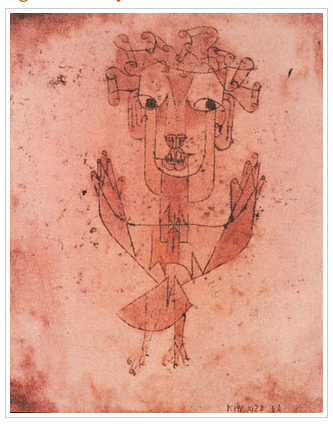
image: Paul Klee, Angelus Novus, 1920
Turning to Walter Benjamin’s On the Concept of History for a moment, we find a remarkable and justly celebrated paragraph about the angel depicted above, a 1920 Paul Klee painted etching which Benjamin himself once owned, now housed in the Israel Museum, Jerusalem:
There is a painting by Klee called Angelus Novus. An angel is depicted there who looks as though he were about to distance himself from something which he is staring at. His eyes are opened wide, his mouth stands open and his wings are outstretched. The Angel of History must look just so. His face is turned towards the past. Where we see the appearance of a chain of events, he sees one single catastrophe, which unceasingly piles rubble on top of rubble and hurls it before his feet. He would like to pause for a moment so fair, to awaken the dead and to piece together what has been smashed. But a storm is blowing from Paradise, it has caught itself up in his wings and is so strong that the Angel can no longer close them. The storm drives him irresistibly into the future, to which his back is turned, while the rubble-heap before him grows sky-high. That which we call progress, is this storm.
*
More prosaically, Benjamin then gives us the twinned realities to which Tim had pointed in his comment at Snarkmarket:
For Robespierre, Roman antiquity was a past charged with the here-and-now, which he exploded out of the continuum of history. The French revolution thought of itself as a latter day Rome. It cited ancient Rome exactly the way fashion cites a past costume. Fashion has an eye for what is up-to-date, wherever it moves in the jungle of what was.
*
Benjamin’s “moment” — his here-and-now — has passed, perhaps. The nuances discoverable through juxtaposition, counterpoint, overlay, constellational thinking, remain.
[ by Charles Cameron — Nancy Fouts, sculpture, juxtaposition, essence of creativity, pocket universes, Arthur Koestler, Mark Turner ]
.

Nancy Fouts is an American artist based in London. I ran across her work a while ago thanks to Michael Weaver on Google+, and was immediately struck by the intensity of her images, each one of which seemed like a landmark from a larger geography, more precisely focused and dense with meaning than our own world usually appears to be.
.
The first image I saw was of a snail on the straight edge of a razor blade (above, left) — an image out of the script of Apocalypse Now to be sure, but presented by Fouts in sharp detail and unadorned by any other context, visually, direct from eye to mind and heart.
This may be the image many people first see of her work — very, very striking, exquisite, terrifying if you allow it to be so, and yet as clear and simple, almost, as a single drop of water on a leaf.
.
But it was this next image that conquered me:

The juxtaposition is impeccable: sewing machine, record on turntable – and the overlap between the two, the link, the vesica piscis between them, is the needle.
The music of Bach, Handel, and Vivaldi — particularly on harpsichord — has been disparagingly called “sewing-machine music”. If that phrase gave rise to this marvelous image, perhaps the slight can be forgiven.
The sewing-machine? It’s a Singer. And in what must surely be an ironic, gender-influenced choice coming to us from an artist so assured and exacting — the music that the needle draws from the groove of the record is, as you can tell from the record label, the music of His Master’s Voice.
.
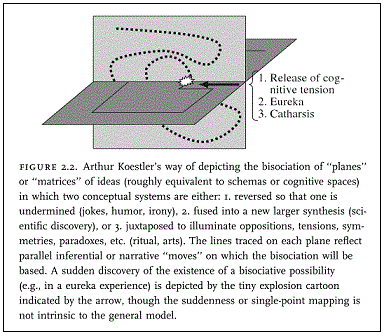
I have pointed before to this diagram from Mark Turner‘s The artful mind: cognitive science and the riddle of human creativity, based on those in Arthur Koestler‘s The Act of Creation (eg those on pp 35 and 37):
It shows the essence of the creative act — the “release of cognitive tension” that occurs when some form of analogy, similitude, overlap allows the mind to join conceptual clusters from two fields in a “creative leap”.
Nancy Fouts’ work doesn’t merely make use of such twinned field overlaps, it makes twinned fields with overlap the defining quality of her works.
She is aiming right at the heart of the creative process. And it shows.
.
In that earlier post of mine, I talked about Ada, Countess of Lovelace, and noted that her analogy between Charles Babbage‘s Analytical Engine and Jacquard‘s mechanical loom, famously expressed by her thus:
The Analytical Engine … weaves algebraic patterns, just as the Jacquard-loom weaves flowers and leaves.
was precisely the creative leap that led to the us of punched card systems in computation from Babbage to Watson…
I could give other examples. The Taniyama-Shimura conjecture which formed the basis of Andrew Wiles‘ proof of Fermat‘s Last Theorem, bridges two previously distinct branches of mathematics precisely by showing that for every elliptic curve, there is a related modular form…
And no, I don’t understand the mathematics. But I understand the concept of twinned fields, and the power of their overlap.
.
Back, then, to Nancy Fouts:

One thing that interests me about her work is that she has a few simple “essences” that she returns to time and again: in this case, bees, forms that resemble honeycombs, and by implication, honey.
In my own work, making similar connections between what we might paradoxically call “kindred ideas in unrelated fields” — I might set Nancy’s honeybees across from the verse from the Upanishads [Brihadaranyaka, fifth Brahmana, 14] which says:
This Self is the honey of all beings, and all beings are the honey of this Self.
Another of Nancy’s tropes connects nature and music…

.
And thimbles, those miniature emblems of armor and protection, are another recurring theme:

Let’s take a look at that last image, of the thimble transpierced by a needle.
I believe it has a history — again, accessible via an associative leap. Here are three images of the “wounded healer” motif, two of them specifically images of the Inuit shaman who has harpooned himself — a motif which the anthropologist and zen roshi Joan Halifax writes “captures the essence of the shaman’s submission to a higher order of knowing”:

Armor, the defenses we have in place to protect our selves, and vulnerability, the ability to to allow our selves to be wounded, so that the “self” which is “the honey of all beings” may shine through us. The paradox of Selflessness and Self.
.
Among wounded healers, we might count the crucified Christ, his side pierced by the spear of a Roman soldier — and here I might suggest that Fouts contrasts (image below, left) the self-sacrifice at the heart of Christianity with the pugilistic approaches of some proponents of his message:

And the image of Christ (right) balancing on a high wire?
Again I’m reminded of the language of shamanism. The anthropologist Barbara Myerhoff studied the religious beliefs and practices of the Huichol or Wixaritari of the Mexican Sierra Madre Occidental, with Ramon Medina Silva, a mara’akame or shaman of the tribe.
In her book, Peyote Hunt: The Sacred Journey of the Huichol Indians, she describes a feat of balance that Ramon performed, which appeared to serve a “sacramental” function for his people – providing them with what Cranmer‘s Book of Common Prayer calls “an outward and visible sign of an inward and spiritual grace”:
One afternoon Ramon led us to a steep barranca, cut by a rapid waterfall cascading perhaps a thousand feet over jagged, slippery rocks. At the edge of the fall Ramon removed his sandals and told us that this was a special place for shamans. We watched in astonishment as he proceeded to leap across the waterfall, from rock to rock, pausing frequently, his body bent forward, his arms spread out, his head thrown back, entirely birdlike, poised motionlessly on one foot. He disappeared, reemerged, leaped about, and finally achieved the other side. We outsiders were terrified and puzzled but none of the Huichols seemed at all worried. The wife of one of the older Huichol men indicated that her husband had started to become a mara’akame but had failed because he lacked balance.
It’s easy to read the description — but by no means as easy to keep one’s balance — something that Fouts’ image perhaps suggests more vividly than words easily can.
Richard de Mille describes the mara’akame‘s function in Huichol society as to “cross the great chasm separating the ordinary world from the otherworld beyond,” and suggests that Medina Silva’s feat of acrobatics on the barranca that day is to be understood as offering “a concrete demonstration in this world standing for spiritual balance in that world.”
Myerhoff herself was never entirely sure whether Medina Silva was “rehearsing his equilibrium,” or giving it “public ceremonial expression” that afternoon: it is clear, however, that for the Huichols, such feats of balance possess a resonance and meaning that extends beyond the “merely” physical.
.
I may of course be projecting some of my own ideas onto Nancy Fouts’ work — and indeed, perhaps that’s the point.
She has some pretty fierce observations to make concerning matters religious — Christian, Buddhist and other — and I’ll leave those who are interested to make their own discoveries on her website. I don’t doubt there are places where her sympathies and my own overlap, and others where we differ.
Fouts speaks a direct and visceral language of images — and her juxtapositions, carefully chosen and choreographed as they are, provoke us to feel and think.
Thank you, Nancy.
No need to reach for the gun, fellas — but that’s art.
_________________________________________________________________________________________
credits for images of Harpooned Shaman: Charlie Ugyuk (left); David Ruben (right).

Zenpundit is a blog dedicated to exploring the intersections of foreign policy, history, military theory, national security,strategic thinking, futurism, cognition and a number of other esoteric pursuits.
Customized Web Site & Blog Design