zenpundit.com » 2017

Archive for 2017

Jerusalem — the joy, the limitation, the fire

Monday, April 17th, 2017

[ by Charles Cameron — winding up with the Easter fire at Holy Sepulchre ]
.

I don’t know which order to post these first two tweets in, but if there’s truth to Dr Cole‘s tweet, it does set a limit to the good news in Avi Mayer‘s. I’ll just spin them a few times like a coin, then move on to the heart of the matter.

The world, as Gerard Manley Hopkins suggests, is intrinsically dappled. And:

Mindblowing WWJD from GOP Teens

Monday, April 17th, 2017

[ by Charles Cameron — a very basic blogpost on religious violence — specifically in authentic and weird, early and late Christianity — and sheer insanity ]
.

On the Monday after The Defeat of Death, a bizarre scriptural exchange among followers of the GOP Teen twitter account at the intersection of christianity and violence, snd a sober examination of the same topic from one of the early Fathers of the Church, Saint John Chrysostom aka GoldenMouth John [below].

**

Take a deep breath as we enter choppy waters:

**

St. John Chrysostom‘s Homily 84 on Matthew 26. 51-54.

And, behold, one of them which were with Jesus stretched forth his hand, and drew his sword, and struck a servant of the high priest’s, and smote off his ear.

Then said Jesus unto him, Put up again your sword unto his place, for all they that take the sword, shall perish by the sword. Thinkest thou that I cannot pray to the Father, and He shall presently give me more than twelve legions of angels? How then should the Scriptures be fulfilled that thus it must be?

Who was this one, who cut off the ear? John says that it was Peter. [John 18:10] For the act was of his fervor.

But this other point is worth inquiry, wherefore they were bearing swords? For that they bore them is evident not hence only, but from their saying when asked, “here are two”. But wherefore did Christ even permit them to have swords? For Luke affirms this too, that He said unto them, When I sent you without purse, and scrip, and shoes, lacked ye anything? And when they said, Nothing, He said unto them, But now, he that has a purse, let him take it, and a scrip, and he that has no sword, let him sell his garment, and buy one. And when they said, Here are two swords, He said unto them, It is enough.

Wherefore then did He suffer them to have them? To assure them that He was to be betrayed. Therefore He says unto them, Let him buy a sword, not that they should arm themselves, far from it; but by this, indicating His being betrayed.

And wherefore does He mention a scrip also? He was teaching them henceforth to be sober, and wakeful, and to use much diligence on their own part. For at the beginning He cherished them (as being inexperienced) with much putting forth of His power but afterwards bringing them forth as young birds out of the nest, He commands them to use their own wings. Then, that they might not suppose that it was for weakness He is letting them alone, in commanding them also to work their part, He reminds them of the former things, saying, When I sent you without purse, lacked ye anything? that by both they might learn His power, both wherein He protected them, and wherein He now leaves them to themselves by degrees.

But whence were the swords there? They had come forth from the supper, and from the table. It was likely also there should be swords because of the lamb, and that the disciples, hearing that certain were coming forth against Him, took them for defense, as meaning to fight in behalf of their Master, which was of their thought only. Wherefore also Peter is rebuked for using it, and with a severe threat. For he was resisting the servant who came, warmly indeed, yet not defending himself, but doing this in behalf of his Master.

Christ however suffered not any harm to ensue. For He healed him, and showed forth a great miracle, enough to indicate at once both His forbearance and His power, and the affection and meekness of His disciple. For then he acted from affection, now with dutifulness. For when he heard, Put up your sword into its sheath, [John 18:11] he obeyed straightway, and afterwards nowhere does this.

But another says, that they moreover asked, Shall we smite? [Luke 22:49] but that He forbad it, and healed the man, and rebuked His disciple, and threatened, that He might move him to obedience. For all they that take the sword, He said, shall die with the sword.

And he adds a reason, saying, Think ye that I cannot pray to my Father, and He shall presently give me more than twelve legions of angels? But that the Scriptures might be fulfilled. [Matthew 26:53-54] By these words He quenched their anger, indicating that to the Scriptures also, this seemed good. Wherefore there too He prayed, that they might take meekly what befell Him, when they had learned that this again is done according to God’s will.

**

What think you?

Carl Jung on Play

Monday, April 17th, 2017

[ by Charles Cameron — all i do is play / to play is to create / I am creature / I am pawn / < bows lifelong gassho >]
.

Here’s a key quote on play from Carl Jung, from Psychological Types, CW vol 6. #197:

My thanks to Mitch Ditkoff for pointing me to this fine quote.

**

The question arises, what is this process in which “The creative mind plays with the objects it loves”? There’s an object, right, and the mind, that much is coear — but does the mind observe the object? absorb it? analyzie it? play around with it?

If play is what we’re trying to understand, around would be the word sitting right next to it, so around may be what we should think about.

Around is context. Playing around is seeing in context, seeing from unexpected angels, seeing unexpected close connections. Here’s Arthur Koestler‘s diagram of play, which he thinks of as a diagram of creativity — which he idemntifies with bisociation, or the conjunction of two otherwise separate planes of thought:

You’ve likely seen it before: that’s my personal Diagram in Chief.

**

Okay, more basics. Play is how infants so richly learn and masters so richly express their mastery. It is rich, it masters and is mastered — “Thou mastering me God” says Hopkins in Wreck of the Deutschland, “giver of breath and bread; World’s strand, sway of the sea..”

**

As a game designer and a Brit with Jungian sympathies, I am also delighted with this other quote:

One of the most striking testimonies to the quality of the English spirit is the English love of sport and games in a classical sense and their genius for inventing games. One of the most difficult tasks men can perform, however much others may despise it, is the invention of good games and it cannot be done by men out of touch with their instinctive values. The English did it and, by heaven, they even taught us Swiss how to climb our own mountains and make a sport of it that made us love them all the more. And their Wimbledon, did they but know it, is in sort a modern version of an ancient ritual.

That’s from Laurens van der Post‘s Jung and the Story of Our Time, and game designer Mike Sellers shares my delight in it.

**

Yup:

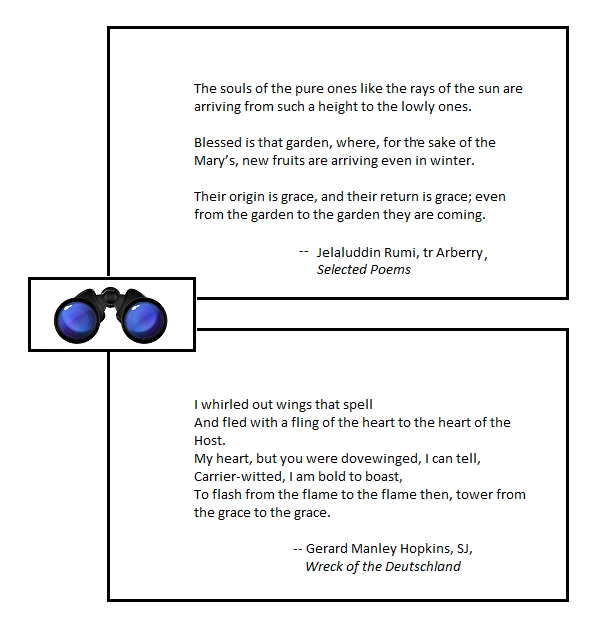
From grace to grace

Sunday, April 16th, 2017

[ by Charles Cameron — Rumi, Hopkins — very content with this.. ]
.

.. just this, that two of my favorite poems, by two of my preferred authors, contain essentially the same phrase:

I have been reading both Hopkins and Rumi for half a century or more; only today did I notice this felicious correspondence between them.

Tommy the Russkie Tank-tank

Sunday, April 16th, 2017

[ by Charles Cameron — A Russian tanker-toy saga ]
.

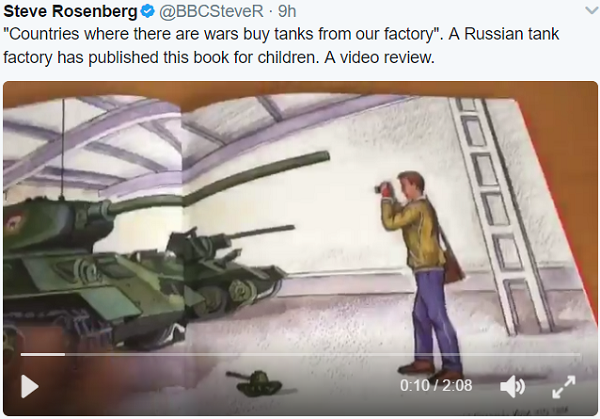
Another contribution to the maxcro / micro, war / games displays in my mental cabinet of wonders:

I’m sorry, this was about the only screen-grab I could manage that showed both the toy tank and its war-fighting seniors. In the children’s story, the toy tank gets left at the tank museum overnight, and is shocked and awed by the realities of which it is but a simulacrum — the OT 76, T 72, and most particularly the T-14 Armata super-tank.

The equation war : war games :: T-14 : toy tank eiher understates the significnce of the T-14 or exaggerates that of the toy — but equations between simulacrum and reality lie at the heart of such philosophical excursions as Baudrillard‘s Simulacra and Simulations, with its phony epigraph, a simulacrum of a quote from Ecclesiastes:

The simulacrum is never that which conceals the truth—it is the truth which conceals that there is none.

In the case of this children’s book, we can postulate another equation: Russia : propaganda :: factory : advertising.

But see for yourself, some of the details are hilarious:


Switch to our mobile site