zenpundit.com » 2018

Archive for 2018

Borders, limina and unity

Saturday, December 1st, 2018

[ by Charles Cameron — bulldozers and trains, more ]
.

Watersheds are natural divisions of landmasses, long predating human presence upon the earth. Borders by contrast are a human invention — a fact that is nowhere more evident than in the borders known as the Durand Line, separating Afghanistan from Pakistan, and the Sykes-Picot agreement, which divided up the Ottoman Empire into British, French and Russian spheres of influence. Durand, Sykes and Picot were respectively British, British and French gentlemen. In fact, make that a DoubleQuote (mini):

And while Pakistan recognizes the Durand line as an international border, Afghanistan does not. ISIS, disliked the Sykes-Picot line dividing Iraq and Syria enough to bulldoze it (upper panel, below)..

And then there’s the Haskell Free Library and Opera House (lower panel, above)..

**

The Haskell Library straddles the US-Canadian border, and has served as a meeting place for Iranians in the US and their relatives, hoping to visit them from the Canadian side..

The library is a relic of a time when Americans and Canadians, residents say, could cross the border with simply a nod and a wave at border agents. It was the gift of a local family in the early 1900s to serve the nearby Canadian and American communities.

“What we are so proud of is that we do have a library that is accessed by one single door,” said Susan Granfors, a former library board member. “You don’t need your passport. You park on your side, I’ll park on my side, but we’re all going to walk in the same door.”

But after the Sept. 11, 2001, attacks, the northern border hardened, and the law enforcement presence in the area is immediately visible. And in September, a Canadian man was sentenced to 51 months in prison for smuggling more than 100 guns into Canada, some of them through the Haskell library.

Still, inside the building itself — decorated with wood paneling, stained-glass windows and, on the Canadian side, a moose head — the old ways mostly prevail. Patrons and staff freely cross the international boundary, marked with a thin, flaking black line extending across the brightly decorated children’s reading room and the main hallway.

The Library — and Opera House!! — then, erases a border more or less, in a friendly manner, while ISIS erasesd another with force. In bith cases, we can sense a distrust of or distaste for artificial separations.

**

Those who are willing to make creative leaps from political geography to the wisdom of the far Orient will recognize the imagery of Pu, the Uncarved Block in Lao Tze‘s Tao Te Ching — representing wood in its natural, uncarved state, end thus the whole, of which all entities are seeming parts, separated only by naming.

G Spencer Brown addresses the same distinction in his book, The Laws of Form — described appropriately enough by Wikipedia as “straddles the boundary between mathematics and philosophy” — between what Brown terms the Unmarked state, “which is simply nothing, the void, or the un-expressable infinite represented by a blank space.. No distinction has been made”, and the Marked State, in which one or more distinctions (Marks) have been made:

In Spencer-Brown’s inimitable and enigmatic fashion, the Mark symbolizes the root of cognition, i.e., the dualistic Mark indicates the capability of differentiating a “this” from “everything else but this.”

Spencer Brown notes that a Mark denotes the drawing of a “distinction”, and can be thought of as signifying the following, all at once:

  • The act of drawing a boundary around something, thus separating it from everything else;
  • That which becomes distinct from everything by drawing the boundary;
  • Crossing from one side of the boundary to the other.
  • .
    All three ways imply an action on the part of the cognitive entity (e.g., person) making the distinction.

    Brown notes, wryly perhaps

    As LoF puts it:

    “The first command:

  • Draw a distinction
  • can well be expressed in such ways as:

  • Let there be a distinction,
  • Find a distinction,See a distinction,
  • Describe a distinction,
  • Define a distinction,<
  • Or:

  • Let a distinction be drawn.”
  • **

    My own DoubleQuotes format both draws distinctions (being binary) and erases them by asserting parallelisms between them (unifying or uncarving, unmarking them).

    All Spencer Brown quotes above are via Wikipedia.

    **

    Okay, now there’s news of another diplomatically significant border crossing:

    That’s good — and it gives us yet another DQ:

    Connecting a prosperous free South with a totalitarian North across a border is a liminal matter, and thus inherently sacred — see my post, Liminality II: the serious part

    As we saw with the fall of the Berlin Wall, however, it is possible and maybe Trump and Pompeo — with a little help from Kim Jong-un and Moon Jae-in? — can pull it off.

    Or maybe, Dennis Rodman?

    **

    Sources, some of ’em:

  • The Guardian, Railway diplomacy
  • PRI, For some Iranian families separated by the travel ban
  • NYRB, The Map ISIS Hates — hey, this by Malise Ruthven
  • Asia Times, Afghanistan takes center stage
  • **

    Oh, ah, another couple of parallelisms, btw:

    **

    What’s the cyber border between the US and Russia?
    .
    Punch counter punch

    Sunday, November 25th, 2018

    [ by Charles Cameron — a perfect two-snake pattern from the WaPo headline writers ]
    .

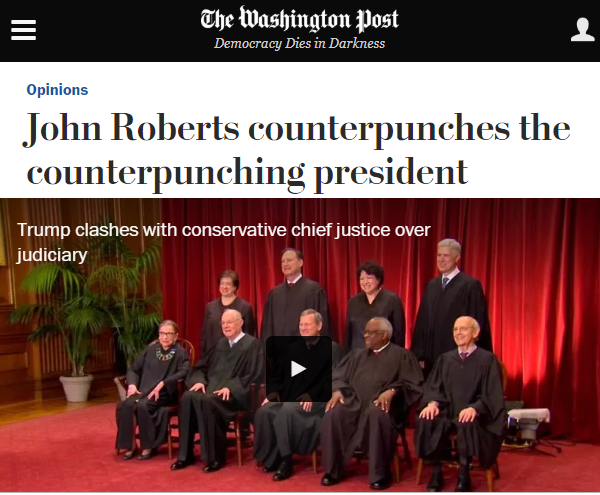
    As patterns go, this one is hard to beat:

    Source:

  • Washington Post, John Roberts counterpunches the counterpunching president
  • **

    As you may have gathered, the human propensity for patterning is an enduring interest of mine, and my collecting of such things as ouroboroi, parallelisms, paradoxes, moebius formats and mirrorings is effectively a small pattern language study after the example of Christopher Alexander‘s Pattern Language. Mine, drawing its materials from verbal and visual exemplars rather than architectural ones, perhaps reveals more about the workings of the human mind, aka consciousness.

    The “outer world” has yet to catch up with the significance of these studies..

    **

    At a time when my worldly goods in book form consisted of fifty or so over-thumbed, used science fiction paperbacks and one hardback — I no longer recall what it was — I won a minor poetry prize of $50 and decided it was better to splurge it on one thing I’d really treasure than to dribble it away, a coffee here, a sandwich there.. much though I like my coffees.

    Henbce, for about $45, I aacquired my copy of Alexander’s book — hardback #2!

    An I Ching for the West! Nobel-worthy! A Master’s Masterpiece!

    Princes & saws DoubleQuote

    Monday, November 19th, 2018

    [ by Charles Cameron — not exactly a knife (or sayf) to a gunfight, but .. ]
    .

    Here:

    **

    The obvious MBS DoubleQuote is with Jared Kushner, as in the Medium article, Two Princes: Jared Kushner and Mohammed bin Salman. Prince Hamlet offers a third and more ambiguous choice..

    When the wind is southerly, Hamlet [Act 2 Scene 2] says, I know a hawk from a handsaw — but tell me, who knows whence [John 3.8] the wind blows?

    Donne Dylan DoubleQuote

    Monday, November 19th, 2018

    [ by Charles Cameron — on the supposed world-shape — real, imagin’d, or foggy with scattered insights ]
    .

    Here:

    **

    Two to my mind great poets of the language on the world-shape.

    The first, John Donne, brilliantly stands astride the ancient metaphysical and modern scientific understandings of world-shape with his stunning, succinct corners of the round earth — he’s familiar to the point of ownership with both traditions, at a time when the ancient was ceding way to the modern..

    The second, Bob Dylan, shuffles anonymously among us at a no less fraught time of anguish as to realities, sings unsure of what’s what or which — a coin toss, a twist of fate..

    bard’s wyrd.

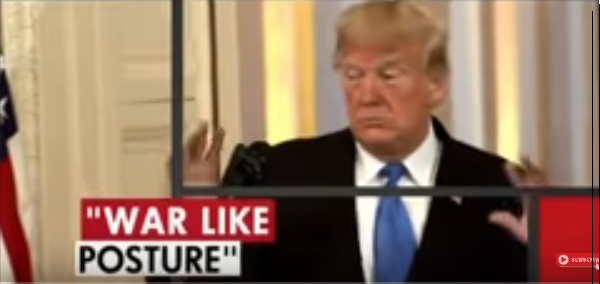
    War like posture and other metaphors

    Monday, November 19th, 2018

    [ by Charles Cameron — continuing the search, plus mckibben & a touch of dylan as a sunday surprise ]
    .

    First a chyron, based on Trump’s words:

    Fascinating article: The Dawn of the Intra-Family Political Attack Ad

    In August, Glosser published an essay in Politico magazine chiding his nephew by sharing the family’s own immigration story as Jews who fled the shtetls of Eastern Europe. “I have watched with dismay and increasing horror as my nephew,” Glosser wrote, “an educated man who is well aware of his heritage, has become the architect of immigration policies that repudiate the very foundation of our family’s life in this country.”

    Is House of Cards a poem, then?

    Doug Stamper is the dog.

    In the opening moments of Netflix’s House of Cards premiere episode from 2013, Frank Underwood (Kevin Spacey) hunched over a dog that’d been injured by a car. “There are two kinds of pain,” he said into the camera. “The sort of pain that makes you strong, or useless pain, the sort of pain that’s only suffering. I have no patience for useless things. Moments like this require someone who will act, who will do the unpleasant thing, the necessary thing.”

    He then broke the dog’s neck. “There,” he said. “No more pain.”

    In the final moments of the final episode of House of Cards—which occurs in a truncated season made after Spacey left the show due to allegations of sexual misconduct—the president, Claire Hale Underwood (Robin Wright), cradles her dead husband’s henchman, Doug Stamper (Michael Kelly), in her lap. She has just stabbed him in the belly with a letter opener after he nearly slit her throat with it. Underwood puts her hand over his mouth and nose and tells him that everything’s going to be okay. His eyes close. “There, no more pain,” she says. Her eyes flick toward the camera. The credits roll.

    Some sort of rhyming is going on here, clearly, but does the poem mean anything?

    That “rhyme” is a DoubleQuote, really — a thought-rhyme if you like, and on a technical film-making sense a clever twist to end on. Not so much a synchronicity or coincidence, more a twist of authorial fate.

    **

    Twists of fate, eh? And tangled up in blue? Here are two recent Dylan pieces to note:

  • New Yorker, Bob Dylan’s First Day with “Tangled Up in Blue”
  • New Yorker, Bob Dylan’s Masterpiece Is Still Hard to Find
  • **

    Bill McKibben, with a s game / play metaphor that derives its strength from the topic, not from the metaphoric play:

    In the face of our environmental deterioration, it’s now reasonable to ask whether the human game has begun to falter—perhaps even to play itself out.

    That’s from How Extreme Weather Is Shrinking the Planet — see also THE END OF NATURE.

    Early and late, McKibben has been one of the voices crying that the wildness is shronking — from within the shrinking wilderness..

    Wilderness / wildness yes, that’s deliberate..

    **

    & by way of a Sunday surprise, here’s some extraordinary music for whenever you need extraordinary, need music — twists of tangled blue fate included:


    Switch to our mobile site