zenpundit.com

Sunday surprise XII: of elves, djinn and more

December 29th, 2013

[ by Charles Cameron — “angels we have hear on high” — were they on your radar? ]
.

When worldviews collide…

**

So —

— do you believe in angels?

And or — do you put your trust in what Adam Smith called the Invisible Hand?

Apocalyptic economics, delightfully captured by Dana Fradon

Or is this more your style?

As for myself, I believe the world is depleted when apsaras are absent from the skies above us:

**

DQ Sources:

  • Economist, Jinn: Born of fire
  • AP Big Story, Iceland’s hidden elves delay road projects
  • At a snail’s pace

    December 29th, 2013

    [ by Charles Cameron — leap frog in very slow motion, and leap razor too ]
    .

    As a poet, I don’t much like that old saw about a picture being worth a thousand words — but there’s a density of information in each of the images below that’s worth considering:

    **

    Two very striking images, in parallel, juxtaposed. What can we read into them, or out of them?

  • That a snail’s pace is always the same, no matter what obstacles it encounters?
  • That slow and steady wins the race?
  • That you can take the easy way, or you can take the hard way?
  • That you [Chinese Buddhists] can go for gradual or sudden enlightenment?
  • That the snail in the upper panel (in an artwork by Nancy Fouts) is enacting and or paying hommage to Colonel Kurtz‘s celebrated line from Apocalypse Now?

    I watched a snail crawl along the edge of a straight razor. That’s my dream; that’s my nightmare. Crawling, slithering, along the edge of a straight razor… and surviving.

  • What else? What do you see?
  • There’s power in images, and even more in juxtapositions.

    **

    Daffodils

    If one picture is worth
    a thousand words,
    what’s a bunch of Wordsworth?

    **

    Here the actor Jeremy Irons gives a refreshingly fresh reading of Wordsworth‘s poem:

    Gaming the Connections: from Sherlock H to Nada B

    December 29th, 2013

    [ by Charles Cameron — the game of Connect the Dots in play and practice ]
    .

    CIA's (now ret'd) Nada Bakos examines the Al Qaida board in the HBO docu, Manhunt

    .

    Manhunt, the HBO documentary, does what (not having been there and seen that at the time) appears to be a decent job of recreating some of the cognitive stratregies employed by CIA officers in the OBL hunt. The one I’m interested in here is the building of a “link chart” or cognitive map — law enforcement “evidence board” — the idea being (a) to note known connections visibly, and (b) to encourage the mind to make intuitive leaps that reveal previously unknown connections between nodes… or “dots”.

    Sophisticated software does this sort of thing algorithmically with regard to (eg) network connections via phone-calls, but the human mind is still better than AI at some forms of pattern recognition, and that’s the aspect that interests me here.

    Aside:

    For more on the cognitive significance of the link chart in Manhunt, see my post Jeff Jonas, Nada Bakos, Cindy Storer and Puzzles.

    **

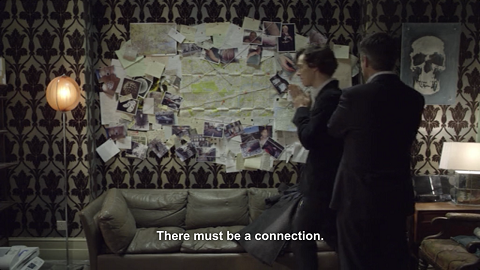
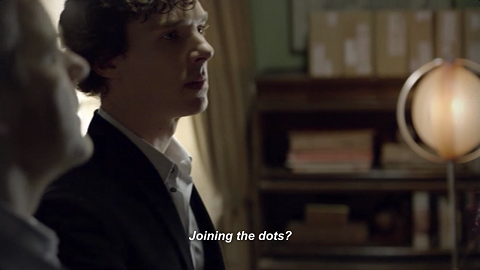
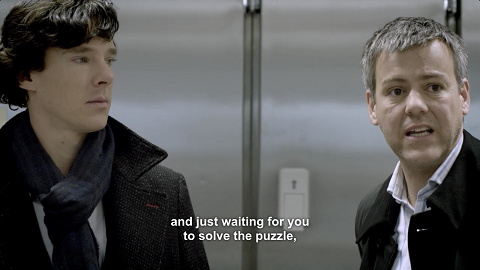
    Benedict Cumberbatch‘s Sherlock lays out the way it works —

    **

    Okay, so one way to visualize connections is to make a fairly random collage of relevant photos, names, dates and places, and tie it together with links of string or ribbon. That’s the equivalent of what in HipBone games terms we’d call a “free-form” game, and it works well for the “divergent”, initial brainstorming phase of thought. But it does little to bottle its own energy, to focus down, to force the mind — in the no less powerful “convergent” phase — into perceiving even more links than occur spontaneously in building the link chart in question.

    HipBone‘s preformatted boards take the cognitive process to that second stage. They work on one of the most powerful ingredients in creativity: constraint. Business writer Dave Gray of Communication Nation puts it like this:

    Creativity is driven by constraints. When we have limited resources — even when the limits are artificial — creative thinking is enhanced. That’s because the fewer resources you have, the more you are forced to rely on your ingenuity.

    But that premise doesn’t just hold true for business problem-solving — it’s at the heart of creative thinking at the Nobel level, too, in both arts and sciences. Consider mathematician Stanley Ulam, writing in his Adventures of a Mathematician:

    When I was a boy I felt that the role of rhyme in poetry was to compel one to find the unobvious because of the necessity of finding a word which rhymes. This forces novel associations and almost guarantees deviations from routine chains or trains of thought. It becomes paradoxically a sort of automatic mechanism of originality…

    Here’s how the poet TS Eliot puts it:

    When forced to work within a strict framework the imagination is taxed to its utmost – and will produce its richest ideas.

    A Hipbone Gameboard such as the Waterbird, Dartboard, or Said Symphony board is chosen precisely to challenge the mind with third, fourth and fifth rounds of “creative leaps” — thus adding both divergent and convergent cognitive styles to this form of graphical analysis.

    That’s my point here — and a plug for HipBone-Sembl style thinking.

    **

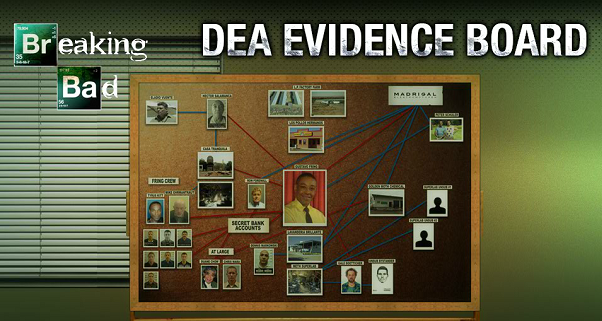
    I can’t resist adding a couple of instances in which the meme of “connecting the dots” via a link chart or evidence board has crept from TV series that I enjoyed into the world of games — this first one based on the terrific French detective series, Engrenages, retitled Spirals for British consumption:
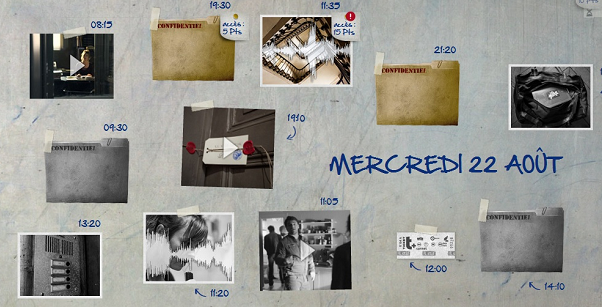
    — and this one for fans of the US TV series, Breaking Bad:
    DoubleQuote in the Wild: Maurits Escher & Juan Cole

    December 29th, 2013

    [ by Charles Cameron — mainly because I’ll post MC Escher any chance I get ]
    .

    I’m often but by no means always a fan of JR Cole. In this instance, though, I’d say he’s built a fine “wild” DoubleQuote out of his own observation and the Escher print he “quotes” in this tweet:

    **

    Hm — did this make anyone else think of Pakistan?

    Matrioshka forensics

    December 29th, 2013

    [ by Charles Cameron — it still takes a live human to see what the human eye cannot see but the machine can ]
    .

    This would appear to be (one version of) the state of the art in facial recognition:

    Image within image within image — the gentleman on the right is more or less recognizable as a reflection in the eye of the gentleman on the left — thus giving new potential meaning to the phrase “you are the apple of my eye” (cf Zechariah 2:8, also Oberon in Midsummer Night’s Dream III.ii.102 ff., and Stevie Wonder, You Are The Sunshine Of My Life).

    **

    Or — to switch disciplines while remaining with the matrioshka form, because such patterns are of interest to the inquiring mind — as Gary Snyder puts it in his marvelous poem, One Should Not Speak to a Skilled Hunter:

    The secret.
    and the secret hidden deep in that.

    **

    For another version of the state of the art in facial recognition, see: Where’s Ms. Waldo?. Aloha!


    Switch to our mobile site