zenpundit.com » IS

Archive for the ‘IS’ Category

A stunning reversal

Wednesday, April 13th, 2016

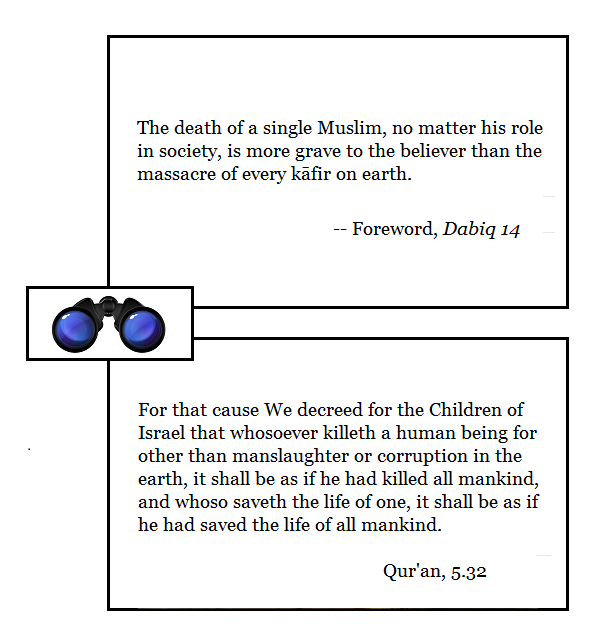
[ by Charles Cameron — Dabiq vs the Qur’an — again, it’s the formal precision of the reversal that inrerests me ]
.

SPEC DQ one vs all

**

It is not the fact that the Islamic State delights in killing infidels that surprises me, it’s the utter reversal of the Qur’an’s own emphasis on the value of a single life that catches my eye.

For the Qur’an, a single human life is worth the world, unless that life is subject to the death penalty for murder or mayhem; for IS, the lives of a world of infidels are worth less than a single Muslim life.

The one and the many, an individual and the whole world — how differently they are regarded in these two texts.

Human Sacrifice and State-Building

Tuesday, April 5th, 2016

[by Mark Safranski / “zen“]

A while back I had a longish post that argued that the mass executions practiced by ISIS drew from the long pagan tradition of ritualistic human sacrifice. Today in the news, some social scientists see evidence of human sacrifice as the catalyst for establishing and maintaining stratified, hierarchical and (usually) oppressive societies:

Human sacrifice may seem brutal and bloody by modern social standards, but it was a common in ancient societies.

Now, researchers believe the ritualised killing of individuals to placate a god played a role in building and sustaining stable communities with social hierarchies.In particular, a study of 93 cultures across Asia, Oceana and Africa, has found the practices helped establish authority and set up class-based systems.

Human sacrifice was once widespread throughout these Austronesian cultures, which used it as the ultimate punishment, for funerals and to consecrate new boats.Sacrificial victims were typically of low social status, such as slaves, while instigators were of high social status, such as priests and chiefs, installing a sense of fear in the lower classes.

….Analysis revealed evidence of human sacrifice in 43 per cent of cultures sampled.

Ritualistic killing of humans was practiced in 25 per cent of egalitarian societies studied, 37 per cent of moderately stratified societies and 67 per cent of highly stratified societies.The researchers constructed models to test the co-evolution of human sacrifice and social hierarchy and found that human sacrifice stabilises social hierarchy once the system has arisen. They said it also promotes a shift to strictly inherited class systems, so that people of a high social class will continue to stay important over time, because of ritualistic killing.

‘In Austronesian cultures human sacrifice was used to punish taboo violations, demoralise underclasses, mark class boundaries, and instill fear of social elites  – proving a wide range of potential mechanisms for maintaining and building social control,’ they wrote. ‘While there are many factors that help build and sustain social stratification, human sacrifice may be a particularly effective means of maintaining and building social control because it minimises the potential of retaliation by eliminating the victim, and shifts the agent believed to be ultimately responsible to the realm of the supernatural.’

Supernatural forces….like for example, because Allah wills it.

This Austronesian study conclusions sounds remarkably similar to the role of (allegedly) Sharia sanctioned horrific punishments meted out by ISIS and fetishistically recorded and widely disseminated in video propaganda. A religiously ritualistic rein of terror as a mechanism to reengineer Sunni Arab society in areas under the group’s control and cement the state-building efforts of ISIS.

For details of ISIS use of extremely ghoulish violence for propaganda and state-building, I heartily recommend ISIS: the State of Terror by Jessica Stern and J.M. Berger.

Palmyra, the delirium

Wednesday, March 30th, 2016

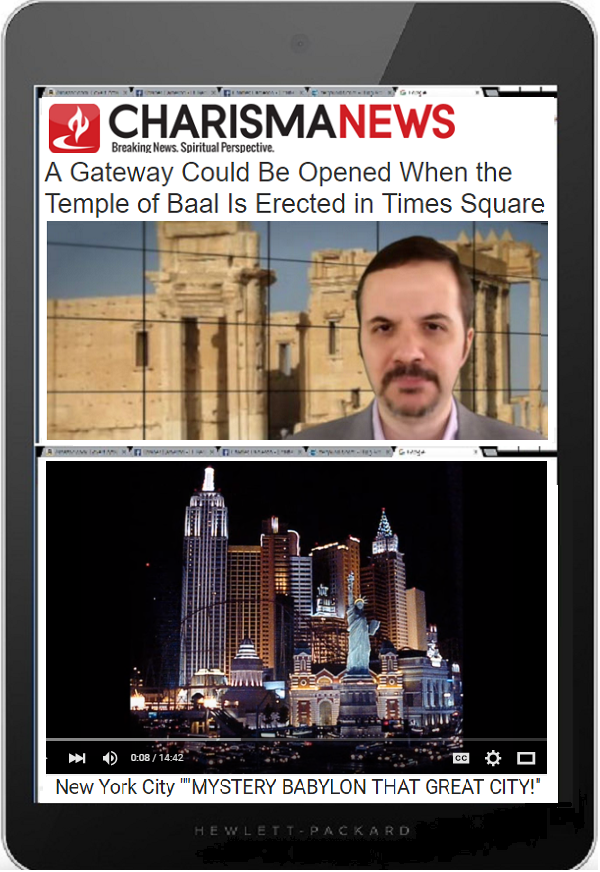
[ by Charles Cameron — any sufficiently advanced Stargate is indistinguishable from magic ]
.

ronfeldt var

**

I spoke too soon. In a post yesterday, I wrote of Palmyra, the grief and the joy. I should have known better — there’s always an end-times element to the news, particularly when it touches on the history of the Middle East.

In my tablet-format DoubleQuote above, you will find dire prognostications of one group of the apocalyptically aroused [upper panel, above] believing that the installation of a replica of the destroyed arch of Palmyra’s Temple of Baal in New York’s Times Square will unleash who knows what forces of evil upon the city — — a city which has in any case earned the sobriquet “Babylon” [lower panel] from others similarly apocalyptically aroused —

In ancient times, child sacrifice and bisexual orgies were common practices at the altars of Baal, and now we are putting up a monument of worship to this false god in the heart of our most important city.

April 2016: The Temple Of Baal Will Be Erected In Times Square In New York City

A tip-of-the-hat, here, to Richard Bartholomew of the Batholomew’s Notes on Relighion blog, who pointed me in this direction.

**

But there is yet time to take comfort, if you will, in the Dispensationalist theology supported by yet other end-timers discussed in this article, Are you ready for the counter-apocalypse? to which David Ronfeldt kindoy pointed me, proposing that things must inm any case “get worse before they can get better, theologically speaking —

Scofield, following Darby, taught that God governs and manages the world according to a sequence of distinct ages, or dispensations, each with distinct sets of rules and expectations. Each meets some kind of catastrophic end. In the Bible, as in Scofield’s life, things always got worse before they could get better—for instance, by Noah’s flood, or the destruction of Jerusalem’s Temple, or whatever social degeneracy we observe around us. Fear not, for God is in control. The job of believers is to accept whatever dispensation they’re in and await, like eager spectators, the next catastrophe.

Understanding sacred history like this has consequences for the present. Justice and peace need not be strived for now; we’re not in the right dispensation yet. Dispensationalists have held that even the beloved commands of Jesus in the Sermon on the Mount can be neglected—love your enemies, give what you have to those in need, do for others what you’d have them do for you.

As one of Scofield’s later followers reasoned, “Every businessman would go bankrupt giving to those who ask of him.” Dispensationalism permits a dose of pecuniary sense to some of the Bible’s more demanding social teachings.

This theology spread in tandem with modern corporate capitalism, aided by Gilded Age benefactors like California oilman Lyman Stewart. A later follower of Scofield’s imagined that Christians who persevere through the present tumult will get to serve as a “ruling aristocracy, the official administrative staff” of Christ’s corporate kingdom to come. The bureaucrat, thus, is the model believer: Play by the rules you’re given, as excellently as you can, and even as the planet is engulfed in flames rest assured that all is well.

**

I’d have far less to write about — and we’d all live in a safer world — if we recognized that the outrageous varieties of apocalyptic expectation just might be the multi-headed beast St John of Patmos was talking about in Revelation, ahem.

Palmyra, the grief and the joy

Monday, March 28th, 2016

[ by Charles Cameron — “the landscape, in general, is in good shape” says Syrian antiquities chief Abdulkarim ]
.

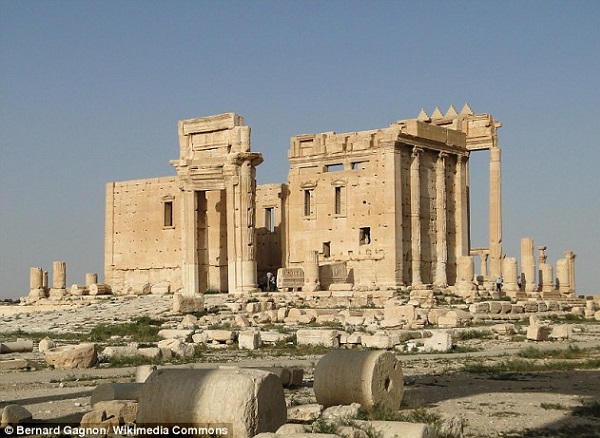
First, let me DoubleQuote the joy and the grief of Palmyra, in the form of the Temple of Bel before —

Temple of Bel whole

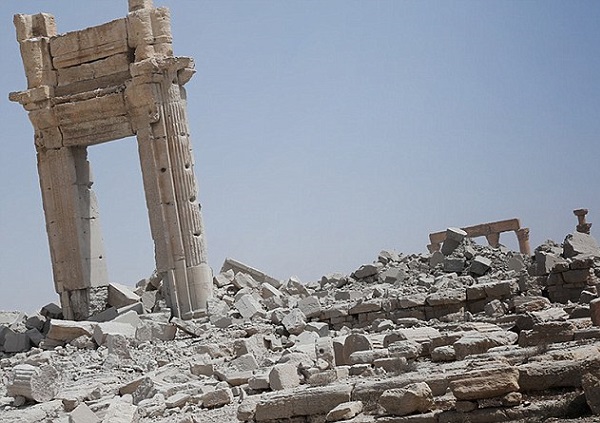
— and after IS wrought its iconoclastic destruction on that site sacred to its original devotees, and sacred also (seculo-sacred?) to contemporary humanists and historians —

Temple of Bel after

In that pairing of grief and joy, the grief predominates.

**

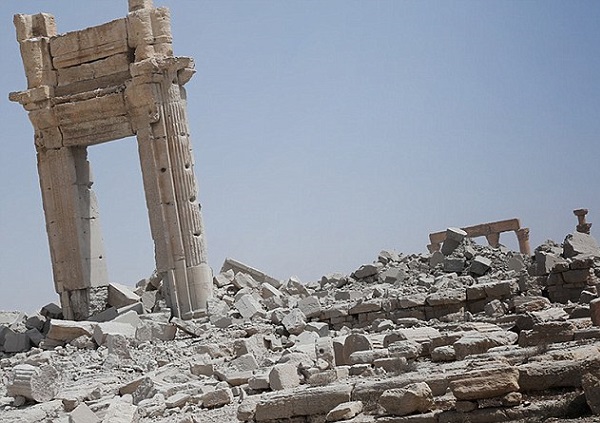
Palmyra, though, has now been retaken from IS, and we can accordingly make a further DoubleQuote in images, this time moving from grief to joy, with the joy predominant, Alhamdulillah! — pairing the “after” image from the previous pair —

Temple of Bel after

— with this image of the theater at Palmyra — recently used by IS for executions, though thankfully not by them demolished —

Palmyra after IS

— thus returning a measure of joy after so tragic an episode.

**

Sources:

  • Daily Mail, ISIS show off their destruction of 2,000-year-old temple at Palmyra
  • BBC News, Syria civil war: Palmyra damage in pictures
  • Islamic State — hanging by a chad?

    Tuesday, March 15th, 2016

    [ by Charles Cameron — light-hearted, almost science-fictional “butterfly-hurricane” question in geopolitics, with an Elkus follow-up ]
    .
    chad bolton
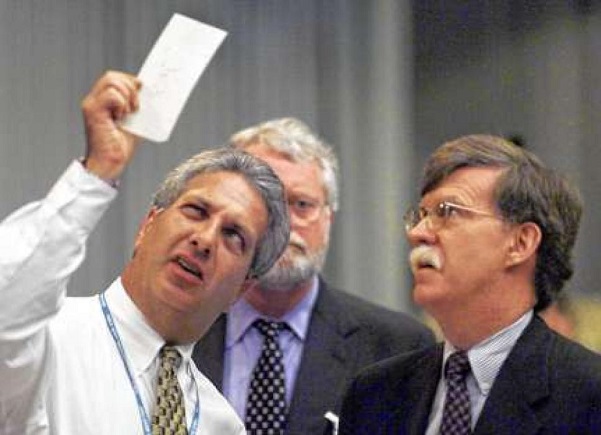
    A scene from the 2000 Florida recount: Palm Beach County’s canvassing board chairman eyes a questionable ballot as Republican attorney John Bolton looks on. Image: Greg Lovett/AP

    **

    Is the Islamic State an “unanticipated consequence” of Bush v Gore?

    Donald Trump, as quoted in Vox’s America’s unlearned lesson: the forgotten truth about why we invaded Iraq:

    You do whatever you want. You call it whatever you want. I want to tell you. They lied. They said there were weapons of mass destruction, there were none. And they knew there were none. There were no weapons of mass destruction.

    Without getting too far into the weeds, my question is this:

    Is it fair to say that the Islamic State (aka ISIS, ISIL) was born in 2006 in response to the American invasion and occupation of Iraq, which in turn was initiated by President George W Bush, who became Commander in Chief in 2000 in a disputed election only resolved by the Supreme Court’s ruling in Bush v. Gore, 531 U.S. 98 (2000)? And if so, looking back at the branching possibilities and eventualities that led to the creation of IS, might I plausibly suggest the Islamic State owes its very existence to a “hanging chad”?

    If the Florida electoral votes hadn’t been disputed on account of flaws in the mechanical method by which they were registered, in other words, might there have been no invasion of Iraq, and hence no IS as such?

    I know: this is hugely simplistic, both in terms of the election and of the drives behind Zarqawi and company — but I’m looking for an illustration of a very small digfference in “initial conditions” giving rise to a notable difference in a “later state” of a related aspect of the world system, Lorenz’s butterfly effect.

    I understand that “dimpled chads” were also part of the “initial conditions” in question, but “hanging by a chad” works better as a phrase than “dimpled by a chad” — although “hanging by a dimple” has a certain charm.

    Srsly, though — to what extent is our current timeline, in which IS may reasonably be viewed as a notable threat, causally connected to the resolution of a mechanical flaw in voting machine design?

    **

    And more seriously:

    I very much appreciated Adam Elkus‘ post, Trump: The Explanation of No Explanation, and the great quote from Charles Kurzman on the Iranian Revolution from which Adam kicks off:

    All of [the Iran] analyses are wrong, even if events unfold the way they predict. After all, if you make enough predictions, some are bound to look accurate. They are wrong because the outcome of this week’s events is simply unpredictable. Unpredictable means that no matter how well-informed you may be, it is impossible to know what will happen next. Moments of turmoil make a mockery of accumulated knowledge. Routine behavior, on the other hand, can be predicted. It is likely to occur tomorrow the way it occurred yesterday, with adjustments for shifts over time. But breaks from routine are a different beast altogether. The more that people feel that normal rules of behavior no longer hold, the more they search around for new rules, surveying their neighbors, collecting rumors, checking their text messages in a frantic attempt to figure out what everyone else is planning to do. Very few people are willing to be the only ones out in the street when the security forces start to advance. If people expect millions of their compatriots to demonstrate, many will want to help make history…. Such moments of mass confusion are unsettling and rare. They usually fade back into routine. Occasionally, however, they create their own new routines, even new regimes, as they did in 1978-1979. In later retelling of these episodes, especially by experts, confusion is often downplayed, as though the outcomes might have been known in advance. But that is not how Iranians are experiencing current events. Their experience, and their response to their experience, will determine the outcome.

    Switch to our mobile site