zenpundit.com » IS

Archive for the ‘IS’ Category

Gaming the Islamic State three ways from Sunday

Thursday, July 16th, 2015

[ by Charles Cameron — what hipbone thinking / gaming could and should bring to the natsec table ]
.

I have just been browsing the Institute for the Study of War‘s report on its ISIS wargame, and thought I’d wargame ISIS a bit myself, using my DoubleQuotes game.

**

The ISW report, in its 32 pages, barely mentions religious drivers, features one use of the word “apocalyptic” in a pretty non-specific sentence that implies nothing about what that word implies in terms of religious instensity — “ISIS intends to expand its Caliphate and eventually incite a global apocalyptic war” — and generally focuses on everything but “knowing” the enemy..

If they’d invited me and added a round or three of DoubleQuotes during a coffee break, I’d have been grateful for the coffee and the visit to DC, and very quickly played these two double-moves:

For wide context:
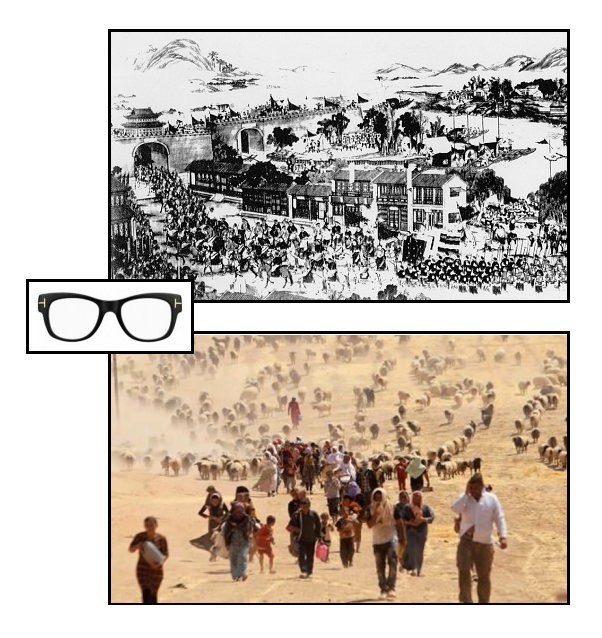
SPEC DQ Taiping IS

Upper panel: the Taiping Rebellion, an apocalyptic (in the true sense) movement in China, 1850 to 1864, with between 20 million and 30 million dead — as a reminder that apocalyptic movements can have, ahem, far-reaching consequences.

Lower panel: Refugees fleeing the Islamic State, a movement whose apocalyptic (in the true sense) strategy includes a focus on great end-times battle to be fought at Dabiq in Syria, Dabiq being the name of their English lnaguage magazine.

Read into the record in support of these two visuals:

  • Jonathan Spence, God’s Chinese Son: The Taiping Heavenly Kingdom of Hong Xiuquan
  • William McCants, The ISIS Apocalypse: The History, Strategy, and Doomsday Vision of the Islamic State
  • And with narrower focus:

    here, on the brutality levels permitted in two rival jihadist groups in Syria:
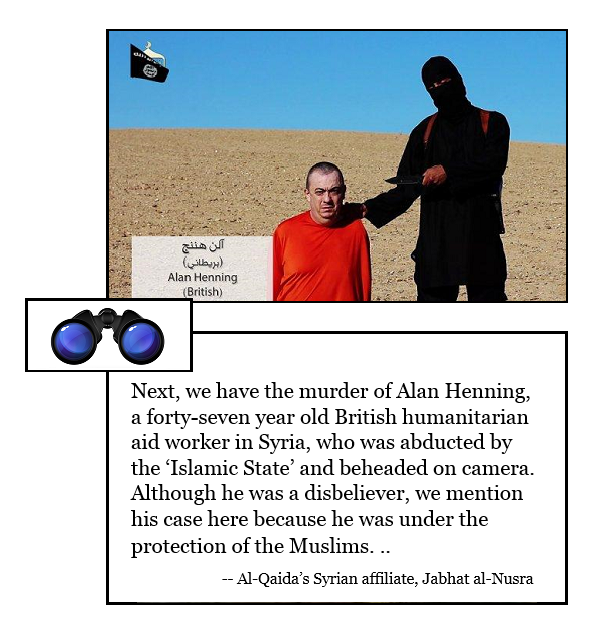
    SPEC DQ IS vs Jabhat

    Upper panel: the Islamic State brutally executes British aid worker Alan Hemming

    Lower panel: AQ affiliate Jabhat al-Nusra points out that he was under an offer of protection binding on all Muslims.

    There would be background reading to explore and expand that DoubleQuote too. But the main point is: the contest of ideas, not simply that of troop movements and materiel, would have been part of the picture.

    **

    The Atlantic Council has also held two wargaming sessions on IS [1, 2], but again the insights to be gained into the Islamic State’s end-times motivations and their implications are almost nonexistent:

    ISIS carries the seeds of its own destruction primarily because it has an extremely small constituency within Islamist populations around the world, an apocalyptic vision, an unsustainable strategy of us-against-theworld, and a failed governance project.

    And that’s about it.

    **

    McCants’ presentation at the Boston conference, and his forthcoming book (above), both make it clear that the apocalyptic stress of today’s “caliphate” has morphed significantly from the more immediate apocaypticism in IS’ Zarqawi-era predecessor, Al Qaeda in Iraq.

    And for a nuanced understanding of time-urgency in apocalyptic rhetoric, Stephen O’Leary‘s Arguing the Apocalypse: A Theory of Millennial Rhetoric is the definitive work.

    So when do we start introducing ideational war (and/or peace) games alongside our games of brute force?

    And how do you factor esprit, morale, and “angels, rank on rank” (Quran 8.9, 89.22) into troop movements and so forth?

    Hint: they’re force-multipliers.
    Jabhat al-Nusra rebukes Islamic State for killing Alan Henning

    Friday, July 10th, 2015

    [ by Charles Cameron — I hav to say, the senseless death of Alan Henning makes me very sad ]
    .

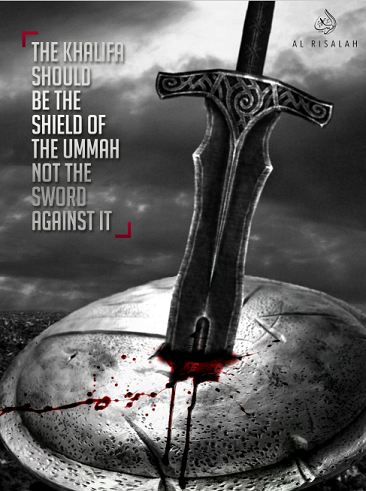
    In the first issue of its magazine, al-Risalah, Jabhat al-Nusra attacks al-Baghdadi’s supposed caliphate.

    Jabhat al Nusra vs IS

    The item that caught my eye, though, was a section in the article Khilafa One Year On titled The Murder of Alan Henning. We read:

    Next, we have the murder of Alan Henning, a forty-seven year old British humanitarian aid worker in Syria, who was abducted by the ‘Islamic State’ and beheaded on camera. Although he was a disbeliever, we mention his case here because he was under the protection of the Muslims. Abu Salaam al-Britani, an aid worker who worked alongside Henning, pleaded to Baghdadi to have him released:

    “I appeal and request in general to all of the members of ad-Dawlah al-Islamiyyah and specifically to Shaykh Abu Bakr al-Baghdadi and Abu ‘Ali al-Anbari to release Alan Henning as he had been given an Amana (security) from two sets of believing parties. Henceforth in the light of the Shari’ah he is considered a Mu’ahid and it is impermissible to harm him…”

    A footnote at this point leads us to Al-Britani’s A personal account of Alan Henning and the covenant of security (Amana) afforded to him by Muslims, in which we read the full version of al-Britani’s appeal. Following a detailed account of this “wonderful man called Alan Henning”, he writes:

    From your brother in Islam Abu Salaam al-Britani,

    I appeal and request in general to all of the members of ad-Dawlah l-Islamiyyah and specifically to Shaykh Abu Bakr al-Baghdadi and Abu ‘Ali al-Anbari to release Alan Henning as he had been given an Amana (security) from two sets of believing parties henceforth in the light of the Shari’ah he is considered a Mu’ahid and it is impermissible to harm him.

    The first Amana was given by me and the rest of the brothers travelling in the aid convoy. We reassured and informed Alan he will be safe and not harmed as he is with a group of Muslims who are going deliver aid to the people of Syria.

    The second Amana was given by indigenous people of ad-Dana they had sent several men to escort us once we entered Syria through the Bab al-Hawa border crossing. They assured us all we will be under their protection and escorted us to the town of ad-Dana.

    I ask you by Allah to honour these covenants as our Lord said in the Qur’an

    “O you who believe, honour your covenant (‘uqud)”

    [Surat Al-M?’idah, Ayah 1]

    The Prophet (peace and blessings of Allah be upon him) also said:

    “If anyone kills a ‘Mu’ahid’ ‘i.e. a person guaranteed protection’ without a just cause, Allah will prevent him from even smelling the fragrance of Paradise”.

    [Sahih Sunan an-Nasai No .4422].

    The Prophet (peace and blessings of Allah be upon him) also said:

    “On the Day of Judgment, I will be protesting against anyone who oppresses a ‘mu’ahid’ ‘i.e. a person guaranteed protection’, belittles him, charges him to do things beyond his ability, or extorts anything from him.

    [Sahih Sunan Abi Dawud, No. 2626]

    Any Muslims is entitled to give protection on their behalf, and that this type of protection can be given to the non-Muslim by any individual from the Muslims whether a male or a female, a nobleman or a poor, a righteous or an evil-doer.

    Ash-Shaybani said in as-Siyar, vol.1, pg.175:

    “The security covenants that a free Muslim man, whether virtuous or immoral, gives are binding to all the other Muslims because of the Hadith, “Muslims are equal in respect of blood. They are like one hand over against all those who are outside the community. The lowest of them is entitled to give protection on their behalf.” The meaning of “protection” is the security covenant whether it is temporary or permanent.

    Zaynab, the daughter of the Messenger of Allah (peace be upon him), granted protection to her husband Abu al-‘As bin Rabi’ah, and the Prophet (saw) approved of her protection.

    It was reported that Umm Hani said:

    “I granted asylum to two non-Muslim relatives of mine, and then Ali bin Abi Talib (may Allah be pleased with him) came upon them to kill them. So I told him, you are not going to kill them unless you kill me first! Then, I locked my door on them and went to the Messenger of Allah (saw) and told him about what happened.

    He (saw) said: “Ali is not allowed to kill them. We grant asylum and protection to the ones you have granted asylum and protection.

    Considering the powerful significance of Ali bin Abu Talib — born in the Kaaba, the son-in-law and cousin of the Prophet, distinguished at the Battle of Badr and subsequent battles, victor in his duel with Amru ibn Abd Wudd, fighter with the sword Zulfiqar of whom it was said, “There is no brave youth except Ali and there is no sword which renders service except Zulfiqar”, named “Lion of God” by the Prophet, fourth of the Rashidun Caliphs and also first Imam of the Shiites — this last is indeed a powerful citation.

    I don’t intend to draw any conclusions here, just to say that this reminds me of OBL’s reproof of Faysal Shahzad in his letter to Atiyya, which I discussed in my post, Key bin Laden para raises translation and other questions.

    Islamic State, the thrill [ ?? !! ]

    Thursday, July 2nd, 2015

    [ by Charles Cameron — the violence, the sheer cruelty, is stupefying, true, and frequently misunderstood ]
    .

    Example:

    **

    What I’d like to do is to reverse the idea that saying IS does horrific things will dissuade those vulnerable to its messaging from joining..

    SPEC DQ thrill of IS

    Or as JM Berger puts it:

    **

    Roger Griffin of Oxford Brookes University notes that on the way in, video imagery of violence may be attractive:

    They have actually succeeded in creating an image for themselves, which to a generation of people who spend a lot of their time in virtual reality can actually make it quite sort of acceptable to enjoy the spectacle of slaughter and bloodshed and crass heroism”

    Attempts to “counter” the violence in IS tweets by commenting on how violent IS is may backfire — an idea that State’s counter-narrative mavens [see example above] may want to take on board.

    On the way out, however, the violence may have been all too real, and no way glamorous in viscerally experienced reality. Prof. Griffin again:

    Some of the Muslims coming back from fighting in Syria aren’t going to be more jihadist than the jihadi and trying to blow things up, but would have actually seen slaughter, cruelty, and the nauseating aspect of violence. They could be wonderfully used, if used sensitively, as part of a counter narrative

    **

    Sources for DoubleQuote:

  • Simon Cottee: Why would anyone join ISIL?
  • Samar Yazbek: Syria has been hung, drawn and quartered
  • Hipbone update & request for your vote!

    Wednesday, June 17th, 2015

    [ by Charles Cameron — 3 Quarks Daily, Boston Apocalyptic conference, LapidoMedia, World Religions and Spirituality Project, Bellingcat, Loopcast, Pragati, Sembl ]
    .

    First, please vote!

    .
    [ Note added: voting is now closed: my story received the fifth highest tally of votes out of 45 entries, and is now up for consideration by the 3QD editors in the next round — many, many thanks! ]

    My story, War in Heaven, is in the running for the 3 Quarks Daily Arts & Literature Prize. 3 Quarks Daily is a great aggregator site, I’m honored to have made the cut so far, and would love to make it to the next level. My entry is #33 in the alphabetical list here, and votes can be cast at the bottom of the page. Networking for votes is all part of the game, so I’m hoping you’ll vote — & encourage your friends to go to that page & vote my entry up.

    If you haven’t read it, here’s my story. It was a finalist in the Atlantic Council‘s Scowcroft Center Art of Future Warfare Project‘s space war challenge, in association with War on the Rocks.

    There’s even a Google Hangout video in which Atlantic Council Non-Resident Senior Fellow August Cole, who directs the Art of Future Warfare project, interviews the contest’s winner and finalists, myself included. August’s book, Ghost Fleet: A Novel of the Next World War, is in the running for next great Tom Clancy like techno-thriller.

    You’ll find plenty of other good entries at the 3QD contest page, and daily at 3QD as well — as I say, it’s excellent in its own right, and one of the richest contributors of varied and interesting posts on my RSS feed.

    **

    Then, in no particular order — check ’em all out —

    The Boston conference on Apocalyptic Hopes, Millennial Dreams and Global Jihad:

    To my way of thinking, the critical thing to know about the Islamic State is its “apocalyptic, end-of-days strategic vision” as Martin Dempsey put it — and the implications of that statement, both in terms of strategy and of recruitment & morale. That’s what the Boston conference focused on, and that’s why I think it was no less significant for being sparsely attended. In a series of future blogs I hope to go over the videos of the various presentations and spell some of their implications out — Will McCants‘ book, The ISIS Apocalypse, is due out in September, and I’d like to have filled in some background by then.

    Here, though, as I’m giving an update on my own doings, is my presentation — an attempt both to tie together some of the strands of the panel I was commenting on (but could barely hear, but that’s a tale or another day), and to express my sense of the importance of apoclyptic thinking, not merely as an intellectual exercise but as an emotional and indeed visceral relaity for those swept up in it:

    The other speakers were Richard Landes, WIlliam McCants, Graeme Wood, Timothy Furnish, Cole Bunzel, Jeffrey Bale, David Cook, J.M. Berger, Itamar Marcus, Charles Jacobs, David Redles, Mia Bloom, Charles Strozier, Brenda Brasher and Paul Berman — quite a stellar crew.

    **

    My two latest pieces for LapidoMedia, where I’m currently editor:

    ANALYSIS: Understanding the jihadists through their poetry and piety
    12th June 2015

    YOU might not think that ‘what jihadis do in their spare time’ would be a topic of much interest, but it’s one that has been under-reported and is just now breaking into public awareness.

    Much of the credit for this goes to Robyn Creswell and Bernard Haykel for their current New Yorker piece, Battle lines: Want to understand the jihadis? Read their poetry.

    But behind Creswell and Haykel’s piece lurks a striking presentation given by the Norwegian terrorism analyst Thomas Hegghammer at St Andrews in April.

    Hegghammer’s Wilkinson Memorial lecture was titled Why Terrorists Weep: The Socio-Cultural Practices of Jihadi Militants…

    Read the rest

    I’m still intending to do a longer and more detailed write-up for Zenpundit on Hegghammer’s highly significant lecture.

    Today:

    The Bamiyan Buddha lives again

    A CHINESE couple, dismayed by the Taliban’s destruction of Bamiyan’s two Buddha statues, has brought the larger of the statues back to life.

    Locals and visitors can once again see the Bamiyan Buddha through the use of laser technology – this time not in stone but in light.

    Carved into the great cliff face towering over the fertile valley of Bamiyan in Afghanistan, two Buddha statues stood for centuries.

    In 2001 the Taliban dynamited the statues, built in the Sixth century in the Gandhara style, the larger of them standing 55 metres tall.

    It was not the first attack against them.Lapido aims to provide (mostly secular) journalists with insight into the religious & spiritual values behind current events.

    Read the rest

    I stood there, atop the Bamiyan Buddha: it’s personal.

    **

    At the World Religions and Spirituality Project at Virginia Commonwealth University, I’m one of two Project Directors for the JIHADISM Project. We’re very much a work in progress, aiming to provide a resource for scholarship of religion as it relates to jihadism.

    **

    Justin Seitz made a post titled Analyzing Bin Ladin’s Bookshelf on Bellingcat, to which I responded, and we had a back-and-forth of emails &c.

    Justin then gave our discussion a shoutout at The Loopcast

    — the immediate context starts around the 30 min mark, and runs to around 35 — and followed up with a second Bellingcat post, Analyzing Bin Ladin’s Bookshelf Part 2 — in which he quoted me again. Key here is his remark:

    a human with domain expertise is always going to be in a better position to make judgement calls than any algorithm

    Agreed — & many thanks, Justin!

    Bellingcat — definitely an honor to get a shoutout there,

    **

    Pragati: The Indian National Interest Review

    My latest on Pragati was my review of JM berger & Jessica Stern’s ISIS: the State of Terror, which I’ve already noted & linked to here on ZP.

    Up next, my review of Mustafa Hamid & Leah Farrall‘s The Arabs at War in Afghanistan

    **

    And last but not by any means least…

    Cath Styles’ new Sembl slideshow:

    It’s a terrific feeling to see the next runner in a relay race take off from the handover… Cath is getting some high praise for her work on Sembl for the museum world, including the following:

    Sembl incredibly succesfully mixes competitive and collaborative play, creativity and expression, and exploration and inspiration. It’s the sort of game you think about when you’re not playing it, and it’s the sort of game that helps you see the world in new ways.

    Paul Callaghan
    Writer, Game Developer, Lecturer at Unversity of East London

    Meanwhile, I’m still quietly plugging away at some other aspects of the HipBone / Sembl project.

    Youssef Rakha on ISIS, Hollywood, Islam

    Monday, May 25th, 2015

    [ by Charles Cameron — stumbling across a new writer, and taking both note and notes ]
    .

    I recently came across the Egyptian writer Youssef Rakha. He asked me to “add him to my network” on LinkedIn, I checked his profile out and discovered he was a highly respected novelist, we exchanged a few words, his novel The Book of the Sultan’s Seal arrived from Amazon today, and sometime in the last 48 hours I ran across his LA Review of Books article, ISIS, Hollywood, Islam — which contained the phrase:

    striking how similar al-Hayat Media Center’s logo is to Al Jazeera’s

    Al-Hayat is the outfit that publishes the Islamic State megazine, Dabiq.

    **

    So I did a due-diligence DoubleQuote:

    SPEC DQ logos al jazeera al hayat

    And as far as one who does not read Arabic can see, I see.

    Two questions arising: correlation or causation? imitation is the sincerest form of flattery?

    **

    Also of particular interest in Youssef Rakha’s LARB piece, this fierce horror-film-critique of the IS film, A Message Signed with Blood to the Nation of the Cross — the one with the beheading of Coptic Christians by the sea:

    I noted that the video is so cinematic it comes across as make-believe. I noted that the Copts were historically against the Crusades. I noted that the ISIS fighters in the film are too herculean to be Middle Eastern, that their victims are the blue-collar breadwinners of indigent families in underdeveloped provinces of my country, guilty of nothing more than the religion of their birth. I noted that they ended up dying where they had gone to — economically — survive.

    But I have given you a sip and a taste — read the whole thingthe man can think! the man can write!


    Switch to our mobile site