zenpundit.com » theater

Archive for the ‘theater’ Category

Prof Pogge teaches ethics at Yale, but does he shave himself?

Wednesday, June 22nd, 2016

[ by Charles Cameron — Pogge’s ethics, Russell’s barber paradox, and self-reference ]
.

It’s that old ouroboros [1, 2, 3, 4] rearing its ugly head again, with its tail firmly between its teeth:
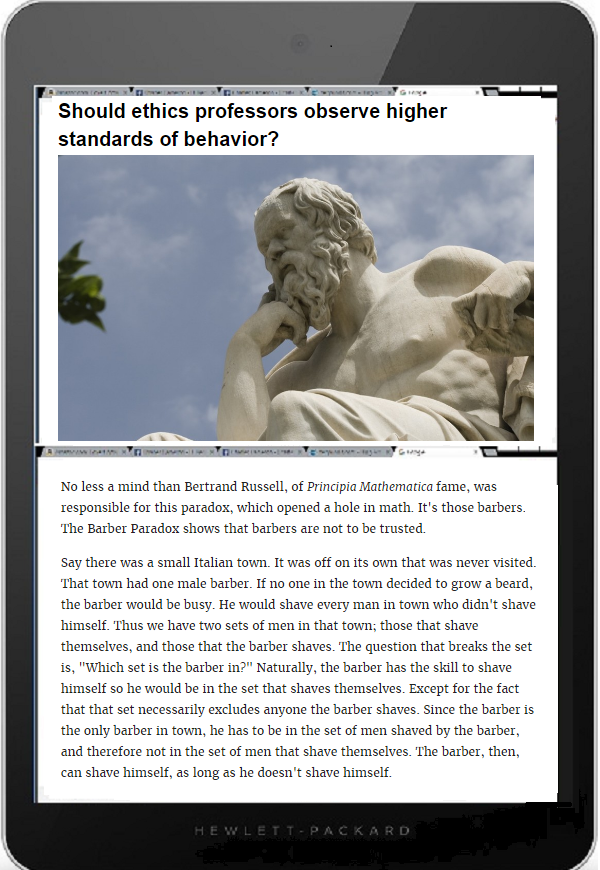
DQ 600 ethicists & barbers

**

The riddle, koan or potential paradox posed in the upper panel alludes to the matter of Yale’s professor Thomas Pogge, a noted ethicist, and some unbecoming behavior of which he has been accused — but as professor Judith Stark writing at Conversation suggests, there’s further interest beyond the case of Pogge and his accusers.

Responding to the question posed by the title of her own piece, Should ethics professors observe higher standards of behavior?, she writes:

This is an enduring dilemma in the area of ethics and one that has recently come to light with charges of unethical behavior brought against a prominent philosopher, Professor Thomas Pogge of Yale University. Pogge has been accused of manipulating younger women in his field into sexual relationships, a charge he has strenuously denied.

Without making any judgment on the case itself, this situation raises larger questions about how the behavior of the experts in ethics is to be reviewed and evaluated.

Profession and practice are, in their own way, like word and act — or are they?

**

In the lower panel, I’ve placed a discussion of Bertrand Russell‘s “barber” paradox that in Russell’s view partially but not fully resembles his paradox of the “class of all classes that are not members of themselves” — the question there being whether this class is a member of itself or not. I’m not in a position to argue such matters with Russell, so I’ll just say that he views both the “classes” and “barber” paradoxes as (different but similar) seeming knots which, when you pull on their loose ends, disentangle themselves, pop!:

Russell writes of the “barber” paradox that it is a variant on the “classes” paradox in which “the contradiction is not very difficult to solve.” The “classes” paradox is harder, he says, but he finally dismisses it as “nonsense, i.e., that no class either is or is not a member of itself, and that it is not even true to say that, because the whole form of words is just a noise without meaning.”

Or as Wm. Shakespeare might have said, “a tale told by an idiot, full of sound and fury, signifying nothing” — to which Witty Wittgenstein might have quipped, “Whereof one cannot speak, thereof one must be silent” — which, alas, has the air of a tautology, with the entire Tractatus thereby eating its own tail..

**

What do you think? Is the entire question of ethicists behaving ethically or unethically moot? a koan? does it eat its own tail? does it just melt into thin air, and leave not a rack behind?

Sources:

  • Judith Stark, Should ethics professors observe higher standards of behavior?
  • Esther Inglis-Arkell, The Barber Paradox Shook the Foundations of Math
  • Bertrand Russell, Logic and Knowledge: Essays, 1901-1950

  • Religion, religions, and the Gotthard Base Tunnel opening

    Saturday, June 4th, 2016

    [ by Charles Cameron — in which a railway tunnel assumes an almost mystical significance ]
    .

    There were some pretty strange-looking goings-on at the opening of the Gotthard Base Tunnel, to be sure:

    Gotthard Base Tunnel opening ceremony Ibex

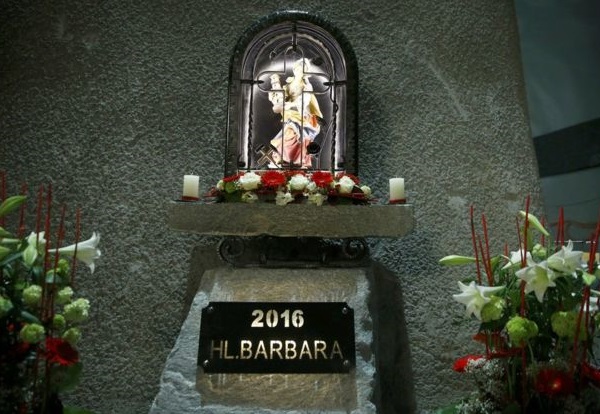
    But in case that Ibex looked just a tad too pagan — or even Satanic, as it did to some — let me assure you that Saint Barbara has a shrine inside the tunnel:

    santa barbara

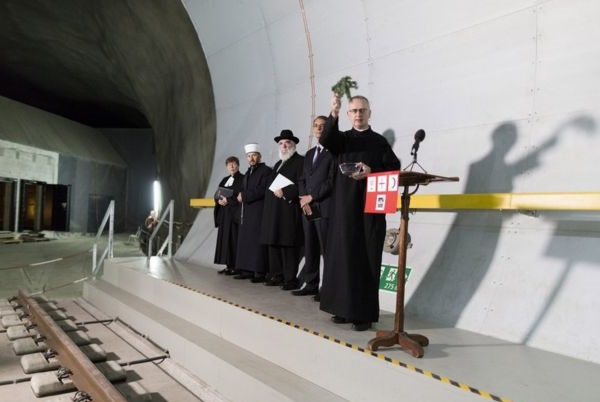
    and that clerics from a handful of reputable religions were on scene to provide appropriate blessings in any case:

    religious figures

    **

    Video:

    **

    Sources:

  • BBC, Gotthard tunnel: World’s longest and deepest rail tunnel opens in Switzerland
  • BBC, Switzerland tunnel: The oddest moments of the opening ceremony
  • Dark Horse News, Bizarre Opening Ceremony For Gotthard Base Tunnel In Switzerland
  • Brevity in Paradox

    Monday, May 2nd, 2016

    [ by Charles Cameron — or as John Cage once said, I have nothing to say and I am saying it and that is poetry ]
    .

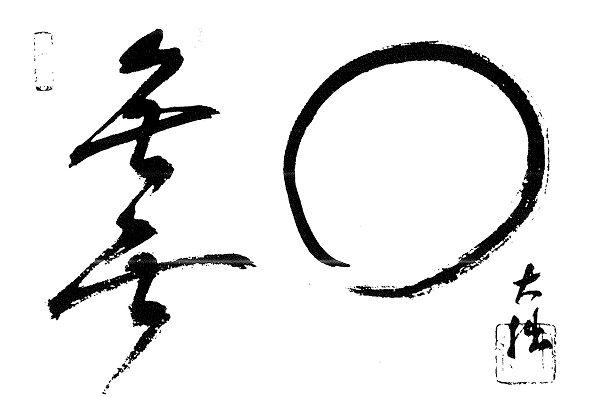
    suzuki_enso-2-sm

    **

    JV Cunningham has a poem which runs in its entirety:

    Life flows to death as rivers to the sea
    And life is fresh and death is salt to me.

    Brilliant and brief. Samuel Beckett goes him one better, writing:

    My birth was my death. Or put it another way. My birth was the death of me. Words are scarce.

    It’s the scarcity that interests me here. Earlier, in Godot, he had written:

    They give birth astride of a grave, the light gleams an instant, then it’s night once more.

    That’s too wordy. “My birth was the death of me” packs a colloquial punch, while “My birth was my death” is more succinct and correspondingly powerful.

    **

    Birth > death.

    They are opposites, obviously, and almost tautologically so — and yet there is a less-than-obvious “double meaning” to them — when brought into close conjunction they can be said to fold the universe from many back into one.

    This business of the conjunction of opposites is one which Carl Jung made the centerpiece of much of his later work, writing for instance:

    Whoever identifies with an intellectual standpoint will occasionally find his feeling confronting him like an enemy in the guise of the anima; conversely, an intellectual animus will make violent attacks on the feeling standpoint. Therefore, anyone who wants to achieve the difficult feat of realizing something not only intellectually, but also according to its feeling-value, must for better or worse come to grips with the anima/animus problem in order to open the way for a higher union, a coniunctio oppositorum. This is an indispensable prerequisite for wholeness.

    Consider the current US election campaign in this light…

    **

    Shakespeare’s “insult, exult, and all at once” in As you Like It, and Dylan Thomas’ “Curse, bless, me now with your fierce tears, I pray” in Do not go gentle are 0other instances of brevity in paradox.

    Beckett, Jung, Shakespeare, Dylan Thomas — heady company.

    Romance as a precursor drug, and as a cure, for terror

    Saturday, April 23rd, 2016

    [ by Charles Cameron — a scary thought for a poet, given that “The lunatic, the lover, and the poet / are of imagination all compact” ]
    .

    Considering the matter of altered states of consciousness as they relate to terrorism, I’m reminded of one of Shankara’s aphorisms:

    Who is the greatest hero? He who is not terror-stricken by the arrows which shoot from the eyes of a beautiful girl.

    **

    I was just reading The American Women of ISIS: Who they are, why they’re joining, and what life is like once they get there:

    Shannon Conley met a guy online. She was 19, a normal Colorado teen with glasses and a big, toothy smile. He was 32.

    One day in early 2014, Conley nervously told her father that she had a new boyfriend. She wanted her dad to meet him, so she set up a Skype call on her laptop. During the chat, the couple asked for his blessing to marry. They also told him that Conley would be moving to Syria, where they would wed and start their lives together.

    Their lives, they told him, would be dedicated to ISIS.

    Conley had recently converted to Islam after researching the religion online, and felt strongly about righting the global wrongs against Muslims. Then, adopting an extremist stance, she decided she wanted to lend her skills as a certified nurse’s aid to ISIS—also called the Islamic State, and known the world over as the vicious terrorist group responsible for brutally murdering countless victims and inciting new levels of global fear. They, she thought, were the way to do it.

    It was then that my question struck me: is anyone studying romance, specifically, as a gateway drug for violent extremism?

    **

    And the converse? How about romance as a cure?

    Bruce Hoffman told us more than a decade ago in All you need is love: How the terrorists stopped terrorism, romance can be the cure…

    Black September was, suddenly, not a deniable asset but a potential liability. Thus, according to my host, Arafat ordered Abu Iyad “to turn Black September off.” My host, who was one of Abu Iyad’s most trusted deputies, was charged with devising a solution. For months both men thought of various ways to solve the Black September problem, discussing and debating what they could possibly do, short of killing all these young men, to stop them from committing further acts of terror.

    Finally they hit upon an idea. Why not simply marry them off? In other words, why not find a way to give these men—the most dedicated, competent, and implacable fighters in the entire PLO—a reason to live rather than to die? Having failed to come up with any viable alternatives, the two men put their plan in motion.

    They traveled to Palestinian refugee camps, to PLO offices and associated organizations, and to the capitals of all Middle Eastern countries with large Palestinian communities. Systematically identifying the most attractive young Palestinian women they could find, they put before these women what they hoped would be an irresistible proposition: Your fatherland needs you. Will you accept a critical mission of the utmost importance to the Palestinian people? Will you come to Beirut, for a reason to be disclosed upon your arrival, but one decreed by no higher authority than Chairman Arafat himself? How could a true patriot refuse?

    So approximately a hundred of these beautiful young women were brought to Beirut. There, in a sort of PLO version of a college mixer, boy met girl, boy fell in love with girl, boy would, it was hoped, marry girl. There was an additional incentive, designed to facilitate not just amorous connections but long-lasting relationships. The hundred or so Black Septemberists were told that if they married these women, they would be paid $3,000; given an apartment in Beirut with a gas stove, a refrigerator, and a television; and employed by the PLO in some nonviolent capacity. Any of these couples that had a baby within a year would be rewarded with an additional $5,000.

    Both Abu Iyad and the future general worried that their scheme would never work. But, as the general recounted, without exception the Black Septemberists fell in love, got married, settled down, and in most cases started a family.

    If so, would that be a sort of variant on the homeopathic formula Similia similibus curantur?

    **

    Shakespeare — who coined the phrase “The lunatic, the lover, and the poet / are of imagination all compact” which I used in my subtitle — died 400 years ago today.

    Two profound instances of ceremonial (liturgical) impact

    Thursday, February 18th, 2016

    [ by Charles Cameron — a follow up to my post on the Vespers liturgy at Hampton Court Palace ]
    .

    Boring as hell or blissful as paradise? Religious worship can be either one.

    I know that when I was at Wellington College I must have sat through dozens of sermons in which one or another scriptural passage was read in that droning pastoral voice which Alan Bennett so skilfully skewered in his Beyond the Fringe satirical sermon on the text of Genesis 27.11, “Behold, Esau my brother is a hairy man, and I am a smooth man”:

    I was a deeply religious kid, but verses like I Samuel 15.3, “Now go and smite Amalek, and utterly destroy all that they have, and spare them not; but slay both man and woman, infant and suckling, ox and sheep, camel and ass” went right past me. I had no qualms back then about Old Testament genocides, pretty much because I didn’t notice them — these were just sacred words, intoned, a strange blend of heaven, lullaby and snooze.

    In my piece on the Hampton Court Vespers, I tried to give readers a sense of how things look from a perspective where liturgy and rites and rituals more generally need not be viewed as dry relics of a past best forgotten, but as well-springs of deep personal, interpersonal and transcendent inspiration and communion.

    **

    Here, I’d like to supplement my attempt with two “cases” that I hope will illustrate the power of liturgy.

    the first I found a few days back in Peter Berger‘s essay, Eastern Orthodox Cacophony in America:

    When the service began late on Saturday evening the cathedral was dimly lit, all the hangings and the altar cover were black in the color of Good Friday. Then the entire congregation went out into the street and marched slowly around the block. It was very cold. When we returned the cathedral was brilliantly lit and the color of everything was very bright. Easter had arrived.

    So — somebody turned the lights on.

    But no, it’s more than that, it’s the utter darkness of Christ’s descent from the cross and burial, it is grief physically imposed by that very cold pilgrimage around the block — and it’s the shock, the palpable beauty of the Resurrection dawn.

    **

    Going back yet a day further, from Good Friday to the Maundy Thursday which in the church’s calendar porecedes it, we can see the similarly profound impact of a simple gesture as my old mentor, Fr. Trevor Huddleston, washes the feet of his students in Sophiatown, the Johannesberg shanty-town where for years he taught and preached. In his own words, drawn from his book Naught for Your Comfort, we read:

    On Maundy Thursday, in the Liturgy of the Catholic Church, when the Mass of the day is ended, the priest takes a towel and girds himself with it; he takes a basin in his hands, and kneeling in front of those who have been chosen, he washes their feet and wipes them, kissing them also one by one. So he takes, momentarily, the place of his Master. The centuries are swept away, the Upper Room in the stillness of the night is all around him: “If I, your Lord and Master, have washed your feet, ye ought also to wash one another’s feet.” I have knelt in the sanctuary of our lovely church in Rosettenville and washed the feet of African students, stooping to kiss them. In this also I have known the meaning of identification. The difficulty is to carry the truth out into Johannesberg, into South Africa, into the world.

    That world, for Fr Trevor, was the world of South African apartheid. He carried that truth out into Johannesberg and the world in his book, and as President of the Anti-Apartheid Movement — and with what impact! He lived to see apartheid gone.

    **

    In closing, let me quote TS Eliot who wrote, in his Dialogue on Dramatic Poetry:

    I say that the consummation of the drama, the perfect and ideal drama, is to be found in the ceremony of the Mass. … And the only dramatic satisfaction that I find now is in a High Mass well performed. Have you not there everything necessary? And indeed, if you consider the ritual of the Church during the cycle of the year, you have the complete drama represented. The Mass is a small drama, having all the unities; but in the Church year you have represented the full drama of creation.


    Switch to our mobile site