zenpundit.com » framing

Archive for the ‘framing’ Category

The Said Symphony: move 19

Sunday, March 18th, 2012

[ by Charles Cameron – extended analytic game on Israeli-Palestinian conflict — for those who wish to catch up, our game thus far consists of an intro to the game and game board, followed by moves 1-5, 6-9, then moves 10-11 which together constitute a meditation, moves 12, 13-15, 16-17, and most recently before this, move 18 with cadenza ]

Move 19: The view from above

Move content:

Discussing strategy, the very canny LTG (USMC, Ret’d.) Paul Van Riper had this to say:

What we tend to do is look toward the enemy. We’re only looking one way: from us to them. But the good commanders take two other views. They mentally move forward and look back to themselves. They look from the enemy back to the friendly, and they try to imagine how the enemy might attack them. The third is to get a bird’s-eye view, a top-down view, where you take the whole scene in. The amateur looks one way; the professional looks at least three different ways.

A bird’s-eye view, a hawk’s eye view, a top-down view, an overview, a view from 30,000 feet, a God’s eye view, a view from above, a zoom…

If move 18 and its cadenza gave us a view of the depth of vision or insight that is necessary for a full and rich understanding of the world we live in — its qualitative or spiritual scope, if you like — this next move, with its picnic and drone-sight, addresses its breadth in space and time — materially and quantitatively speaking.

The classic expression of the sheer material scope of the universe was put together by Charles and Ray Eames in their justly celebrated film, Powers of Ten, from which the lower of these two images is drawn:

Here are some other relevant scans of the scope of things, in terms of time and space:

The Scale of the Universe 2
A Brief History of The Universe
The Known Universe
A Time-Lapse Map of Every Nuclear Explosion Since 1945

These are impressive videos to be sure, but as an aside I’ll invite you to ask yourselves how well they compare with this zoom in words, a poem by the zennist, ecologist, essayist and poet Gary Snyder, from his book, Axe Handles: Poems:

Such breadth of vision, such craft.

*

If this “material scope of things” too has a cadenza, it would be that all of this is shot through with some primary oppositions, dappled as the poet Gerard Manley Hopkins would have it, with swift, slow; sweet, sour; adazzle, dim — as indicated in the drone-sight and picnic double image at the head of this move.

This dappling, this constant flux of opposites, takes many forms — day and night lead to the more abstract light and dark, which can then be interpreted morally as good and evil, to which we respond with repulsion and attraction as the case may be, building our worldviews from love or fear…

At different scales the opposites that matter most to us may have different names and shadings, but here I’d just like to draw attention to the dappling of our world with:

competition and cooperation
Darwin‘s natural selection and Kropotkin‘s mutual aid
duel and duet (ah! — a favorite phrasing of mine)
war and peace

Provocatively, we find this dappling in scriptures, too, wherein the ripples of such verses as “The LORD is a man of war: the LORD is his name” (Exodus 15.3) dropped like a stone into the pond of the human mind, meet with the ripples of other verses such as “God is love; and he that dwelleth in love dwelleth in God, and God in him” (I John 4.16).

There are times when we take such oppositions literally, perhaps too literally, and times when we begin to see oppositions as abstract and theoretical end-points to what is in fact a yin-yang process continually unfolding…

Which brings me by a commodius vicus of recirculation to this image of the great opposition between war and peace, its dappling, its unfolding:

Links claimed:

To the Lamb, move 18: this move presents the material scope of the universe in counterpoint to its visionary scope as laid out in move 18 with its cadenza.

To Revelation, move 17 — the word revelation means unveiling, as we have seen, and our sciences and technologies, with their spectra of telescopes, microscopes, cameras and zooms, are unveiling and revealing to us much about the physicality of the world we live in — much that was accounted for in other times and places through intuition, vision and poetry.

This scientific and technical revelation of material existence, for many of us moderns, has largely eclipsed the mode of visionary revelation of move 17 — yet it cannot eradicate it. Implicit in this move, then, is the sense that we carry with us both subjective and objective, inner and outer, qualitative and quantitative understandings — though the data that “sight” and “insight” provide us with may be different in kind, and resolving them may be something of a koan to us, the deep problem in consciousness as philosophers of science have named it — and that we can discount neither one if we are to have and maintain a rich sense of our situation.

Comment:

If the two previous moves have shown us the scope of the universe we co-inhabit, perhaps we should now make our own zoom in, much as James Joyce did when he had the schoolboy Stephen inscribe his name and address in his geography book as Stephen Dedalus, Class of Elements, Clongowes Wood College, Sallins, County Kildare, Ireland, Europe, The World, Universe – an address that Stephen then read both forwards and backwards, finding himself in one direction, and finding in the other that he had no means of knowing what might lie beyond the universe…

Imagine then, skipping rapidly from (unimaginable) cosmos via such things as the intriguingly named End of Greatness to galaxy or nebula…

…solar system and planet — whence we can slow down and zero gently in on the Middle (or as my friend Ralph Birnbaum would call it, the Muddle) East, Israel / Palestine, Jerusalem / Al Quds / the Temple Mount / Noble Sanctuary – and to such matters of contemplative vision and tribal passion as the first, second and projected third Temples, the al-Aqsa mosque.

Our increasing focus will bring us, then, to that the rock which Jews believe marks the place where Abraham bound his son Isaac (the Akedah), and which Muslims believe to be the place of ascent of the Prophet to the celestial realms (the Mi’raj) on his Night Journey (Qur’an, Al-Isra).

Here again myth and history collide, and both visionary and material considerations merge in the heart of the what my friend the Israeli journalist Gershom Gorenberg has justly called “the most contested piece of real estate on earth”.
Vivaldi, veiling and revelation…

Wednesday, March 14th, 2012

[ by Charles Cameron — some glorious music, Venice, Kandahar ]
.

I was listening to Pergolesi‘s Stabat Mater the other day, and talk came around to the question of whether women would have sung the two solo parts – whether they were written for soprano and contralto, in other words, or for treble and counter-tenor – all of which reminded me that the “red priest” Vivaldi was, for over thirty years, maestro of the Ospedale della Pietà orphanage in Venice.

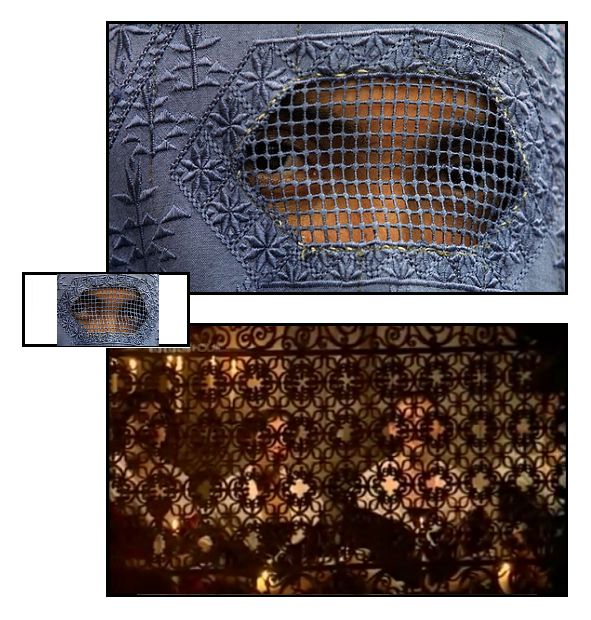
The Ospedale’s all-woman choir performed many of his sacred choral works in church, hidden from view if not speculation in a high balcony behind an iron grille…

The BBC has an hour-long documentary on the subject of Vivaldi’s Women, which features the Ospedale but also the contemporary choir and orchestra, Vivaldi’s Women, more properly known as the Schola Pietatis Antonio Vivaldi.

The (lower) image of the present-day women’s choir singing behind one of those grilles – accompanied by a voice-over reading from a fashionable “grand tour” diary of the day which reports that the “grilles conceal the angels of loveliness” (the writer was perhaps aware, perhaps not, that many of the orphans in Vivaldi’s day would have been scarred or deformed by the pox or their parents’ syphilis) reminded me of another contested icon of “women behind a grille” – this time, the traditional Afghan chadari (upper image)…

*

I have exchanged greetings through a grille with Carmelite nuns in California, and they clearly appreciated the sanctuary that their enclosure offered them…

My point is not to argue the superiority of bikini over burqa or vice versa: it is to offer you a chance to hear some Vivaldi or Pergolesi, and to consider the issue of veiling and revealing — intimacy’s equivalent of secrecy and transparency — from what was for me at least an unexpected and fresh angle.

One quick illustrated quote from Secretary Clinton

Wednesday, March 14th, 2012

[ by Charles Cameron — sometimes i post things so obvious they might actually be useful ]
.

One quick annotated quote from Sec. Clinton‘s speech at the U.S. Institute of Peace China Conference, March 7th:

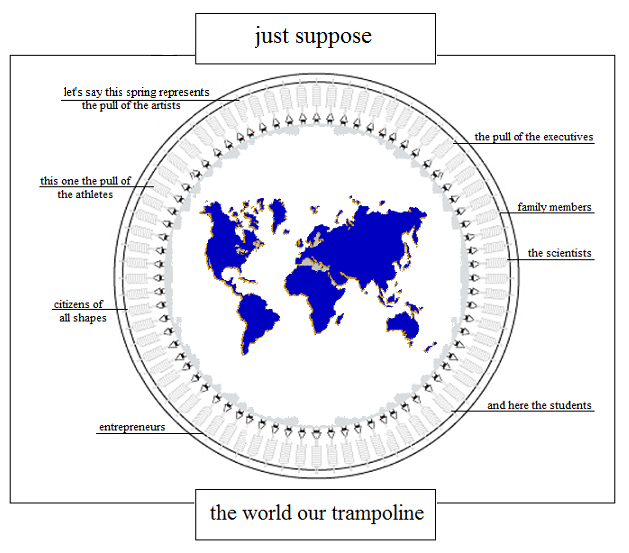
Now when I say “we,” I do not mean only our governments, as important as they are. Every day, across both of our countries, executives and entrepreneurs, scientists and scholars, artists and athletes, students and teachers, family members and citizens of all kinds shape and pull and add to this relationship. Together, they represent a vast range of priorities, concerns, and points of view. And they are all stakeholders in how we build toward a shared future.

It’s really that list I’m after…

There are seven billion individuals bouncing up and down on our trampoline, some of them holding hands, some of them in gangs that want to trip up rival gangs, or make a clearing for themselves and themselves alone, some too weak to bounce much at all…

and each time each one of us lands, we impact the trampoline from a different angle, stretch it a different way – tugging it to the will of the artist, the entrepreneur, the child, the retiree, the curious, the aggressive, the meek…

As we know, the earth is round, which is to say three-dimensional – but the tugs on it, the tensions, are more complicated than that, in fact they’re complex, n-dimensional – and constantly shifting.

Hilary Clinton wants to wake up in the morning, have coffee – and model that! – along with, and in balance with, her counterpart in another huge mass of population, half a globe and at least six philosophies away…

The coffee’s good, but it’s not enough — what we all could use is a new mode of thinking.

*

Maps courtesy of www.theodora.com/maps used with permission

The speeds of thought, complexities of problems

Wednesday, February 1st, 2012

[ by Charles Cameron — instinct, rationality, creativity, complexity and intelligence ]
.

Guy Claxton, Hare Brain, Tortoise Mind
Daniel Kahneman, Thinking, Fast and Slow

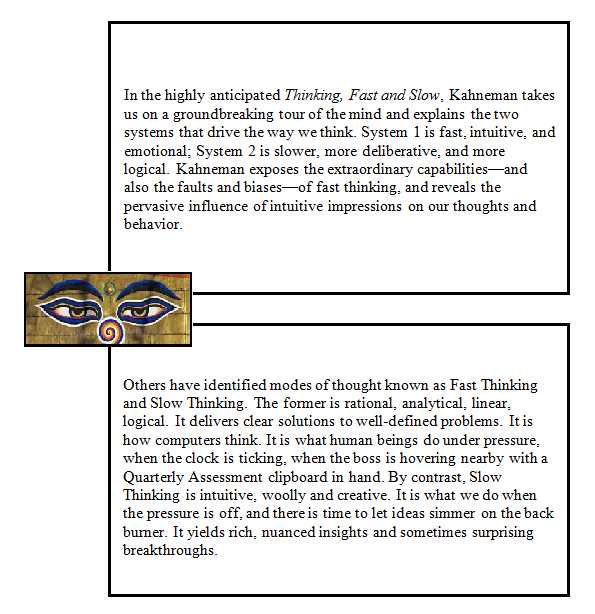
You might think, taking a quick glance at their titles, that these two books would be in substantial agreement with one another about the speeds of thought. But consider these two comments, in one of which the deliberative, logical mind is “slower” than the intuitive and emotional — while in the other, it is the rational mind that is “faster” and the intuitive mind which is “slower”. Brought together, the two quotes are amazing — it would seem that either one or the other must be wrong:

\

Happily, I don’t believe either one is wrong — I think it’s more a matter of there being three speeds of thought, and the two books in question using different terminologies to emphasize different distinctions between them.

Here’s a more extended version of Guy Claxton’s position:

Roughly speaking, the mind possesses three different processing speeds. The first is faster than thought. Some situations demand an unselfconscious, instantaneous reaction. … Neither a concert pianist nor an Olympic fencer has time to figure out what to do next. There is a kind of ‘intelligence’ that works more rapidly than thinking. This mode of fast, physical intelligence could be called our ‘wits’. (The five senses were originally known as ‘the five wits’.)

Then there is thought itself — the sort of intelligence which does involve figuring matters out, weighing up the pros and cons, constructing arguments and solving problems. A mechanic working out why an engine will not fire, a family arguing over the brochures about where to go for next summer’s holiday, a scientist trying to interpret an intriguing experimental result, a student wrestling with an examination question: all are employing a way of knowing that relies on reason and logic, on deliberate conscious thinking. … Someone who is good at solving these sorts of problems we call ‘bright’ or ‘clever’.

But below this, there is another mental register that proceeds more slowly still. It is often less purposeful and clear-cut, more playful, leisurely or dreamy. In this mode we are ruminating or mulling things over, being contemplative or meditative. We may be pondering a problem, rather than earnestly trying to solve it, or just idly watching the world go by. What is going on in the mind may be quite fragmentary. What we are dunking may not make sense. We may even not be aware of much at all. As the English yokel is reported to have said: ‘sometimes I sits and thinks, but mostly I just sits’. […]

That third mode of thinking is the one Claxton identifies with “wisdom” — which is interesting enough. Just as interesting, though, is his identification of this slowest mode of thought with “wicked problems”:

Recent scientific evidence shows convincingly that the more patient, less deliberate modes of mind are particularly suited to making sense of situations that are intricate, shadowy or ill defined. Deliberate thinking, d-mode, works well when the problem it is facing is easily conceptualised. When we are trying to decide where to spend our holidays, it may well be perfectly obvious what the parameters are: how much we can afford, when we can get away, what kinds of things we enjoy doing, and so on. But when we are not sure what needs to be taken into account, or even which questions to pose — or when the issue is too subtle to be captured by the familiar categories of conscious thought — we need recourse to the tortoise mind.

I haven’t read either book, and I’d hope that Kahneman as well as Claxton actually addresses all three speeds of thought. But my immediate point is that the slowest of the three forms of thought is the one that’s best suited to understanding complex, wicked and emergent problems.

And that’s the one that can’t be hurried — the one where the Medici Effect takes effect — and the one which provides Claxton with one of his finest lines, with which he opens his book, a western koan if ever I saw one:

There is an old Polish saying, ‘Sleep faster; we need the pillows’, which reminds us that there are some activities which just will not be rushed. They take the time that they take.

More on that front shortly, insha’Allah and the creek don’t rise.

A poignant week or so in DoubleQuotes

Friday, December 30th, 2011

[ by Charles Cameron — fictitious peoples (Israelis, Palestinians), approved and disapproved scriptures (Hindu, Falun Gong), religious violence (Afghanistan, Nigeria, Bethlehem) ]
.

So, is there some sort of contest going on between Iranian and American ex-Speakers? Perhaps Elliott Abrams‘s response to Gingrich, quoted in the Washington Post piece, applies equally well to Haddad-Adel?

There was no Jordan or Syria or Iraq, either, so perhaps he would say they are all invented people as well and also have no right to statehood.

Next up…

And okay, what’s the point here? Is it that the Russians want to please both the Chinese and Indian governments — or that they don’t like new scriptures but are okay with old ones? Or is the problem that they haven’t decided yet on a “one size fits all” approach to unOrthodox religions?

Sigh. Next…

This is brutal — and apparently intercontinental.

You might think it’s obvious what the wrong answer is, and who’s doing the killing, in Nigeria. But these things can cut both ways:

Even here, it’s not clear who threw the bomb into the madrasa, although one could hazard a guess…

And even the site of the Nativity is infected. The Guardian’s account of events there this Christmas season is harsh in tone — but consider whose Nativity is supposedly being celebrated…

I’d say the Qur’an offers a better image of Christian monks than that experienced by those Palestinian riot police… who, in the event, although they themselves were also assailed with broom-sticks, declined to arrest anyone because, as Palestinian police lieutenant-colonel Khaled al-Tamimi put it:

Everything is all right and things have returned to normal. No one was arrested because all those involved were men of God.

Still, things could be worse. It was a squabble along similar lines in which nine several Orthodox monks were killed that triggered the Crimean War: details in Raymond Cohen, Conflict and Neglect: Between Ruin and Preservation at the Church of the Nativity — h/t Juan Cole, who also has video of this year’s brouhaha.

*

Et in terra pax hominibus bonae voluntatis.


Switch to our mobile site