zenpundit.com » theory

Archive for the ‘theory’ Category

Guest Post: Of Weaponry and Flags

Sunday, October 24th, 2010

 Charles Cameron is the regular guest-blogger at Zenpundit, and has also posted at Small Wars Journal, All Things Counterterrorism, for the Chicago Boyz Afghanistan 2050 roundtable and elsewhere.  Charles read Theology at Christ Church, Oxford, under AE Harvey, and was at one time a Principal Researcher with Boston University’s Center for Millennial Studies and the Senior Analyst with the Arlington Institute:

Originally posted at Chicago Boyz.com

Of Weaponry and Flags

by Charles Cameron

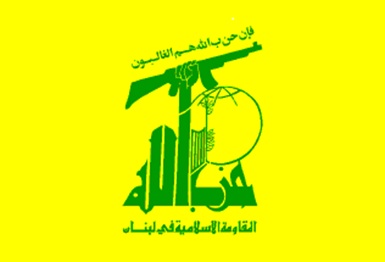
Hezbollah Flag Use

A day or two ago, Abu Muqawama asked whether the Hizballah flag showed an AK-47, and in general what flags carried what weapons as emblems.

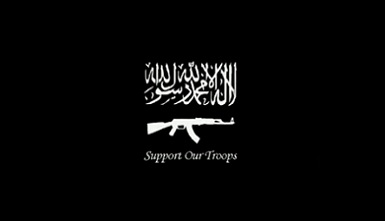
As it happens, I’d just been viewing a pro-jihadist United States of Islam video and made the following screen-capture as an illustration of my continuing concern about the “black flags of Khorasan” and the issue of whether AQ and or its franchises and or portions of the Taliban consider themselves to be fighting the apocalyptic war of the end of time.

Black Flag Support out Troops Sm

Note also that the filmmaker’s ironic borrowing of the phrase “Support Our Troops” to urge support of the troops of the Mahdi will not be lost on some viewers.

This screen-capture, from the United States of Islam video, in turn reminded reminded me of the Saudi flag, which likewise carries the shahada or Muslim profession of faith and a weapon – a sword.

Saudi flag

According to a note on an earlier version of the World Flag Database:

The script in the centre of the flag is the Islamic creed, “There is no God but Allah, and Mohammed is the Prophet of Allah”. The flag is therefore considered sacred and special protocol rules apply: the flag does not dip in salute, nor is it ever flown at half-mast. Note that the creed always reads properly from right to left, with the sword hilt to the right, so the reverse of the flag is not a mirror image of the obverse. When making the flag, the creed must be reproduced precisely, including the accent marks. The use of the flag on any commercial item (especially clothing) is not recommended as it might be considered inappropriate, or even insulting.

The Shahada is the central testament of faith of Islam, as is the Shema Yisroel of Judaism and the Credo of Christianity, and I respect it as such – and likewise the Saudi flag., on which it is displayed.

*

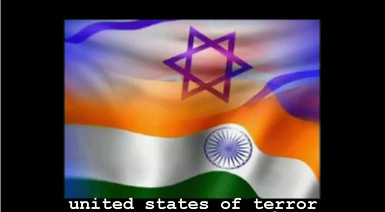
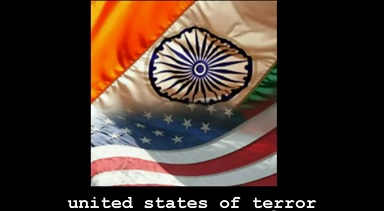
Flags, however, are potent symbols, and the graphical power of the “black flags of Khorasan” motif should not, in my view, be underestimated. The particular video that I took that screen-capture from makes use of “mix” flags of its own devising:

Flag01

– merging the American and Indian flags – or the flags of India and Israel –

Flag02

to create an imagery of the “United States of Terror” to juxtapose against their own black flags as the “United States of Islam” – giving us Huntington’s “Clash of Civilizations” in visceral graphic form.

And that conjunction of India with Israel bears thinking about, too… not only in terms of military aid between the two nations, but also of the symbolic juxtaposition of the Al-Aqsa Mosque and Jerusalem with the Babri Masjid and Ayodhya…

Indeed, the Indian flag itself also deserves consideration in our context.

indian-flag

Originally, Mahatma Gandhi had hoped that it would feature the charka or spinning wheel which he had made famous. As an informative article on the subject from The Hindu puts it:

For Gandhiji, the charka represented not a mere hand-spinning device that could provide employment and income to the poor, but much more. “The message of the spinning-wheel is much wider than its circumference. Its message is one of simplicity, service of mankind, living so as not to hurt others, creating an indissoluble bond between the rich and the poor, capital and labour, the prince and the peasant.” (Young India, September 17, 1925). “Above all, charka is a symbol of non-violence” (Collected Works of Mahatma Gandhi, Vol. 71, first edition, p.234).Gandhiji was, therefore, all the more sad when a correspondent from Hyderabad brought to his notice, on the eve of Independence, K. M. Munshi’s indictment in his broadcast speech that the wheel in the new flag represented the Sudarshana Chakra (discus of Lord Vishnu), a symbol of violence! But Gandhiji consoled himself that “under no circumstances, can the Asoka Chakra become a symbol of violence as Emperor Asoka was a Buddhist and a votary of non-violence” (Harijan Sevak, August 17, 1947).

So there’s another weapon-flag connection – albeit one where non-violence seems to triumph over violence.

*

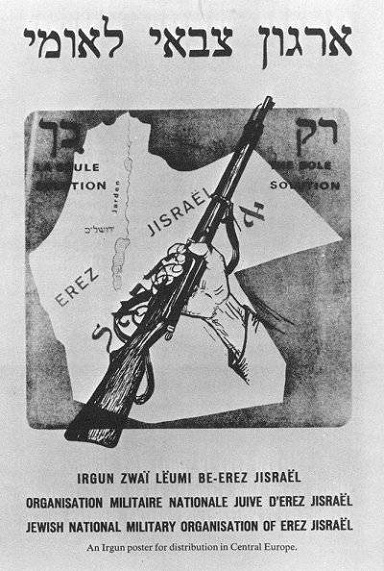
But let me get back to the yellow Hizbollah flag with which we started, and quickly note the resemblance (which I don’t claim to be the first to note, but cannot presently find my source for) between its portrayal of a rifle raised in a victorious fist, and this poster from the Irgun:

Irgun poster

And that’s enough about weaponry and flags for now, I think.

I hope to follow this post up shortly with a more detailed account of the United States of Islam video mentioned above, and its many and curious references and resonances.

Guest Post: A Hipbone Approach to Analysis

Saturday, October 23rd, 2010

Charles Cameron is the regular guest-blogger at Zenpundit, and has also posted at Small Wars Journal, All Things Counterterrorism, for the Chicago Boyz Afghanistan 2050 roundtable and elsewhere.  Charles read Theology at Christ Church, Oxford, under AE Harvey, and was at one time a Principal Researcher with Boston University’s Center for Millennial Studies and the Senior Analyst with the Arlington Institute:

A Hipbone Approach to Analysis

by Charles Cameron

I think it’s about time I laid out some of the basic thinking behind the style of analysis that I refer to as the “hipbone” approach.

Seen from one angle, it has to do with Sun Tzu’s double-whammy: “know your enemy, know yourself”.

F Scott Fitzgerald wrote, “The test of a first-rate intelligence is the ability to hold two opposing ideas in mind at the same time and still retain the ability to function.” Let me be blunt about this: if you want to “know yourself” and “know your enemy” as Sun Tzu recommends you should, you’ll need to be able to keep two opposing minds in mind at the same time – and still retain the ability to function.

The hipbone approach uses very simple concept-mapping tools and some fairly subtle insights derived from a lifetime of introspection and the arts to facilitate and annotate that process, and to make the resulting understandings available to others.

But first, let’s get down to the kind of thinking that lies behind this approach.

1

One thing I want to know is: what are the most subtle and complex mini-structures that the human mind can take in, more or less at one swoop. Then I’d like to know what their moving parts are, how — to the extent that they have a “main thrust” — they handle parallelisms and reconcile oppositions to that thrust, and what they do with stuff that’s oblique or orthogonal to it, how they put constraints to use in service of expression, what use they make of decoration, how they handle ignorance, how they reconcile head and heart, certainty and doubt, and how they keep the surface mind occupied while affecting the deeper layers of our being… And I want to know that, viscerally — to feel it in my bones, if you like – because I’d like to be able to do more or less the same thing with regard to complex real-world problems, on a napkin, by myself, or with friends or enemies.

2

I want to know what those things are because (a) they’re the most nourishing things I can feed myself, and I need all the nourishment I can get, and (b) because it turns out that if I can come up with product that has the same formal properties, I’ll be able to explain things both to myself and other people that otherwise leave me stuttering platitudes.

Somewhere right about there, I run into a quotation like this one, from Cornelius Castoriadis in his World in fragments: writings on politics, society, psychoanalysis, and the imagination:

Remember that philosophers almost always start by saying: “I want to see what being is, what reality is. Now, here is a table. What does this table show to me as characteristic of a real being?” No philosopher ever started by saying: “I want to see what being is, what reality is. Now, here is my memory of my dream of last night. What does this show to me as characteristic of a real being?” No philosopher ever starts by saying “Let Mozart’s Requiem be a paradigm of being, let us start from that.” Why could we not start by positing a dream, a poem, a symphony as paradigmatic of the fullness of being and by seeing in the physical world a deficient mode of being, instead of looking at things the other way round, instead of seeing in the imaginary — that is, human — mode of existence, a deficient or secondary mode of being?

What I think I’m hearing here, half-hidden in the words, is that the Mozart Requiem is one of those high-density, subtle and complex mini-structures.

And I agree — in fact I find myself thinking of the arts that way, as the natural places to look for high-density, subtle and complex models of reality.

3

Of course, it would be absurdly neat if nobody else had ever noticed this, and I could take all the credit for myself – but no, the great anthropologist and cybernetician Gregory Bateson makes pretty much the same observation about poetry:

One reason why poetry is important for finding out about the world is because in poetry a set of relationships get mapped onto a level of diversity in us that we don’t ordinarily have access to. We bring it out in poetry. We can give to each other in poetry the access to a set of relationships in the other person and in the world that we are not usually conscious of in ourselves. So we need poetry as knowledge about the world and about ourselves, because of this mapping from complexity to complexity.

Poems are precisely “high-density, subtle and complex mini-structures” – that’s how they manage the “mapping from complexity to complexity” – and so the question comes up, what’s the role of structure in the arts?

4

Let’s take a quick look at musical structure, and at polyphony and counterpoint in particular. Your enemy’s perspective and your own – or the many perspectives of the various stakeholders in a complex, perhaps “sticky” or “wicked” problem – can be compared with the different, often discordant melodies from which a Bach or Mozart or Beethoven weaves a fugue – melodic themes which are not infrequently “inverted” or in “contrary motion”.

So what can the musical structure of counterpoint teach us, who are faced with real-world situations comprised of different needs and ideals — often discordant, often in counterpoint or opposition to one another, often in “contrary motion”?

Here’s Edward Said, discussing the Israeli-Palestinian problem in terms (gasp!) of musical form:

When you think about it, when you think about Jew and Palestinian not separately, but as part of a symphony, there is something magnificently imposing about it. A very rich, also very tragic, also in many ways desperate history of extremes — opposites in the Hegelian sense — that is yet to receive its due. So what you are faced with is a kind of sublime grandeur of a series of tragedies, of losses, of sacrifices, of pain that would take the brain of a Bach to figure out. It would require the imagination of someone like Edmund Burke to fathom.

Like him or leave him, Said in this paragraph is clearly thinking along similar lines to the ones I’m proposing.

Or to move to yet another art, that of theater — what can we learn about the simulation and modeling of complex issues from Shakespeare? Keith Oatley’s Shakespeare’s invention of theatre as simulation that runs on minds is a serious exploration of that possibility.

5

I’m going to return to the arts, and lay out a theory of what an art is and how it works, in a later post in this series – but for now, let me just say that I’ve devised a cognitive mapping tool, or more precisely a family of games and mapping tools, that I call “HipBone Games and Analysis” because they’re all about the way one idea connects with another – just as “the hip-bone’s connected to the thigh-bone” in the song.

And as I commented recently on Zenpundit:

What I’m aiming for is a way of presenting the conflicting human feelings and understandings present in a single individual, or regarding a given topic in a small group, in a conceptual map format, with few enough nodes that the human mind can fairly easily see the major parallelisms and disjunctions, as an alternative to the linear format, always driving to its conclusion, that the white paper represents. Not as big as a book, therefore, let alone as vast as an enormous database that requires complex software like Starlight to graphically represent it, and not solely quantitative… but something you could sketch out on a napkin, showing nodes and connections, in a way that would be easily grasped and get some of the human and contextual side of an issue across.

6.

To balance Sun Tzu’s “know your enemy, know yourself” with which I began, I’ll offer by way of counterpoint Christ’s “But I say unto you which hear, Love your enemies, do good to them which hate you” (Luke 6.27). And now for two of my favorite words: more soon…

Guest Post: Shipman on Boyd and Beyond, 2010

Thursday, October 21st, 2010

J. Scott Shipman is the owner of a boutique consulting firm in the Metro DC area that is putting Boyd’s ideas into action.

Boyd and Beyond, 2010

by J. Scott Shipman

Boyd & Beyond 2010, 15-16 October 2010

Mr. Stan Coerr (GS-15 Marine Corps, LtCol, USMCR), coordinator. Hosted by the USMC Command and Staff College at the Marine Corps University, Quantico, VA.

This was my first Boyd conference. I discovered Boyd in early 2005 through Robert Coram’s book, BOYD, The Fighter Pilot Who Changed the Art of War. I did not know what to expect of the conference, and was anxious to meet guys I’d corresponded with over the last couple of years (the ones who made it: Robert Coram, Fred Leland, Don Vandergriff, and Adam Elkus); so my thinking going in was at least I’d get to meet these guys regardless, and besides Quantico is right down I-95 from my home.

As others have already observed, Boyd 2010 exceeded any expectation. It was a pleasure to be in the same room with such an impressive collection of talent and intellect and listen to what they have done and continue to do with Boyd’s work and ideas. At the end of the first day, I felt my head was going to explode—and heard many others echoing similar sentiment. I told a friend, those two days were like drinking from a fire hydrant.

As many readers are probably already aware, the reaction to the conference has been universally positive, and calls for a 2011 event have been heard and is scheduled for 14-15 October 2011 at Quantico, same location. Stan Coerr and the USMC University deserve our gratitude for this recent event and the opportunity to reconvene next year. The bar, has indeed been set high.

What follows is from my notes, and I apologize in advance if I leave out something I should have remembered. I will try and avoid repeating too much of Adam Elkus’ excellent review, so all presenters are not covered—while all presenters provided valuable and enlightening insights. At the conclusion, I’ve added the references of books and online links that I heard (there were many more) recommended, and books and articles I recommended during the conference.

The day began with a colorful introduction to Boyd by Robert Coram. He related the circumstances of how he came to write BOYD, and shared several stories of the evolution of the book and the people he met. Coram reported that as of the conference, 73,000 copies of BOYD are in print—not bad for a book about someone most people have never heard of.

Ray Leopold, PhD, (the third acolyte) gave a touching and penetrating retrospective of how he came to be associated with John Boyd, and how that association changed his life for the better. Of interest, Ray shared a common introduction that he and Boyd used when they visited other Air Force officers. They would write the following on the blackboard:

DUTY, HONOR, COUNTRY

They would then cross these familiar words out, and replace with:

Pride, Power, Greed

From Boyd’s perspective, the military industrial complex and the inherent bureaucracy had (and in my humble opinion, continues) corrupted the original intent of those core principles military members are taught to embrace.

Don Vandergriff followed with a fast-paced explanation of his continuing efforts within the US Army to advocate Outcome Based Training and Education (T&E). He follows with successful practical examples of allowing his student to think and adapt-“off-script.” Vandergriff also recommended the work of Dr. Robert Bjork, Dean of the School of Psychology at UCLA, particularly his presentation “How We Learn Versus How We Think We Learn: Implications for the Organization of Army Training.”

General Paul Van Riper (LtGen, USMC, Ret) was the keynote and gave a compelling address on mental models and systems theory. Throughout his talk, he added insight into how John Boyd’s ideas found a home in the USMC. Gen Van Riper made the distinction between informational knowledge and transformational knowledge, and the “eloquent schema” that is OODA. He also discussed systems theory, and distinguished between linear systems (cause & effect), complex systems, and interactive complex systems. Of the later, he reminded that these systems are non-linear and unknowable using a deductive approach, and one output is emergent behavior(s).

Marcus Mainz (Major, USMC) provided insight into how he is using Boyd’s ideas in the training and development of young Marine officers and how he and his colleagues are creating the desire to learn. LtCol Mike Grice (USMC) provided our group with insight into how Boyd’s ideas translate in the field—having just returned from Afghanistan and a tour in one of Iraq’s more dangerous provinces. Both of these officers reflect well on the USMC—and if this caliber of leadership and thought is any indication, the USMC is in good hands in the years to come.

On the second day, Linton Wells, PhD, (CAPT, USN, Ret) gave a talk on naval maneuver warfare. Dr. Wells was providing a preview of his update to a seminal article of the same title he wrote for Proceedings in December 1980. Dr. Wells also provided one of the best quotes of the two days: “make knowledge accidents happen.”

Fred Leland’s presentation revolved on how he has used Boyd’s work to teach law enforcement personnel how to make good decisions. Fred began his talk with an absolutely frighteningly disturbing video from the dash-cam of a young police officer caught in a dangerous place. Fred lives his curricula, as he is an active duty police lieutenant, so his presentation had a resonance unique to our gathering.

Terry Barnhart, PhD, (Pfizer R&D) provided unique insight into how he is using Boyd’s ideas (OODA, to be specific) in his company’s R&D efforts. Barnhart, in my estimation, is onto something very powerful. He repurposed Boyd’s OODA from the traditional vernacular into: See, Reframe, Experience, Grow—but the intent remains. Dr. Barnhart placed great emphasis on “SEE” where his definition is: “assume it is wrong” and see without prejudice. He reported exciting results from using this and another model derived from Boyd’s work.

Chip Pearson, Managing Partner of a software company in Minnesota, gave an impassioned recounting of how he used/uses Boyd’s concepts to start and successfully operate his software company. His philosophy, “we make meaning, not money.” Chip focused on values, capability, and objectives. On his management philosophy, he remarked, “complete independent action scares the hell out of people”—which is how he wants his organization to operate.

Jussi Jaakonahon, from Nokia, travelled the furthest, coming from Norway, to give his talk on his experience using OODA in IT security exercises. He confirmed Boyd’s emphasis on sharing information of validity and integrity, and adapting on the fly to the mission. During this exchange someone remarked: “companies die because they do the right thing too long.” We hope he will be able to join us for both days next year.

CORRECTION:

I was contacted by Jussi Jaakonaho, I misspelled his name—this is the correct spelling. He came from Finland, not Norway. This quote should be attributed to Jussi: “companies won’t die because of their false actions. they die because of the continuing of the same actions for too long (which once were right).”

My sincere apologies for the inaccuracies. 
There was a language barrier, and as a Southerner, English is my second language:))

Dave Foster provided an introduction to his draft paper on portfolio complexities in the fog of war. One goal of his paper is helping to shrink the knowledge-doing gap. Foster is on to something, and I’m guessing this forum will help him advance his ideas.

TJ Jankowski (Col, USMCR) was the anchor man for our two days. His talk, COIN Technology and Universal Structures of Technical Knowledge, dealt with emerging theories of a taxonomy of technologies. His ideas are based on the work of Dr. Rias van Wyk which advances the idea of “a fundamental structure of technological knowledge, based in part on a very precise definition of technology and a functional  classification of all technological knowledge.” (TJ Jankowski follow-up email) The implications of these ideas could be revolutionary in our ability to conduct macro technology analysis.

Alan D. Beyerchen, Clausewitz, Nonlinearity ?and the Unpredictability of War http://www.clausewitz.com/readings/Beyerchen/CWZandNonlinearity.htm

DoD Command and Control Research Program (CCRP) by Tom Czerwinski: http://www.dodccrp.org/events/13th_iccrts_2008/CD/library/html/pdf/Czerwinski_Coping.pdf

Hew Strachan, Clausewitz’s On War: A Biography

http://www.amazon.com/gp/product/0802143636/ref=ord_cart_shr?ie=UTF8&m=ATVPDKIKX0DER

John Shook, Managing to Learn: Using the A3 Management Process

http://www.amazon.com/Managing-Learn-Using-Management-Process/dp/1934109207/ref=sr_1_1?ie=UTF8&qid=1287607276&sr=8-1

Nik Gowing, “Sky Full of Lies and Black Swans” (free registration required to access whole article)

http://www.bbcworldnews.com/Pages/Programme.aspx?id=362

Richard E. Neustadt and Ernest R. May, Thinking in Time: The Uses of History for Decision-Makers

http://www.amazon.com/Thinking-Time-Uses-History-Decision-Makers/dp/0029227917/ref=sr_1_1?ie=UTF8&qid=1287610406&sr=8-1

A few titles I recommended:

Seen recently here at Zenpundit comes with a hearty recommendation:

Magic and Mayhen, The Delusions American Foreign Policy from Korea to Afghanistan by Derek Leebaert

http://www.amazon.com/Magic-Mayhem-Delusions-American-Afghanistan/dp/1439125694/ref=sr_1_1?s=books&ie=UTF8&qid=1287610785&sr=1-1

Jim Storr, The Human Face of War. Storr does not hold Boyd and OODA in high regard, however there is much in this excellent book to admire and much to learn—it is worth the $100 price tag.

http://www.amazon.com/Human-Face-War-Birmingham-Studies/dp/1847065236/ref=sr_1_1?ie=UTF8&s=books&qid=1287611995&sr=1-1

Robert Leonhard, The Principles of War For the Information Age. Again, Leonhard is not a Boyd fan, but an important contribution to how we think—his IT ideas are dated, but the core is thought-provoking.

http://www.amazon.com/Principles-War-Information-Age/dp/0891417133/ref=sr_1_1?ie=UTF8&s=books&qid=1287612234&sr=1-1

Michael Van Nooten, The Law of the Somalis. The late Mr. Van Nooten married into a Somali tribe and used his training as an attorney to propose innovative ideas for the peaceful coexistence of Western jurisprudence with systems based on tribes or clans.

http://www.amazon.com/Law-Somalis-Foundation-Economic-Development/dp/156902250X/ref=sr_1_1?s=books&ie=UTF8&qid=1287612336&sr=1-1

Fredrich Hayek, Economics and Knowledge.

http://www.virtualschool.edu/mon/Economics/HayekEconomicsAndKnowledge.html

Fredrich Hayek, The Use of Knowledge in Society.

http://home.uchicago.edu/~vlima/courses/econ200/spring01/hayek.pdf

Many thanks to Mark for making this venue available, and I hope to see you next year at Boyd & Beyond 2011.
Guest Post: Blip 01: Bin Laden the Avatar

Friday, October 15th, 2010

Charles Cameron is the regular guest-blogger at Zenpundit, and has also posted at Small Wars Journal, All Things Counterterrorism, for the Chicago Boyz Afghanistan 2050 roundtable and elsewhere.  Charles read Theology at Christ Church, Oxford, under AE Harvey, and was at one time a Principal Researcher with Boston University’s Center for Millennial Studies and the Senior Analyst with the Arlington Institute:

Regarding the popular intel phrase “connect the dots”,  this is the first, brief ‘blip’ in a series of short posts that Charles will be feeding in here along with more substantial pieces, to capture the sort of stray thoughts, while they are flying by, that may add up to more of a mosaic later.

Bin Laden the Avatar

by Charles Cameron

Just a quick question:

binladen1.jpg

Is bin Laden portrayed as an “Avatar” in the James Cameron sense in this
video in which he also talks about climate change — a significant
ecological theme in his recent discourses?

h/t Ibn Siqilli, frame taken from the video “Help Your Brothers in Pakistan”. People have joked about it – see Here for instance… But is AQ picking up on the meme and exploiting it, as they’ve exploited Tolkien on occasion?

Moral Decay and Civilizational Rebirth

Wednesday, October 13th, 2010


John Robb at Global Guerrillas:

JOURNAL: Moral Decay?

Moral decay is often cited as a reason for why empires/civilizations collapse.  The slow failure of the US mortgage market, the largest debt market in the world and the shining jewel of the US economic/financial system, is  a good example of moral decay at work.  

Why is this market failing?  It’s being gutted — from wholesale fraud and ruthless profiteering at the bank/servicer level to strategic defaults at the homeowner level — because a relatively efficient and effective moral system is being replaced by a burdensome and ineffective one.  What shift?  Our previous moral system featured trust, loyalty, reputation, responsibility, belief, fairness, etc.   While these features were sometimes in short supply, on the whole it provided us with an underlying and nearly costless structure to our social and economic interactions.  

Our new moral system is that of the dominant global marketplace.  This new system emphasizes transactional, short-term interactions rather than long-term relationships.  All interactions are intensely legalistic, as in: nothing is assumed except what is spelled out in the contract.  Goodness is solely based on transactional success and therefore anything goes, as long as you don’t get punished for it.  

In this moral system, every social and economic interaction becomes increasingly costly due to a need to contractually defend yourself against cheating, fraud, and theft.  Worse, when legalistic punishment is absent/lax, rampant looting and fraud occurs.  

Given the costs and dangers of moral decay, it’s not hard to see why it can cause a complex empire/civilization to collapse.

John is drawing on an intellectual tradition goes back to Gibbon, Ibn Khaldun, Polybius, Confucius and Mencius  but is mashing it up with modern concepts of social complexity, such as is found in Joseph Tainter’s The Collapse of Complex Societies. This makes sense; when members of a ruling class start to behave in an unethical manner, there is a natural reaction by morally vigilant members of the ruling class to check future abuses of power by dividing administrative authority, increasing regulations, creating new watchdogs and erecting balancing countermeasures. This is an increase in complexity that decreases rather than improves efficiency. Society pays more for the same level of effective governance and the creep of corruption will soon require another “re-set” and yet another no-value added  increase in complexity as the elite multiplies and seeks their own aggrandizement.


When Robert Wright wrote of “ossifying” societies unable to stand the test of barbarians in the ancient and medieval worlds, in Nonzero:The Logic of Human Destiny, he was explicit that a moral critique often correlated with economic/darwinian fitness. Rome, for example, eschewed adaptive technological innovation due to it’s heavy reliance on inexpensive slave labor. Oligarchic societies fit the moral decay theory because oligarchies focus on the zero sum game of extracting existing wealth from the population instead of creating and accumulating it. The extraction process requires an expensive social architecture of control and this is subject to diminishing returns. At a certain point, any system reaches the tipping point on adding the next level of non-productive complexity and begins to unravel.

What if the historical ratchet could be reversed?

What if the excess complexity could be systemically pared back along with the opportunities for corruption and self-aggrandizement that required countermeasures?

Societies are occasionally capable of moral and political renovation, cases in point, the Glorious Revolution and the Meiji Restoration, both of which tied ancient ideals to new political forms while sweeping away a corrupt elite. The American Revolution period, through the adoption of the US Constitution would be another example of societal transformation. These successes, which involve constitutional reforms and a rejuvenated political economy are essentially of a social contractual nature and are rare. Failure is more common, as with Sulla’s bloody reforms that temporarily got rid of bad actors and rebooted the Roman Republic to an older, more virtuous model but failed to address the fact that the structural flaws of the Republic itself were the problem, not the ambition of Marius.

Things are not yet too far gone. There is much that is wrong with the United States but we have a more resilient and coherent foundation upon which to reconstruct than did the Romans of the 1st century BC. 

America has many Mariuses but a better Republic.


Switch to our mobile site