zenpundit.com » theory

Archive for the ‘theory’ Category

Pushtunistan Rising?

Tuesday, May 19th, 2009
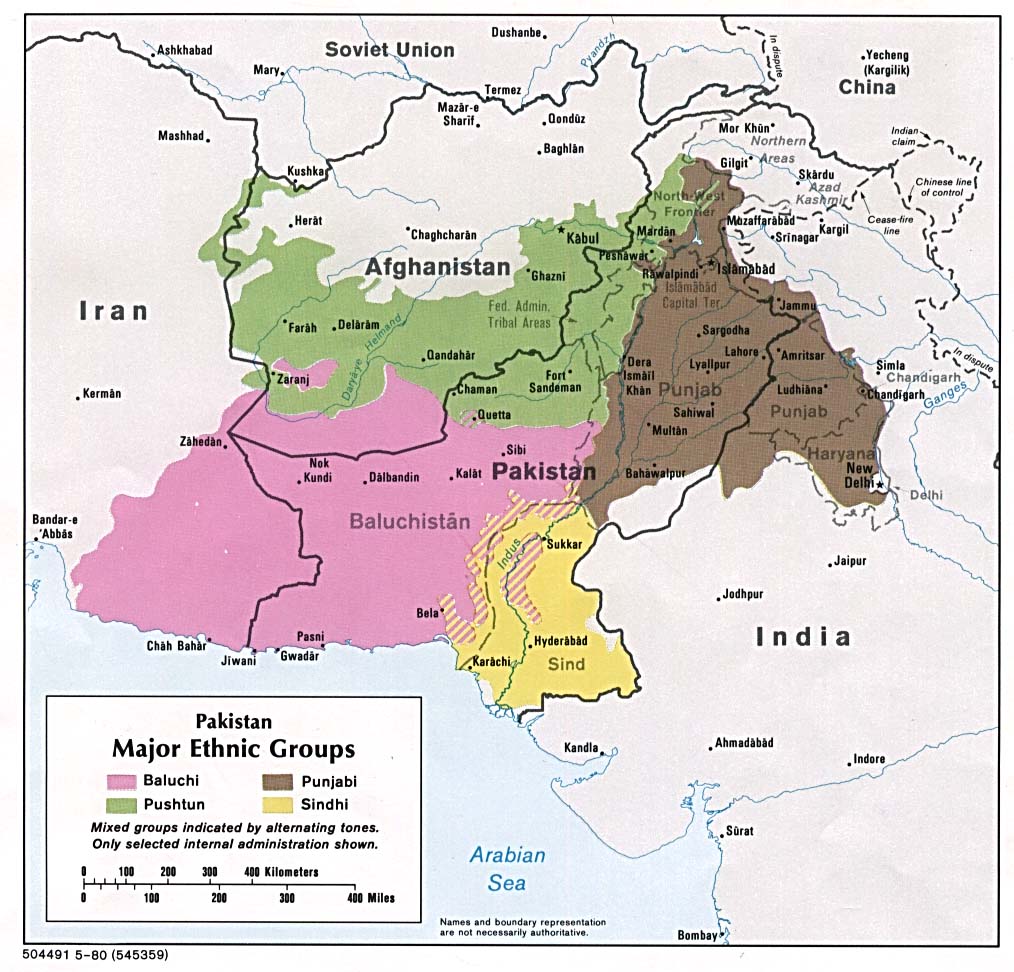

Steve Hynd at Newshoggers made the intriguing suggestion of an independent Pushtun state as a solution to the strategic problems of the Afghanistan-Pakistan region. The Pushtuns, like the Kurds are one of the world’s largest ethnic groups without a state:

The Punjabi and Sindh populations have always regarded the Pashtun as mountain wild men, bandits and reivers. The Pashtun have always regarded their neighbours as prey for their raids. It’s been that way since before the British arrived and shows no sign of abating anytime soon. The Pashtun were only forced at gunpoint into accepting the splitting of their traditional tribal ranges by the Durand Line in 1893. The situation is entirely analogous to the old border reiver clans of the English/Scottish border – another bunch of inter-related hill country wildmen who raided their neighbours irrespective of nationality for over 300 years before finally calming down and accepting imposed nationality. That territorial stramash was only solved by exiling the worst offenders to the American colonies.

….More, with the Pashtun in their own homeland free from outside overlords their reason for supporting the Taliban politically would disappear and the incompatibility between the Taliban’s extreme form of Islam and the Pashtun’s own traditional religious forms would put the two at odds more often than not.

Rather than insisting on fighting the Pashtun, the amswer in Af/Pak may lie in giving them back the independence they once had.

Read the rest here

Sort of like Ralph Peters famous re-drawing of the Mideast map a few years ago, Steve’s suggestion is provocative.The Kurds took decades to get beyond the Talabani-Barzani rivalry and seize the de facto independence that the U.S. invasion of Iraq made possible and “frontier agents”, whether British or from the ISI , have always succeeded in playing off one Pushtun group against another with only the Soviet invasion of Afghanistan in 1979 creating even semi-unity among Pushtuns – and then temporarily. This is the stuff of Pakistani nightmares but a latent sense of Pushtun nationalism lurks in the shadows, with Afghanistan being thought of as a “Greater Pushtunistan”.

The Wrath of Kahn

Wednesday, May 13th, 2009


The post title is tongue in cheek. Herman Kahn was anything but wrathful and came across in his day as a remarkably cheerful strategist of the apocalypse and deep futurist. Long time readers have noted my admiration for Kahn’s metacognitive strategies but for those unfamiliar with Herman Kahn, he was one of those polymathic, individuals of the WWII generation who, like Freeman Dyson and Richard Feynman, could jump into high level nuclear physics research without bothering to first acquire a PhD in the field (Feynman later received a doctorate, Dyson and Kahn never did). Kahn was noted for his forthright willingness to consider humanity’s long term prospects despite the worst calamities imaginable – unlike most optimists, he assumed the events most terrible could happen – but life nevertheless would go on. A position that caused many of his critics to go ape, including the editors of Scientific American.

I bring this up because his daughter, Deborah Kahn Cunningham, emailed to say that Kahn’s classic On Thermonuclear War  had been reissued by Transaction Publishing and there would soon be a new edition of On Escalation the latter of which will have a new foreword by the eminent nuclear strategist Thomas Schelling.

This could not come at a better time. The Obama administration is making grandiose gestures with America’s nuclear deterrent based less on a hardheaded and comprehensive strategic analysis than self-serving political showmanship, tailored to mollify a Left-wing base deeply resentful of the COIN strategy the administration is starting to take in Afghanistan. Nuclear weapons affect the strategic calculus across the entire spectrum of potential decisions, they’re not just shiny, anachronistic, bargaining chips but the overwhelming reason that great power war came to an end in 1945. Period.

Human nature has not made much moral progress since the end of the Third Reich but its very worst instinct for total destruction has, so far, been held at bay by the certainty of self-destruction.

We need someone to remind us again of how to think about the unthinkable.

The Handbook of 5GW

Tuesday, May 12th, 2009


Just scanned the rough draft of The Handbook of 5GW: A Fifth Generation of War?, in which I will have a modest contribution ( which needs some work, in my view).

The book will be controversial.

Published by Nimble Books and edited by Dan of tdaxp.

More as the project develops.

Chet Richards: Review of The Scientific Way of Warfare

Monday, April 20th, 2009

Dr. Chet Richards has a methodical review up at DNI on Antoine Bousquet’s new book The Scientific Way of Warfare: Order and Chaos on the Battlefields of Modernity:

The Scientific Way of Warfare

….Bousquet opens with and ultimately answers the question of “does network-centric warfare (NCW) work?” To reach his conclusion, he proposes four “regimes” in the application of science to modern warfare:

  1. Mechanism, whose “key technology” was the clock, whose scientific framework was Newtonian, and whose military format was what we’d call first generation warfare — line, column, conformance, regularity
  2. Thermodynamics, characterized by engines, whose framework included entropy, energy, and probability, and whose military paradigm was 2GW (Bousquet does not use the generations of war model)
  3. Cybernetics — computers — whose scientific concepts included “negentropy,” negative feedback, homeostasis and whose military model would be modern 2GW, with heavy top-down, real time command and control
  4. Chaoplexity, where networks reign, whose framework is built upon the new sciences of non-linearity, complexity, chaos, and self-organization, and where warfare is conducted by decentralized cells, teams, or swarms — what we would call both 3GW and 4GW (p. 30)

Subsequent chapters take the reader on a tour of these ideas in turn, exploring their evolution as scientific patterns and their influence on the warfare of their, and subsequent, eras. So the chapter on mechanistic warfare introduces Vauban, close-order drill, and culminates in Frederick the Great’s Clockwork Army. The next chapter, Thermodynamic Warfare, concludes with Clausewitz, which is a stretch, of course, since the great Prussian died in 1831, some 20 years before the first publications in that discipline. But with liberal interpretation of the massive text of On War, passages can be found that seem like precursors of the Second Law. Bousquet does point out that these interpretations were not made in Clausewitz’s day but were retrofitted by later analysts and generals, including as he also notes, John Boyd.

Read the rest here. Good stuff!

Government 2.0 and National Security

Saturday, April 18th, 2009

Dr. Mark Drapeau and Dr. Linton Wells II in a National Defense University paper:

Social Software and National Security: An Initial Net Assessment (PDF)

….We have approached this research paper as an initial net assessment of how social software interacts with government and security in the broadest sense.1 The analysis looks at both sides of what once might have been called a “blue-red” balance to investigate how social software is being used (or could be used) by not only the United States and its allies, but also by adversaries and other counterparties. We have considered how incorporation of social software into U.S. Government (USG) missions is likely to be affected by different agencies, layers of bureaucracy within agencies, and various laws, policies, rules, and regulations. Finally, we take a preliminary look at questions like: How should the Department of Defense (DOD) use social software in all aspects of day-to-day operations? How will the evolution of using social software by nations and other entities within the global political, social, cultural, and ideological ecosystem influence the use of it by DOD? How might DOD be affected if it does not adopt social software into operations?

Saw this a day or two ago. Just finished reading the intro. Read the rest here.


Switch to our mobile site