Nerds of Jihad and the Virtual Worlds Evolution
Tuesday, July 1st, 2008Tim Stevens of Ubiwar had a very intriguing post Thoughts on Countering Online Radicalisation that deals with Islamist “cyberterrorism” but also the evolution and state of online life and the challenges these pose to CI, CT and law enforcement . You should go read it in full because I am going to comment upon particular snippets:
Terrorists know their actions are reported instantaneously through a multitude of television channels, radio stations, websites, blogs and newsgroups. If the effectiveness of a violent act relies on being able to broadcast it as swiftly as possible to as many people as possible, then the contemporary global communications environment is as near perfect a tool as has yet been invented.
The media environment is at saturation point for “early adapter” elite Westerners by the saturation is fractured. A good visual analogy of the total media picture would be the social media “ripple effect” diagram by David Armano – including all forms of media would greatly  increase the complexity by orders of magnitude but the logic of the effect would remain the same ( the memetic velocity of each form of media differs but they all interact nonetheless). The message of Islamist terrorism like any other meme in a highly competitive, complex adaptive media system must follow the rules of an attention economy or languish to little effect. There must be psychological “hooks” in the message and content, delivery and the multiplicity of audiences must be considered strategically.
Reams of newsprint, untold hours of televisual hyperbole and a thousand academic articles have been expended on this subject, but it remains of critical importance. How do we adjust our Western liberal mores to account for the fact that every violent sub- or non-state actor knows the internet is a tool and, like ‘us’, knows how to use it? The time has long passed when we should be surprised by this, although articles crop up regularly in provincial newspapers and magazines, and occasionally in national dailies, somehow expressing surprise that terrorists use the internet for their own ends, and that something-must-be-done. We wrestle with the First Amendment, the spectre of censorship looms, militaries worry about operational security, and politicians tack with the prevailing wind, dispensing legislation and initiatives like sticking plasters in a bucket of razor blades.
But what is the fuss all about? Do commentators on the subject actually know what happens on the internet? The videos of IEDs in Iraq, or of Juba the Baghdad Sniper, or viral 9/11 videos, might just be the thin end of the wedge. Terrorists and insurgents leverage the tools of new media to broadcast violent propaganda, but why? What lies beneath?
The substrate below the spectacular image factory is a world that most readers of this blog well recognise. Websites, blogs, chatrooms, social networking sites, discussion fora, mailing lists, internet relay chat, massively multiplayer online role-playing games, virtual worlds, email, instant messaging, video sharing, file sharing, torrenting, and a host of other spaces where people – fundamentally – interact.
At this point here it would be profitable for non-geeks and enjoyable for the geeks to detour to Metaverse Roadmap Overview to get a better look at the part of the iceberg of the future that will be beneath the surface of the water. The cognitive power of games should not be underestimated as a learning modality or community-building tool. Virtuality tools drastically lower the transaction costs and risk for experimenting with challenging the social contract and these tools are in the hands of far more more socially alienated people than ever before, not merely unemployed, hiphop listening, Islamist wannabes in Marseilles unhappy with French public housing. The next generation of Ted Kacyznskis might be a superempowered scale free network like “Anonymous“.
Comprehension is critical. All movements congregate around a message, a coherent narrative understood by all, a rallying cry. Extremist propaganda serves this function, and discriminates amongst different audiences. In the court of international public opinion it aims to create either fear or a broad sense of sympathy. When aimed at the enemy, whether military or civilian, the intention is to create fear and uncertainty, and to undermine morale. Different emphases can be placed on the message distributed to extant supporters of an extremist organisation – corroboration, encouragement, reinforcement, righteousness. The fourth audience is the population in whose interest extremists claim to act. Propaganda mobilises public support, constructs bottom-up legitimacy, and affirms credibility through action. Within this population lies the most important group of all: the next generation of extremists.
What would John Boyd have said here ?
“Shape or influence events so that we not only amplify our spirit and strength (while isolating our adversaries and undermining their resolve and drive) but also influence the uncommitted or potential adversaries so that they are drawn toward our philosophy and are empathetic toward our success. – Patterns of Conflict“
I would also add that the potential radical online is also drawn in by the same psychological process that occurs with cults – acceptance, affirmation of identity, certainty, an emotive connection that is continually reinforced and provides a neurophysical stimulus. A good book to pick up here would be Eric Hoffer’s classic The True Believer: Thoughts on the Nature of Mass Movements (Perennial Classics). The mad gleam in the eye of the ranting Islamist has been seen before in SS diehards, Maoist Red Guards, anarchists of the 19th century People’s Will and innumerable others.
Extremism itself is not the problem and nor is radical thinking, but violence against innocent individuals – becoming ‘kinetic’ in military parlance – is not acceptable in modern liberal society. Although its role is sometimes overstated online radicalisation is very real. It cannot be viewed in isolation from the societies in which it occurs but there are targeted approaches available to mitigate its worst excesses. Testimonies of violent extremists of every ilk highlight the role of the internet in radicalisation, either of themselves or of others, and we are obliged to pay attention.
Prior to the 1960’s, liberal societies and liberals themselves did not have problems accepting the fact that the open society had blood enemies and treating them as such. Liberals volunteered to go to Spain to fight fascism and were enthusiastic advocates for the crusade to destroy Nazism in WWII. Social Democrats and trade unionists fought to kick Stalinists out of unions and democratic-Left organizations and so on. They had a moral center and argued for a “vital center” against extremism, at home or abroad.
Unfortunately, ever since the Vietnam War, liberals have been unable to effectively answer the anti-Western, anti-democratic, illiberal critique posed by New Left radicals, deconstructionists, multiculturalists, gender feminists and various forms of au courant intellectual nihilism. Instead, the democratic Left have accepted the undemocratic extremists as political allies in good standing against the Right, are loath to criticize them and implicitly accepted the moral legitimacy of their crypto-Marxist jeremiad, if not their policy recommendations or often inane political advice. While a general cultural trend, this effect is most acute in the baby boom generation, particularly the ’68’ers and New Right oponents who are at their zenith of systemic responsibility as managing editors, CEO’s, political leaders, intellectuals and bureaucrats.
A generation still torn by the cultural civil war of their youth make ineffective defenders of a civilization. “The Long War” will be long in part because our leadership is badly divided and on occasion, blind and grossly incompetent.
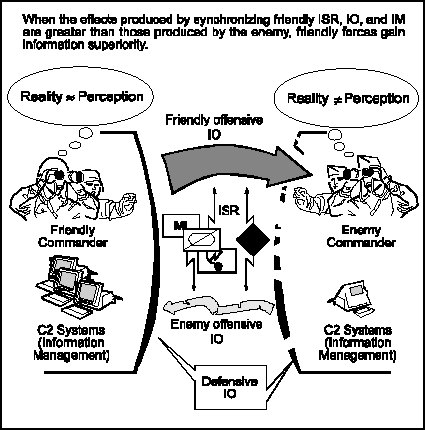
 some and intimidating to others. New Media collapses traditional concepts of time and space as information moves around the world in an instant. Unlike traditional media,
  public diplomat, and persuader. Our adversaries understand and exploit this reality. Writing to
  successes in the short run but having the global audience grdugingly concede that “the Americans speak the truth” adds momentum of every word, every idea and every action we undertake. It will not bring us love because oftentimes, our pursuing national interests will come at the expense of others but truth-telling will yield something more valuable, respect. No one cares to be treated as if they were a fool and most of the transparently self-serving gibberish official spokesmen offer up pays dividends only in contempt being added to the anger foreigners already feel at some of our policies. Credibility is to the war of ideas what COIN is to guerilla warfare and it is a valuable and exceedingly rare quality because once your credibility is lost, it is lost.
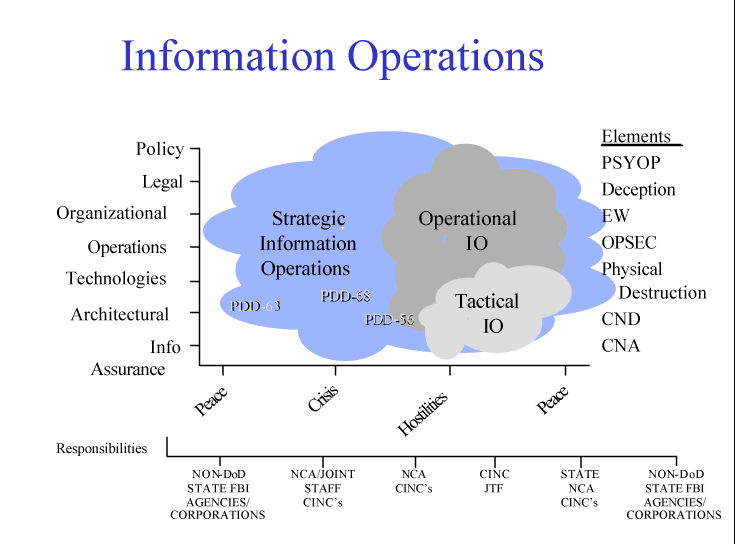 programs, plausibly deniable third parties and used sparingly and with subtlety. The increasingly “radically transparent” world ensures that too many sophisticated eyes with all sorts of agendas will be analyzing our official spokesmen 24/7. The best will can hope to accomplish is effectively framing our public message to be truthful and compelling. Any meme that is verifiably false, if we believe we must put it out into the global media environment, cannot have a return address.


