zenpundit.com » china

Archive for the ‘china’ Category

The quantity of mercy is not strain’d?

Wednesday, August 12th, 2015

[by Charles Cameron — some remedial philosophy at age 71 ]
.

I seem to be doing remedial political philosophy this week. As it happens, I read a Chinese comedian in my youth and was admonished against “sitting down while running round in circles” and have been aerating my brain with too much conscious breathing ever since — neither leaving me much time or interest for what in Oxford in my day was known, somewhat dismissively, PPE — Philosophy, Politics and Economics.

Which brings me today, and to grabbing lectures in just that sort of thing from Harvard’s Michael Sandel, courtesy of YouTube:

The video shows Sandel’s lectures, “Justice: Putting a Price Tag on Life”, and “How to Measure Pleasure” — salted with some dark humor:

Back in ancient Rome, they threw Christians to the lions in the Coliseum for sport. If you think how the utilitarian calculus would go, yes, the Christian thrown to the lion suffers enormous, excruciating pain, but look at the collective ecstasy of the Romans. .. you have to admit that if there were enough Romans delirious with happiness, it would outweigh even the most excruciating pain of a handful of Christians thrown to the lion.

I enjoyed the two lectures immensely — maybe I should rewind fifty years, and try PPE at Harcard?.

**

All of which caused me to wonder:
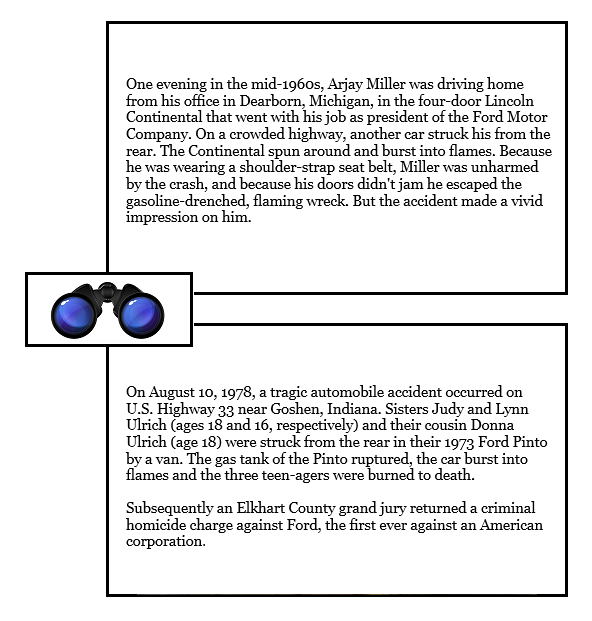
SPEC pinto and lincoln continental

Sources:

  • Mark Dowie, Pinto Madness
  • W Michael Hoffman, Case Study: The Ford Pinto
  • See also:

  • ES Grush and CS Saunby, Fatalities Associated with Crash-Induced Fuel Leakage and Fires
  • **

    I mean, all of which made me wonder about Jeremy Bentham, I suppose.

    We had Locke at Christ Church, staring disdainfully from his portrait during dinners in the Great Hall — but Bentham? I don’t think I saw any utility in utilitarianism.

    **

    But then I also wondered:

    SPEC trolley problem torture

    I wondered: how close is the analogy between the trolly problem and the ticking bomb torture questionn? Do we start from numbers of likely victims in each case and decide from there, or should we instead start by contemplating torture — and recognize the abyss staring back at us?

    Sources:

  • Wikipedia, Trolly problem
  • Michael Sandel, Justice: Putting a Price Tag on Life & How to Measure Pleasure
  • See also:

  • Kyle York, Lesser-Known Trolley Problem Variations
  • **

    What Shakespeare said, though — getting back to my title — was “The quality of mercy is not strain’d” — not the quantity, the quality — unquantifiable.

    On the various uses and modes of DoubleQuotes thinking

    Monday, August 10th, 2015

    [ by Charles Cameron — working my way towards that ever-elusive Grand Theory of Linkage ]
    .

    Standard_legirons_taiwan01
    Ahem — not unlike my DoubleQuote format, these Taiwanese leg-irons offer another form of linkage

    **

    Here’s a cross-cultural DoubleQuote embedded in a Guardian paragraph — from Xiaolu Guo, writing on the Analects of Confucius in Ten Books that Changed the World:

    If you are Chinese, lines from the Bible such as “Love your enemies and pray for those who persecute you” can only bewilder you, as Confucius said nearly the opposite: “It is only the truly virtuous man who can love and hate others.” Hate is a necessary moral stance for a Chinese man.

    **

    More elaborately, Marcy Wheeler over at emptywheel has an entire post using what’s in effect a DoubleQuotes form of argument, comparing Buffalo’s ISIS Supporting Terrorist and Its Klan Supporting Terrorist as her title puts it, and including such quotes as these..

    Concerning Michael O’Neill:

    On January 21, 2015, the Niagara County Sheriff’s office responded to a report of an explosion at the house of Chair of the Niagara County Legislature, William Ross. They discovered that his stepson, former corrections officer Michael O’Neill, who lived with his mother and stepfather at the house, had blown off his leg while working with explosives in the garage. In addition to the one that exploded, there were 6 completed Improvised Explosive Devices in the garage, along with shrapnel, fireworks powder, and other explosives precursors.

    and..

    That evidence shows that the work bench at which Ross’ stepson was emptying fireworks for powder and adding nails to IEDs was decorated with a Stormtrooper poster, a picture of Nathan Bedford Forrest, a Confederate flag, and a poster advertising, “The KKK wants you.” O’Neill also appears to have had a sword (most visible in Exhibit 14) not mentioned in any legal document.

    Concerning Arafat Nagi:

    A week later, on July 29, also in the Buffalo area, FBI Agent Amanda Pike arrested US citizen Lackawanna resident Arafat Nagi on charges of attempting to materially support ISIS. The complaint laying out the case against Nagi relied on trips to Turkey and Yemen (Nagi has family in the latter), a slew of tweets supporting ISIS, and some 2012 and 2013 purchases of military equipment — including body armor and a machete — and Islamic flags from eBay. The complaint also included pictures Nagi had tweeted out depicting ISIS and extremist flags and Abu Bakr al-Baghdadi

    — and concluding:

    Still, these two extremists were working their way through the same court room at the same time. The contrast between the two cases is instructive.

    Read her entire piece for further elaboration.

    **

    A DoubleQuote in my DQ format is intended to work as a sort of haiku, or perhaps a stem christie, incorporating in miniature a change of direction or leap of insight — they come to much the same thing.

    A single, glorious gothic arch — you get the picture.

    It is becoming ioncreasingly obvious, though, that the DoubleQuote method of comparison and contrast has far wider application — and as my collection of DoubleQuotes in the Wild has hopefully shown, that the basic idea continues to strike artists, writers and analysts as a powerful means of corralling and communicating concept and meaning.

    It’s a naturally occurring form for thought, in other words, and at best my graphical DoubleQuotes format can bring a formal unity to many of its possible examples, and thus sharpen it — as a the general idea of a branch can be “formalized” into the concept of a fishing rod or baseball bat — into a tool.

    A Bit of Summer Reading

    Tuesday, July 28th, 2015

    [by J. Scott Shipman]

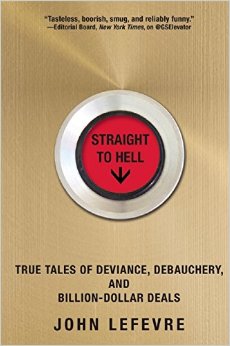
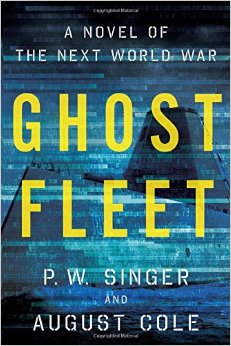
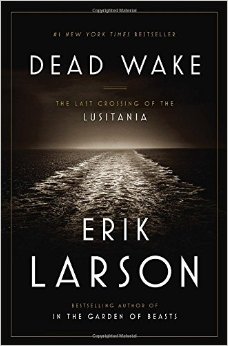
    dead wakestraight to hellGhost Fleet

    The Fate of a ManBachCalvin Coolidge


    Dead Wake, The Last Crossing of the Lusitania, by Erik Larson

    Straight to Hell, True Tales of Deviance, Debauchery and Billion Dollar Deals, by John Lefevre

    Ghost Fleet, A Novel of The Next Work War, by P.W. Singer & August Cole

    The Fate of a Man, by Mikhail Sholokhov

    BACH, Music in the Castle of Heaven, by Sir John Eliot Gardiner

    Seeing Calvin Coolidge in a Dream, by John Derbyshire

    The summer of 2015 for me is becoming memorable for the diversity of the books making it into my queue through unexpected circumstances. Larson’s Dead Wake was an surprise gift from a neighbor familiar with my professional pursuits. I read “Wake” in two sittings and it is superb. Larson puts faces on the victims, and highlights the politics from both sides of the Atlantic, to include the German U-boat commander responsible for the sinking. This tragedy reads like a novel and is wicked good.

    Last year my son turned me on to the feed of @GSElevator on Twitter. I would have never read this book  had I not become a fan of Mr. Lefevre’s decidedly politically incorrect sense of humor. With over 700k followers on Twitter he created an instant potential market and I bit. Straight to Hell is an entertaining irreverent look at the top of the banking profession, and is not for the faint of heart—and very funny.

    Ghost Fleet is one of the most anticipated techno-thrillers in recent memory. Singer and Cole have spun a good yarn of how a future world war between the USA and China/Russia. While the book is a page turner, the authors thankfully sourced their technology assertions in 22 pages of notes! A great resource for a very good book. One could quibble over lack of character development, but this book is driven more by technological wizardry and is a fun and instructive read.

    Fate of Man was recommended either at a blog or in blog comments—I don’t remember. This tiny but poignant book (it is more a bound short story) provides the reader with a glimpse of the hardships and sacrifices in Russia post WWII. Torture and suffering on a scale foreign to 99.9% of those living in the modern Western world.

    BACH was a birthday gift, and I would like to report I have finished Gardiner’s masterpiece, but that may take some time (I’m at page 330). Gardiner shares insights on JS Bach’s life and music, and while I have over forty Bach recordings in my iTunes account, this lovely book is introducing a massive body of Bach’s cantata work—over 200 and I’m unfamiliar with most. My method has been to read Gardiner’s description of the piece, then find a recording on YouTube. Unfortunately, Gardiner does not discuss one of my all-time favorite Bach Cantatas Ascension Oratorio BWV-11 (the last five minutes are simply divine).

    Finally, the Calvin Coolidge book came to me via CDR Salamander in a Facebook thread. As a fan of Coolidge and Derbyshire, I grabbed a copy and I’m glad I did. Derbyshire has written a sweet and insightful story of love, betrayal, and redemption, all the while providing the reader a frightening description of China’s cultural revolution.

    My China study continues, adding Edward Rice’s Mao’s Way, along with CAPT Peter Haynes’ Towards a New Maritime Strategy: American Naval Thinking on the Post-Cold War Era—-both are thus far very good. Also thanks to a friend, I recently spent some quality time with the late master naval strategist, Herbert Rosinski’s The Development of Naval Thought. This is my third or fourth pass through a very good little book.  If naval strategy holds any interest, this little book is not to be missed.

    Are you reading any unusual titles?

    Cold War and Political Fire: Speculation on the State of Sinology

    Monday, June 8th, 2015

    [by Mark Safranski, a.k.a. “zen“]

    China HandJohn Paton Davies 

    Our newest ZP team member, T. Greer of Scholar’s Stage blog has reposted two very thoughtful essays on the Chinese strategic tradition and its interpretation that can be found in modern Sinology. They are excellent and I encourage you to read them in full.
    .
    In his second post, T. Greer raises many questions regarding the state of Sinology, as well as topics for future investigation yet unexplored that would represent in equivalent fields, the fundamentals. Given that China represents not just a nation-state and a potential near-peer competitor of the U.S. but thousands of years of a great civilization, it is remarkable that the professional community of Western Sinologists is so small. The number of USG employees with the highest level of conversational fluency in Chinese who are neither native speakers nor children of immigrants would probably not fill a greyhound bus.
    .
    Why is the state of Sinology relatively parlous?

    I think the poor state of Sinology is traceable primarily, albeit far from exclusively, to the Cold War for two reasons:

    .

    First, Mao’s tumultuous, totalitarian rule cut off access to Chinese sources and China to Western scholars for roughly a generation and a half. This in itself, coming on the heels of almost forty years of revolution, warlordism, foreign invasion and civil war, was enough to cripple the field. Without access to in-country experience, archival sources and foreign counterparts, an academic field begins to die.  Furthermore, Mao’s tyrannical isolation of mainland China was  far more severe than the limited access for Western scholars of Russian history and journalists imposed by the Soviet Union. Josef Stalin, in contrast to Mao, was partially a great Russian chauvinist and the Soviet dictator demanded  certain aspects of Russian history, culture and the reigns of particular Tsars be celebrated alongside the Marxist pantheon . Mao’s feelings towards traditional Chinese culture were much more hostile and ideologically extreme.  Stalin’s worst abuses of Russian history in demolishing a historic Tsarist cathedral for a never-built, gigantic Soviet labyrinthe pale next to the mad vandalism of the Cultural Revolution .

    .

    Secondly, the fate of “the China hands” like John Paton Davies and the “Who Lost China” debate during McCarthyism rendered Sinology politically radioactive in America. It is true that many of the China hands like Davies combined a realistic strategic assessment of Kuomintang/Chiang Kai-shek shortcomings with politically naive or wishful thinking about Mao and the Communists, but the field was dealt a blow from which it never recovered in American universities. Davies was not a Communist or even a leftist (though some China Hands were fellow travelers) but that nuance was lost on the public  in a period that saw in swift succession Alger Hiss, the Berlin blockade, the the Fall of China, the Soviet A-Bomb, Klaus Fuchs, the Rosenbergs and the Korean War. It seemed at the time that the Roosevelt administration had been infiltrated with Soviet spies and fellow travelers (largely because it had been) and in that atmosphere of Red-baiting, Davies was subsequently scapegoated, smeared and fired.  This McCarthyite political cloud over Sinology was curiously juxtaposed with the simultaneous robust funding of studies of the USSR, Russian culture and the training of Slavic linguists in the 1950’s to 1991 by the USG. For academics, going into Sinology could become a professional dead end and carried (at least in the early fifties) an odor of disloyalty.

    .

    There are certainly other and more contemporary reasons for American  Sinology being more of an esoteric field than it deserves, to which someone else with expertise can address but all fields need to attract talent and funding and until Nixon’s “China opening”, American Sinologists struggled against the political current.

    The Chinese Strategic Tradition: A Research Program (II)

    Friday, June 5th, 2015
    [by T. Greer]
    This post is the second in a series. It was originally published at The Scholar’s Stage on the 26th of May, 2015. I strongly recommended readers start with the first post in this series, which introduces the purpose and methods of this essay. That post focused on what is published in English on Chinese strategic thought. This post focuses on what has been written about Chinese strategic practice–that is, the military, diplomatic, and political history of China’s past. 
    A map depicting the most famous military campaign in East Asian history, decided at the Battle of Red Cliffs (208 AD) in modern-day Hubei.
    Source: Wikimedia

    STRATEGIC PRACTICE 

    In the West, the study of traditional China has been the domain of the Sinologists. For reasons that are entirely natural but also too complex and lengthy to explain here, this has meant that historians studying traditional China have focused their efforts on the history of Chinese philosophy, aesthetics, literature, and religion, as well as the closely related fields of archeology, linguistics, and philology. The much lamented decline of political, diplomatic, and military history across the American educational system had little perceivable effect here, for there was not much political, diplomatic, or military history to begin with. [1]

    It should not be a surprise that many of the most important books on Chinese military and diplomatic relations have not been written by historians, but by political scientists. The interest political scientists might have in these topics is obvious, for theirs is a field devoted to the scientific and theoretical exploration of politics and international relations. The real mystery is why it took so long for political scientists to start writing about traditional East Asian international relations in the first place (most of the important books are less than a decade old). The answer to that question is not too hard to find if one looks at the books being written. The new crop of scholars writing these books hail from the international relations (IR) side of the science, and are part of a growing critique of the grand IR theories the discipline traditionally used to make sense of international affairs. [2] These theories were for the most part developed and tested in reference to traditional European great power politics.  One of the central barbs of these critiques is that we cannot know if the grand theories of generations past describe truly universal laws  or simply describe patterns unique to European history if these theories have not been tested on case studies outside of the last few hundred years of European politics. In response, scholars have searched for case studies outside of Europe with which they can test these theories or find the data needed to develop new ones entirely. East Asia, a region filled with bureaucratic states thousands of years before their development in the West, was a natural place to start.

    The problem these researchers repeatedly ran into was that their fellow political scientists were not familiar enough with East Asian history to follow their arguments and there were no good primers on the topic to refer them to. So theses scholars ended up writing the historical narratives others would need to read before they could assess their theoretical arguments. Thus Victoria Tinbor Hui‘s chapter on the Warring States (453-221 BC) in War and State Formation in Ancient China and Early Modern Europe is one of the best narrative accounts of Warring States great power politics; Wang Yuan-kang‘s Harmony and War: Confucian Culture and Chinese Power Politics contains one of the only accounts of Song Dynasty (old style: Sung, 960-1279 AD) foreign relations and one of the most fluid narratives of the Ming Dynasty‘s (1368-1644) adventures abroad; and David Kang‘s East Asia Before the West: Five Centuries of Trade and Tribute has the most coherent discussion of the Chinese “tributary system” written in the last five decades. Historians have lauded these books for the amount of historical research that was poured into them [3], and I second their appraisal. As a field IR should take Asia more seriously and it should engage with historical sources more thoroughly than is common practice. However, I cannot help but lament the circumstances that pushed IR scholars to adopt these methods. Hopefully historians feel some shame over the sorry state of the field and how difficult it is for outsiders to approach their research.

    One example will suffice to prove the point. I mentioned that Wang Yuan-kai’s War and Harmony has one of the few complete accounts of the Song Dynasty’s international relations. As far as scholarship goes, the amount of material devoted to this topic is middle-of-the-road: there are some periods where scholarship is more plentiful–say, the Late Ming, or the Qing (Ch’ing, 1644-1912), and there are some other periods where the scholarship is much more scarce–say, anything about the Tang (T’ang, 610-907 AD) or Han (206 BC-220 AD) dynasties. It is an interesting period to work with, for it is one of the few times in Chinese history when China was faced with external enemies whose military power was undeniably stronger than her own. It was the time of some of the most famous military figures and most horrible military disasters in Chinese history.  It also saw some of the most historically influential debates about how to manage civil-military relations and the relationship between economic prosperity and military power. (more…)


    Switch to our mobile site