zenpundit.com » obit

Archive for the ‘obit’ Category

The Middle East in two War Games — and a tribute to Ibrahim Mothana

Friday, September 6th, 2013

[ by Charles Cameron — with regard to Mothana: the voice of sanity is not easily heard in the asylum ]
.

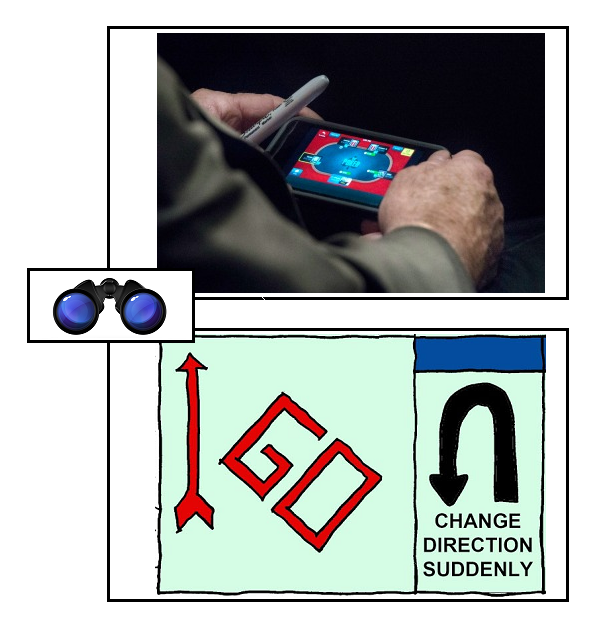
Here’s most everything you need to know about the complexities of the Middle East, spelled out in two simple war games:

Sources:

  • McCain plays poker during Syria war hearing
  • Detail from Yemeni Politics — The Board Game
  • **

    The Yemen politics game was the work of 24 year old Ibrahim Mothana, who died this week. His moving NYT op-ed about his beloved Yemen in June last year told us:

    Drone strikes are causing more and more Yemenis to hate America and join radical militants; they are not driven by ideology but rather by a sense of revenge and despair. Robert Grenier, the former head of the C.I.A.’s counterterrorism center, has warned that the American drone program in Yemen risks turning the country into a safe haven for Al Qaeda like the tribal areas of Pakistan — “the Arabian equivalent of Waziristan.”

    Anti-Americanism is far less prevalent in Yemen than in Pakistan. But rather than winning the hearts and minds of Yemeni civilians, America is alienating them by killing their relatives and friends. Indeed, the drone program is leading to the Talibanization of vast tribal areas and the radicalization of people who could otherwise be America’s allies in the fight against terrorism in Yemen.

    His written testimony for the Senate Judiciary Committee’s Subcommittee on the Constitution, Civil Rights and Human Rights can be found in this Guardian post from Glenn Greenwald in May of this year.

    Mothana had many admirers across the spectrum, as this tweet from Gregory Johnsen attests:

    We mourn his loss, and ask for peace.

    Margaret Thatcher

    Wednesday, April 17th, 2013

    [ by Charles Cameron — on Margaret Thatcher’s funeral, with a brief note on her theological stance ]
    .

    Many of my friends in the UK detested her, many of my friends here at Zenpundit think highly of her: my interest here is to note on the day of her funeral in St Paul’s Cathedral the grace and closure which high ceremonial brings to a nation — the other side of the coin, if you will, to the vigorous and at times raucous debate which marked her time as Prime Minister in London’s House of Commons:

    The Church of England understands the power of ceremonial, and the English choral tradition is among its greatest treasures. Both are on display in the video above, which makes a fine addition to those of the recent Papal and Canterbury enthronements and the Coronation of Elizabeth II, which I presented in my recent post, A tale of two cities: Rome and Canterbury.

    For your convenience, today’s Order of Service can be found here.

    **

    As to Thatcher’s theology, I found these paragraphs from the blogger Cranmer illuminating:

    Baroness Thatcher’s Christianity was grounded in the Protestant nonconformity of devout and evangelical Methodism: her conservatism was Tory in its Burkean deference to the great institutions of state but thoroughly Whiggish and libertarian after Mill in its iconoclastic challenge to the big agencies of state; in her emphasis on the ‘work ethic’ kind of Protestantism, and her patriotic belief in the national British Christian spirit and her notion of morality as the opportunity for free choice. She had what some identified as a ‘puritan streak’, espousing the values of the English suburban and provincial middle-class and aspiring skilled working-class. These contrasted with the values of the establishment élite of the Church of England, landowners, university academics, the Foreign Office and the professions.

    Her writings and speeches are unequivocal in the provenance of her theo-political worldview. In Statecraft, she wrote: ‘I believe in what are often referred to as “Judaeo-Christian” values: indeed my whole political philosophy is based on them’. In the second volume The Path to Power she went further: ‘Although I have always resisted the argument that a Christian has to be a Conservative, I have never lost my conviction that there is a deep and providential harmony between the kind of political economy I favour and the insights of Christianity’.

    Also useful — and also via Cranmer — come these remarks from Antonio E. Weiss, The Religious Mind of Margaret Thatcher:

    Of all British Prime Ministers from Harold Macmillan to Tony Blair, Margaret Thatcher was by far the most vocal about her faith whilst in office, and the only one to draw direct and explicit parallels between her personal beliefs and her political ones. Macmillan believed that ‘a nation can[not] live without religion’, and, more personally in his official biography, he claimed that ‘I go to Communion as long as I can…I reach for the Bible whenever I can…I still find religion a great help’. For Douglas-Home, ‘Christianity was of the heart, not of the pew, a matter of private witness and personal conduct’. Wilson was brought up very much in the Nonconformist manner as a Baptist, joined the evangelical Oxford Group at university and told an interviewer in 1963 that ‘I have religious beliefs and they very much affected my political views’. Heath’s attitude to religion was more similar to Home’s, in that he did not speak openly about it – as he told James Margach in 1965: ‘It’s not a thing one talks about very much but it has a secure hold’, but when reminiscing in his memoirs, he did also claim that: ‘My Christian faith also provided foundations for my political beliefs … I was influenced by the teaching of William Temple (former Archbishop of Canterbury)’. Callaghan’s mother was ‘deeply religious and fundamentalist’. He became a Sunday school teacher in the late 1920s and although he claimed to turn away from his Baptist upbringing when his activities in the Labour Party increasingly had the ‘first charge on my energies’, he also stated in his memoirs that he owed an ‘immense debt’ to his Christian upbringing and that he had never ‘escaped its influence’. Major, on the other hand, whilst professing belief in God – ‘I do believe. I don’t pretend to understand all the complex parts of Christian theology, but I simply accept it…[I pray] in all circumstances’ – seemed to be uncomfortable with the whole issue: ‘I was mortally embarrassed to be interviewed about my religious faith on Radio 4’s Sunday programme’. And of course Tony Blair famously admitted to praying to God for guidance when preparing for the Iraq war of 2003.

    **

    Some further reading, including the sources quoted above:

    Cranmer, Margaret Thatcher has died and passed into Glory
    Cranmer, Margaret Thatcher renewed the relationship between Christianity and Conservatism
    The Economist, High office, low church
    Damian Thompson, Margaret Thatcher’s Christianity: if only the Churches had reached out to her
    Telegraph, Margaret Thatcher: her unswerving faith shaped by her father
    Catholic Herald, Some think it ironic that pugnacious Mrs Thatcher should pray for harmony. But she was closer to St Francis than you may think

    Margaret Thatcher: Christianity and Wealth, Speech to the Church of Scotland General Assembly, May 21,1988

    Of related interest:

    Slavoj Zizek, The simple courage of decision: a leftist tribute to Thatcher

    **

    It would be interesting to see a similar set of quotations and readings for recent US Presidents…

    Carlos Fuentes (1928 – 2012)

    Wednesday, May 16th, 2012

    [ by Charles Cameron — in memory of Carlos Fuentes, requiescat in pace ]
    .

    .

    Carlos Fuentes‘ great novel, Terra Nostra, opens with these words:

    Incredible the first animal that dreamed of another animal.

    It’s a sentence to stop you in your tracks, a sentence to give pause to time itself, circling back on itself like the serpent that eats its own tail, a dream of a sentence, a dream sentence.

    Fuentes continues:

    Monstrous the first vertebrate that succeeded in standing on two feet and thus spread terror among the beasts still normally and happily crawling close to the ground through the slime of creation. Astounding the first telephone call, the first boiling water, the first song, the first loincloth.

    How does a mind move so agilely among these many and diverse firsts — the sleeping, the archeo-anthropological, the technical, the musical, the shameful or sinful or perhaps decorative, even erotic? In a single paragraph — the first in a book that will run 890 pages and not tire?

    And Fuentes continues:

    About four o’clock in the morning one fourteenth of July, Pollo Phoibee, asleep in his high garret room, door and windows flung wide, dreamed these things, and prepared to answer them himself.

    Pollo Phoibee dreamed these things, Carlos Fuentes dreamed Pollo Phoibee…

    And we are in Paris, Paris of the artists, of the garret, and yet a Paris where the Seine is boiling, where the Louvre has become crystalline, the black eyes of the gargoyles of Notre Dame see “a much vaster panorama”…

    *

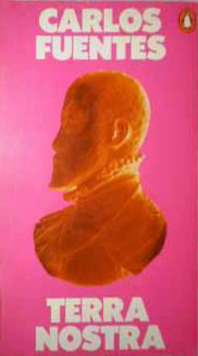
    Carlos Fuentes died today, and I am saddened — remembering him signing my short, fat British Penguin paperback of Terra Nostra (its fondly remembered cover image above) and commenting that it was his preferred English edition, since one could slip it into one’s pocket…

    And Terra Nostra was special to me, both as a great and tumultuous fiction, and as a fiction that quoted Norman Cohn‘s In Pursuit of the Millenniun, the book that back in my Oxford days introduced me to the history of apocalyptic thought… a fiction also familiar with Frances Yates, another scholar I greatly admire, and her writings on the Memory Theater

    Carlos Fuentes, the imagination that conceived Terra Nostra, is no longer with us.

    *

    He had been a diplomat, this great imagination. Born into a diplo family, he had served as Mexican ambassador to Paris — Paris of the diplomatic banquets, but also of the artist’s garret, of this New World imagination spanning continents and centuries as though they were a playground, the playground of a single, multiple, cosmopolitan and erudite mind.

    The poet Paul Claudel, French ambassador to Japan, was reproved by the Surrealists in 1925 with the words:

    One cannot be both ambassador for France and poet!

    The poet Saint-John Perse was secretary to the French Embassy in Peking, and later General Secretary of the French Foreign Office. The poet Giorgos Seferis was Royal Greek Ambassador to the United Kingdom. The poet Pablo Neruda was Chilean ambassador to France… The poet Octavio Paz, Mexico’s ambassador to India.

    Among novelists, it was Lawrence Durrell — an Englishman born in India with what he described as “a Tibetan mentality” — one who found life in England itself “like an autopsy … so, so dreary” — who was British press attaché in Alexandria, Egypt, during World War II, where as they say:

    Ostensibly working, Durrell was in reality closely observing the assortment of sights, sensations, and people that wartime Alexandria, a crossroads of the East and West, had to offer.

    The result was his masterpiece, The Alexandria Quartet.

    *

    Fuentes is heir to many lineages: of Mexico, of the world, of literature, of diplomacy, of the imagination.

    In honoring him today, my researches turned up this apposite quote from Aldo Matteucci at the Reflections on Diplomacy blog:

    To survive, a diplomat needs poetry. Filed amidst the many layers of the brief, the short poem will refresh the bleary mind. Poetry brings distance – hence perspective and insight. Poetry reminds the diplomat that the best professional is the amateur.

    Most deeply – poetry is truth.

    Carlos Fuentes survives us all.
    Another fine voice gone, a fiery liquid, and a Lorca quote or two

    Wednesday, February 15th, 2012

    [ by Charles Cameron — Whitney Houston, RIP, Rumi, a broken reed, Federico Garcia Lorca, the duende ]
    .
    .
    Live performance — Whitney Houston singing Amazing Grace.

    *

    Blog-friend Peter J Munson just recently tweeted this quote:

    “Through the empty archway a wind of the spirit enters, blowing insistently over the heads of the dead”

    That’s from the Spanish poet Federico Garcia Lorca, from an essay of his that I remembered vividly when I heard the other day that Whitney Houston had died. I wrote, then:

    So Whitney Houston has died, far earlier than one might have wished, and the question comes up again whether some gifts essentially “demand” a life that breaks one — as though there’s a liquid inside the anger, the pain, the hurt, that must be set free for the voice to sing.

    I didn’t post that here, because it felt at the time a little too private — but Peter Munson’s quote from Lorca reminds me that I followed up that observation about the “liquid” with this:

    My sense that there might be “a liquid inside the anger, the pain, the hurt, that must be set free for the voice to sing” comes from the way her voice breaks, and breaks again, as she’s singing “a wretch like me” — from about 1’45” with the liquid finally spilling at 1’51″….

    in the Amazing Grace video above…

    *

    If you’re interested in the background to that idea of mine about the liquid, I’ll admit to two sources here — the first is Jalaluddin Rumi, who compares himself in the opening of his Masnavi with a reed, severed from its roots in the marshes to become a flute:

    “Ever since I was cut off from my reed-bed, men and women all have lamented my bewailing. I want a breast torn asunder by severance, that I may fully declare the agony of yearning. Every one who is sundered far from his origin longs to recapture the time when he was united with it. In every company I have poured forth my lament, I have consorted alike with the miserable and the happy: each became my friend out of his own surmise, none sought to discover the secret in my heart. My secret indeed is not remote from my lament, but eye and ear lack the light to perceive it. Body is not veiled from soul, nor soul from body, yet to no many is leave given to see the soul.

    As Rumi himself comments:

    This cry of the reed is fire, it is not wind; whoever possesses not this fire, let him be naught!

    My second source, echoing to us perhaps from the Cordoba of the Sufis, is Garcia Lorca, in his astounding essay, Theory and Play of the Duende — from which these paragraphs, like Peter Munson’s quote, are torn:

    Once, the Andalusian ‘Flamenco singer’ Pastora Pavon, La Niña de Los Peines, sombre Spanish genius, equal in power of fancy to Goya or Rafael el Gallo, was singing in a little tavern in Cadiz. She played with her voice of shadows, with her voice of beaten tin, with her mossy voice, she tangled it in her hair, or soaked it in manzanilla or abandoned it to dark distant briars. But, there was nothing there: it was useless. The audience remained silent.

    In the room was Ignacio Espeleta, handsome as a Roman tortoise, who was once asked: ‘Why don’t you work?’ and who replied with a smile worthy of Argantonius: ‘How should I work, if I’m from Cadiz?’

    In the room was Elvira, fiery aristocrat, whore from Seville, descended in line from Soledad Vargos, who in ’30 didn’t wish to marry with a Rothschild, because he wasn’t her equal in blood. In the room were the Floridas, whom people think are butchers, but who in reality are millennial priests who still sacrifice bulls to Geryon, and in the corner was that formidable breeder of bulls, Don Pablo Murube, with the look of a Cretan mask. Pastora Pavon finished her song in silence. Only, a little man, one of those dancing midgets who leap up suddenly from behind brandy bottles, sarcastically, in a very soft voice, said: ‘Viva, Paris!’ as if to say: ‘Here ability is not important, nor technique, nor skill. What matters here is something other.’

    Then La Niña de Los Peines got up like a madwoman, trembling like a medieval mourner, and drank, in one gulp, a huge glass of fiery spirits, and began to sing with a scorched throat, without voice, breath, colour, but…with duende. She managed to tear down the scaffolding of the song, but allow through a furious, burning duende, friend to those winds heavy with sand, that make listeners tear at their clothes with the same rhythm as the Negroes of the Antilles in their rite, huddled before the statue of Santa Bárbara.

    La Niña de Los Peines had to tear apart her voice, because she knew experts were listening, who demanded not form but the marrow of form, pure music with a body lean enough to float on air. She had to rob herself of skill and safety: that is to say, banish her Muse, and be helpless, so her duende might come, and deign to struggle with her at close quarters. And how she sang! Her voice no longer at play, her voice a jet of blood, worthy of her pain and her sincerity, opened like a ten-fingered hand as in the feet, nailed there but storm-filled, of a Christ by Juan de Juni.

    Perhaps we could say that Houston’s inspiration was a duende-haunted angel…

    *

    Another live performance a few years later… the solo:

    *

    Pondering these things, and thinking of that “liquid” I mentioned, my friend William Benzon quoted Lena Horne to me, as reported by David Craig in On Performing:

    And then when they killed [Robert] Kennedy and Martin Luther King, it seemed like a floodgate had opened. There had been a lot of deaths in my own family. … and when I say, I was different. I began to “listen” to what I was doing and thinking. I listened to the audience. Even to the quiet. I had never listened to it before. … I was different because I was letting something in. The tone was developing differently. I could do what I wanted with it. I could soften it. I wasn’t afraid to show the emotion. I went straight for what I thought the songwriter had felt at a particular moment because he must have felt what I’d been feeling or else I couldn’t have read that lyric, I couldn’t have understood what he was saying. And I used my regretfulness and my cynicism. But even my cynicism had become not so much that as … logic. Yes, life is shit. Yes, people listen in different ways. some nights they’re unhappy at something that has happened to them. OK. I can feel that knot of resistance. OK. That’s where I’m going to work to. … And the second “eight” would be different than the first because the first was feeling it out and the second would change because I could come in “to my mood.” … It developed out of this relaxation … a tone that was softer, more liquid.

    *

    My life had no troubles while I was listening to those tracks.

    Blues for Ali Abdullah Saleh and Etta James

    Saturday, January 21st, 2012

    [  by Charles Cameron – pop irony for Yemen, requiem for Etta James ]

    .

    .

    There’s a lot of doubling up here: for starters, the lyrics each of the two songs have a significant amount of double entendre, and there’s a terrific parallelism between them – as well as some real differences between the two singers and genres…

    But that’s just the beginning.  The linkage between these two songs on the level of their lyrics – up down, stay go – has nothing to do with the fact that I was playing them today.

    I ran across one of these songs today because I’m fascinated by the ways pop culture can model, influence, and even on occasion drive events in the global seriousphere – and the other simply because I had a vague blog-acquaintance at one time with someone who played with Etta James, and wanted to note her passing with sadness, gratitude, and a few minutes appreciative listening.

    1.

    So the Middle East Channel over at Foreign Policy featured a mash of Katy Perry’s Hot n’ Cold along with some quotes from Ali Abdullah Saleh today, in which he too doesn’t seem to know whether he’s coming or going — video below.

    I also heard Clay Shirky‘s TED presentation Why SOPA Is a Bad Idea today as it happens, and he was saying that every times new recreational tools came along – analog tools like the photocopier, tape recorder and VCR as well as digital tools and technologies like the internet, file-sharing, laptops and tablets – industrial concerns like the publishing, movie and music industries fought them.  Why?

    Because it turned out we’re not really couch potatoes. We don’t really like to only consume. We do like to consume, but every time one of these new tools came along, it turned out we also like to produce and we like to share. And this freaked the media businesses out — it freaked them out every time.

    So yeah, someone serious enough about Yemen to mock President Saleh and savvy enough to make a YouTube video of Katy Perry intercut with choice selections from Saleh’s speeches – that’s just what Shirky’s talking about, it’s human nature, it’s creative

    And sometimes stuff like that can go viral – so it’s not just pop music, it’s more than that, as Bob Dylan said, it’s “life, and life only”.

    2.

    And Etta’s song? — again, video below…

    To me, Etta’s song, voice and life between them bring up a whole different set of issues. Here’s where “love” trumps “morality”.

    Etta James’ obituary in The Guardian contains this paragraph:

    Her approach to both singing and life was throughout one of wild, often desperate engagement that included violence, drug addiction, armed robbery and highly capricious behaviour. James sang with unmatched emotional hunger and a pain that can chill the listener. The ferocity of her voice documents a neglected child, a woman constantly entering into bad relationships and an artist raging against an industry and a society that had routinely discriminated against her.

    Is that “immoral” – as one part of my brain would like to conclude?  Or is it glorious — is a voice soaked in whiskey and wreathed in smoke the only voice that can chill us like that, that can bring us to our senses, to our knees, to compassion?

    Is this — “and armed robbery’ — the price we sometimes have to pay for artistry?

    One way of dealing with this recurring business of those who bless us with extraordinary gifts despite their own lives seeming at times wretched and accursed is – to tweak a well-worn phrase slightly – to hate the sin but love the singer.

    I think that’s cheap.  I think Etta – and many others – was hollowed out, and that it’s that hollowing, precisely, that gave her the depth and the voice to reach us so profoundly.  So I lament Etta’s passing today, and have taken time out to let her sing to me.

    Etta James: may she rest in peace.

    3.

    Katy Perry:

    4. Etta James:

    5.

    h/t Maureen Lang and taters.


    Switch to our mobile site

