zenpundit.com » geopolitics

Archive for the ‘geopolitics’ Category

Wikistrat

Wednesday, February 9th, 2011

Wikistrat

I am pleased to announce that I have accepted an offer from CEO Joel Zamel to join Wikistrat as an analyst.

What this means, in essence, is that I will become a contributor of exclusive content to the Wikistrat site and will be collaborating on specific analyical products. In return, I will be able to feature some of their interesting pieces here, such items from future issues of their CoreGap Bulletin 11.04 [PDF] or video presentations by Dr. Thomas P.M. Barnett or other Wikistrat experts. Here is their current public sample:

Wikistrat will also become a sponsor of zenpundit.com (actually, the only sponsor,as I do not normally accept advertising). If you have been visiting Chicago Boyz lately for the ongoing Roundtable, you may have noticed a Wikistrat banner ad there; there will be one here at ZP soon as well.

If you have enjoyed reading ZP over the years, I encourage you to subscribe to Wikistrat – not just to see what I’m writing, or Tom, but to get in early into an interactive, analytical community that is going to grow rapidly in terms of talent and influence.

Hope to see you there!

NSDD-32 as Ronald Reagan’s Grand Strategy

Wednesday, February 9th, 2011


[Cross-posted to the Ronald Reagan Roundtable at Chicago Boyz]

Big Peace blogger Sun Tzu has dug into the historical archives to post NSDD-32, the cornerstone document for coordinating the Reagan administration’s foreign, defense and intelligence policies ( Hat tip to Col. Dave).

“NSDD” stands for “National Security Decision Directive”. In essence, the document is an executive order issued through the National Security Council to executive branch agencies represented or under the supervision of the NSC. A NSDD (or “PDD” in Democratic administrations) carries the force of law and is often highly classified, frequently being used for presidential “findings” for approving covert operations, as well as to set national security policy.

NSDD-32: Ronald Reagan’s Secret Grand Strategy

CLASSIFIED:  TOP SECRETTHE WHITE HOUSE
WASHINGTON

May 20, 1982

National Security Decision
Directive Number 32

U.S. NATIONAL SECURITY STRATEGY

I have carefully reviewed the NSSD 1-82 study in its component parts, considered the final recommendations of the National Security Council, and direct that the study serve as guidance for U.S. National Security Strategy.

Our national security requires development and integration of a set of strategies, including diplomatic, informational economic/political, and military components.  NSSD 1-82 begins that process. Part I of the study provides basic U.S. national objectives, both global and regional, and shall serve as the starting point for all components of our national security strategy.

The national security policy of the United States shall be guided by the following global objectives:

  • To deter military attack by the USSR and its allies against the U.S., its allies, and other important countries across the spectrum of conflict; and to defeat such attack should deterrence fail.
  • To strengthen the influence of the U.S. throughout the world by strengthening existing alliances, by improving relations with other nations, by forming and supporting coalitions of states friendly to U.S. interests, and by a full range of diplomatic, political, economic, and information efforts.
  • To contain and reverse the expansion of Soviet control and military presence throughout the world, and to increase the costs of Soviet support and the use of proxy, terrorist, and subversive forces.
  • To neutralize the efforts of the USSR to increase its influence through its use of diplomacy, arms transfers, economic pressure, political action, propaganda, and disinformation.
  • To foster, if possible in concert with our allies, restraint in Soviet military spending, discourage Soviet adventurism, and weaken the Soviet alliance system by forcing the USSR to bear the brunt of its economic shortcomings, and to encourage long-term liberalizing and nationalist tendencies within the Soviet Union and allied countries.
  • To limit Soviet military capabilities by strengthening the U.S. military, by pursuing equitable and verifiable arms control agreements, and by preventing the flow of militarily significant technologies and resources to the Soviet Union.
  • To ensure the U.S. access to foreign markets, and to ensure the U.S. and its allies and friends access to foreign energy and mineral resources.
  • To ensure U.S. access to space and the oceans.
  • To discourage further proliferation of nuclear weapons.
  • To encourage and strongly support aid, trade, and investment programs that promote economic development and the growth of humane social and political orders in the Third World.
  • To promote a well-functioning international economic system with minimal distortions to trade and investment and broadly agreed and respected rules for managing and resolving differences.

In addition to the foregoing, U.S. national security policy will be guided by the operational objectives in specific regions as identified in Parts I and III of the study.

Read the rest here.

Normally, for important NSDD, there will be several preliminary meetings of principals (the statutory members of the NSC) or their key deputies, before the text of the NSDD is prepared by the NSC adviser or executive director (sort of the chief of staff of the NSC) and the White House Counsel before it is formally approved by the NSC and signed by the President. This however, is not set in stone. Presidents are free to determine the NSC procedures of their administrations or ignore them if it suits their purpose. It is hard to imagine Richard Nixon fully briefing his SECSTATE William Rogers on anything of importance, much less doing it through Kissinger’s NSC, or JFK permitting any kind of bureaucratic structure to constrain his prerogatives.

NSDD-32 was prepared under the auspices of Reagan’s second NSC Adviser, “Judge” William P. Clark, who succeeded the hapless William V. Allen. Clark was the most conservative of Reagan’s many NSC Advisers and, as a California political crony of the president, the only Washington outsider. As a result, Clark was in tune with DCI William Casey and UN Ambassador Jeanne Kirkpatrick, hostile toward the views of State Department Soviet experts and far more interventionist than the top officials at Cap Weinberger’s OSD (Office of the Secretary of Defense). Clark had previously served at State as Deputy Secretary under Al Haig, an experience that did not leave him with a good impression of the loyalty of senior State Department officials to the administration’s foreign policy goals.

The activist “we win, they lose” strategy laid out NSDD-32 reflects Clark’s alignment with William Casey and it is very hard to credit Reagan’s national security strategy looking like NSDD-32 if it had been concocted by Colin Powell, Frank Carlucci and George Schultz, making Clarks brief tenure of critical historical importance. Powell, Carlucci and Schultz are all fine public servants but were disinclined by temperment and institutional loyalty to have articulated a strategy that “went on offense”; though, in fairness to Schultz, as SECSTATE he made very effective diplomatic use of Reagan Doctrine programs that State consistently opposed ( Contra aid, covert aid to the Afghan Mujahedin, UNITA and RENAMO) to extract concessions from the Soviets at the bargaining table.

Egypt: the jihad’s receding tide?

Saturday, February 5th, 2011

[ by Charles Cameron — cross-posted from Chicago Boyz ]

Here’s the evidence I’m seeing for one hopeful outcome…

From an Egyptian FaceBook page:

I will NOT accept that religious groups hijack what we have been doing for their own agenda. A large group of the ones organizing them yesterday were people in galabeyas and long beards shouting “Al Jihad fe Sabeel Allah (Jihad in the name of Allah), you have to continue fighting, we will win this war, if you die here today, you will be a martyr and go straight to heaven, don’t stop, fight, fight, fight”. NO! This is NOT why we were in the streets on Friday being tear gassed and dodging rubber bullets and it is not why we have been going to Tahrir everyday to be heard. The reason why this revolt went through and became successful was because it was not religiously or politically charged.

quoted on the The International Centre For The Study Of Radicalisation blog – ICSR is a joint venture between King’s College London, the University of Pennsylvania, Israel’s Interdisciplinary Center, Herzliya, and the Jordan Institute of Diplomacy.

*

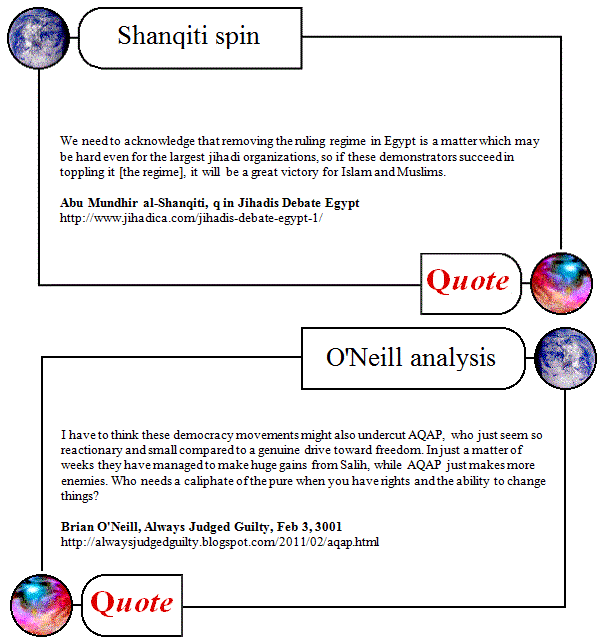
This DoubleQuote first presents a jihadist spin on things, from a legal team member at Minbar al-Tawhid wa’l-Jihad, in Quote #1:

Below that, and lending it both context and irony, is a comment from one of our best analysts of the situation in the Yemen, a former editor for the Yemen Observer.

*

John Robb gives the same general message a little strategic push…

What’s the best way to defuse Islamic radicalism across the ME and beyond? Help make the protest in Egypt work.

.
Sources: ICSRShanqitiO’NeillRobb Feb. 3, 2011.

DQ Egypt: impact on Israel

Wednesday, February 2nd, 2011

[ by Charles Cameron [hoping Zen’s ISP will be back up shortly] — cross-posted from ChicagoBoyz ]

Someone posted an excerpt from an interview with Khaled Hamza, the webmaster of the Muslim Brotherhood, as a comment on an earlier post of mine on ChicagoBoyz, where I also blog, and I was interested enough to track the original interview down, and have presented the key points of the excerpt here in Quote #1.
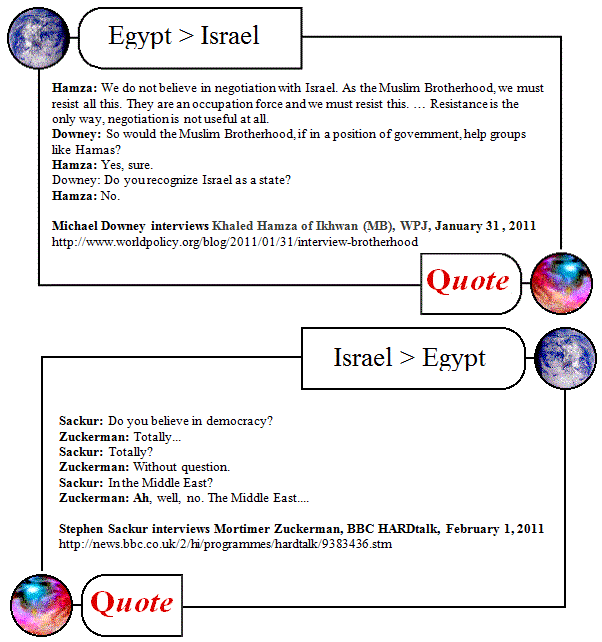
I am pairing it, in Quote #2, with an excerpt from an interview the BBC recently conducted with Mortimer Zuckerman – because I find the two quotes taken together suggest something of the complexity of the breaking situation in the Middle East.

*

I’d like to float a trial balloon / try a though experiment, if I might. And since I’m more “tail” than “left” or “right wing”, I’ll be posting this in more than one place, and hope to get comments from all sides…

On the face of it, Zuckeman is applying what’s arguably a racist double-standard. He advocates democracy, “totally” and “without question” – but not for the Egyptians, or at least not today or tomorrow.

On the face of it, the Egyptian public seems distinctly unenthused by Mubarak’s regime and will, in a democratic election, presumably vote in a fair number of Muslim Brotherhood representatives – though it’s by no means clear that they would be in the majority, and their present ideology in any case is closer to the processes of electoral politics than those of violent jihad.

So there is reason for Israel to be concerned, and reason for those who support democracy to see some hope for democracy, in the ongoing events in Egypt.

Let me put it this way: Quote #1 illustrates why Zuckerman might make the remarks quoted in Quote #2, while Quote #2 illuminates why Hamza might make the remarks quoted in Quote #1.

*

And here’s the thought experiment — I’d like to come at this from a Maslovian angle.

Maslow’s Hierarchy of Needs

I’d like to suggest that “democracy” is an ideal, or to get away from that word with its somewhat ambiguous political connotations, an activity of the “the better angels of our nature” – and thus, from a Maslovian perspective, an aspect of a group or nation’s “self-actualization” level of interest, whereas “stability” would fall under “safety” or even “physiological”.

If that’s right, Zuckerman is at least arguably articulating a “stability first, eventual democracy would be ideal” position.

Does that “Maslovian” formulation throw any additional light on the situation?

*

The problem with the position I just described is nicely articulated by Mohammad Fadel at the very end of a Foreign Policy post, Can Black Swans lead to a sustainable Arab-Israeli peace? — and it’s only his conclusion I’m quoting here:

Tunisia and Egypt have demonstrated categorically that any peace which relies on the stability of police states is doomed from the outset.

If a butterfly flapping its wings in Brazil can in theory cause a tornado in Texas – heaven alone knows what someone blinking in Cairo or Jerusalem or Washington can do.

Myself, I pray for empathy, which seems a reasonable request, I hope for wisdom, which seems a great deal more chancy — and I long for peace.

In the current environment of hatred and mistrust, that seems entirely beyond the capacity of anyone’s present thinking to achieve.
Egypt: tear-gas and hotels

Monday, January 31st, 2011

[ by Charles Cameron, cross-posted from Brainstormers on the Web ]

Here are two data-points to drop into the mind-pool as we think about current events in Egypt, the Middle East in general, and the way the world turns.

DoubleQuotes is my name for the format I’m using here, which I came up with a few years back on Brainstorms. The idea is simply to generate fresh insights by juxtaposing two thoughts – be they images, quotes, or even equations (I don’t have the technical chops for music or film clips yet) — in condensed, haiku-like form.

Think of them as pebbles dropped in a pond, watch the ripples…

[ note to Zenpundit readers: I’ll say more about Brainstorms and Brainstormers on the Web in a week or two, once the “on the Web” blog gets under way ]


Switch to our mobile site