zenpundit.com » obama

Archive for the ‘obama’ Category

DoubleQuotes and Questions

Friday, January 28th, 2011

[ by Charles Cameron ]

You know, I really enjoy building my DoubleQuotes. They can be entirely frivolous, as is this one, for instance:

with its touch of gothic — a taste I share with my friend Bryan Alexander.

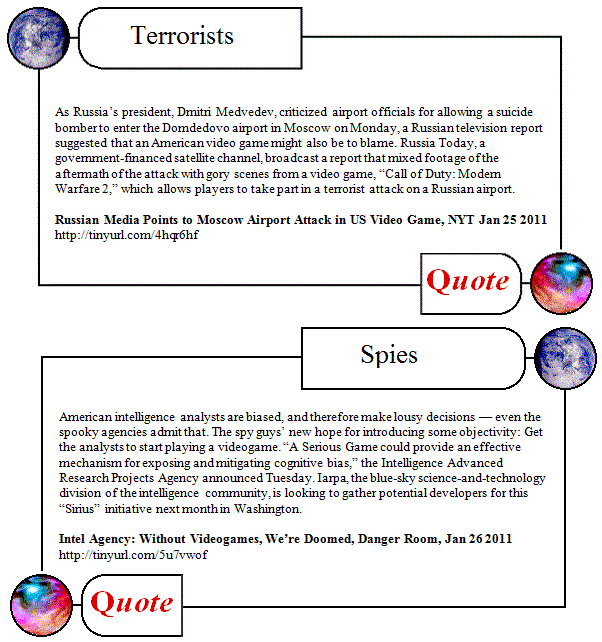
Or they can work like a Necker cube, offering opposite framings with which to view a single topic — in this case, video games.

They can also work like Rorschach blots — this one compares two prophecies, one from the Quran and one from a contemporary Christian prophet (if I’m not mistaken, President Obama quoted him recently) —

— but it is left up to the reader to determine the value of each…

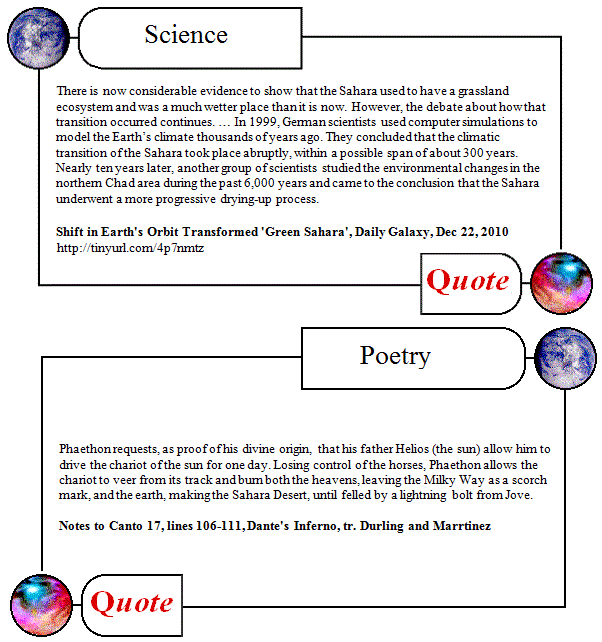
And they can also pose fundamental questions of preference:

Has science simply replaced myth, d’you think? or is science for the facts, perhaps, and the mind — while poetry and myth are for the heart, and truth?

Perhaps We Can Call it “The Crony Capitalist Council”

Monday, January 24th, 2011

I was going to post on this subject but Dave beat me to it:

Theodore Vail’s America

….Among the greatest barriers to innovation are the industrial giants like GE which have shed jobs at an alarming rate over the last 30 years while wielding intellectual property laws and political clout to crush upstart competitors which are hiring. One way of spurring innovation would be to get dinosaurs like GE, grown huge through rent-seeking, the hell out of the way. I doubt we’ll see suggestions in that vein from Jeffrey Immelt.

The only jobs Immelt will create in America are for K Street lobbyists to secure yet more government contracts for GE. Expect a blizzard of proposed agency regs and executive orders this year as the Oligarchy tries to lock in as much of a permanent rentier economy as they can before the next election cycle.

Tracking the Mahdi on WikiLeaks

Tuesday, November 30th, 2010

by Charles Cameron

A quick search for “Mahdi” and “Mehdi” and “Twelfth Imam” in the 294 messages so far published in diplomatic Wikileaks reveals some references to individuals with those names, and a couple to Moqtada al-Sadr’s Jaysh al-Mahdi (spelled “Jaysh al-Madhi” in one cable by someone who is perhaps confused by the similarity of the name to that of Mahatma Gandhi), along with three cables in which Mahdism is touched upon.

1

09ASHGABAT1182 of September 16, 2009 reports a comment by an undisclosed source who is “adamant” that the US should not enter into direct talks with Iran’s leadership:

Not only, he insisted, is the Iranian leadership “untrustworthy,” and dominated by a group of “messianics,” who base crucial decisions about domestic and foreign policy on a belief in the imminent return of the “Missing” (Twelfth) Imam.

From my point of view, any foreign policy based on or strongly influenced by belief in the imminent return of a prophesied figure of good or evil, whether that figure be Moshiach or Christ or Mahdi, Antichrist or Dajjal, should be cause for concern: from a religious perspective, because messianic expectations are precisely what Matthew is talking about when he writes that “false Christs and false prophets will rise and show great signs and wonders to deceive, if possible, even the elect” (Matt 24.24) – and from a secular perspective because such identifications have been made again and again across history, often with disastrous results (think Waco, think the 1979 siege of Mecca, think the Taiping Rebellion).

That’s why I’m interested in monitoring the various strands of apocalyptic thinking out and about in the world today.

2

A little over a month earlier, on August 3, 2009, 09RPODUBAI316 under the sub-head “A Benevolent Dictator’s Fall from Grace” discussed the idea that the “Arab street” (both Sunni and Shi’a are mentioned) initially saw some Mahdist qualities in Ahmadinejad:

A Syrian journalist and blogger, who owns a media consultancy firm in Dubai, believes that many in the Arab street initially viewed Ahmadinejad when he came to power in 2005 as a “benevolent dictator.” Citing the tradition of the Mahdi, the media consultant argued that both Shi’a and Sunni Arabs are taught from early childhood to await the arrival of a strong and unimpeachable figure who will lead the Muslim world. The media consultant maintained that even secular Arabs view the world, albeit unintentionally, with this ingrained mindset. Our contact argued that Ahmadinejad played in to this narrative, and when Ahmadinejad arrived on the international stage many Arabs saw him, in contrast to their own flawed leaders, as a humble and pious man who was brave enough to stand up for his people and the greater Muslim world by confronting Israel and the West head on. However, both the intensely competitive campaign period and the forceful reaction by the Iranian people to the official election results have led some moderate Arabs to rethink Ahmadinejad’s true disposition. The election, the media consultant said, led some Arabs to understand that despite his astutely crafted and well-marketed image in the Arab world, Ahmadinejad is resented by many Iranians for domestic mismanagement, incompetence, and corruption. Because of this public fall from grace, so the media consultant told us, Ahmadinejad is no longer the “untouchable, holy figure” in the Arab world he once was — his flaws have brought him down to the level of the Arab world’s own imperfect leaders.

I’m reminded of the way that Steve Davis of Charleston, SC, among others, projected messianic qualities onto then-candidate Obama, when he wrote:

Barack’s appeal is actually messianic, it’s something about his aura, his spirit, his soul, that exudes enlightenment in the making.

I interpret Obama’s Lebanon, NH remarks as making light of that sort of projection (McCain’s video makes light of it, too), whereas Ahmadinejad appears to take his own status within the aura of the Mahdi all too seriously.

3

The last reference allows me to end on a happier note.

The French diplo Jean-Christophe Paucelle is quoted in 09PARIS1046 of July 31, 2009 on the topic of Ahmadinejad’s inauguration.

First he mentions that since non-Muslims had not been invited to previous inaugurations, European members of the diplomatic corps might not know which door to take if they wished to walk out on the ceremony, should such an action be called for… and then he discusses an additional reason why the French would attend the ceremony, despite the contested nature of the election:

Paucelle said that the case of detained French citizen Clothilde Reiss has also influenced the EU decision to attend the inauguration ceremonies. “We think she may be released soon, and we don’t want to create another irritant,” Paucelle said. “There are enough already.” He reported that the French have reason to believe Reiss may form part of a group of detainees likely to be released on the August 7 anniversary of Imam Mahdi. Paucelle noted that a letter released July 29 by Ahmadinejad supported the idea of granting clemency to post-election protesters during Mahdi celebrations. “The Iranians will need to take face-saving measures, and so she will likely transfer to house arrest or some other status,” Paucelle said. He added that, of course, she may not be released at all next week, but the French remain optimistic that she will soon be out of prison.

Clotilde Reiss was indeed not released on that occasion — but she was in fact freed somewhat later, on Sunday, May 16th, 2010.

Google as a Dishonest Broker?

Tuesday, April 13th, 2010

This strikes me as an exceedingly bad idea from Google:

From Drudge:

GOOGLE FRANKENSTEIN: MACHINES TO CHOOSE YOUR NEWS
Mon Apr 12 2010 08:15:34 ET

GOOGLE CEO and Obama political activist Eric Schmidt declared this weekend that his machines will help decide what news you receive!

News sites should use technology to PREDICT what a user wants to read by what they have already read, Schmidt told the AMERICAN SOCIETY OF NEWS EDITORS, where a few humans still remained in the audience.

“We’re all in this together.”

MORE

Schmidt said he doesn’t want ‘to be treated as a stranger’ when reading online, POLITICO reports.

He envisions a future where technology for news editing could help tailor advertisements for individual readers.

And he wants to be challenged through technology that ‘directs readers’ to a story with an ‘opposing’ view.

[An odd suggestion from the CEO of a company long accused of offering little to no conservative-leaning links on its news page, while aggressively promoting left-leaning hubs.]

Schmidt said GOOGLE is working on new ways to push adverts and content for consumers, based on what stories they’ve read.

What stories his machines have selected.

Developing…

If this no-choice “opposing view” meme sounds familiar, that’s because a prominent friend and appointee of President Obama, former U. of Chicago law professor Cass Sunstein, has, for several years, articulated a sophisticated  theory on the need for government to regulate speech, “reformulate” the 1st Amendment to ensure greater “diversity” and compel the presentation of “opposing views”. While I share Sunstein’s concern that many people are deliberately corrupting their OODA Loops by only reading sources with which they already agree, forcing legal adults to read something else isn’t the answer. It’s a free country and with liberty comes the right to be left to wallow in ignorance in peace.

Getting the Congress and states to turn the free speech and free press clauses on their head is a task with small chance of political success. Persuading or pressuring a small number of friendly CEO’s of search engine companies to optimize their own systems to produce politically favorable results for the administration and the Democratic Party is a lot easier, far less transparent to the public and more difficult for the GOP and conservatives (or for that matter, dissident progressives and unpopular minorities) to combat.

To put it simply, the long term strategy here is that the information aggregators – Google being the 800lb gorilla – will become the new “gatekeepers” with their finger on the scales that determine the page rank of opposing views on controversial issues.

I feared that Google might be tempted to go down this road when they first became entangled with the Chinese government in a way that compromised the integrity of their search engine. At the time I asked:

” If you have agreed to censor what information can be accessed in China in return for greater market opportunities, have you also agreed to censor what information can be accessed about China by the rest of us ?”

As far as I am aware, that question has never been answered, though I think the answer has bearing on American national security and our domestic tranquility. The temptation to use the enormous informational power of Google to deliberately shape public discourse and cultural evolution to “manufacture consent” for policies favored by the elite without the commoners being aware of the manipulation, appears to be very difficult to resist.

I like Google. The company has provided a truly amazing array of informational services that – and I do not think this is an exaggeration – have added real and significant value to civilization. But part of that value comes from Google being regarded universally as an “honest broker” of information. Their CEO’s proposal jeopardizes that trust and once credibility is lost, it is gone for good.

The odd thing is, that this proposal is a really poor business strategy for Google – unless the objective is to create paranoia and drive a large segment of the population to use rival search engines or create new ones free of elite political gamesmanship.

Spinney on the QDR

Friday, February 5th, 2010

Boyd Acolyte Franklin “Chuck” Spinney writing on the QDR ( Hat tip to Kev Hall).

The Pentagon Goes Intellectually AWOL

….Even by the dismal intellectual standards of Pentagon bureaucracy, the QDR and the FY 2011 budget, taken together, establish a new standard of analytical vacuity, psychological denial, and just plane meaningless drivel. I will keep this short by using just one important case to prove my allegation. Judge for yourself if it is necessary and sufficient to make the point.

First, I must bore you with a little background: The Pentagon has been producing FYDPs since 1962. But these FYDPs have been repeatedly criticized for producing defense budgets that were disconnected from the national military strategy — and because the dollar allocations made in any budget determine what any government’s policy really is, the critique was logically equivalent to saying there was no strategy. The congressional legislation in the mid 1990s that established the QDR was only the most recent attempt to deal with this long standing criticism. The aim of that legislation was to require the Pentagon to lay out an intellectual framework for matching its military strategy and ambitions to the resource constraints shaping those ambitions, especially budgetary constraints, but also constraints relating to people, the limitations imposed by available technologies, etc.

The new FY 2011 budget and its accompanying FYDP, therefore, are supposed to attach budgetary and programmatic meat to the strategic skeleton that is the QDR, both of which were completed at the same time and made public on 1 February — itself a somewhat illogical sequence, given that one is supposed to precede the other. In theory, these documents should permit an analysis of the strengths and weaknesses implicit in the matchup between resources and strategy. Therefore, these documents should enable the Secretary of Defense to send the President and the Congress a comprehensive set of priorities, opportunity costs, and risks associated with his strategic plan. This information would then become the grist for a rational national debate by linking strategic considerations to the inevitable compromises made in the sausage making factory that is Congress. Moreover, as this is President Obama’s first budget, and because it represents $700+ billion that Mr. Obama just put off limits in the coming national debate over whether or how to shrink the federal deficit, it was crucially important for the Pentagon to get the QDR and the accompanying FY 2011-2015 FYDP right in a logically consistent and transparent manner.

If we apply this standard to the Pentagon’s recently completed handiwork, only one conclusion is possible: the Pentagon flunked the test by being intellectually absent without leave.

Read the rest here.

Defense acquisitions and budgeting process arcana are not my forte, but Spinney is not the only defense analyst giving the QDR a thumbs down for being insufficient on important issues. If the process is rigidly determinative of the kinds of outcomes generated and if that process is dysfunctional or broken, then even a talented top DoD civilian staff armed with an ocean of money and a deep reservoir of political capital will not be able to translate our national security priorities into concrete military results.

“Methods are the masters of masters.” – Talleyrand


Switch to our mobile site