zenpundit.com » politics

Archive for the ‘politics’ Category

Introducing the Person / Position Paradox

Saturday, October 6th, 2012

[ by Charles Cameron — ye olde war of science vs religion embodied in Rep. Paul Broun, with sundry comparisons to human rights, UN, dominionism, JFK, creeping shariah etc ]
.

.

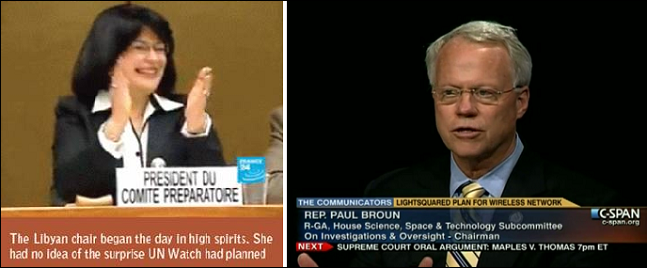
Lest we forget, Muammar Gaddafi‘s Libya, in the person of Ms. Najat Al-Hajjaji (above, left), was elected to preside over the United Nations Commission on Human Rights in 2003:

The Commission on Human Rights — meeting this morning under a new procedure two months in advance of its annual six-week session — elected Najat Al-Hajjaji of the Libyan Arab Jamahiriya as Chairperson for 2003, along with three Vice-Chairpersons and a Rapporteur.

And as recently as May 2010, still under Col. Gaddafi’s rule, Libya was elected a member of the UN Human Rights Council, and only suspended in February 2011.

Might we call this an instance of a Person / Position Paradox?

**

You know I like what I term “forms” as analytic tools — this would be another one to keep an eye out for, a particularly intriguing sub-type of the self-referential paradoxes I discussed in an earlier post.

It isn’t, of course, an analytical breakthrough for me to recognize the paradox inherent in a brutal dictatorship gaining the chair of the international Human Rights Commission at this late date: the United States protested Libya’s nomination at the time, which is why there had to be a secret ballot in the first place.

Let’s look at some of the accompanying language. Here’s Ms. Al-Hajjaji herself:

In an address following the ballot, Ms. Al-Hajjaji said among other things that the Commission must send a message that it would deal with human rights in all countries, and not just some of them; that it would take into account in its activities the world’s many different religious, cultural and historical backgrounds; and that among its tasks was to affirm the universality, indivisibility, and complementarity of human rights

Who could complain about that? And here’s the UN High Commissioner, praising the system that got her elected for its wisdom:

High Commissioner for Human Rights Sergio Vieira de Mello, also speaking briefly, reviewed his recent mission to the Democratic Republic of the Congo and to Angola, lauded the Commission’s new procedure for early election of a Bureau, and said it was important for the Commission to demonstrate that it could manage with wisdom, speed and restraint its procedural business so as to create the best possible spirit and conditions for addressing and resolving the many substantive issues on its agenda.

The lesson I learn here?

Paradoxes of this kind lead to a divergence of words from truths — in line with de la Rochefoucauld‘s maxim:

Hypocrisy is the homage vice pays to virtue.

**

Now comes the potentially contentious part.

Rep. Paul Broun MD (R-GA) (top, right), member of the US House Committee on Science, Space and Technology and chairman of the US House Science Subcommittee on Investigations and Oversight, told the Liberty Baptist Church of Hartwell, Georgia’s Sportsman’s Banquet last month:

God’s word is true. I’ve come to understand that. All that stuff I was taught about evolution and embryology and the Big Bang Theory, all that is lies straight from the pit of Hell. And it’s lies to try to keep me and all the folks who were taught that from understanding that they need a savior. You see, there are a lot of scientific data that I’ve found out as a scientist that actually show that this is really a young Earth. I don’t believe that the Earth’s but about 9,000 years old. I believe it was created in six days as we know them. That’s what the Bible says.

As a student of religions, I don’t find that statement particularly surprising: while the original 1611 edition of the King James Version of the Bible doesn’t include Archbishop Ussher‘s dating of the creation to 4004 BC, many versions of the KJV since 1701 have done so, the wildly popular “dispensationalist” Scofield Reference Bible, first published in 1909, does so… and Broun is being somewhat generous in allowing for the passage of 9,000 years since creation, where others might see the earth as entering the seventh (Sabbath) day (or millennium) about now…

As a religious belief, then, this is one of many attempts to fit chronology to scripture. I recall from my days studying the religious impact of millennial rollover (“Y2K”) concerns that one Rabbi Pinchas Winston claimed the year 2,000 (5760 in the Jewish calendar) would be a year of purification:

The secret regarding this is that, at the end of the year 5760 from creation, the verse, ‘I [God] will remove the impure spirit from the land’ (Zechariah 13.2) will be fulfilled.

For my source and further millennial date issues in Islam, Hinduism etc, see my chapter, Y2KO to Y2OK in Cathy Gutierrez and Hillel Schwartz, eds., The End that Does: Art, Science and Millennial Accomplishment, Equinox, 2006.

Politics, though — and the politics of science and science funding at that? Here’s more of Rep. Broun’s talk, explaining how Broun’s theology affects his politics:

And what I’ve come to learn is that it’s the manufacturer’s handbook, is what I call it. It teaches us how to run our lives individually, how to run our families, how to run our churches. But it teaches us how to run all of public policy and everything in society. And that’s the reason as your congressman I hold the Holy Bible as being the major directions to me of how I vote in Washington, D.C., and I’ll continue to do that.

**

I’m afraid this reminds me all too clearly of RJ Rushdoony‘s Institutes of Biblical Law, which opens with the following words:

When Wyclif wrote of his English Bible that “This Bible is for the government of the people, by the people, and for the people,” his statement attracted no attention insofar as his emphasis on the centrality of Biblical law was concerned. That law should be God’s law was held by all…

Those are the opening words of Rushdoony’s Introduction to his magnum opus. And I know, I know, I’m cherry-picking from its 850-page first volume, but on p. 251 he writes:

The law here is humane and also unsentimental. It recognizes that some people are by nature slaves and will always be so. It both requires that they be dealt with in a godly manner and also that the slave recognize his position and accept it with grace.

Is this all just another version of “creeping” theocracy?

Compare John Hubbard, Arkansas State Rep, whose book Letters to the Editor: Confessions of a Frustrated Conservative (not on Amazon) apparently includes this choice morsel:

… the institution of slavery that the black race has long believed to be an abomination upon its people may actually have been a blessing in disguise …

**

Some possible parallels that may be worth pondering, coming at similar issues from a diversity of angles — hopefully with enough different implications to generate some questioning of easy assumptions:

Can a Catholic be POTUS (JFK, eg) without serving the every whim of a foreign Head of State? Can a Mormon be POTUS without serving the wishes of a living prophet, seer and revelator? Can a person who aspires to the highest post in a “government of the people, by the people, for the people” be relied upon if he says things like this?

There are 47 percent of the people who will vote for the president no matter what. All right, there are 47 percent who are with him, who are dependent upon government, who believe that they are victims, who believe that government has a responsibility to care for them, who believe that they are entitled to health care, to food, to housing, to you name it. … And so my job is not to worry about those people — I’ll never convince them that they should take personal responsibility and care for their lives.

And what if he then admits he was in error?

In this case, I said something that’s just completely wrong.

Is that hypocrisy (see above) — or humility? And come to that: in politics, is honesty a vice?

**

But I’m sliding from religion into politics here, unless you take the Gettysburg Address as one of the central documents — akin to a scripture — of American civil religion. Or remember it was the Bible translator John Wyclif who said those words about government of, by, and for the people first…

Religion, not politics, is my concern and my “beat” — but right now, the “Warfare of Science With Theology” (to quote the apt title of Andrew Dickson White’s celebrated 1895 book) is once again in full swing, so the question of whether Rep. Broun’s positions as a a member of the US House Committee on Science, Space and Technology and chairman of the US House Science Subcommittee on Investigations and Oversight, given his views on voting according to his reading of the Bible, is also an instance of the Person / Position Paradox?

**

It seems to me that questions such as these are of vital to many of us. The question is: are they vital to our democratic principles — or to our salvation?

On Eric Hobsbawm

Wednesday, October 3rd, 2012

I was going to comment on the death of the famed historian who was the Soviet Union’s most venerable and shameless apologist, but I was beaten to it in a brilliant piece by British blogger and fellow Chicago Boyz member, Helen Szamuely:

A great Communist crime denier dies

On my way to and from Manchester yesterday and today I read Anne Applebaum’s latest book Iron Curtain about the subjugation of Eastern Europe between 1944 and 1956. Ms Applebaum’s knowledge and understanding of the European Union is not quite what it ought to be, given that she usually appears in the guise of one of our leading political commentators but she does know the history of Communism and what it did to the countries and peoples who, for various reasons, found themselves under its rule. The first few chapters describe in some detail the brutality, violence, whole scale looting and widespread rapine that marked the Red Army’s route across Eastern and Central Europe, regardless of whether they were in enemy or friendly countries, with soldiers or civilians, men or women, adults or children, friend or foe. And then came the NKVD and the organized violence and looting. How many people know, for instance, that several of the Nazi camps, Auschwitz and Buchenwald included, were reopened by the Soviets for their own purposes? Not a few of the people they imprisoned there had been liberated only a few weeks previously.

As I was reading this horrible tale I got a text message from somebody who saw on the news that Professor Eric Hobsbawm, the best known apologist for Stalin and denier of Communist crimes, has died. We are entering a period of unrestrained mourning for this man who has on various occasions been described as the greatest living historian and one of the most influential ones. Sadly, the last part of it is true. He has been influential.

While Holocaust deniers are rightly excoriated Professor Hobsbawm has been treated in life and will be in death with the greatest adulation. Channel 4 lists some of the misguided souls who are pronouncing sorrowfully on the demise of this supposedly great man and asks rather disingenuously whether he was an apologist for tyranny.

Well, yes, as a matter of fact, he was….

Read the rest here.


Nir Rosen Among the Alawites

Thursday, September 20th, 2012

Controversial journalist Nir Rosen is, by my standards, a left-wing extremist with carcinogenic political views. On the other hand, he is also a fearless and skillful war correspondent who goes places to report where few others dare; as a result, Rosen is usually worth reading, particularly as he seldom is treading a well-worn path:

London Review of Books: Among the Alawites -Nir Rosen reports from Syria 

….When Abu Laith took me to Rabia itself, news of our arrival spread quickly. Thousands of residents staged a seemingly spontaneous but clearly sincere demonstration in support of the regime in the centre of town, next to a statue of Hafez al-Assad holding an olive branch and a sword. The statue, paid for by locals, was erected after the uprising started. Behind it was a massive poster with a picture of Hafez and Bashar. On it was written ‘Rabia is the lion’s den,’ a play on the word assad, which means ‘lion’. I was dragged from house to house so people could speak of their dead and wounded relatives, and of Rabia’s 42 martyrs. I told one group of local men that when I visited opposition strongholds like Baba Amr in Homs I always heard similar stories about fathers or sons being martyred. ‘Our sons were just going to work,’ an army colonel whose nephew was killed in Idlib said in reply. ‘There is a difference between killing a man going to work for the state and killing an armed man taking up weapons against the state. Is it peaceful demonstrators who kill five officers at a checkpoint?’

For the past year Rabia’s Alawites have clashed with neighbouring Sunni villages. Last summer the town’s students couldn’t travel into the city of Hama to take their exams because the opposition had blocked the road. Around thirty Alawite families from one nearby majority Sunni village have settled in Rabia, feeling it was no longer safe to stay where they were. The displaced families were disappointed with the government’s response. ‘We didn’t have any weapons or we would have fought back,’ one man told me. ‘They should have sent in tanks but the opposition blocked the roads. We want the state to solve our problems and the army to return us to our land. The army has to enter the villages, but the army is busy in Hama. Why is the state taking its time?’ Abu Laith’s father, a retired soldier, agreed. ‘Only the army can solve this,’ he said. ‘If we respond ourselves it will be seen as sectarian violence and other villages will join them against us. They will outnumber us.’

From Rabia I headed north-west towards Aziziya, a remote Alawite village which has clashed with the neighbouring Sunni village of Tamana. As in most Alawite villages, the majority of its men work in security or the army. Its Sunni neighbours all support the opposition, and opposition militias have been operating in the area since last spring. Salhab, the nearest town of any size, contains hundreds of displaced Alawite mothers and children who have fled the village. The fight between Aziziya and Tamana showed no sign of abating and in the town I found several families in a near hysterical state. A woman who’d recently reached Salhab shouted at me: ‘We left under fire! Our dignity is precious! Our leader is honourable! They are traitors! Everything for Bashar!’

The Alawites and Syria’s Christian minorities are not going to fare well if Syria falls to the increasingly Salafist-tinged opposition. Their back is against the wall. The Druze and Kurds, with potential ethnic allies in neighboring states, may have greater leverage if the Baathist regime collapses.


New Book: Mission Revolution by Jennifer Morrison Taw

Sunday, September 16th, 2012

Mission Revolution: The US Military and Stability Operations by Jennifer Morrison Taw

Columbia University Press just sent me a review copy of Mission Revolution: The US Military and Stability Operations by Jennifer Morrison Taw, an assistant professor of IR/Security Studies at Claremont McKenna College.  Taw has written a very timely book given the looming threat of sequestration – she has investigated and analyzed the institutional and strategic impact of the US having elevated MOOTW (military operations other than war) in 2005 to a DoD mission on par with war-fighting, terming the change a “Revolution”.

[ Parenthetical aside: I recall well Thomas Barnett loudly and persistently calling for the Pentagon to deal with MOOTW by enacting an institutional division of labor between a heavy-duty Leviathan force to handle winning wars and a constabulary System Administration force to win the peace, manage stability, defend the connectivity. Instead, in Iraq and Afghanistan we had one Leviathan force trying to shoehorn in both missions with a shortage of boots, a river of money and a new COIN doctrine. Soon, if budget cuts and force reduction are handled badly we could have one very expensive, poorly structured, force unable to do either mission.]

Thumbing through Mission Revolution, it is critical and well focused take on the spectrum of problems the US has faced in the past ten years trying to make a “whole of government” approach an effective reality in stability operations and counterinsurgency. Taw covers doctrine, training, bureaucratic politics, procurement, policy, grand strategy, mission creep, counterterrorism and foreign policy visions of the civilian leadership, all with generous footnoting.

I am looking forward to reading Mission Revolution and giving it a detailed, in-depth, review in the near future.

Inventing Grand Strategy and Teaching Command, The Classic Works of Alfred Thayer Mahan Reconsidered, a review

Tuesday, September 4th, 2012

[by J. Scott Shipman]

Inventing Grand Strategy and Teaching Command, by Jon Tetsuro Sumida

As of August 2012 this is the best non-fiction book I’ve read this year. Professor Sumida brings a potentially dry topic to life making Alfred Thayer Mahan relevant in the process; as indeed, he should. At a mere 117 pages of moderately footnoted text, Sumida provides the reader a grand tour of Mahan’s life work, not just The Influence of Sea Power 1660-1983. Sumida includes the major works of Alfred Thayer Mahan’s (ATM) father Dennis Hart Mahan, as he introduces ATM’s major works, lesser works, biographies, essays, and criticisms.

Sumida begins his chapters with quotes, and weaves his recounting of ATM’s work with musical performance, Zen enlightenment, and naval command; which is quite a combination, but convincing. Of ATM’s “approach to naval grand strategy” he writes:

Mahan believed the security of a large and expanding system of international trade in the twentieth century would depend upon the creation of a transnational consortium of naval power. His handling of the art and science of command, on the other hand, was difficult, complex, and elusive. It is helpful, therefore, to achieve an introductory sense of its liminal character by means of analogy.

This is where musical performance and Zen enlightenment become relevant and instructive. Sumida writes on musical performance:

Teaching musical performance…poses three challenges: improving art, developing technique, and attending to their interaction.

Sumida goes on to illustrate the parallels between learning musical performance and naval command/strategy and the common thread is performing or, “doing it.” He writes that most musical instruction is through the understudy watching demonstrations by the master, but the higher purpose of replicating the master’s work is “to gain a sense of the expressive nature of an act that represents authentically a human persona.” In other words, the development of relevant tacit knowledge, or as I have come to refer to this as “tacit insight.”

Sumida continues with six short chapters that pack a powerful punch and a good introduction to the trajectory of Mahan’s work from the beginning to end. My favorite was Chapter Six, The Uses of History and Theory. In this chapter Sumida deals with complexity, contingency, change, and contradiction, naval supremacy in the Twentieth Century, Jomini, Clausewitz, and command and history. Quite a line-up, but a convincing inventory of Mahan’s influences and how his work remains relevant today. Sumida writes:

Mahan’s role as a pioneer and extender of the work of others has been widely misunderstood and thus either ignored or misused. The general failure to engage his thought accurately is in large part attributable to the complexity of his exposition, the difficulties inherent in his methods of dealing with several forms of contingency, changes in his position on certain major issues, and his contradictory predictions about the future and application of strategic principles…His chief goal, however, was to address difficult questions that were not susceptible to convincing elucidation through simple reasoning by analogy. He thus viewed history less as a ready-made instructor than a medium that had to be worked by the appropriate intellectual tools.. Mahan’s analytical instruments of choice were five kinds of argument: political, political-economic, governmental, strategic, and professional.

The first three were used in grand naval strategy, the latter two with the “art and science of command.” The section of Command and History is particularly relevant given two recent posts, one at the USNI Blog, The Wisdom of a King, by CDR Salamander, and the other in a September 2012 Proceedings article by LCDR B.J.Armstrong, Leadership & Command. Here’s why: Sumida quotes Admiral Arleigh Burke, who latter became Chief of Naval Operations, during WWII. Of “Decentraliztion,” Burke wrote:

…means we offer officers the opportunity to rise to positions of responsibility, of decision, of identity and stature—if they want it, and as soon as they can take it.

We believe in command, not staff. We believe we have “real” things to do. The Navy believes in putting a man in a position with a job to do, and let him do it—give him hell if he does not perform—but be a man in his own name. We decentralize and capitalize on the capabilities of our individual people rather than centralize and make automatons of them. This builds that essential element of pride of service and sense of accomplishment.

The U.S. Navy could do worse than return to this “father” of naval strategy and give his ideas more attention; Professor Sumida’s little book would be a good place to start.

Strongest recommendation—particularly to active duty Navy personnel.

Cross-posted at To Be or To Do.


Switch to our mobile site

