This summer I read the autobiography of America’s greatest near-great president. It was partly a memoir but mostly idiosyncratic, stream of consciousness commentary by TR, who seemingly grew bored with attempting a dry recounting of his life within the first few dozen pages and launched into a series of never-ending and generally entertaining digressions. Teddy regales the reader with honest beat cops in New York slums, crooked saloonkeeping politicians, rugged cowboys in the twilight of the Old West, ramrod straight Army officers, genteel Harvard men, desperados, captive madmen, wild animals in locales from the silence of nature to the sound of battle with orders barked over the cries of wounded men. Every story involves a fistfight, a gun, a test of integrity and manly honor where respectable men who are “right square” do their duty without complaint and few concessions, except perhaps to a glass of whiskey “taken for medicinal purposes”.
My God, to have a president like that again!
Theodore Roosevelt was an accomplished historian and polished writer and was capable of scholarly work, such as his first book on The Naval War of 1812, or of focused popular history as in his books on the West or his account of his fabled volunteers in the Spanish-American War, The Rough Riders ( I have a 1920 edition); his autobiography is not that kind of book. While historians regard Ulysses S. Grant’s memoir as the greatest written by an American president, Roosevelt’s has a different quality. His voice comes through on the pages; it is more like he is sitting in a chair in his study at Sagamore Hill, talking to you directly, gesticulating, shouting, laughing, leaping up like a jack-in-the-box, leaning forward, face fierce with emphasis and good humor.
The autobiography has it’s weaknesses. Despite his ability to cunningly turn a phrase, TR could have used the services of a stern editor. There are parts of this book, particularly in his recounting of minor legislative battles with creatures of the New York political machines that wander at times into redundancy and tediousness. Roosevelt’s periodic expositions into public morality and social problems of his day have a weird conflation of victorian prudishness and liberal noblesse oblige that can run so contradictory that the modern reader wonders which sentiment represents Roosevelt’s real views and which have been judiciously added for public consumption. Outspoken and impetuous in person, TR’s autobiography bears the imprint of an author who has repeatedly gone back and toned down or qualified original judgments or recollections and excised names to spare others embarrassment. Roosevelt was in many ways, a product of his era and his class.
The Autobiography of Theodore Roosevelt is not a great book but is still a good read after over a hundred years since Teddy Roosevelt last sat in the Oval Office. That’s praise enough.
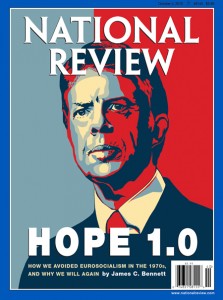
For decades, America had been on a course toward a more centralized society. But 1980 – with the arrival of Reagan and the departure of Carter – marked the point at which the nation reversed course. Thenceforth it would be headed in the opposite direction, toward a new vision of individualism and decentralism.
I have read Jim’s piece in draft, and I strongly suggest you read it.
Charles Cameron is the regular guest-blogger at Zenpundit, and has also posted at Small Wars Journal, All Things Counterterrorism, for the Chicago Boyz Afghanistan 2050 roundtable and elsewhere. Charles read Theology at Christ Church, Oxford, under AE Harvey, and was at one time a Principal Researcher with Boston University’s Center for Millennial Studies and the Senior Analyst with theArlington Institute:
In a Time of Religious Arousal
by Charles Cameron
We live in times of considerable religious arousal – witness the Manhattan mosque and cultural center controversy, the on-again, off-again Florida Quran burning, last week’s Glenn Beck rally at the Lincoln Memorial,Hindutva violence against Muslims in India, Muslim violence against Christians, the wars ongoing or drawing to an end in Afghanistan and Iraq, the threat of an Israeli or American attack on Iran, the Palestinian-Israeli conflict and peace process… In each of these instances, religious arousal has a role to play.
It would require considerable care, research, and craftsmanship to produce a nuanced and appropriately balanced view of human nature, the current state of the world, American, European and Islamic popular, polite and political opinions, the global admixture of peoples and approaches that characterize Islam, the history of violence, religious and otherwise, the braiding in different times and places of religion with politics, the roots of violence, the roots of peace and its meanings both as a state of cessation of conflict and as a state of contemplative calm…
Such a presentation would require at least a book-length treatment, and cannot be trotted out every time some new spark emerges from the ancient fires… but perhaps I can lay out some of my own considerations about the topic here, in somewhat condensed form.
The teachings of Jesus appear to have been directed towards an audience that included regular folk: fishermen, members of an occupying military force, radical zealots, a tax-collector, a physician, a prostitute, religious scholars… a fair cross-section of human kind…
Every religion of any real “size” will have followers who are intellectuals, fearful followers, angry and reactive followers, contemplative followers – followers who are skilled in the various businesses of crime prevention, defense, contemplation, literature, the sex trade, theft, medicine, art, bargaining, diplomacy, music, architecture, investigativejournalism, yellow journalism, inspirational writing, poetry…
It will of necessity address, and over time retain traces, of all their concerns.
Every religion of any real “size” will also have begun in a particular time, place and cultural setting, and will carry considerable parts of that setting with it, although it may also contain elements of a more profound or elevated spirit…
Every religion and scripture will, I suggest, promise a garden / paradise / city which is both attainable “outside” life, in a “there” which is hard to put into words, and “within” us, a similarly difficult concept to verbalize, in the moment, here. It will also contain what I call “landmines in the garden” – verses or narratives that offer sanction to what we today might regard as abhorrent violence against the innocent “other”.
Thus in Numbers 25 in the Jewish Tanakh and Christian Bible, the Lord offers to Phineas / Pinchas a “covenant of priesthood”, because he recognized that his Lord did not appreciate an Israelite and a woman of the Midianitescopulating, and skewered the pair of them in flagrante through their conjoined parts with his spear — without first seeking the approval of the High Priest.
One of the most radical Christian Identity theorists is Richard Kelly Hoskins, who in 1990 invented the notion of the “Phineas Priest,” built around the concept of the biblical Phinehas, who used a spear to slay an Israelite and a Midianite who had lain together. Phineas Priests believe themselves modern day Phinehases, with a self-appointed mission to strike out in the most violent and ruthless way against race mixers, abortionists, homosexuals, Jews, and other perceived enemies.
It seems highly probable that Byron de la Beckwith, killer of civil rights leader Medgar Evers, considered himself a Phineas Priest, see Reed Massengill, Portrait of a Racist: The Man who Killed Medgar Evers, pp 303-305. Similarly, it appears that Rev. Paul Hill, convicted of abortion clinic murders, was considered by his friends, and may have considered himself, a Phineas Priest. Likewise Yigal Amir, assassin of Yitzak Rabin, seems to have had the Phineas story in mind when deciding, without rabbinic support, to go ahead and kill the Israeli PM.
For an example of a recent meeting of rabbis — in Jerusalem’s Ramada Renaissance hotel– to promote the permissibility under halachic law of the killing of goyim / gentiles, see this article by Max Blumenthal and the accompanying video:
Individuals, small sects or powerful movements will on occasion seize on these “landmine” texts within a religious tradition, and use them to justify acts of violence, large and small.
The Crusades, for instance, did this on behalf of Christianity and against Islam, notwithstanding which St Francis was able to approach Saladdin’s nephew, the Sultan Malik al-Kamil, across the battle lines, coming in peace, discussing matters of devotion, and departing in peace. The Islam of al-Andalus was for centuries, in comparison to the Christendom of its time, a model of scholarship and tolerance – though not without aspects of the pre-eminence of Islam, dhimmi status for People of the Book, the jizya, etc.
Mark Juergensmeyer, author of Terror in the Mind of God and currently our finest analyst of religious terrorism, recently co-edited a book on Buddhist Warfare (obligatory, cautionary note: Juergensmeyer and I are both contributors to Michael W Wilson and Natalie Zimmerman’s book, A Kingdom at Any Cost: Right-wing Visions of Apocalypse in America). The world of Zen has been rattled by controversy regarding the support of leading roshis for the Japanese imperial war effort — and there are apocalyptic references to a future war between Buddhists and the mleccha (presumably Islam) in the text ofwhat the Dalai Lama has termed an “initiation for world peace” — the Kalachakra tantra.
Alexander Berzin, who has translated for the Dalai Lama on numerous occasions when this teaching was given, comments:
A careful examination of the Buddhist texts, however, particularlyThe Kalachakra Tantraliterature, reveals both external and internal levels of battle that could easily be called “holy wars.” An unbiased study of Islam reveals the same. In both religions, leaders may exploit the external dimensions of holy war for political, economic, or personal gain, by using it to rouse their troops to battle. Historical examples regarding Islam are well known; but one must not be rosy-eyed about Buddhism and think that it has been immune to this phenomenon. Nevertheless, in both religions, the main emphasis is on the internal spiritual battle against one’s own ignorance and destructive ways.
Any and all religions can be used to justify internal struggle, external violence, external peace-making and inner peace: the question is how these various threads are interwoven in individual cultures and histories, and in our own times.
That is, I’d suggest, a matter for legitimate dispute – but not one with an easy one sentence or even single paragraph answer.
In my view, the most powerful response to the current global “jihadist” movement will come not from advocates of democracy (whether backed up or not by military force or threat of force) who will naturally appear to be interfering in affairs between the soul and its God that do not concern them – but from people within the jihadists’ own religious tradition.
Noman Benotman, one-time leader of the Libyan Islamic Fighting Group and colleague of bin Laden and Zawahiri, wrote an open letter to bin Laden dated 10 September 2010 / 1 Shawwal 1431 AH, which the Quilliam Foundation just released under the title “Al-Qaeda: Your Armed Struggle is Over“.
Benotman’s letter opens with an invocationfrom Qur’an57:16:
Is it not time for believers to humble their hearts to the remembrance of God and the Truth that has been revealed.
The text of Benotman’s message is only four pages long, and I recommend reading the whole of it – but have selected this single passage as representative of his critique:
What has the 11th September brought to the world except mass killings, occupations, destruction, hatred of Muslims, humiliation of Islam, and a tighter grip on the lives of ordinary Muslims by the authoritarian regimes that control Arab and Muslim states? I warned you then, in summer 2000, of how your actions would bring US forces into the Middle East and into Afghanistan, leading to mass unrest and loss of life. You believed I was wrong. Time has proved me right
Benotman closes:
In urging you to halt your violence and re-consider your aims and strategy, I believe I am merely expressing the views of the vast majority of Muslims who wish to see their religion regain the respect it has lost and who long to carry the name of “Muslim” with pride.
For those who are concerned at the influence of Anwar al-Awlaki on English-speaking youth, there’s a detailed 130-page critique of his approach to global jihad from a strict Salafist perspective available on the web:
On the topic of suicide bombing / martyrdom operations viewed from an Islamic perspective, I’d suggest reading the Ihsanic Intelligence “Hijacked Caravan“:
To me religious belief in Islam is, as Sufi Muslims put it, “love of God,” not a political ideology of hatred. … In my heart, therefore, I am a Sufi, but in my mind I subscribe to ‘aql/”reason”, and in this I follow the Islamic rationalism of Ibn Rushd/Averroes. Moreover, I read Islamic scripture, as any other, in the light of history, a practice I learned from the work of the great Islamic philosopher of history IbnKhaldun. The Islamic source most pertinent to the intellectual framework of this book is the ideal of al-madina al-fadila/”the perfect state”, as outlined in the great thought of the Islamic political philosopher al-Farabi.
Lexington Green is politically conservative, but he and others at Chicago Boyz have been willing to put up with me; I respect them, too, because they think out what they’re about. I think they actually listen to me, too, even as we disagree.
So when Green’s post was endorsed by Glenn Beck, I realized that this might be a way to get into his admirers’ minds. Green begins with a John Boyd hierarchy that I haven’t spent much time with; this is another of my departures from my friends at Chicago Boyz. But I suspect that that part can be skipped with little loss. He’s saying that Beck is taking a broad view, going up a couple of levels.
But I don’t feel like I get the rest of it. I can do a sentence-by-sentence exegesis, but that wouldn’t be quite right. I’m trying to get into Green’s and Beck’s heads, not dispute them. But there are barriers. Since I wrote that, Green has added another update, which makes some things clearer. I’ll get to the update later.
One is that so much of what Beck offers is factually flawed. Green is an intelligent person; how can he miss that? Perhaps because the bigger things he talks about in the post are more important to him. But those factual flaws are a barrier to me. A lack of fact is a poor foundation for anything to come after.
What Green likes is Beck’s creation of a large narrative.
Beck is building solidarity and cultural confidence in America, its Constitution, its military heritage, its freedom…
Beck is creating positive themes of unity and patriotism and freedom and independence which are above mere political or policy choices, but not irrelevant to them.
This sort of narrative is indeed attractive; I have wished for a vision that can unite Americans, that would provide a solidarity that we can rest on, a positive vision.
But there is a double-mindedness to Green’s analysis that is another barrier to me. I agree that we need unifying themes for us as Americans. Period. Unfortunately, it’s easy to unify around an enemy, and, while talking about solidarity and unity, Green develops an enemy, “the Overlords”, and a sense of aggrievedness. Since “the Overlords” are Americans too, that sense cannot be the basis for unity. But that duality is in Beck’s words too: he condemns President Obama for a cult of victimization, and then tells his followers how victimized they’ve been. And for him and for Palin, there are very definitely an “us” and a “them.” Apparently I am one of “them.”
Everyyear I make an effort to increase my reading of books during the summer months. Inevitably, I fail at completing whatever overambitious reading list that I compose while somehow finding time to read other books that were never on the list. This year was no exception.
Starting this weekend, I am going to be reviewing all the books I did read from late May to early September. It was an eclectic collection and I hope to complete this series of posts by mid-September. A few reviews that have already appeared in this time period will be re-posted to make the series complete.
Readers are free to offer comments and recommendations about their own favorite summer books or their idiosyncratic reading habits as the series rolls along……
Zenpundit is a blog dedicated to exploring the intersections of foreign policy, history, military theory, national security,strategic thinking, futurism, cognition and a number of other esoteric pursuits.


 officers, genteel Harvard men, desperados, captive madmen, wild animals in locales from the silence of nature to the sound of battle with orders barked over the cries of wounded men. Every story involves a fistfight, a gun, a test of integrity and manly honor where respectable men who are “right square” do their duty without complaint and few concessions, except perhaps to a glass of whiskey “taken for medicinal purposes”.
 , collaborated on the featured cover article in the latest edition of National Review.