zenpundit.com » recommended reading

Archive for the ‘recommended reading’ Category

Recommended Reading

Monday, July 11th, 2011

Top Billing! Crispin Burke –Be honest: Who actually read FM 3-24?

The past year has done little to bolster the COINdinistas’ cause.  General David Petraeus, the lead architect of counterinsurgency theory, has ramped up airstrikes and night raids, and has even begun to re-institute body counts as a measure of effectiveness.  Last week, a UN report undercut US claims of success, pointing out that civilian deaths in Afghanistan increased twenty percent in the last year alone, with the ten-year campaign displacing over 400,000 Afghans.  And let’s not forget a recent scandal involving a beloved counterinsurgency text, “Three Cups of Tea“, which, to this day, still features in some military organizations’ recommended reading lists.

All this has led some to proclaim the “death of COIN“, and others to muse how to save the COIN baby from the bathwater.  In light of all the COIN resentment, noted COINtra Carl Prine has even quipped, “Everyone is Gian Gentile now“.

But is all the criticism deserved? Let’s take a look.

A tour de force by Starbuck. Hat tip to Adam.

Joseph FoucheUnhappy Medium: The Perils of Annoyance as Your Strategic Default

…The U.S. system of government is designed around the institutionalized stasis of factional trench warfare. Governmental power derives from the consent of contingency, built on system of representation heavily tilted towards votes cast by catastrophe. Based on the rule of crisis, not of men, the U.S. federal government creaks limply forward only under the lash of perceived calamity. In such an environment, without a crisis (real or manufactured) at hand, strategy leans imperceptibly towards the unhappy medium of a strategy of annoyance. Reasons of state demand that strategically substantive and consequential action be taken from time to time. But the inertia of the system demands that nothing be done within the system to raise an inconvenient stir or distract the American public from its patriotic consumption. This places two constraints on strategically significant action:

  1. It must be small enough to escape sustained public awareness.
  2. It must be big enough to have real strategic effect.

The result of struggling to square these two incompatible constraints is settling by default on a strategy of annoyance. A strategy of annoyance is big enough to irritate an enemy but not big enough to produce real strategic effect. It produces increased friction for the U.S. from the enemy so irritated without the compensating strategic effects that build toward real strategic gain…

JF has been en fuego – this is just one of many excellent strategy posts he has written lately.

Lexington GreenDemocratic Party of Oak Park Grassroots Planning Session, Oak Park, IL; Tea Party/American Majority Grassroots/Activist Training, Oak Lawn, IL; 50th Wedding Anniversary Party, USA

Part investigative reporting, part anthropology and part analysis, Lex hears trial balloons for 2012 being floated by emissaries from the Party machinery to the well-to-do, liberal activist base, observes their reaction and ponders where the presidential election is headed.  A must read for political junkies.

Bruce Kesler –The Immorality of Scapegoating Greece’s Jews

European anti-semitism is on the rise again, as the economic crisis in Greece makes old stereotypes politically fashionable on the Left and Right.

Galrahn –Israeli Soft Power Crushing Free Gaza Movement

….Israel appears to have operationalized the Adapting, Adopting, and Adeptness model with the latest Gaza flotilla. As Melanie Phillips laid out, by targeting INMARSAT and maritime insurance companies with advisory letters ahead of the flotilla, Israel set the bar very high on the issue of compliance to law. Israel has essentially leveraged a lawfare model often effectively leveraged by NGOs against states back against the Free Gaza Movement. The media has frequently discussed the behind the scenes pressure by the United States and Israel, but they have been short on details regarding the pressure points. You see, the Israeli’s and US are pressuring Europeans to rigidly enforce their own laws. That puts a lot of pressure on organizations like the Greek Coast Guard not to make any mistakes, and the resulting red tape is burying the flotilla every time a vessel makes port. Pardon me while I laugh that the most leveraged weapon by Israel against the flotilla so far is European government bureaucracy….

An important analysis by Ray.

RECOMMENDED VIEWING:

John Robb speaks on the business model he is developing.

Recommended Reading

Tuesday, June 21st, 2011

Overdue!

Top Billing! Fred Leland  Book Review: TEMPO Timing, Tactics and Strategy in Narrative Driven Decision Making by Venkatesh Rao

 The author of Tempo, Venkatesh Rao a man I have never met or heard of prior to the book, began research into decision making that was funded by the United States Air Force and concerned key concepts such as mixed initiative command and control models: complex systems where humans, autonomous robotic combat vehicles and software systems share decision making authority. This research led Rao to this insightful 157 page book, packed full of useful information all law enforcement and security professionals should read.

….In the chapter he titled Narrative Rationality described as; “an approach to decision making that starts with an observation that is at once trivial and profound: all our choices are among life stories that end with our individual deaths. Surprisingly, this philosophical observation leads to very practical conceptualizations of key abstractions in decision making, such as strategy and tactic, and unique perspectives on classic decision-science such as risk and learning.” Orientation and the factors Boyd discuss that shape and reshapes orientation; cultural traditions, genetic heritage, previous experiences, new information and analysis and synthesis all play a roll here. He goes on to say that the simple view “calculative rationality” or planning is not wrong, it’s just limited to simple situations that fits one or more of your existing mental models very well. In complex situations, planning based on such models is merely a training exercise to sample the space of possible worlds, get a sense of the complexities involved, and calibrate your responses appropriately

Speak of the devil…. 

Venkat RaoA Brief History of the Corporation: 1600 to 2100

….If this sounds eerily familiar, it shouldn’t. The year was 1772, exactly 239 years ago today, the apogee of power for the corporation as a business construct. The company was the British East India company (EIC). The bubble that burst was the East India Bubble. Between the founding of the EIC in 1600 and the post-subprime world of 2011, the idea of the corporation was born, matured, over-extended, reined-in, refined, patched, updated, over-extended again, propped-up and finally widely declared to be obsolete. Between 2011 and 2100, it will decline – hopefully gracefully – into a well-behaved retiree on the economic scene.

In its 400+ year history, the corporation has achieved extraordinary things, cutting around-the-world travel time from years to less than a day, putting a computer on every desk, a toilet in every home (nearly) and a cellphone within reach of every human.  It even put a man on the Moon and kinda-sorta cured AIDS.

So it is a sort of grim privilege for the generations living today to watch the slow demise of such a spectacularly effective intellectual construct. The Age of Corporations is coming to an end. The traditional corporation won’t vanish, but it will cease to be the center of gravity of economic life in another generation or two.  They will live on as religious institutions do today, as weakened ghosts of more vital institutions from centuries ago.

Infinity Journal has an amazing array of authors for their third issue including Martin van Creveld, TX Hammes, Gian Gentile and David Betz 

SWJ Blog – Ordinary Men and Abhorrent Behavior

The mediocrity of Evil.

Information Dissemination (Galrahn) – The Navy is Losing the Narratives Battle

If you have been following ADM Roughead’s speeches lately, whether at the Current Strategy Forum (PDF) or last Thursday’s event sponsored by the Center for Strategic and International Studies (PDF), you may have noticed that AirSea Battle is no longer discussed. The question has come up a few times… is AirSea Battle dead?

The answer is yes and no. AirSea Battle doctrine is rarely discussed anymore in public by the Navy because the Navy is backing off AirSea Battle, and some would call it backpedaling with speed. AirSea Battle is a warfighting doctrine developed towards dividing roles and responsibilities of military forces in combat from the sea, and is intended to provide guidance towards cutting redundancy and insuring all mission requirements are clearly understood by the services. The development includes a great deal more detail, but that’s the general overview. That guidance would inform the services where overlap exists, and in theory inform services where cuts need to be made and where renewed focus on capabilities needs to be emphasized.

Committee of Public SafetyOvergrown Comment, Short Post

Joseph Fouche summarizes and extends the debate on whether or not the administration is “astrategic

…Whatever framework you use to analyze human actions, especially those actions your framework categorizes as war or conflict, it should be equally capable of shedding light (and defining) “good” or “successful” actions and “bad” or “failed” actions. Categorizing one lump of actions as Actions while excluding another lump of actions as less than actions does not a good framework make.

Shlok reviews The Profession 

Wikistrat’s Grand Strategy Competition is underway

Jihadica –Zawahiri at the Helm

Seth GodinCoordination

The internet has largely mirrored (and amplified) this competition. eBay, for example, not only pits sellers against one another, it also pits buyers. Craigslist makes it easy for buyers to see the range of products and services on offer, making the marketplace more competitive. Google, most of all, encourages an ecosystem where producers can evolve, improve and compete.

I think the next frontier of the net is going to use the datastream to do precisely the opposite–to create value by making coordination easier.

Adam Elkus –We Go to War With The Strategic Culture We Have

Dr. Von –An Attempt to Make Some Sense of Quantum Mechanics

Eide Neurolearning Blog –A Jolt of Insight

Singularity Hub –Archetype Movie Asks: Can The Dead Live On As Robots?

WSJ (Gillepsie and Welch)-  Death of the Duopoly

Outside the Beltway –Obama Impersonator Tells Racist Jokes at Republican Conference

I share Dr. Joyner’s utter weariness with the GOP’s politically self-immolating wingnut faction who appear to have secret brainstorming sessions where the objective is to come up with some jackass way to lend maximum credibility to 2012 Democratic campaign attack ads. OTOH, Rep. Weiner appears to have cornered the all important “national laughingstock” crown for his party, proving stupidity is thoroughly bipartisan.

RECOMMENDED VIEWING:

Robot Mercs of Armored Core

Book Review: JM Berger’s Jihad Joe

Monday, June 20th, 2011

[ by Charles Cameron — “homegrown” jihad ]

.

41nibyw1jbl_sl500_aa300_.jpg

Jihad Joe: Americans who go to war in the name of Islam

by JM Berger

Potomac Books, Inc, 2011, hard back, $29.95

*

The title by itself is striking — Jihad Joe – and captures nicely the somewhat surreal blend of the normal and the utterly strange that we encounter when we think about “Americans who go to war in the name of Islam” – the subtitle and topic of JM Berger‘s book. And think about them, know a bit about them, we should.

The big question, of course, is Why?

Berger writes early on of young men who gather “to focus their rage through a religious filter” and while noting that jihadists comes from varied backgrounds and travel for varied reasons, correctly zeroes in on the sense of obligation that a jihadist interpretation of Islam imposes:

While all major religions have rules that limit or justify war, a small but significant minority of Muslims believe that under the correct circumstances, war is a fundamental obligation for everyone who shares the religion of Islam. When war is carried out according to the rules, it is called military jihad or simply jihad. [emphasis mine]

The rage may spring from many sources, social, economic, political, but when religion is used to focus it, as Berger nicely puts it, that obligation is what provides divine legitimacy — and the promise of miracles, martydom and a paradisal afterlife – and the sense of serving a higher purpose, to otherwise quieter lives.

*

Berger starts at the beginning. After a brief mention of the presence of many Muslims under slavery, two early and distinctly American expressions of Islam (the Moorish Science Temple and the Nation of Islam), and the beginnings of Muslim Brotherhood activity as Egyptian and other Muslim immigrants brought more orthodox strands of Islam to the States, Berger alerts us to the idea that Americans leaving to fight jihad may have deeper roots than we think.

Bin Laden‘s mentor Abdullah Azzam, for instance, was in the US in the 1980s appealing for Americans to help the mujahideen in their resistance to the Soviet occupation of Afghanistan – a cause supported by President Reagan, who took tea with muj leaders for discussion and photo op, and by the wily Charlie Wilson of Charlie Wilson’s War. Azzam’s calls for volunteers were successful:

No one kept track of how many Americans answered the call, and no one in or out of the U.S. Government would venture a guess on the record. More than 30 documented cases were examined for this book. Based on court records and intelligence documents, a conservative estimate might be that a minimum of 150 American citizens and legal residents went to fight the Soviets.

Implications for today: this has been happening for a long time, it’s not something Anwar al-Awlaki invented just yesterday — and there have been times when the US was no too displeased at such activities.

Azzam’s appeal was precisely to the sense of a general, compulsory obligation for Muslims – fard ayn in Arabic – buttressed by tales of the miraculous and promises of paradise. I emphasize these points because their appeal is real. The day Al-Qaida was founded, an American was present, Mohammed Loay Bayazid, aka Abu Rida al Suri, and it was his reading of Azzam’s account of miracles among the jihadists in Afghanistan – apparent supernatural protection from and/or paralysis of superior forces, the “odor of sanctity” on martyrs’ bodies – that turned him from a not very pious Muslim into a volunteer jihadist. You can read the stories yourself — Azzam’s book is now available for download, in English, on the web.

I’m focusing in on the religious element because that’s my area, others will comment better than I on the military or historical aspects that Berger deals with. But Berger makes it clear that from its inception, Al-Qaida numbered Americans among its higher echelons, and bin Laden was “strangely enamored of Americans and people who had spent time in the United States” – if only for the very practical reason that their passports allowed them access most anywhere.

*

The first act of violence on American soil generally attributed to AQ, Berger tells us, was the 1990 killing of Rashad Khalifa in Tucson, AZ. Khalifa was the numerologically inclined leader of a Tucson mosque and translator of the Qur’an whose apocalyptic date-setting (2280 CE) I mentioned in my Zenpundit post Apocalypse Not Yet? a week ago.

Khalifa’s story leads into that of Al Fuqra, a group that Berger describes in some detail, writing of their “rural compounds and small private villages” and their “covert paramilitary training grounds” and noting that while they have been implicated in “at least thirty-four incidents … from bombings to kidnappings to murder … the government has never moved against the group in an organized manner.”

Berger turns next to the blind Sheikh Omar Abdel Rahman and his followers, soon joined by the AQ-trained bomb-maker Ramzi Yousef, and the 1993 bombing of the World Trade Center – which failed to topple the towers — leaving the task for Mohammed Atta to complete in 2001 under bin Laden’s command

1992 sees several thousand US troops in Arabia given briefings on Saudi culture – largely a matter of Wahhabist Islam – and four-day passes to visit Mecca at Saudi expense were available for converts. As the Bosnian crisis began to unfold, ex-military Muslims converted by these means formed a natural pool for recruitment as jihadists to defend their Muslim brothers against ethnic cleansing and genocide at the hands of their Serb neighbors.

With the combination of the first WTC bombing and the Bosnian jihad, the “far enemy / near enemy” combo was in place: jihad could draw on both local and global events to fuel its global plans, and find both local and targets to take down…

By the beginning of the 1990s, America was in AQ’s sights, though AQ was barely known to a handful of Americans. The 1993 Black Hawk Down incident in Mogadishu featured AQ-trained forces, and the Nairobi and Dar es Salaam embassy attacks were soon in the planning stages. In 1996, bin Laden publishes his declaration of war on America, and the CIA put together a first plan to kidnap him…

*

Anwar al-Awlaki enters the picture around this time, a complex man Berger calls “a study in contradictions” – “a gifted speaker who was capable of moving men to action”.

If the power of religion to focus rage, and the concept of jihad as a compulsory obligation, fard ayn, are two of our first take-aways from Berger’s book, here is a third: rhetoric is the tool that transforms the curious (pious or not so much) into the committed. Anwar al-Awlaki had “a powerful cocktail of skills” but they boil down to this: the ability to talks Islam casually, in the American manner, to American kids — in American English, in a way that appears pious and scholarly, presents jihad as both obligation and adventure, and moves them to action…

Three of the 9-11 hijackers were al-Awlaki contacts… Nidal Hasan, the army psychiatrist who massacred his fellow soldiers at Fort Hood… Umar Farouk Abdulmutallab, the suspected “underwear bomber”… Faizal Shazad, the Times Square bomber… the list of those who have known and been influenced by al-Awlaki goes on…

The history of AQ by now is well known, covered in such books as Lawrence Wright‘s The Looming Tower and Peter Bergen‘s The Longest War, so Berger can concentrate on the “home grown” side of things, featuring — alongside al-Awlaki — his clumsier precursor the AQ propagandist Adam Gadahn, and paying considerable attention to another less-than-widely reported aspect of the jihad – the Pakistani Lashkar-e-Taiba group and its ISI-assisted 2008 attack on Mumbai, India, for which the intelligence scouting was done by the Pakistani-American sometime DEA agent David Headley, and the subsequent planning of an attack in Denmark…Berger turns next to Somalia and al-Shabab – but you get the drift, he is offering us a thoroughgoing, fully researched tour of the various Americans and groups joined by Americans across the world, involved in waging jihad, against scattered local enemies, or against the “far enemy” – the United States.

*

Berger’s work is detail-packed and focused, and a useful resource for that reason alone. But it is also and specifically the work of someone who has read and talked with and listened to the people he is writing about, and his work carries their voices embedded in his own commentary. It thus joins such works as Jessica Stern‘s Terror in the Name of God: Why Religious Militants Kill and Mark Juergensmeyer‘s similarly named and similarly excellent Terror in the Mind of God: The Global Rise of Religious Violence.

Bringing us up to date, Berger offers an overview of jihadist use of the internet, paying special attention to English-language sites – Islamic Awakening, Revolution Muslim — emphasizing the peripheral nature of “forum” activities, but also crediting them as an active doorway to recruitment. Zach Chesser, Samir Khan, Jihad Recollections and Inspire magazine, they’re all here. Read Berger’s recent blog post on “gamification” after this chapter, follow him at @intelwire, and you’ll be ongoingly up to date on his thought…

Berger closes with a look at future prospects. The opening of this chapter – an overview of the history so far covered – speaks volumes:

The journey of the American jihadist spans continents and decades. Americans of every race and cultural background have made the decision to take up arms in the name of Islam and strike a blow for what they believed to be justice.

Many who embarked on this journey took their first steps for the noblest of reasons – to lay their lives on the line in defense of people who seemed defenseless. But some chose to act for baser reasons – anger, hatred of the “other,” desire for power, or an urge towards violence.

In the early days of the movement, it was possible to be a jihadist and still be a “good” American…

Berger neither condemns nor excuses: he sees, he asks, he researches, he reports. His observations of the current situation can thus be trusted to be driven by insight rather than ideology – not the most common of stances, but one we very much need.

He pinpoints as the first element that almost all American jihadists have in common as “an urgent feeling that Muslims are under attack”. Foreign policy implications? Yes indeed – but Berger is also looking to the Muslim community to take an approach less focused on what he terms a “litany of grievances” – valid though some of them may be – which in effect helps perpetuate a “counterproductive narrative” of how the US views and treats Muslims.

Once a narrative that America is at war with Islam is established, the argument for jihad as fard ayn can be made – and all manner of shame, frustrations, rage, violent tendencies, alienation and idealism can be unleashed under the jihadist banner.

Berger’s conclusion:

We must preserve the constitutional rights and basic human respect due to American Muslims while changing the playing field to create conditions in which extremism cannot thrive. These goals are not mutually exclusive – they are independent.

If principle and pragmatism are not enough reason to change the tone of the conversation, there isx one more thing to consider. It would be not only dangerous but shameful to prove that our enemies were right about us all along.

Berger’s is a book to read, certainly — and more significantly perhaps, a book to admire.
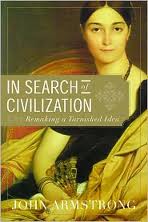
In Search of Civilization, a review

Saturday, June 18th, 2011

 [by J. Scott Shipman]

civilization.jpg

In Search of Civilization, by John Armstrong 

In Search of Civilization is a refreshing and erudite examination of civilization, how it developed in the past, negative present day connotations, and why it remains importance and relevant today. What follows is a detailed overview of Part One, and with any luck, the teaser will be enough to convince you to read this important book. For me, this is a truncated review. Normally, I would provide a 1200-1500 hundred word overview, but like Zen, I’ve been busy and wanted to share what I had with you. This books makes a nice foil for John Gray’s Black Mass, which I read recently but probably will not review.

Also, some books have wonderful finds in the bibliography. Back in the early 80’s I chased footnotes for about two years—and have no memory of what the original book was, but I went from one reference to another. Going forward, I’ll provide the titles from the bibliography that piqued my interest, which may also provide the you a little more insight on the works that influenced the author. Please let me know if this is or is not useful to you.

Part One Civilization as Belonging

Armstrong’s quest to define civilization began as he was reading a bedtime story to his son, and he advances that “with the possible exception of God, civilization is the grandest, most ambitious idea that humanity has devised.” From that introduction, Armstrong makes a compelling case for civilization.  He notes that it is difficult to get one’s mind around the concept since “civilization” touches everything. As a result, he offers that our ideas about “civilization tend to be rather messy and muddled.”

Armstrong goes on to frame civilization as “a way of living,” a level of political and economic development, “the sophisticated pursuit of pleasure,” and finally, “a high level of intellectual and artistic excellence.” Separately each of these, what I’ll call working definitions, made sense. But Armstrong rightly attempts to define, frame, contextualize civilization, not from historical perspective, but rather the philosophical in a way that is relevant to our times.

The actual word “civilization” is, according to Armstrong, not “fashionable” in our globalized world, particularly among those one would expect to be the “defenders.” He offers that civilization carries a “moral implication” whereby one society is somehow better than another, “fully human” or “superior.” And nations often advance the idea that they are better, more civilized, etc. Those defenders (in the arts and humanities) mentioned above have become “wary and negative” with respect to civilization. I’ll call this standard-less ambivalence based primarily on fear. Fear of “what,” you may ask. Fear of offending. Harvey Mansfield in City Journal made an excellent point with respect to political correctness:

“When there is no basis for what we agree to, it becomes mandatory that we agree. The very fragility of change as a principle makes us hold on to it with insistence and tenacity. Having nothing to conform to, we conform to conformism—hence political correctness. Political correctness makes a moral principle of opposing, and excluding, those of us who believe in principles that don’t change.”

Principles are a big part of civilization.A brief review of Samuel P. Huntington’s classic The Clash of Civilizations follows. Armstrong reminds of Huntington’s words: “In coping with an identity crisis, what counts for people are blood and belief, faith and family.” Armstrong recounts Huntington’s view of civilization a sense of “loyalty” and “shared identity.” Armstrong calls this an “organic conception of civilization;” witness the identity politics of the in the aftermath of 9/11 where it seemed the US, for once, stood as one. The phenomena can be found around the world, regardless race, religion, or ethnicity.  If there is a community of people, chances are there will be shared identities, but is this “sharing” civilization?

One of the strongest parts of the book is the emphasis he places on the “quality of relationships.” With the aforementioned “sharing” and “loyalty” Armstrong rightly asks about the quality of individual relationships and the impact on civilization. He compares the loyalty of religious believers to their faith to their loyalty to their civilization. Armstrong believes, and I agree, we share much more in common than one might, on first glance imagine. He says, “The rich achievements of any civilization are not in violent conflict, and in fact are on the same side in a clash between cultivated intelligence and barbarism. The irony is that such barbarism too often goes under the name of loyalty to a civilization.” Armstrong believes that a “true civilization is constituted by high-quality relationships to ideas, objects, and people.” In high quality relationships there is love and Armstrong sees civilization as “the life-support system for high-quality relationships.” Civilization sustains love; I like the implications.

The cultivation of high quality relationships tends to bring out the best in people.  He goes on to discuss the paradox of freedom—as we in the West live in cultural democracies. He asserts that vulgarity is “triumphant” because of our democratic ideals; the majority rules. Freedom comes with great responsibilities, greater responsibilities than living in a coercive state. At the level of the individual we make choices, satisfy appetites. “The civilizing mission is to make what is genuinely good more readily available and to awaken an appetite for it.”

Part Two Civilization as Material Progress, Part Three: Civilization as the Art of Living, Part Four: Civilization as Spiritual Prosperity 

References you may find of interest:

F.R. Leavis, The Great Tradition

C.P. Snow, a lecture “The Two Cultures and the Scientific Revolution

Matthew Arnold, Culture and Anarchy  A free online copy here.

 Kenneth Clark’s BBC television series Civilization

Bernard Berenson, The Florentine Painters of the Renaissance (1896)

T.S. Elliot, an essay called “Tradition and the Individual Talent

Rapturous times, neh?

Saturday, May 21st, 2011

[ By Charles Cameron — apocalyptic movements, best readings, budget shortfalls, lack of support for scholarship in crucial natsec areas — and with a h/t to Dan from Madison at ChicagoBoyz for the video that triggered this post ]
.
.
What with rapture parties breaking out all over, billboards in Dubai proclaiming The End and thousands of Hmong tribespeople in Vietnam among the believers, this whole sorry business of Harold Camping‘s latest end times prediction is catching plenty of attention. I thought it might be helpful to recommend some of the more interesting and knowledgeable commentary on Camping’s failed prophecy.

*

First, three friends and colleagues of mine from the Center for Millennial Studies at Boston University, about which I will have a further paragraph later:

Richard Landes of BU has a text interview here, and a TV interview here. His forthcoming book, Heaven on Earth, is a monumental [554 pp.] treatment of millenarian movements ranging “from ancient Egypt to modern-day UFO cults and global Jihad” with a focus on “ten widely different case studies, none of which come from Judaism or Christianity” — and “shows that many events typically regarded as secular–including the French Revolution, Marxism, Bolshevism, Nazism-not only contain key millennialist elements, but follow the apocalyptic curve of enthusiastic launch, disappointment and (often catastrophic) re-entry into ‘normal time'”.

Stephen O’Leary of USC wrote up the Harold Camping prediction a couple of days ago on the WSJ “Speakeasy” blog. He’s the rhetorician and communications scholar who co-wrote the first article on religion on the internet, and his specialty as it applies to apocalyptic thinking is doubly relevant: the timing of the end — and the timing of the announcement of the end. His book, Arguing the Apocalypse, is the classic treatment.

Damian Thompson of the Daily Telegraph is a wicked and witty blogger on all things Catholic and much else beside — the normally staid Church Times (UK) once called him a “blood-crazed ferret” and he wears the quote with pride on his blog, where you can also find his comments on Camping. Damian’s book, Waiting for Antichrist, is a masterful treatment of one “expecting” church in London, and has a lot to tell us about the distance between the orthodoxies of its clergy and the various levels of enthusiasm and eclectic beliefs of their congregants.

Three experts, three highly recommended books.

*

Two quick notes for those whose motto is “follow the money” (I prefer “cherchez la femme” myself, but chacun a son gout):

The LA Times has a piece that examines the “worldwide $100-million campaign of caravans and billboards, financed by the sale and swap of TV and radio stations” behind Camping’s more recent prediction (the 1994 version was less widely known).

Well worth reading.

And for those who suspect the man of living “high on the hog” — this quote from the same piece might cause you to rethink the possibility that the man’s sincere (one can be misguided with one’s integrity intact, I’d suggest):

Though his organization has large financial holdings, he drives a 1993 Camry and lives in a modest house.

*

Now back to the Center for Millennial Studies.

While it existed, it was quite simply the world center of apocalyptic, messianic and millenarian studies. CMS conferences brought together a wide range of scholars of different eras and areas, who could together begin to fathom the commonalities and differences — anthropological, theological, psychological, political, local, global, historical, and contemporary — of movements such as the Essenes, the Falun Gong, the Quakers, Nazism, the Muenster Anabaptists, al-Qaida, the Taiping Rebellion, Branch Davidians, the Y2K scare, classic Marxism, Aum Shinrikyo and Heaven’s Gate.

And then the year 2000 came and went, and those who hadn’t followed the work of the CMS and its associates thought it’s all over, no more millennial expectation, we’ve entered the new millennium with barely a hiccup.

Well, guess what. It was at the CMS that David Cook presented early insights from his definitive work on contemporary millennial movements in Islam — and now we have millennial stirrings both on the Shia side (President Ahmadinejad et al) and among the Sunni (AQ theorist Abu Mus’ab Al-Suri devotes the last hundred pages of his treatise on jihad to “signs of the end times”)…

Apocalyptic expectation continues. But Richard Landes’ and Stephen O’Leary’s fine project, the CMS, is no longer with us to bring scholars together to discuss what remains one of the key topics of our times. When Richard’s book comes out, buy it and read it — and see if you don’t see what I mean.

Or read Jean-Pierre Filiu‘s Apocalypse in Islam.  Please. Or Tim Furnish‘s recent paper.

*

And while it may not see Judgment Day or the beginning of the end of the world as predicted, what this week has seen is the end of funding of Fulbright scholarships for doctoral dissertation research abroad.  But then as Abu Muqawama points out:

hey, it’s probably safe to cut funding for these languages. It’s hard to see Iran, Afghanistan, Pakistan or anywhere in the Arabic-speaking world causing issues in terms of U.S. national security interests anytime soon.

Right?

So the CMS isn’t the only significant scholarly venue we’ve lost to terminal lack of vision.


Switch to our mobile site

