zenpundit.com » recommended reading

Archive for the ‘recommended reading’ Category

Two courtyards, two hundred camels

Sunday, March 6th, 2011

a light-hearted canon in two voices

[ by Charles Cameron ]

*

I’d been doing some research for a follow-up post on story-telling in Afghanistan to go with Scott‘s account of his day at DARPA’s recent STORyNET conference, and one of the interlocutors on the list we’re both on posted a question about the impact of drug use as a consideration in narrative.

Baudelaire and Cocteau both have writings on drug use — hashish and opium respectively — but it was Afghan or more generally Islamic story-telling that I was after, and it occurred to me that the four stories in Paul Bowles‘ collection, A Hundred Camels in the Courtyard, were easily accessible examples of the kind of story-telling that Moroccans are prone to under the influence of hashish.  Bowles describes their mental processes thus:

Moroccan kif-smokers like to speak of the “two worlds,” the one ruled by inexorable natural laws, and the other, the kif world, in which each person perceives “reality” according to the projections of his own essence, the state of consciousness in which the elements of the physical universe are automatically rearranged by cannabis to suit the requirements of the individual. These distorted variations in themselves generally are of scant interest to anyone but the subject at the time he is experiencing them. An intelligent smoker, nevertheless, can aid in directing the process of deformation in such a way that the results will have value to him in his daily life. If he has faith in the accuracy of his interpretations, he will accept them as decisive, and use them to determine a subsequent plan of action. Thus, for a dedicated smoker, the passage to the “other world” is often a pilgrimage undertaken for the express purpose of oracular consultation.

The title of Bowles’ little collection, by the way, comes from the Moroccan proverb which is gives me the first of my two quotes, two courtyards, two intoxicants and two hundred camels below…

I wasn’t entirely satisfied, though, which a Moroccan account of hash-flavored narrative when DARPA was looking for an understanding of narrative that would apply in Afghanistan, so I thought I’d look up some of Idries Shah‘s writings, and Kara Kush in particular, to see if perhaps I could find an Afghan equivalent of Bowles’ stories there…

I already had Bowles’ one courtyard and one hundred camels in mind, so you’ll understand how pleased I was to stumble upon another slightly obscure but interesting writer — Peter Lamborn Wilson, aka Hakim Bey, who gave use the concept of the TAZ or Temporary Autonomous Zone — writing about Afghanistan rather than Morocco, opium rather than hashish, and a second courtyard, with a second hundred camels:

quo-100-camels.jpg

Two terrific writers: Paul Bowles and Peter Lamborn Wilson.

Sources: BowlesWilson

Courtyards with a hundred camels in them are popping up all over.
Recommended Reading

Monday, February 28th, 2011

These are worth reading:

Top Billing! GrEaT sAtAn”s gIrLfRiEnD – COIN Passé?

…COIN, as done up in Iraq is certainly not a one size fits all bustier and the debate may be more about style over substance.

As world famous Surge Expert and charter member of Great Satan’s cadre of Combat Rock Stars Major Few recently shared about the sexyful upgradation of FM 3-24 – v2.0

 “…Courtney, FM 3-24 was born out of necessity.  GEN Petraeus brought together a team of experts to provide the US military some desperately needed help while Iraq was spiraling out of control.  The majority of the text covers the wisdom of David Galula, the godfather of population-centric counterinsurgency.   It was a good start.  Galula was smart, had a lot of experience, and could write, but, it was only a start.” (GsGf Editorial note -Italics bis mein)

 There’s more than one way to nail a hottie or do a Surge, as Captain Burke of WoI fame psychically predicted.

“Bottom line: keep FM 3-24–updated as necessary–on the bookshelves. While the book is not without its flaws, it does have a number of good lessons applicable from everything from counterinsurgency, to hybrid-style wars, to disaster relief.“Secondly, COIN is an operational framework, not a strategic one. Furthermore, FM 3-24 was written in a specific context, when America was good at offensive operations, but poor at human intelligence gathering and population security.”….

The intrepid Fraulein Messerschmidt was kind enough to solicit a jeremiad from me prior to posting and, knowing that her blog is a favorite read among the COINdinista set, I rode that hobby horse at a gallop. 🙂

Swedish Meatballs Confidential(p.NSFW)The Intel Biz Is Changing As Never Before (Or Should Be)

Good observations here re: wikileaks, authoritarian states and institutions of manipulative antics.

The New Criterion/Arma Virumque (Bruce Kesler)Jawohl Mein Professor!

…The stereotype of ruler-wielding, dogma-enforcing Catholic nuns has nothing on the parody-proofing self-image being created by the AAUP of college professors as academic thugs.

In its latest draft document to define academic freedom, the American Association of University Professors has gone abroad to authoritarian regimes and overboard to try to suck the air out of critiques of academia.

Fabius MaximusAn explanation of the US and Pakistan governments’ odd behavior in the Raymond Davis affair

The US-Pakistani alliance increasingly resembles a bad shotgun marriage between a white-knuckle drunkard and a hysterical mental patient.

TDAXP, PhD.-Review of “The Party: The Secret World of China’s Communist Rulers,” by Richard McGregor

Dr.VonMulti-disciplinarity and The Birth Of America

….Building off that theme, a second book, Steven Johnson’s The Invention of Air: A Story of Science, Faith, Revolution and The Birth of America, examines the life and work of Joseph Priestley, and his deep friendships with Ben Franklin, Thomas Jefferson, and his influence on those two Founding Fathers as well as John Adams.Priestley began as one of the leading and first modern chemists, whose main contemporary scientific rival was Antoine Lavoisier. Priestley had numerous discoveries, including providing key evidence for the existence of oxygen and its role in combustion and life itself, but what was new for me was his deep friendship with Benjamin Franklin. Franklin and Priestley met and corresponded with each other about science for many years prior to the American Revolution, and influenced each other greatly as far as the development of experiments, analysis and interpretation of data. Their letters show how they were onto the conceptual understanding of the cycling of oxygen and carbon dioxide for all of life, and how ecosystems work in terms of the flow and transformation of different energy types from one to another. These concepts were decades ahead of their time….

Shrinkwrapped – Fully Immersive Virtual Reality May Be Closer Than We Think

Don VandergriffPetraeus’s Last Stand?

Thomas RicksWhy I don’t believe there is really such as thing as an ‘operational’ level of war

Out of my tattered Lands End attaché bag this week came Hew Strachan‘s article titled “Strategy or Alibi? Obama, McChrystal and the Operational Level of War,” which appeared last September in Survival….So far, so good. But then I think Strachan goes off the tracks a bit. Like a doctor whose diagnosis is spot on but who errs in prescribing the remedy, he argues that this sort of operational approach became problematic because it assumed the existence of strategy. But what, he says, if “strategy has been absent throughout the wars in Iraq and Afghanistan”? (166)

I actually think that may have been true in Iraq until late 2006 or early 2007, because until then, American generals tended to offer up aspirations rather than strategy. But I do think we had a strategy under the Petraeus/Odierno/Crocker team. What may have thrown Professor Strachan off the scent is that the strategy couldn’t be stated explicitly. I don’t think I really understood this clearly when I was writing The Gamble, and Strachan’s paper helped me think it through…

I understand Ricks’ point re: Iraq and find it reasonable, but I think there really is an “operational level” of war….at least in the institutional culture of some armies in some historical periods, including  today’s US Army. I’ve previously argued   similarly to Strachan here, albeit not as authoritatively or persuasively and – FWIW – I think China’s PLA is moving in that direction as well (though I’m willing to be corrected by Sinologists out there).

Information Dissemination – US Naval Institute Official Announcement on Mission Change and The Mission of the U.S. Naval Institute by Rear Admiral Tom Marfiak (ret)

Campaign War Room – The dynamic nature of public opinion 

Inkspots Some thoughts on LTG Caldwell’s probably-legal-but-still-wildly-inappropriate influence operations 

Eide Neurolearning BlogMade to Stick Learning

SEEDHumans, Version 3.0

….Neuronal recycling exploits this wellspring of potent powers. If one wants to get a human brain to do task Y despite it not having evolved to efficiently carry out task Y, then a key point is not to forcefully twist the brain to do Y. Like all animal brains, human brains are not general-purpose universal learning machines, but, instead, are intricately structured suites of instincts optimized for the environments in which they evolved. To harness our brains, we want to let the brain’s brilliant mechanisms run as intended-i.e., not to be twisted. Rather, the strategy is to twist Y into a shape that the brain does know how to process.

American ScientistRefuting a Myth About Human Origins

…Premodern humans-often described as “archaic Homo sapiens“-were thought to have lived in small, vulnerable groups of closely related individuals. They were believed to have been equipped only with simple tools and were likely heavily dependent on hunting large game. Individuals in such groups would have been much less insulated from environmental stresses than are modern humans. In Thomas Hobbes’s words, their lives were “solitary, nasty, brutish and short.” If you need a mental image here, close your eyes and conjure a picture of a stereotypical caveman. But archaeological evidence now shows that some of the behaviors associated with modern humans, most importantly our capacity for wide behavioral variability, actually did occur among people who lived very long ago, particularly in Africa. And a conviction is growing among some archaeologists that there was no sweeping transformation to “behavioral modernity” in our species’ recent past.

….The idea of an archaic-to-modern human transition in Homo sapiens arises, in part, from this narrative tradition. All this makes for a satisfying story, but it is not a realistic framework for understanding the actual, complex and contingent course of human evolution. Most evolutionary changes are relatively minor things whose consequences play out incrementally over thousands of generations.

RECOMMENDED VIEWING:

Conversations with History – Ian Morris on Why the West Rules for Now

Gene Sharp

Monday, February 21st, 2011

[ by Charles Cameron ]

I was impressed by him in London in the early sixties.

Okay, I was young and impressionable. But others have noticed him more recently, too: Hugo Chavez accused him of being a conspirator with the CIA, and the Iranians thought he, George Soros and John McCain were in cahoots.

gene-sharp.jpg

Gene Sharp has been in the news quite a bit recently [1, 2, 3, 4], because he pretty literally wrote the book on non-violent resistance.

The young leaders of the Egyptian revolt that toppled Mubarak studied tactics with members of the Serbian Otpor youth resistance who topped Milosevic, Otpor studied tactics in the writings of Gene Sharp, specifically his 90-page pamphlet From Dictatorship to Democracy [download as .pdf]. Sharp wrote that handbook for use in Burma, where it was apparently translated at the request of Aung San Suu Kyi — who once cautioned her readers that that phrase they kept hearing wasn’t “jeans shirt”, it was “Gene Sharp”.

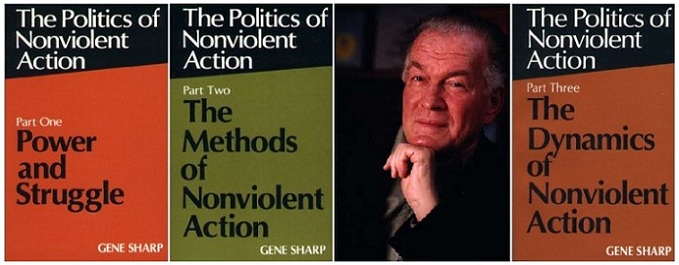
And before that, he’d penned his masterful 900-page, three-volume work, The Politics of Nonviolent Action

I told you he was impressive.

Recommended reading:

From Dictatorship to Democracy is now available in Amharic, Arabic, Azeri, Belarusian, Burmese, Chin (Burma), Jing-paw (Burma), Karen (Burma), Mon (Burma), Chinese (Simplified Mandarin), Chinese (Traditional Mandarin), English, Farsi, French, Indonesian, Khmer (Cambodia), Kyrgyz, Pashto, Russian, Serbian, Spanish, Ukrainian, Tibetan, Tigrigna, and Vietnamese.

COL Pat Lang on Twitter

Wednesday, February 16th, 2011

[ by Charles Cameron ]

Excellent news!  COL Patrick Lang has now signed up on Twitter, so a quick and easy way to know when he’s posted at Sic Semper Tyrranis is to follow him @pat_lang. I hope he’ll post the occasional quick comment on — or pointer to — breaking news there, too.

*

Okay, that’s the main message here — but there’s also an amusing aside to be made.

I tend to pride myself (I’m afraid that’s probably the right word) on my humility — so you can imagine how I felt when I discovered earlier today that Twitter was doing my humility for me:

humility-by-twitter.jpg

That’s right: as a follower of COL Lang, I rate precisely zero.

Humility by twitter — is our technology getting wise to us at last?

Recommended Reading Round-up on the Egyptian/Arab Revolution

Monday, January 31st, 2011

I had intended to write an analytical post about the tumultuous events in Egypt and elsewhere in the Arab world and then I recalled that a) I do not speak or read Arabic b) am not versed in contemporary Egyptian politics c) am not an Arabist by academic training d) have never visited the Middle East and e) even those who are all of these things are often doing more news updating on twitter than deep analysis.

Egypt is the demographic and geographic center of the Arab Sunni world – but without the economic resources to make Egypt the power that Nasser once aspired that it would be in the heady era of postcolonial, nationalist, Pan-Arabism. So Nasser became a client of the Soviets, who could fund his ambitions and Egypt was a quasi- Soviet satellite until Sadat kicked the Soviets out for trying to undermine him in favor of a more pliant stooge, and accepted American patronage. Sadat’s assassination gave us Mubarak and his hated familial-military-party oligarchy (Ok, the military and party were largely there, but Mubarak’s rule has discredited them).

So, instead of my projecting what will happen next, I’ll devote this recommended reading to other bloggers and news sources who are freer with their conjecture:

Top Billing! Thomas P.M. Barnett Preliminary scenario voting results at Wikistrat’s Egyptian war room (updated 1630 EST Sun) and First ever Virtual Strategic War-Room Launched following Egyptian Chaos and the Wikistrat Virtual Strategic War Room site.

No Tom is not an Arabist either, but he does have experience with designing and participating in professional war games and futurism sessions inside the USG and out. The war room, to my casual observation, seems like an IT effort to synthesize expert analysis and crowdsourcing a primitive/structured prediction market. Interesting.

Abu MuqawamaAn Open Letter to the Egyptian PeopleEgypt: A Humble Request.

Arabist.net The who’s who of the has-beens

Marc Lynch –Washington eyes a fateful day in Egypt and Obama’s handling Egypt pretty well

Col. Pat Lang-The Outlook for Egypt and the Middle East Is Grim By – Robert K. Lifton , More sensible attitudes on Egypt today, Omar Suleiman sworn in as VP

SWJ Blog Days of Unrest (Update)

STRATFOR –  The Egypt Crisis in a Global Context: A Special Report | STRATFOR

Fabius Maximus –Important information about the riots in Egypt and Why do we fear the rioters in Egypt?

HNN (Haider Khan)Egypt, What Next?

Global Guerrillas – EGYPT: How to Lead and Open Source Protest , EGYPT: Mubarak’s Survival Strategy and EGYPT: Looting as Counter-Insurgency

Juan Cole –Egypt’s Class Conflict

Outside the Beltway –Egyptians Upset With U.S. Response To Crisis and Egypt and the Limits of US Power

That’s it.


Switch to our mobile site

