zenpundit.com » anthropology

Archive for the ‘anthropology’ Category

New Book: America 3.0 is Now Launched!

Tuesday, May 21st, 2013

America 3.0: Rebooting American Prosperity in the 21st Century – why America’s Best Days are Yet to Come by James C. Bennett and Michael Lotus

I am confident that this deeply researched and thoughtfully argued book  is going to make a big political splash, especially in conservative circles – and has already garnered a strong endorsement from Michael Barone, Jonah Goldberg, John O’Sullivan and this review from  Glenn Reynolds in USA Today :

Future’s so bright we have to wear shades: Column 

….But serious as these problems are, they’re all short-term things. So while at the moment a lot of our political leaders may be wearing sunglasses so as not to be recognized, there’s a pretty good argument that, over the longer time, our future’s so bright that we have to wear shades.

That’s the thesis of a new book, America 3.0: Rebooting American Prosperity In The 21st Century.The book’s authors, James Bennett and Michael Lotus, argue that things seem rough because we’re in a period of transition, like those after the Civil War and during the New Deal era. Such transitions are necessarily bumpy, but once they’re navigated the country comes back stronger than ever.

America 1.0, in their analysis, was the America of small farmers, Yankee ingenuity, and almost nonexistent national government that prevailed for the first hundred years or so of our nation’s existence. The hallmarks were self-reliance, localism, and free markets.

At the end of the 19th century and the beginning of the 20th, people were getting unhappy. The country was in its fastest-ever period of economic growth, but the wealth was unevenly distributed and the economy was volatile. This led to calls for what became America 2.0: an America based on centralization, technocratic/bureaucratic oversight, and economies of scale. This took off in the Depression and hit its peak in the 1950s and 1960s, when people saw Big Government and Big Corporations as promising safety and stability. You didn’t have to be afraid: There were Top Men on the job, and there were Big Institutions like the FHA, General Motors, and Social Security to serve as shock absorbers against the vicissitudes of fate.

It worked for a while. But in time, the Top Men looked more like those bureaucrats at the end of Raiders Of The Lost Ark, and the Big Institutions . . . well, they’re mostly bankrupt, or close to it. “Bigger is better” doesn’t seem so true anymore.

To me, the leitmotif for the current decade is supplied by Stein’s Law, coined by economist Herb Stein: “Something that can’t go on forever, won’t.” There are a lot of things that can’t go on forever, and, soon enough, they won’t. Chief among them are too-big-to-fail businesses and too-big-to-succeed government.

But as Bennett and Lotus note, the problems of America 2.0 are all soluble, and, in what they call America 3.0, they will be solved. The solutions will be as different from America 2.0 as America 2.0 was from America 1.0. We’ll see a focus on smaller government, nimbler organization, and living within our means — because, frankly, we’ll have no choice. Something that can’t go on forever, won’t. If America 2.0 was a fit for the world of giant steel mills and monolithic corporations, America 3.0 will be fit for the world of consumer choice and Internet speed.

Every so often, a “political” book comes around that has the potential to be a “game changer” in public debate. Bennett and Lotus have not limited themselves to describing or diagnosing America’s ills – instead, they present solutions in a historical framework that stresses the continuity and adaptive resilience of the American idea. If America”s “City on a Hill” today looks too much like post-industrial Detroit they point to the coming renewal; if the Hand of the State is heavy and it’s Eye lately is dangerously creepy, they point to a reinvigorated private sector and robust civil society; if the future for the young looks bleak,  Bennett and Lotus explain why this generation and the next will conquer the world.

Bennett and Lotus bring to the table something Americans have not heard nearly enough from the Right – a positive vision of an American future that works for everyone and a strategy to make it happen.

But don’t take my word for it.

The authors will be guests Tuesday evening on Lou Dobb’s Tonight and you can hear them firsthand and find out why they believe “America’s best days are yet to come

On eating one’s enemy

Saturday, May 18th, 2013

[ by Charles Cameron — not good branding, not Islamic, dumbstruck? — not a whole lot else to say ]
.

Commander Abu Sakkar / the Farouq Brigades logo


Let’s take the bald facts first:

Commander Abu Sakkar of the Farouq Brigades, Free Syrian Army, had himself videotaped this month cutting open and seeming to eat the flesh of a just-killed Syrian soldier loyal to President Assad — to send a message. According to a New York Times “Lede” blog-post, he preceded this act with the words:

I swear to God, soldiers of Bashar, you dogs — we will eat your heart and livers! … God is great! Oh, my heroes of Baba Amr, you slaughter the Alawites and take their hearts out to eat them!

His rhetoric as reported speaks of eating the heart: in the event, it is a portion of lungs that he eats, or mimics eating.

**

This has to be seen in many contexts — one of them, the branding of the Syrian rebels in general and the Farouq Brigades in particular.

This is taken from an article a couple of weeks ago on a WSJ blog titled For Some Syrian Rebels, It’s a Battle of the Brands:

Twelve activists in an office in Reyhanli, Turkey near the border run Farouk’s Facebook page, web site, and Twitter account. They’re working on the TV channel, which Mr. Awad says they’ve envisioned as a tool to resocialize fighters off the battlefield.

“The regime will fall one day,” he says. “We have 20,000 fighters–they all won’t stay fighters. They will put down their weapons, and need to integrate into the world. TV, radio, these things will help.”

The media office’s latest brand offering? A three-dimensional version of the Farouk logo, which will be used in videos and other online material.

“The guys complained the logo wasn’t nice enough,” Mr. Awad said, laughing. “They wanted a 3D one.”

**

Moralizing about someone eating the flesh of a deceased enemy is pretty easy to pull off — unless one still thinks it’s a potent way to acquire one’s enemy’s courage, which is now something of a curiosity in the anthropologist’s cabinet of concepts. Here, dug up from the section on Homeopathic Magic of a Flesh Diet in Sir JG Frazer‘s 1922 edition of The Golden Bough, now long out-dated, is the picture as it used to be seen:

When Basutos of the mountains have killed a very brave foe, they immediately cut out his heart and eat it, because this is supposed to give them his courage and strength in battle. When Sir Charles M’Carthy was killed by the Ashantees in 1824, it is said that his heart was devoured by the chiefs of the Ashantee army, who hoped by this means to imbibe his courage. His flesh was dried and parcelled out among the lower officers for the same purpose, and his bones were long kept at Coomassie as national fetishes. The Nauras Indians of New Granada ate the hearts of Spaniards when they had the opportunity, hoping thereby to make themselves as dauntless as the dreaded Castilian chivalry.

Even as a cannibal delicacy, the white man’s heart seemed to have special virtue! As I say, though — that’s all a little out of date.

**

Eating one’s enemy, however, is a distinctly un-Islamic behavior, whatever century we’re in. One early Islamic narrative concerns Hind bint ‘Utbah avenging deaths in her own family by eating the heart of a great Muslim warrior, dear to the Prophet — far from being an example of what is permitted in Islam, she’s an example of what Muhammad was up against by way of enemies in the early days of his preaching:

Hind Bint `Utbah, the wife of Abu Sufyaan, ordered Wahshiy to bring her Hamzah’s liver, and he responded to her savage desire. When he returned to her, he delivered the liver to her with his right hand, while taking the necklaces with the left as a reward for the accomplished task. Hind, whose father had been killed in the Battle of Badr and whose husband was the leader of the polytheist army, chewed Hamzah’s liver hoping to relieve her heart, but the liver was too tough for her teeth so she spat it out and stood up shouting her poem:

                    For Badr we’ve paid you better
                    In a war more flaring than the other.
                    I was not patient to revenge the murder of
                    `Utbah, my son, and my brother.
                    My vow’s fulfilled, my heart’s relieved forever.

Hind did eventually become a Muslim — but on account of this very event, was never fully included among “the Companions of the Prophet”.

**

I don’t want to moralize over Commander Abu Sakkar‘s act, not having been in his shoes — but it is vile under pretty much any moral standard you might choose. A problem arises, though, when one attempts to use it to justify one side or another, in a conflict in which brutality of one kind or another seems to be present on both sides. As Sakkar himself told a Time correspondent:

You are not seeing what we are seeing, and you are not living what we are living. Where are my brothers, my friends, the girls of my neighborhood who were raped?

**

Peter Bouckaert of Human Rights Watch is quoted giving another kind of context to the affair:

Abu Sakkar is just one man, and there are many other armed fighters in Syria who reject such sectarian actions and would be horrified by the mutilation and desecration of a corpse — let alone an act of cannibalism. But he is a commander in a decisive battle in Syria — hardly a marginal figure.

**

Not without reason did Kurtz whisper at the end of Joseph Conrad‘s Heart of Darkness, as in Francis Ford Coppola‘s Apocalypse Now:

The horror! The horror!

On getting it right, eh?

Thursday, April 25th, 2013

[ by Charles Cameron — with a little help from the Buddha, fake quotes, self-referential paradox, a pinch of salt, and two tbsps of anthropology ]
.

Over the last ten days we have seen a whole lot of speculation, misinformation, spin and gossip masquerading as analysis and journalism, and that was on my mind when I ran across an alleged Buddha-quote that told me to use my common sense — and since my common sense told me there probably wasn’t a phrase in Pali, the language of the earliest Buddhist texts, that would correspond too closely to the highly idiomatic English usage, common sense, I thought I should check it out with Fake Buddha Quotes, my go-to place for checking what the Buddha is supposed to have said:

I’m pretty sure the Buddha never said “Pretty sure I never said that” too, for much the same reason.

**

But what delights me most about all this is just how self-referential this all is: the Buddha allegedly warns us against trusting what we read even when it’s attributed to him, in what turns out to be a faux quote attributed to him, based on a real quote that reads (in one translation):

Any teaching should not be accepted as true for the following ten reasons: hearsay, tradition, rumor, accepted scriptures, surmise, axiom, logical reasoning, a feeling of affinity for the matter being pondered, the ability or attractiveness of the person offering the teaching, the fact that the teaching is offered by “my” teacher. Rather, the teaching should be accepted as true when one knows by direct experience that such is the case.

**

Fpr what it’s worth, the abbreviated version doesn’t mean the same as the original. From Koun Franz at Sweeping Zen:

his is a very different idea. The original says we need to verify through direct experience; the popular version says that we can stand back from the practice, at a distance, and use reason to determine its authenticity.

Or this, from Bodhipaksa, the Fake Buddha Quotes guy, :

The Buddha of course isn’t saying we should jettison reason and common sense. What he’s implying is that both those things can be misleading and what’s ultimately the arbiter of what’s true is experience. It’s when you “know for yourselves” that something is true through experience that you know it’s true.

**

Another comment on the same page led me to this first comment on cultures and languages —

which in turn reminded me of the second, a long-time favorite of mine from the time when I was some sort of Anthro professor in dreamy Oregon…

**

And, y’lnow, both those quotes in my second pair give you a visceral sense of what today’s SWJ article by Robert R. Greene Sands and Thomas J. Haines, Promoting Cross-Cultural Competence in Intelligence Professionals is very rightly on about, though it’s all phrased in a manner so abstract you might easily miss the point…

Mitigating cognitive, cultural and a host of tradecraft biases is essential for intelligence professionals to navigate through today’s culturally complex environments. Adopting the perspective of contemporary cultural groups, including nation-states, often defies understanding because the intelligence professional is challenged to both appreciate and consequently discern meaning of behavior that is predicated on vastly different beliefs and value systems. Fundamental to this dissonance is a markedly different cultural reality resulting from different histories, traditions and the stasis of culture. The professional’s western and deeply seated worldview impedes either the analysis itself, or is perjured by the cognitive restrictions imposed by the structured analytic strategies used.

The quote about the Wintu — it’s from Dorothy Lee, Linguistic Reflection of Wintu Thought, Chapter 9 in Dennis and Barbara Tedlock‘s Teachings from the American earth: Indian religion and philosophy — goes on to say:

The Wintu relationship with nature is one of intimacy and mutual courtesy. He kills a deer only when he needs it for his livelihood, and utilizes every part of it, hoofs and marrow and hide and sinew and flesh. Waste is abhorrent to him, not because he believes in the intrinsic virtue of thrift, but because the deer had died for him.

Now there‘s “a markedly different cultural reality” for you!

Honor, Shame, Scandal and Integrity

Friday, March 8th, 2013

[ by Charles Cameron — reflecting on the anthropology of honor – shame, its relevance to cover ups of many kinds, and its potential for impact in our search for a more peaceable modus vivendi ]
.

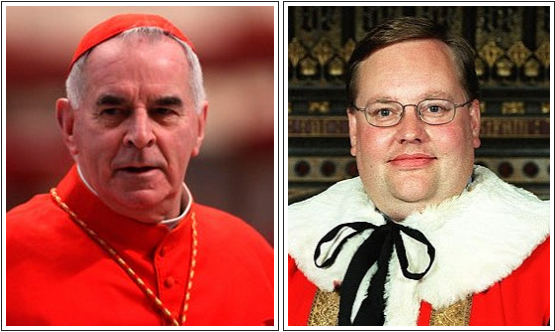
Cardinal O'Brien & Lord Lennard, their images as juxtaposed on the Cranmer blog


**

Recent political news in the United Kingdom, from The Telegraph:

Liberal Democrat leader Nick Clegg has been forced to admit that his office knew for years of claims that a senior party figure might be sexually molesting volunteers and staff.

The Deputy Prime Minister changed tack in a statement on Sunday evening over the sex scandal which is engulfing his party.

He broke into the end of his holiday to admit for the first time that his office had been aware of the allegations surrounding his former chief executive Lord Rennard since 2008. But he said he was personally unaware of the claims.

Nick Clegg admits his office knew of Lord Rennard rumours for five years

**

In today’s Wired, concerning a cover-up in the US Air Force:

A military jury found Lt. Col. James Wilkerson guilty of groping a sleeping woman’s breasts and vagina. But the Air Force wasn’t done with the “superstar” F-16 pilot. It reinstated Wilkerson to active duty and wiped away his conviction — but, to save face, is pledging not to promote him to full colonel.

[ … ]

Now the embarrassed Air Force is looking for a face saving way out of its institutional mess. Its answer thus far, reports Stars & Stripes, is to remove Wilkerson’s name from its promotions list. There’s an opportunity for Wilkerson to appeal the decision.

Air Force Accountability for Sexual Assault: Not Promoting Convicted Officer

**

And concerning Lockheed and China, a short while back from emptywheel:

I’m just wondering out loud here: what if China did more than just steal data on the F-35 when it hacked various contractors, and instead sabotaged the program, inserting engineering flaws into the plane in the same way we inserted flaws in Iran’s centrifuge development via StuxNet?

[ … ]

I don’t know that we would ever know if this clusterfuck was caused with the assistance of China. It’s not like Lockheed would publicize such information, just as it asked for another $100 billion. And I don’t want to underestimate the defense industry’s ability to screw up all by themselves.

What if China Not Just Hacked — But Sabotaged — the F-35?

**

I think one of the least appreciated parts of our human make-up is what anthros call the honor-shame system. It considers the honor of a larger group — the family, the regiment, the city, the nation, the corporation, the church — as of overriding importance, with personal considerations clearly secondary. And by honor I mean the respect with which the rest of society views it.

That’s the system that gives us “honor killings” in a swathe of countries, and in modified western form it’s also at the root of every cover-up, every attempt by hacks and flacks to put a good face on things — and it’s very much something that investigative journalism exists to uncover, just as PR attempts to cover it up.

To my mind, this is one of the big battlefronts in the world today, comparable perhaps to the battle post-Descartes between “enlightenment” and “superstition”. And when there’s murky business to cover up or admit to, corporations are often slower than individuals to ‘fess up — if only because the stock market favors appearances rather than realities. Until the bubble bursts.

And much the same is true for politicians and the electoral market, and for churches and the market in faith.

**

My mentor Richard Landes believes honor-shame is a large part of the battlefront between “the Israelis” and “the Arab world” — he quotes these two definitions:

Politeness is not saying certain things lest there be violence; civility is being able to say those certain things and there won’t be violence.

and writes:

In an honour culture, it is legitimate, expected, even required to shed blood for the sake of honour, to save face, to redeem the dishonoured face. Public criticism is an assault on the very “face” of the person criticised. Thus, people in such cultures are careful to be “polite”; and a genuinely free press is impossible, no matter what the laws proclaim.

Modernity, however, is based on a free public discussion, on civility rather than politeness, but the benefits of this public self-criticism – sharp learning curves, advances in science and technology, economic development, democracy – make that pain worthwhile.

Leaving aside their applicability to the Israeli-Arab issue, are those fair distinctions between two modes of being? How much of the battle between those forces can be found in the world around us, in our politics, our economics situation, and so on?

How much impact did the differences between honor cultures and modernity have, in the wars in Iraq and Afghanistan? Where else might this kind of conflict of values confront our leaders and ourselves?

How can we best handle interfaces between these two ways of experiencing, evaluating and acting in our shared world?

What all these measures will not address is the mindset

Monday, December 24th, 2012

[ by Charles Cameron — concerning the implications of the phrase “all things visible and invisible” ]
.

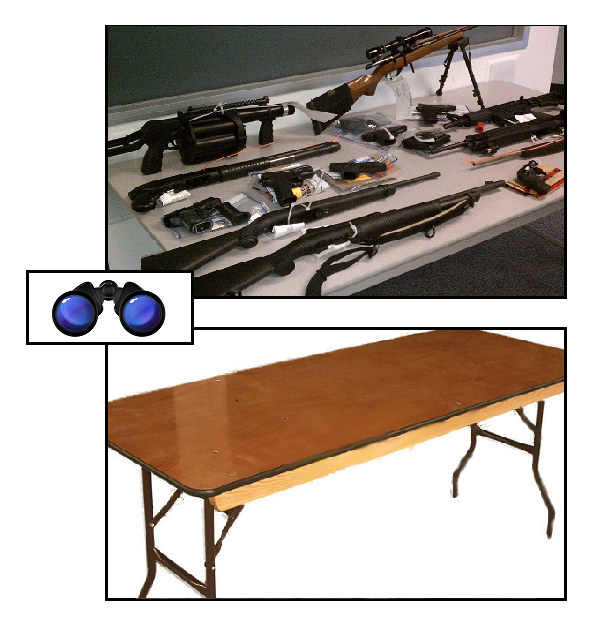
In the upper panel above, you can see a bunch of “guns and ammo” displayed on a table, and in the lower panel, a bunch of “hearts and minds” similarly displayed. Putting that another way, you can see guns and ammo but you can’t see hearts and minds — they’re invisible, you can only intuit them.

And therein lies the reason we focus so much on the quantitative and so little on the qualitative: we can see and count the one, the other is invisible and unaccountable.

**

I thought the paragraph that follows was terrific. The article I’ve taken it from happens to be about a multiple rape of a teenage girl this July in India, and it was posted on the Times of India site. If that’s an issue of importance to you, the article is Why Indian men rape by Anand Soondas. It’s not the whole article that I’m pointing you to, though — it’s just this one paragraph:

We at The Times of India in our edition today laid out a 6-point action plan to make India safer for women – harsher punishment, sensitization of the police force, setting up of fast-track courts, better patrolling, cleverer use of technology like GPS and CCTVs and a data base of public transport personnel – but what all these measures will not address is the mindset.

More specifically, I want to address you to its concluding phrase: What all these measures will not address is the mindset.

I want to re-purpose that paragraph. I want to remove the specific problem and proposed solutions, and to see the paragraph as a form, a vessel into which all manner of liquids could be poured.

The form would look something like this:

What follows is an n-point plan to make the world a better place — do x, do y, do z, do abc if it comes to that — but what all these measures will not address is the mindset.

What all these measures will not address is the mindset.

**

We almost always think about ways to fix the world, but forget that any and every fix has to work its way through not just our own mindset — though that can be a problem in itself — but also the multiple mindsets and differing culture sets of multiple others.

  • Do this, that and the other in Afghanistan — but what all these measures will not address is the mindset.
  • Do this, that and the other about Syria, about Egypt, about the Middle East, the Arab Spring — but what all these measures will not address is the mindset.
  • Do this, that and the other to combat global warming — but what all these measures will not address is the mindset.
  • Do this, that and the other about the possession and use of firearms — but what all these measures will not address is the mindset.
  • Do this, that and the other, and the world will be a far better place.
  • The thing is, you can’t simply deploy other people’s hearts and minds, the way you can deploy your own troops and materiel.


    Switch to our mobile site