zenpundit.com » insurgency

Archive for the ‘insurgency’ Category

Arquilla on the New Rules of War

Thursday, February 25th, 2010

John Arqilla, along with David Ronfeldt, was the pioneering military and security theorist who forseaw the rise of networked non-state adversaries, which they detailed in their now classic book, Networks and Netwars. Below, in a Foreign Policy mag article, Arquilla expounds on the failure of the Pentagon to adapt sufficiently to leverage the power of networks or counter those opponents who have done so.

The New Rules of War

When militaries don’t keep up with the pace of change, countries suffer. In World War I, the failure to grasp the implications of mass production led not only to senseless slaughter, but also to the end of great empires and the bankruptcy of others. The inability to comprehend the meaning of mechanization at the outset of World War II handed vast tracts of territory to the Axis powers and very nearly gave them victory. The failure to grasp the true meaning of nuclear weapons led to a suicidal arms race and a barely averted apocalypse during the Cuban missile crisis.
 
Today, the signs of misunderstanding still abound. For example, in an age of supersonic anti-ship missiles, the U.S. Navy has spent countless billions of dollars on “surface warfare ships” whose aluminum superstructures will likely burn to the waterline if hit by a single missile. Yet Navy doctrine calls for them to engage missile-armed enemies at eyeball range in coastal waters.
 
The U.S. Army, meanwhile, has spent tens of billions of dollars on its “Future Combat Systems,” a grab bag of new weapons, vehicles, and communications gadgets now seen by its own proponents as almost completely unworkable for the kind of military operations that land forces will be undertaking in the years ahead. The oceans of information the systems would generate each day would clog the command circuits so that carrying out even the simplest operation would be a terrible slog.
 
And the U.S. Air Force, beyond its well-known devotion to massive bombing, remains in love with extremely advanced and extremely expensive fighter aircraft — despite losing only one fighter plane to an enemy fighter in nearly 40 years. Although the hugely costly F-22 turned out to function poorly and is being canceled after enormous investment in its production, the Air Force has by no means given up. Instead, the more advanced F-35 will be produced, at a cost running in the hundreds of billions of dollars. All this in an era in which what the United States already has is far better than anything else in the world and will remain so for many decades.
 
These developments suggest that the United States is spending huge amounts of money in ways that are actually making Americans less secure, not only against irregular insurgents, but also against smart countries building different sorts of militaries. And the problem goes well beyond weapons and other high-tech items. What’s missing most of all from the U.S. military’s arsenal is a deep understanding of networking, the loose but lively interconnection between people that creates and brings a new kind of collective intelligence, power, and purpose to bear — for good and ill…..”

Read the rest here.

It was nice to see Arquilla give some props to VADM Art Cebrowski, who is underappreciated these days as a strategic thinker and is much critricized by people who seldom bothered to read anything he actually wrote. Or who like to pretend that he had said a highly networked Naval task force is a good way to tackle an insurgency in an arid, mostly landlocked, semi-urban, middle-eastern nation.

It also occurs to me that one of the reasons that the USAF resisted drones tooth and nail is that robotics combined with swarming points to en end ( or serious diminishment) of piloted warplanes. Eliminating the design requirements implicit in human pilots makes for a smaller, faster, more maneuverable, more lethal aircraft that will probably be infinitely cheaper to make, more easily risked in combat and usable for “swarming”. Ditto attack helicopters.

Of course, nuclear bombers will probably stay in human hands. Probably.

ADDENDUM:

Contentious Small Wars Council thread on Arquilla begun by “student of war” and defense consultant Wilf Owen. I have weighed in as has Shlok Vaidya.
Senator’s Son

Wednesday, February 17th, 2010

larson.jpg

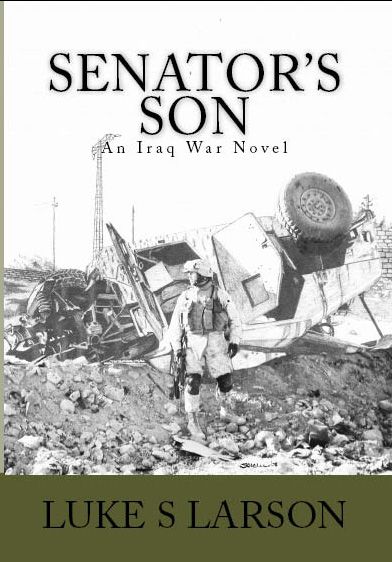
Senator’s Son: An Iraq War Novel  by Luke S. Larson

Just received a review copy of new author Luke Larson’s novel Senator’s Son. I can probably count on the fingers of one hand the number of works of fiction that I have reviewed at ZP, but two things caught my attention about Senator’s Son:

First, the novel is historical realism with a theme of COIN. Secondly, the author Luke Larson is a decorated Marine officer with two tours in Iraq under his belt. Flipping the pages reveals a gritty, sometimes humorous, staccato writing style and military/strategy/policy issues that are discussed here, or at SWJ or Abu Muqawama come to life through the eyes of still learning practitioners. I’m looking forward to reading Senator’s Son and reviewing it in full in late February or early March ( need to finish Carr’s Inside Cyber Warfare first).

Setting aside the book itself, something else occurred to me – that we have reached the point where the war is now appearing not as news, but as literature; Iraq and Afghanistan are proving to be culturally transformative wars for America in ways that the Gulf War or the Korean War were not.

If you consider WWI, the Great War represented an existential crisis for Western Civilization that found expression in the Lost Generation and, in Germany, the polar opposite novels All Quiet on the Western Front and Storm of Steel as well as Hemingway’s A Farewell to ArmsThe Spanish Civil War electrified international opinion, foreshadowing as it did the ideological death-match of the 20th century, and yielded Orwell’s Homage to Catalonia. WWII and the Vietnam War have generated an ocean of histories down to the minutest detail, as well as their share of novels, short stories and movies. It is noteworthy, that most of the time, literature and history followed the conclusion of peace, be it in victory or defeat.

In our time, the books on the war in Iraq, or Afghanistan or against terrorism are arriving while the conflict is still in full throttle, in time to shape the perceptions of policymakers and the public to an unprecedented extent. Something is happening out there, an inchoate need for answers or reassurance that writers are attempting to answer. Most of these books so far have been non-fiction, journalistic instant histories salted with examples of policy analysis and war memoirs.

Senator’s Son marks a new turn toward a wave of fiction addressing the crucible of America’s current wars. Literature can shape a nation’s psyche more profoundly than even the most soberly researched work of history.

Petting the Cobra When We should be Looking for a Big Rock

Monday, February 15th, 2010

On SECDEF Robert Gates doing Q&A in Pakistan: Attackerman and Duck of Minerva (Vikash Yadav)

The Depth Of Official Pakistani Anger At Us

Simple and plain: the Obama administration has to do something about Pakistan’s legitimate security fears emanating from India. As Gates points out, it’s completely absurd to argue that the U.S. has had a policy of “propping up” formerly-Soviet-allied India, but it doesn’t matter at this point (yes, yes, you guys who are big on “narrative”; score one for you). The Pakistanis believe that the lack of U.S. hectoring directed at India is part of a concerted policy of supporting India at Pakistan’s expense. Consequently, pushing the Pakistani military into Waziristan, to fight fellow Pakistanis, is easily misconstrued as weakening Pakistan for India’s sake.

There were good arguments for not stuffing the India relationship into Richard Holbrooke’s pillbox of headaches. India is too big a relationship to reduce to just a security issue. And for much of last year, the U.S. was waiting for India to elect a new government. But if we mean what we say about security, diplomacy, politics and development being interrelated and mutually supportive/corrosive, then it’s time to broker a real India-Pakistan peace process. Unless we want Gates’ next appearance at the Islamabad NDU to go even worse.

Gates Grilled at Pakistan’s National Defense University

The Defense Department has pulled from its website the transcript of the Q and A session last month between Secretary of Defense Gates and Pakistani military officers.  The frank talk was apparently a bit heated. At one point, one of the Pakistani military officers asked Secretary Gates point blank: “Are you with us or against us?”The transcript reveals a deep level of distrust between the US and the Pakistani military.  It also shows that some junior officers of the Pakistani military do not take ownership of their government’s current offensives against militants in the North West Frontier Province and the Federally Administered Tribal Areas of Pakistan.

Yadav has posted the entire transcript.

Count me as someone who thinks the single most effective move the US could do in the War on Terror is to bomb ISI headquarters with a few 30,000 lb superbombs  shortly after everyone arrived at work. Yes, I know that’s completely non-serious – I’m venting my irritation.

The second best moved be reducing our footprint in Afghanistan to what can be sustained via air from the ‘Stans and cutting off all aid to Pakistan. Every last dime. Our dollars are paying for the IEDs and bullets that kill our soldiers but shhhhhhhhhh….we’re not supposed to talk about that in polite company. That part is serious. We can live without Islamabad. Really, we can. We’ll do just fine. And they’re the bad actors who make a lousy neighborhood a whole lot worse. That Pakistan has legitimate security concerns is true – let’s tighten the screws on those and see if that helps induce a more cooperative attitude as eight and a half years of bribery has been counterproductive.

SECDEF Gates has an unenviable task. Pakistan, or at least an autonomous part of its military, is our enemy in Afghanistan and have been since 2001. Let’s accept that reality and revise our policies accordingly. Being an enemy of the United States ought to come with some costs rather than aid packages.

Tools vs. Strategies: Or, Why “An” Alternative to COIN is Not “THE” Alternative

Friday, February 12th, 2010

Dr. Bernard I. Finel has an important and provocative article in AFJ challenging the current operational primacy of COIN in Afghanistan and Iraq that has stirred a great deal of backchannel and listserv discussion, but not nearly enough open commentary in the blogosphere. I checked an unscientific sampling of COIN blogs and did not find much discussion of Dr. Finel’s article, except one comment at SWJ Blog by respected SWC member Ken White, who called it  a “well stated and logical essay” with a “valid premise”. Finel’s article merits greater attention and debate:

An alternative to COIN

The U.S. military is a dominant fighting force, capable of rapid global power projection and able to defeat state adversaries quickly and at relatively low cost in American lives and treasure. Unfortunately, American leaders are increasingly trying to transform this force into one optimized for counterinsurgency missions and long-term military occupations. A fundamental problem with the adoption of population-centric counterinsurgency (COIN) doctrine as an organizing principle for American military operations is that it systematically fails to take advantage of the real strengths of the U.S. military.

It is true that not all political goals are achievable through the use of conventional military capabilities. However, “victory” in war is not dichotomous, and the cases of Iraq and Afghanistan – often seen as proving the necessity for COIN-capable forces as well as a commitment to nation-building – demonstrate in reality that the vast majority of goals can be accomplished through quick, decisive military operations. Not all political goals are achievable this way, but most are and those that cannot be achieved through conventional operations likely cannot be achieved by the application of even the most sophisticated counterinsurgency doctrine either.

As a consequence, I believe the U.S. should adopt a national military strategy that heavily leverages the core capability to break states and target and destroy fixed assets, iteratively if necessary. Such a strategy – which might loosely be termed “repetitive raiding” – could defeat and disrupt most potential threats the U.S. faces. While America’s adversaries may prefer to engage the U.S. using asymmetric strategies, there is no reason that the U.S. should agree to fight on these terms.

This essay argues the U.S. can largely defeat threats using conventional capabilities, and that what encourages a desire to engage in long-drawn-out asymmetric conflicts is not the elimination of threats, but rather the unattainable goal of trying to prevent threats from emerging in the future.

Read the rest here.

First, I have some sympathy with Finel’s position that COIN operations generally do not maximize the utility of America’s military comparative advantages and extended nation-building via COIN is a costly investment. Dr. Finel is correct here. I’m certain even David Kilcullen would agree with Finel that America trying to do heavy footprint, pop-centric COIN everywhere and anywhere is unwise and too expensive. We need to sync our military might with our political will as well as our wallet.

Secondly, I have no problem with punitive expeditions, or what Finel euphemistically calls “repetitive raiding”. Such “Perdicaris Alive or Raisuli Dead!” tinged operations are as old as warfare itself and a state’s demonstrated willingness to carry them out serves a useful deterrent purpose. William Lind has been advocating a combination of punitive expeditions and containment/isolation for years in his writings on 4GW. This is an option we should definitely consider first in a cost-benefit fashion prior to committing sizable deployments of troops to a long-term nation building adventure.

That said, exchanging one operatiuonal emphasis (COIN) for another (punitive expeditions) does not change our strategic situation much, it just represents a different kind of hammer, a mallet instead of a ball peen. Under Finel’s prospective doctrine, the US military will be greenlighted to fight only the wars it likes best because some foes are more targetable than others, resembling a drunkard looking for his car keys under a street lamp because that is where the light is good. If we can just convince all of our enemies to oblige us by becoming states with flags, armies and capitols, then I’d say junk COIN.

Unfortunately, they won’t and the days when only states can cause damage are long past. A well-trained, paramilitary, insurgency can wreck one hell of a lot of damage, especially when it is striking first with the element of surprise. This is why, even in the state-centric days of the Cold War, that the Soviet Union invested heavily in SPETSNAZ, OSNAZ and various GRU sleeper units to wreck havoc behind NATO lines with terrorism, assassination and sabotage in the run up to WWIII. The Soviets expected at least major tactical, if not strategic, results from such units.

Operational tools are not strategies. This was my prior complaint about COIN being oversold in Afghanistan and punitive expeditions likewise do not fit every geopolitical situation and work best with particular circumstances. The fact is, where we have a real national interest in friendly states with legitimate governments beating back insurgents, COIN is a better choice. Many problems will require a response that is altogether different from either. The enemy, when there is an enemy, has to be dealt with as they are and not as we’d really like them to be in our ten year procurement schedule. We have to select the tools that best fit operational conditions, our policy objectives and our resources.

Strategy must conform to reality and not the reverse.

Milpub

Tuesday, February 9th, 2010

seydlitz89, the clausewitzian analyst and former Marine Corps officer and US Army intelligence officer who wrote articles in the past for Dr. Chet Richard’s DNI site and participated in two Chicago Boyz Roundtables ( Clausewitz and Xenophon), is now blogging at Milpub.

Here is seydlitz89’s most recent post where he asks some tough questions about how US/NATO strategy in Afghanistan comports with classical COIN theory and a basic need for intellectual coherence:

The Current Crisis in US Counterinsurgency

….To me the crisis reflects much deeper issues. Some of these have to do with the contradictions between the actual theory of Counterinsurgency Warfare as developed by David Galula, and the current wars in Iraq and Afghanistan which are presented to the American people as counterinsurgencies (from our perspective) but are not. This confusion in strategic theory and strategy in turn feeds the political confusion on the US side. What is sorely missing is a honest disclosure of what our actual political purposes are and the best way seen to achieve them.In 1964, a professional French Army officer named David Galula had published a short, but first-rate book on strategic theory entitled Counterinsurgency Warfare. Galula’s conclusion based on his own experiences in Greece, Indochina, China and Algeria, was that to be successful against Revolutionary Warfare (read Maoist-influenced strategies of insurgency), the established state would have to adopt a specific form of warfare based on the realities of this type of conflict, or “counterinsurgency warfare”. Galula’s approach while very coherent and compatible with Clausewitz’s general theory, is specific to a certain political context and thus limited in applicability since the strengths and weaknesses he ascribes to each side refer to this specific political context.

Read the rest here.


Switch to our mobile site
