zenpundit.com » al qaida

Archive for the ‘al qaida’ Category

Games of telephone and counter-telephone?

Wednesday, October 3rd, 2012

[ by Charles Cameron — embassy or consulate — a minor detail for an editor, perhaps, but all the difference in the world for Ambassador J Christopher Stevens ]
.

Here’s a screen grab of a piece posted on the Atlantic site today:


.

The article itself is worth your time, and I’ll get back to the screen grab later. Here’s the text para that interests me:

In the famous “Bin Ladin Determined to Strike in US” Presidential Daily Brief of August 6, 2001, one of the major analytic points was that “Al-Qa’ida members — including some who are US citizens — have resided in or traveled to the US for years, and the group apparently maintains a support structure that could aid attacks” (emphasis added). Notice that this analysis uses two hedges in a single sentence. Given the lack of certainty on the issue, such linguistic dodging made sense — as it does in report after report where individuals are discussing information below the level of actionable intelligence.

Leah Farrall has been tweeting about the way this characteristically cautious phrasing used by analysts gets lost as “the higher up the food chain an analytical report goes the greater the tendency for bosses in [the] food chain to add their two cents worth” — so that by the time it reaches the politicians, “there is absolutely WMD.”

The shift from “apparently” to “absolutely” is an interesting one.

**

The 2007 National Intelligence Estimate featured a section on the nomenclature of such distinctions, which I trust and imagine was directed more at its readers than towards the analysts who produced it:

What We Mean When We Say: An Explanation of Estimative Language

When we use words such as “we judge” or “we assess”—terms we use synonymously — as well as “we estimate,” “likely” or “indicate,” we are trying to convey an analytical assessment or judgment. These assessments, which are based on incomplete or at times fragmentary information are not a fact, proof, or knowledge. Some analytical judgments are based directly on collected information; others rest on previous judgments, which serve as building blocks. In either type of judgment, we do not have “evidence” that shows something to be a fact or that definitively links two items or issues.

Intelligence judgments pertaining to likelihood are intended to reflect the Community’s sense of the probability of a development or event. Assigning precise numerical ratings to such judgments would imply more rigor than we intend. The chart below provides a rough idea of the relationship of terms to each other.

We do not intend the term “unlikely” to imply an event will not happen. We use “probably” and “likely” to indicate there is a greater than even chance. We use words such as “we cannot dismiss,” “we cannot rule out,” and “we cannot discount” to reflect an unlikely—or even remote—event whose consequences are such it warrants mentioning. Words such as “may be” and “suggest” are used to reflect situations in which we are unable to assess the likelihood generally because relevant information is nonexistent, sketchy, or fragmented.

In addition to using words within a judgment to convey degrees of likelihood, we also ascribe “high,” “moderate,” or “low” confidence levels based on the scope and quality of information supporting our judgments.

• “High confidence” generally indicates our judgments are based on high-quality information and/or the nature of the issue makes it possible to render a solid judgment.
• “Moderate confidence” generally means the information is interpreted in various ways, we have alternative views, or the information is credible and plausible but not corroborated sufficiently to warrant a higher level of confidence.
• “Low confidence” generally means the information is scant, questionable, or very fragmented and it is difficult to make solid analytic inferences, or we have significant concerns or problems with the sources.

**

You could think of these as counter-telephone measures — attempts to avoid the distortions and corruptions that tend to arise when a message is passed from one person to another, And that’s important a fortiori when an ascending food-chain of transmitters may wish (or be persuaded) to formulate a message that will assure them the favorable attention of their superiors — but also because the higher the report goes, the closer it gets to decision-time..

As the Atlantic article says, this kind of “linguistic dodging” (aka attention to nuance) makes sense “in report after report where individuals are discussing information below the level of actionable intelligence.”

Inevitably there’s a shift in tempo between contemplation and action.

**

Anyway, messages tend to get distorted as they’re passed along.

Consider, for instance, the caption to the photograph that graces the Atlantic piece at the top of this post:

The U.S Embassy in Benghazi burns following an attack in September. (Reuters)

There’s only one problem there. The US didn’t have an Embassy in Benghazi — they had a Consulate — and that’s not a distinction that lacks a consequence. Whatever else may be the case, Ambassador Stevens would certainly have been better guarded had he been back in Tripoli in his embassy.

Whoever wrote that caption wasn’t as deeply immersed in the situation as the former CIA analyst who write the article. And when you’re not deeply immersed, it is perilously easy to get minor but important details wrong.

Waco in Pakistan

Monday, September 24th, 2012

[ by Charles Cameron — on the way not listening sometimes leads to trouble, the importance of ultimate concerns, and a remarkable remark by M. Morsi ]
.

It’s happening again, this time in Pakistan.

Nicholas Kristof‘s NYR op-ed a day or two ago, Exploiting the Prophet, included one particularly interesting little quote that set me thinking – and my friend Bryan Alexander noted it too. Kristof was talking about how people in Muslim countries with little or no tradition of free speech sometimes “have an addled view of how the United States handles blasphemy” and commented, almost as an aside:

A Pakistani imam, Abdul Wahid Qasmi, once told me that President Bill Clinton burned to death scores of Americans for criticizing Jesus. If America can execute blasphemers, he said, why can’t Pakistan?

I challenged him, and he plucked an Urdu-language book off his shelf, thumbed through it, and began reading triumphantly about the 1993 raid on David Koresh’s cult in Waco, Tex.

That’s absurd, preposterous. Perfectly understandable. And dangerous.

**

Here’s a description of how Americans listened to al-Qaida, drawn from Benjamin and Simon’s book, The Age of Sacred Terror, p. 159:

So much of what was heard from al-Qaeda after the attacks sounded to Americans like gibberish that many chords of the apocalypse were missed.

According, that is, to two senior members of President Clinton‘s National Security Council charged with counterterrorism, jihadist “chords of the apocalypse” were missed because they sounded like “gibberish”.

When I read that, I couldn’t help but recall the label given by FBI field agents to attempts by David Koresh to engage them in a discussion of the Book of Revelation, which for him was a roadmap of the very events he was living through — the FBI’s siege of Mount Carmel in Waco, TX.

Here’s a quote from the abstract of Robert Agne and Karen Tracy‘s analysis, ‘Bible Babble’: Naming the Interactional Trouble at Waco, published in Discourse Studies (v 3 # 3, 269-294):

A frustrating yet persistent aspect for the FBI negotiators was the Davidians’ talk about the Bible and their religious beliefs, what agents dismissively described as ‘Bible babble’.

So:

Does it matter if one group of people persists in misunderstanding the religious positions of another in high-tension disputes?

In the case of Waco, it may indeed have contributed to the tragic outcome.

In this study, we analyze several exchanges between Koresh and one of the FBI agents. The analysis shows how the FBI’s identifying their problem as ‘Bible babble’ contributed to the negotiation failure.

**

There are other parallels that can be drawn between the Branch Davidians and their worldview, and al-Qaida and theirs — parallels that may have significance wherever there is a clash in which the “irrational” religious discourse of an (often apocalyptically inclined) “other” is easily brushed off by our own “more rational” mindset.

According to conflict resolution scholar Jayne Seminaire Docherty, writing in Learning Lessons from Waco (p. 99):

During the Waco negotiations, the Mount Carmel residents invited the FBI negotiators to choose God’s law over man’s law.

Compare al-Qaida, as seen in two excerpts from Michael Scheuer‘s Al-Qaeda’s Completed Warning Cycle – Ready to attack? published by the Jamestown Foundation in Terrorism Focus (v 2 #5, 2005):

After 9/11, bin Laden received sharp criticisms from Islamist scholars that dealt with the al-Qaeda chief’s failure to satisfy several religious requirements pertinent to waging war. The critique focused on three items: (1) insufficient warning; (2) failure to offer Americans a chance to convert to Islam; and (3) inadequate religious authorization to kill so many people. Bin Laden accepted these criticisms and in mid-2002 began a series of speeches and actions to remedy the shortcomings and satisfy his Islamist critics before again attacking in the United States.

Parallel to the warnings, bin Laden on two occasions since 2002 asked Americans to convert to Islam as the means of terminating the war al-Qaeda is waging against the United States. “We call you to Islam,” bin Laden said on both occasions, addressing himself to President Bush – as the leader of the American people – and asking him to lead his countrymen to Islam. He also offered to serve as guide and teacher for the American people, urging them to “follow the right path” to Islam. “I am an honest adviser to you.” bin Laden concluded, “I urge you to seek the joy of life and the after life…. I urge you to become Muslims….” (Al-Jazeera 6 Oct 02; Waaqiah.com, 26 Oct 02)

**

The Davidian invitation to the FBI interlocutors to talk Revelation — like the AQ invitation to President Bush and all America to convert to Islam — may seem a foredoomed invitation, but it’s one that at the very least situates one side of the conflict in the territory of “ultimate concerns”. Thus Docherty continues:

The negotiators resisted these invitations as situationally inappropriate conversion efforts. The Branch Davidians, they said, were disrupting the “real” negotiations with their proselytizing. However, for the Mount Carmel residents, proselytizing was the truly important business at hand. With the Second Coming looming on the horizon, all else was trivial by comparison, even the task of peacefully resolving the barricade standoff.

What is ultimate and what is, strictly by comparison, trivial?

One of the most significant answers to that question was given by Muhammad Morsi when he said recently:

To God, the attack on a person to Allah is bigger an attack on the Kaaba.

I still have a post or two in me concerning the ugly video clip and the far uglier riots it triggered, and in one of them I’d like to explore that remarkable remark of Morsi’s — deploring the killing of Ambassador Stevens — and supporting texts from the Qur’an, hadith and the writings of the late Egyptian cleric Sheikh Ghazali.

New Book: Mission Revolution by Jennifer Morrison Taw

Sunday, September 16th, 2012

Mission Revolution: The US Military and Stability Operations by Jennifer Morrison Taw

Columbia University Press just sent me a review copy of Mission Revolution: The US Military and Stability Operations by Jennifer Morrison Taw, an assistant professor of IR/Security Studies at Claremont McKenna College.  Taw has written a very timely book given the looming threat of sequestration – she has investigated and analyzed the institutional and strategic impact of the US having elevated MOOTW (military operations other than war) in 2005 to a DoD mission on par with war-fighting, terming the change a “Revolution”.

[ Parenthetical aside: I recall well Thomas Barnett loudly and persistently calling for the Pentagon to deal with MOOTW by enacting an institutional division of labor between a heavy-duty Leviathan force to handle winning wars and a constabulary System Administration force to win the peace, manage stability, defend the connectivity. Instead, in Iraq and Afghanistan we had one Leviathan force trying to shoehorn in both missions with a shortage of boots, a river of money and a new COIN doctrine. Soon, if budget cuts and force reduction are handled badly we could have one very expensive, poorly structured, force unable to do either mission.]

Thumbing through Mission Revolution, it is critical and well focused take on the spectrum of problems the US has faced in the past ten years trying to make a “whole of government” approach an effective reality in stability operations and counterinsurgency. Taw covers doctrine, training, bureaucratic politics, procurement, policy, grand strategy, mission creep, counterterrorism and foreign policy visions of the civilian leadership, all with generous footnoting.

I am looking forward to reading Mission Revolution and giving it a detailed, in-depth, review in the near future.

Obama’s Foreign Policy Gamble on the Moderate Islamists

Wednesday, September 12th, 2012

As you probably already know, the US Embassy in Cairo Egypt was stormed today by Islamists supposedly angry about a video on Youtube supposedly made or endorsed by anti-Muslim Quran-burner and bigot Rev. Terry Jones. The embassy, deliberately left without sufficient protection by the Egyptian government of Islamist President  Mohamed Morsi, was overrun, Islamists tore down the US flag and hoisted the black flag of al Qaida while a senior Muslim Brotherhood official has called on the US to “apologize”. All on the anniversary of 9/11.

The US Consulate in Benghazi, Libya was attacked by an Islamist militia with RPGs and small arms, sacked and burned, killing at least one American.

The Obama administration has gambled heavily upon a Mideast policy of engagement verging into appeasement and sponsorship of Sunni Islamist groups’ political and even revolutionary aspirations in the hopes of  co-opting “moderate” or “pragmatic” Islamists into a durable partnership with the United States. The new regime of American-educated Mohammed Morsi, represents the cornerstone of this policy, alongside the Libyan Revolution that toppled Gaddafi. This initiative has been delicately balanced, Nixon-style, with a very tough campaign of unapologetic targeted drone strikes on hard-core al Qaida terrorists in Afghanistan, Pakistan, Yemen and Somalia.

If you have a sense of deja vu, you are harkening back to 1979, when another Democratic administration and an arrogantly uninformed group of senior State Department officials severely misread another, that time Shia, Islamist revolution. We lost several embassies then as well and endured a national humiliation of the Iranian hostage crisis.

But give the Carter administration, it’s due: when the embassy in Teheran was seized or the one in Islamabad burned by military-sponsored Islamist mobs, no State Department official at the time responded with quite this level of truckling moral cowardice and incompetence:

@Mbaha2

@USEmbassyCairo you say all humans are equal but the truth is you hate Muslims and describe us as terrorists when u are the real terrorists

@USEmbassyCairo

@mbaha2 No, that’s not true. We consistently stand up for Muslims around the world and talk abt how Islam is a wonderful religion

Perhaps the time for anxiously politically correct FSOs describing Islam as “a wonderful religion” to an online Salafist hater could wait a few days, at least until Egypt restored the American embassy to it’s sovereign status with an apology and the body of the slain American diplomat is returned to their family from Libya for a decent burial?

The administration’s policy teeters on a knife’s edge. Their so far craven and confused response today to two of our diplomatic missions being attacked by the forces they themselves have engaged could potentially cause a snowball effect across the region. Their would-be “allies” are  currently calculating the costs of biting the hand that fed them vice the dangers of their own swarming fanatics in the streets. The administration’s officials as of today seem to have little awareness of the effects of their bizarrely conciliatory words and a stubborn determination to double-down rather than correct their course  have begun to reevaluate at least their rhetoric. The policy is another question.
.
Perhaps for our next hostage crisis, we will see an American ambassador beheaded live on al Jazeera……
.
UPDATE:
.
Events in Libya were worse than news reports yesterday indicated. Ambassador Stevens and three other diplomatic personnel were killed and the security situation in Libya remains dicey.
.
When this terrible incident is examined by Congressional committees, one focus will be on the security provided to the embassy and Ambassador Stevens by the State Department and the government of Libya, whose security minister reported that the government safe house sheltering American diplomatic personnel had been discovered by the attackers. “Where were the Marine guards?” is a question already being asked privately by national security and defense professionals which will soon be put forward in public.
.
UPDATE II:
.
Now policy may be changing sharply in the direction of realism. Good

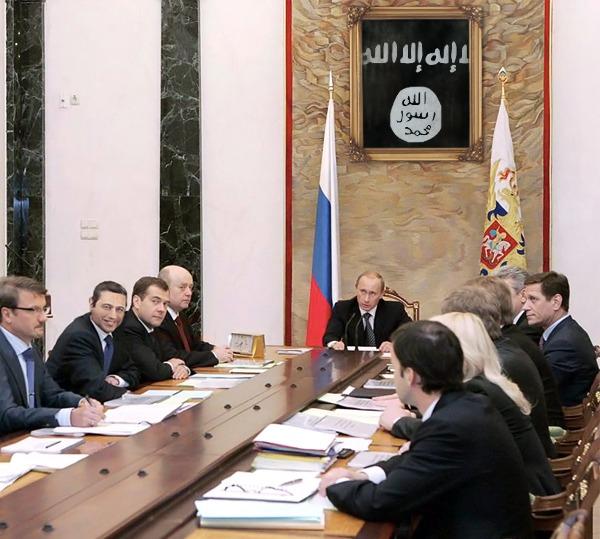
A slight change of ideology at the Kremlin?

Monday, September 10th, 2012

[ by Charles Cameron — with irony, skepticism, and just a dash of dry humor ]
.

image from the Ansar forum, h/t to Aaron Zelin

**

You’re probably familiar with the idea of a jihadist flag flying over the White House. Anjem Choudry, the British radical Islamist preacher told Christiane Amanpour on ABC This Week a while back:

Indeed, we believe that one day the flag of Islam will fly over the White House. Indeed, there’s even a narration of the prophet where he said that ‘the Judgment will not come until a group of my Ummah conquered the White House’.

I’ve dealt with this hadith before as it happens, and pointed out that in one telling the Prophet is asked which “white palace” he’s referring to and replies that he’s referring to the palace of Khosrau (Chosroes) I of Persia:

Jabir b. Samura said:

I heard the Messenger of Allah (may peace be upon him) say on Friday evening, the day on which Ma’ez al-Aslami was stoned to death (for committing adultery): A small force of the Muslims will capture the white house. I said: Kisra? he replied Kisra.

**

Never mind, Choudary thinks the jihadist flag will fly over the White House on Pennsylvania Avenue — and like-minded protesters in New York even carried a photoshopped image of the concept (below) as a placard at a 2006 rally in New York.

**

Hey! Put those two ideas together — a little “more of the same” photoshopping should do the trick — and you’d have a magnificent end to the Cold War, eh?

Maybe that’s what Choudary meant when he said, earlier in the same conversation with Amanpour:

Well, just let me say that Islam has a solution for all of the problems that mankind faces.

I suppose that’s one way to avoid a clash of civilizations — have just one guy holding both cymbals, right?


Switch to our mobile site

