zenpundit.com » al qaida

Archive for the ‘al qaida’ Category

TransApocalyptic UnCreativity

Saturday, February 11th, 2012

[ by Charles Cameron — minor stuff — Anwar al-Awlaki an interfaith copycat? ]

.

No biggie.

I ran across an al-Awlaki video today where the sheikh talks about the Mahdi, which as you may know is a topic of interest to me. So I was checking to see how much I’d written previously about al-Awlaki’s apocalyptic views, and a quick search brought me to the End of Time / New Beginning CD set I’d expressed a wish for earlier, and I remembered that back then when I first ran across it, it was unavailable…

In any case, that little memory jog sent me back to see whether that particular item had been restocked, and apparently no it hasn’t, but I thought I’d better check on eBay in case they might have a copy, and typed up those keywords, “end of time new beginning”…

and up came a book by Alfred McBride, a Catholic priest of the Praemonstratensian or Norbertine order. So that even the title of the event on which Awlaki’s end times Q & A session was issued was in fact the ripped-off subtitle of a Catholic book published a decade earlier.

O tempora, o mores! Young people today! : )

*

In case you want to see what Anwar al-Awlaki had to say about the Mahdi back in his San Diego days, you can find the video here: www.youtube.com/v/We91CKWQEgg

But what I really wanted to talk about is the serious Mahdist streak in the thought and writings of the newly released Abu Musab al-Suri, okay? Coming up shortly…

Book Review: A Terrorist’s Call to Global Jihad

Thursday, December 29th, 2011

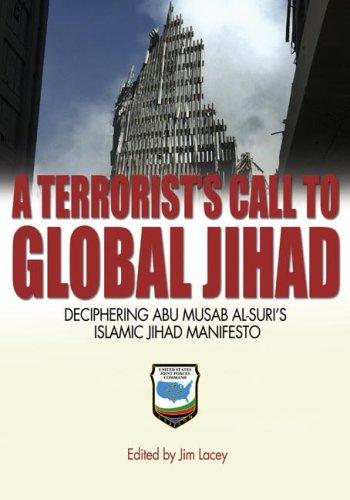
A Terrorist’s Call to Global Jihad: Deciphering Abu Musab al-Suri’s Islamic Jihad Manifesto by Jim Lacey (Ed.)

Previously, I read and reviewed Brynjar Lia’s Architect of Global Jihad, about Islamist terrorist and strategist Abu Musab al-Suri. A sometime collaborator with Osama bin Laden and the AQ inner circle, a trainer of terrorists in military tactics in Afghanistan and an advocate of jihadi IO, al-Suri was one of the few minds produced by the radical Islamist movement who thought and wrote about conflict with the West on a strategic level. Before falling into the hands of Pakistani security and eventually, Syria, where al-Suri was wanted by the Assad regime, al-Suri produced a massive 1600 page tome on conducting a terror insurgency,  The Global Islamic Resistance Call, which al-Suri released on to the jihadi darknet.

Jim Lacey has produced an English digest version of al-Suri’s influential magnum opus comprising approximately 10 % of the original  Arabic version, by focusing on the tactical and strategic subjects and excising the rhetorical/ritualistic redundancies common to Islamist discourse and the interminable theological disputation. There are advantages and disadvantages to this approach.

First, Lacey has produced a concise and readable book from a large mass of sometimes convoluted and repetitive theorizing that al-Suri strung together piecemeal, sometimes on the run or in hiding. For those interested in getting to the heart of al-Suri’s nizam la tanzim strategic philosophy, A Terrorist’s Call to Global Jihad is an invaluable resource for strategists, counter-terrorism specialists, tactical operators,  law enforcement and laymen. Secondly, it is also a useful reference for policy people to see through al-Suri’s eyes the internal political and philosophical divisions within the radical jihadi community. al-Suri himself writes very ambivalently about 9/11 as a great blow against America and yet a complete calamity in it’s effects for the “jihadi current” that destroyed everything the Islamist revolutionaries had so painstakingly built, including the Taliban Emirate. Thus a climate was created by the American counter-attack where old methods of struggle were no longer useful and jihadis must adopt radically decentralized operations ( what John Robb terms Open-Source Warfare; indeed it is clear to an informed reader that al-Suri, a wide-ranging intellectual rather than a narrow religious ideologue, was influenced by Western literature on asymmetric warfare, 4GW, Three Block War  and COIN).

The drawback to this approach is more for scholars looking at the deeper psychological and ideological drivers of jihadi policies, strategy and movement politics. The religious questions and obscure Quranic justifications cited by Islamist extremists that are so tedious and repetitive to the Western mind are to the jihadis themselves, of paramount importance in establishing both the credentials of the person making an argument but also the moral certainty of the course of action proposed. al-Suri himself had some exasperation with the degree to which primarily armchair ideologues, by virtue of clever religious rhetoric, could have more influence over the operational decisions of fighting jihadis than men with field experience like himself. By removing these citations, an important piece of the puzzle is missing.

The Musab al-Suri whose voice appears in A Terrorist’s Call to Global Jihad is consistent with the one seen in Lia’s book, dry, sardonic, coldly hateful toward the West and highly critical of the jihadis own mistakes, laden with overtones of pessimism and gloom. al-Suri did not envision a quick victory over the West and wrote his manifesto as a legacy for future generations of Islamist radicals because the current one was nearly spent after the American onslaught and poorly educated in comparison with predecessors like the generation of Sayid Qutb.

Strongly recommended.

A “Big Dream” attributed to Osama bin Laden

Tuesday, December 13th, 2011

[ by Charles Cameron — hadith, Aden-Abyan, Abu M. al-Maqdisi, major dream of young bin Laden, role of narration 1 month after his death, any comments? ]

.

.

I was trying to follow up on a hadith which declares:

An army of twelve-thousand will come out of Aden-Abyan. They will give victory to Allah and His messenger. They are the best between myself and them.

There’s an extensive discussion of it on Somalinet offered by Sheikh Abu Muhammad al-Maqdisi [teh Sheikh Abu M al-Maqdisi?] and posted on June 4 of this year, but it doesn’t answer my question as to how this narration fits in with the various narrations about the army from Khorasan.

1.

While reading in and around this topic, however, I ran across this account of a dream on the young bin Laden, which appears on a number of sites favorable to jihad around June 4, 2011, i.e. after bin Laden’s death, and which I have not seen discussed on those analysts’ sites that I manage to follow.

It’s extremely interesting to me not only because dreams are potentially important vehicles for divine guidance in Islam, but also because it ties bin Laden specifically to the Khorasan / black banners hadith, and to the Mahdi.  In this dream, I( don’t think it’s going too far to say that bin Laden himself plays a preparatory role with regard to the Mahdi that we can perhaps understand in the west as equivalent to that of John the Baptist in preparation for Christ.

2. 

If this dream narrative has been explored in the open source analytic literature, I would be very interested to see what has been said.  In  the meantime, I will simply post the narration as I found it:

3.

This incident was narrated to me by a student of knowledge who spent more than 20 years in the company of scholars acquiring knowledge. He told me about a dream that Shaykh Osama bin Laden had when he was 9 years old, which indicated that Allah swt was preparing Shaykh Osama bin Laden, may Allah have mercy on him, since childhood, for battles against the Crusaders.

He told me that once he was sitting with a companion and discussing the deplorable condition of the Ummah but that all the incidents taking place in the Muslim Ummah are going according to Allah’s plan and that it is certain that the victory of Allah the Almighty will come. He will surely send a Leader and a Guide from amongst our Ummah who will deliver the humiliated and pitiful Ummah to the enlightened path of ascent and loftiness. We started thinking that who could be such a person!

Immediately, the thought of Shaykh Osama bin Laden came to our minds, since he has made innumerable sacrifices for the sake of the Ummah. On this, my companion smiled and said, “I will narrate to you a dream of Shaykh Osama bin Laden; you will be pleased to hear it, and your love for the mujahideen will only increase.”

He said, I was in al-Madinah al-Munawwarah at the house of a Scholar who used to lecture at the Prophet’s masjid. We had just arrived at his house when someone knocked on the door. The Shaykh returned with a person of luminous and honorable appearance who was about 80 years old.

The host welcomed him and requested the Tafsir of a few verses from the Qur’an. We quietly listened to him while the guest Shaykh recited a few verses, and then he gave the Tafsir of those verses. By Allah, I had studied a number of Tafsirs, but that Shaykh was a sea of knowledge. When he completed his lesson, the host invited him for a meal, but he declined politely, and we came to understand that he was fasting.

Eventually, the guest asked for permission to leave, but the host insisted, ‘Until you narrate to us the dream of Shaykh Osama bin Laden once more, you will not get the permission to leave.’

The Shaykh smiled and asked, ‘The dream that Shaykh Osama bin Laden had when he was 9 years old?’ The host replied in the affirmative.

This is how that Shaykh narrated the incident:

I was a close friend of Muhammed bin Laden, the father of Osama bin Laden. Many times I would be in his company. And many times, I used to visit his house regarding work related to construction. During the discussions, our talk would be disturbed by the playing of his children, and then he would ask them to go out and play.

But I was surprised to see that he would always ask one particular son to sit beside him. I asked him, “Why don’t you let this son of yours to play with his other brothers? Is he sick?”

Mohammed bin Laden smiled and said, “No, there something special about this son of mine.”’

When I asked his name, he said, “His name is Osama, and he is 9 years old. Let me share with you something strange which happened a few days ago. My son woke me up few minutes before the morning prayer and told me, ‘Dear father, I want to tell you about a dream that I had.’ I thought he must have had a nightmare. I made ablution and took him along with me to Masjid.

On the way, he told me, ‘In the dream, I saw myself in a huge, flat area. I saw an army mounted on white horses moving towards me. All of them were wearing black turbans. One of the horsemen, who had shiny eyes, came up to me and asked me, “Are you Osama bin Muhammed bin Laden?” I replied, “Yes.” He then asked me again, “Are you Osama bin Muhammed bin Laden?” I again replied, “Yes, that is me.” He again asked, “Are you Osama bin Muhammed bin Laden?” Then I said, “By Allah, I am Osama bin Laden.” He moved a flag towards me and said, “Hand this flag over to Imam Mahdi Muhammad bin Abdullah at the gates of Al-Quds.” I took the flag from him, and I saw that the army started marching behind me.’

Muhammed bin Laden said, “I was surprised at that but, due to business at work, I forgot about the dream. The next morning, he woke me up just before the morning prayer and narrated the same dream. The same thing happened on the third morning also. Now, I began to worry for my son. I decided to take him with me to a knowledgeable person who can interpret dreams.

Accordingly, I took Osama to a person of knowledge and informed him about the whole incident. He looked at us with surprise and asked, ‘Is this your same son who had the dream?’ I said, ‘Yes.’ He kept staring at Osama for some time. My concern multiplied. He comforted me and said, ‘I will ask you a few questions. I am sure that you will answer them truthfully.’

He asked Osama, ‘Son, do you remember anything about that flag which that horseman gave you?’ Osama replied, ‘Yes, I remember it.’

He asked him, ‘Can you describe it, how it was?’

Osama said, ‘It was similar to the flag of Saudi Arabia, but its color was not green but black, and there was something written on it in white color.’

He then put the next question to Osama, ‘Did you ever see yourself also fighting?’

Osama replied, ‘I commonly see such dreams.’ He then asked Osama to go out of the room and do recitation of the Qur’an.

Then that person of knowledge turned towards me and asked, ‘Where is your ancestry from?’

I replied from Hadramawt in Yemen. Then, he asked me to tell him something about my tribe. I replied that we are related to the tribe of Shanwah which is a Qahtani tribe from Yemen. He then cried out the Takbir loudly and called in Osama and kissed him while crying. He also said that the signs of the hour are near.

‘O Muhammed bin Laden, this son of yours will prepare an army for Imam Mahdi and for the sake of protecting his religion, he will migrate to the region of Khurasan. O Osama ! Blessed is he who will do Jihad by your side and undone and disappointed be he who leaves you alone and fights against you.’

4.

It is notable that this account appears to have surfaced in the English-language literature about a month after the Abbottabad raid of May 2.  At least in this English-language form, it seems to be a posthumous account, hagiographic in tone, and directly linking  bin Laden and those who fought with him to the fulfillment of Mahdist prediction.

My questions would be whether anyone knows of an earlier appearance of this narrative, perhaps in Arabic — and if it indeed is first found after bin Laden’s death, how the readers of signs, both Islamist and  Western-analytic, read this particular text.

I have seen this narrative featured on sites relating to the Netherlands, Egypt, Somalia, South Africa, Kashmir, and Pakistan — and as a text video with nasheed accompaniment on YouTube – so it seems to have spread pretty rapidly, which suggests it “fits” powerfully with the needs of the jihadizing internet shortly after bin Laden’s death.

5.

Sources include:


Twitter combat, al-Shabaab, black banners, Tahrir and more

Thursday, December 8th, 2011

[ by Charles Cameron — first Twitter as combat zone, then black banners again, Somalia, Mahdism, Babism, AQ, Iraq, Libya, Egypt  ]


Just for the record.

You probably already knew ISAF has been tweeting back at the Islamic Emirate, and you can follow both at @ABalkhi and @ISAFmedia…

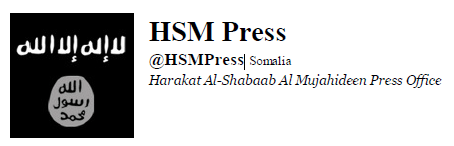
Well, @HSMPress just joined the fray — that’s al-Shabaab:

Notice the flag?

It’s that black banner again.

*

There has been some controversy over whether or not there was an element of support for AQ in Libya, and at the recent Tahrir Square demonstrations, and black banners have featured heavily in the discussions.

Let’s get our black banners straight. First, Libya.

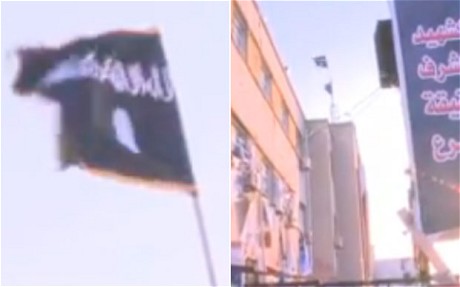
This was the black flag allegedly flown in Libya after the ouster of Col. Gadhafi.  It was published as illustrated here by the Daily Telegraph, under the headline “Libya: Al Qaeda flag flown above Benghazi courthouse” and with the commentary ” The black flag of Al Qaeda has been spotted flying over a public building in Libya, raising concerns that the country could lurch towards Muslim extremism.”

Note the resemblance to the logo al-Shabaab is using.

*

Juan Cole pooh-poohed the idea that this was an AQ flag, calling it a “silly urban legend going around” and quoting a Libyan scholar-friend on the point:

I looked up the mentioned flag, it appears to be a black flag with the shahada [Muslim profession of faith] in it. A black flag goes back all the way to the prophet, and the addition of the shahada makes it a Jihadist flag. There have been Jihadists in Libya from day one, and they fought against Qaddafi. But is Al-Qaeda, as in the global network taking over? No.

Cole’s friend’s comments are worth reading in full: they provide context on the various factions and their relative strengths, and Cole sums it all up in terms of the specific issue of AQ and Benghazi thus:

What this informed observer is saying is that a miniscule group of jihadists put up that flag, in the chaos of the post-revolutionary period, but that they are highly unrepresentative of politics in Benghazi.

Fair enough. But that wasn’t just a black flag with the Shahada, was it?

When Cole’s friend rites “A black flag goes back all the way to the prophet, and the addition of the shahada makes it a Jihadist flag,” Cole comments “Moreover, the black flag as a symbol is not a monopoly of al-Qaeda. Revolutionaries raised a black flag in the medieval Abbasid Revolution of 750 AD.”

Indeed. They may also have produced the ahadith about the army with black banners from Khorasan, which give such flags a distinctively Mahdist application – ahadith which Ali Soufan tells us have been used extensively in AQ recruitment.

So there are black banners and black banners. There was “Khalifa Abdullah’s great black banner, black-lettered with text from the Koran and the Mahdi’s sayings” mentioned in Burleigh‘s account of the Battle of Omdurman – and a little earlier, the Bab had instructed his followers to “gather under the black standard which was being raised in Khurasan” according to Munirih Khanum‘s Memoirs and Letters.

*

Aaron Zelin has a post at The Wasat which allows for a quick comparison between various black flags and banners. Here’s the flag that Aaron identifies as that of the Islamic State of Iraq:

That’s an AQ-related flag, and it distinctly features what is believed to be the seal of Muhammad:

So I wouldn’t be so sure that “No, that wasn’t an al-Qaeda Flag over Benghazi” Dr. Cole.

*

What about Egypt?

In another piece — this one entitled “Did the Muslim Brotherhood Threaten to Kill “All Jews”?” — Dr. Cole wrote:

The Muslim Brotherhood and other religious parties in Egypt (including the Salafis and the Gama’a al-Islamiya) held a rally at al-Husayn Square in Cairo last Friday to which a few thousand people came. The big rally was at Tahrir Square in downtown Cairo and was dominated by secular forces.

Cole is entirely right in rebutting a YNet correspondent’s claim that “a Koran quote vowing that ‘one day we shall kill all the Jews’ was uttered” at the al-Husayn site:

Beck, who clearly does not know what he is talking about, said that the crowd repeatedly quoted a verse in the Qur’an that spoke of killing all Jews. There is no such verse in the Islamic holy book. The Jewish revelation from God to Abraham and Moses is retold in the Qur’an, which has positive stories of the Children of Israel. The castigation of the Children of Israel in the Qur’an is of the same sort you see in the Hebrew Bible, and often put in the mouth of Moses or another Jewish prophet.

Indeed, a commenter on the YNet article from Quebec went further:

Eldad Beck wrote: “Time and again, a Koran quote vowing that ‘one day we shall kill all the Jews’ was uttered at the site”.

There is NO such verse in the Qur’an. In fact, the Qur’an says this:

“Those who believe in the Qur’an, those who follow the Torah and the Sabians and Christians–anyone who believes in G-d and the Last Day and who does righteous deeds need not be in fear and will not grieve.” (5:69)

There were indeed hotheads in the crowd who yelled that they would “fight the Jews (i.e., Israelis)”. If Mr. Beck spoke Arabic fluently, he would not have mistaken the shouted word “mutaqalah” (to fight, combat, overcome) with the word “qatala” (to kill). In addition, he would know that in Palestinian colloquial Arabic “al-yahud” (the Jews) usuallhy has the limited meaning of “the Israelis”.

Sadly the errors (or willful misrepresentations) of Beck have been repeated in dozens if not hundreds of paper and electronic media.

If he made an innocent error, he should apologize and set the record straight.

If not, let him stand before the Mercy Seat of Ha-Shem and explain why he violated the commandment given to Moses: “You shall not bear false witness against your neighbour.”

*

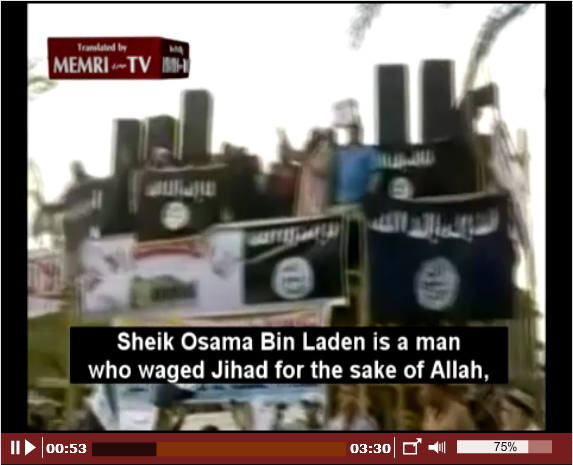
The thing is — getting back to our black banners with Shahada and distinctive seal of Muhammad — there were in fact demonstrations in Tahrir Square just a week earlier, at which those pesky black flags were in evidence:

MEMRI brought us the video of which that is a screen-capture, and provided a transcript of Sheikh Tawfiq al-Afni‘s address to the crowd, of which this is an excerpt:

Tawfiq Al-Afni (On stage): ”Sheikh Osama bin Laden is a man who waged Jihad for the sake of Allah, and we pray that Allah will unite us with him and the martyrs in Paradise. My brothers, in Islam, we say with great pride that we adhere to the Jihad for the sake of Allah…”

Crowd: “Allah Akbar.”

Tawfiq Al-Afni: “We are not waging Jihad for worldly benefits or for positions. By Allah, we have only come to pledge our allegiance to Islam. We wage Jihad for the sake of Allah and the Koran. […]

“We respond to Your call. Please turn our skulls into a ladder for your glory.”

Crowd:
“We respond to Your call. Please turn our skulls into a ladder for your glory.”

Black banner, Shahada, seal of Muhammad, Tahrir Square.

*

So it’s important that we should know these things (oh, and much more besides):

  • The black banners are in Tahrir and Somalia, as they have been in Mahdist movements stretching back to the Abbasids.
  • Black banners featuring the seal of Muhammad appear to have a connection with AQ, often indicative of sympathetic support, if not active participation.
  • That such voices exist in Egypt should not make us think that they represent a majority, nor indeed that they are the voice of the Muslim Brotherhood, but rather that they are among the voices raised in a tumultous situation.
  • There are many secular voices raised in Tahrir, and also Islamist voices with a willingness to take the path of politics and compromise.
  • We should remember that there are voices in Tahrir of both terror and reconciliation. We should not forget the voices of those Muslims who protected Coptic churches, nor of the Copts who protected Muslims while they bowed their heads in prayer
  • And no-one, no-one left or right should forget that the Egyptian army, too, has a voice, and a megaphone, and much more besides.

One hadith, one plan, one video, and two warnings

Friday, November 11th, 2011

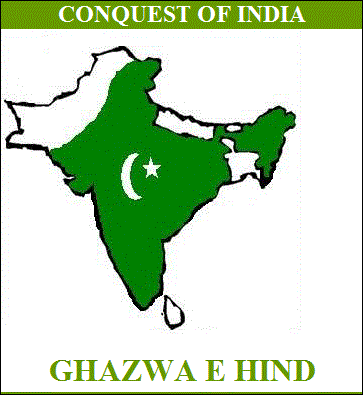
[ by Charles Cameron – Ghazwah-e-Hind, the other prong of Khorasan jihad, YouTube propaganda, Zaid Hamid, his warnings to the West (leave well alone!) and to the Hindus (convert!) ]

.

ghazwa.gif

1.

The Hadith:

The major sweep of the victorious army with black banners will be from Khorasan to Jerusalem, as described in various earlier posts here — but  there are ahadith that deal with the conquest of India (and China, but that’s another story, see David CookStudies in Muslim Apocalyptic, pp 170 ff) that are currently enjoying a vogue in Pakistan…

Here is one version of the hadith, as quoted  by the Shaikh of the Naqshbandi Owaisiah Sufis, Muhammad Akram Awan, to whom I shall return in a future post, in a speech he gave in Pakistan in November 2008:

From Abu Hurairah (rau), he said: (saws)

The Messenger (saws) of Allah promised us Ghazwah-tal Hind. Now, if I encounter it, I shall invest my wealth and life in it. Then, if I am killed I will be among the most chosen Shuhada (martyrs) and if I live, I would be Abu Hurairah ‘the freed’ (from Hell Fire).

2.

The plan:

So how does that translate into contemporary geopolitics?

Syed Saleem Shahzad (Inside Al-Qaeda and the Taliban: Beyond Bin Laden and 9/11, pp 206-215) offers a brief overview of the Indian Jihad / Ghazwa-e-Hind in its current incarnation, with the involvement of the Pakistani ISI and AQ’s (presumed late) Ilyas Kashmiri, bringing us fast forward to the present day:

This was the ISI plan drawn up 30 years ago with Harkat-ul-Jihad-iIslami, Jamaat-e-Islami, Muslim Brotherhood connections, Islamic seminaries, and Sufi networks of constructing a theater of war from Central Asia to Bangladesh to defeat the Soviet Union in Afghanistan, and simultaneously to acquire the right of self-determination for Kashmiris in India. Thirty years later, Al-Qaeda simply refurbished the plan after sketching out its ideological boundaries, to prepare the greater theaters of war of Khurasan and Ghazwa-e-Hind for victory, before its armies, holding the black flag aloft, entered in the Middle East for the final battle against the Western world.

From my POV, the ghazwa is one of the topics Stephen Tankel might profitably have addressed as theological matter relevant to the LeT and the Mumbai attack…

Here’s the close of Shahzad’s book, to make the apocalyptic thrust in all this quite clear:

However, the saga of Al-Qaeda’s One Thousand and One Nights tales continues with new strategies and new characters. For Al-Qaeda these are just measures to keep the West running from pillar to post until it exhausts itself and Al-Qaeda can announce victory in Afghanistan. Al-Qaeda next aims to occupy the promised land of ancient Khurasan, with its boundaries stretching all the way from Central Asia to Khyber Paktoonwa through Afghanistan, and then expand the theater of war to India.

The promised messiah, the Mahdi, will then rise in the Middle East and Al-Qaeda will mobilize its forces from Ancient Khurasan for the liberation of Palestine, where a final victory will guarantee the revival of a Global Muslim Caliphate.

3.

The video: 

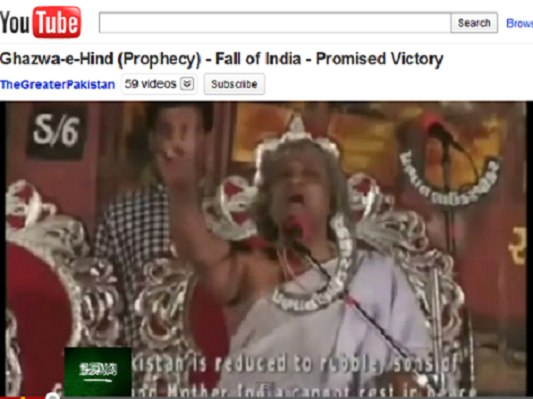
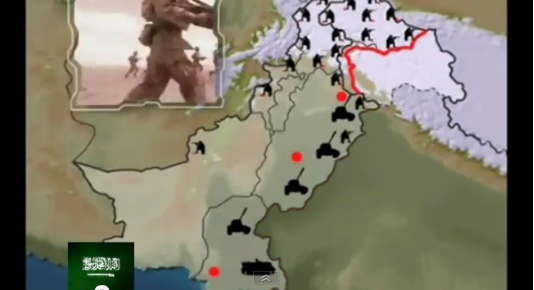
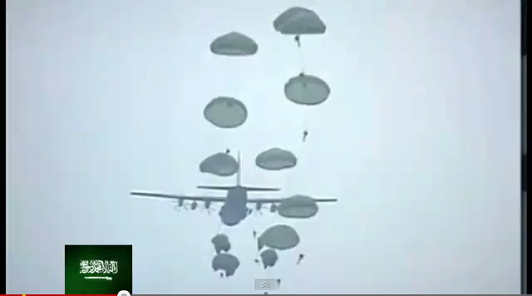
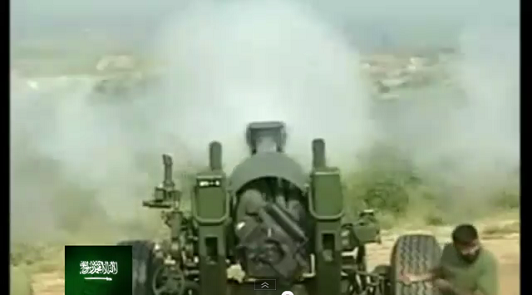
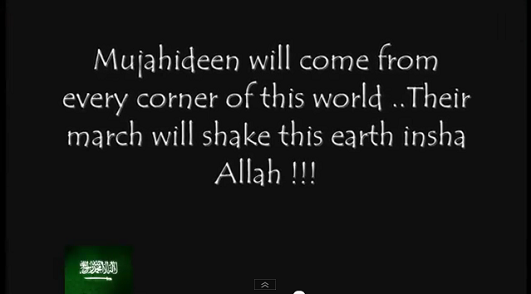
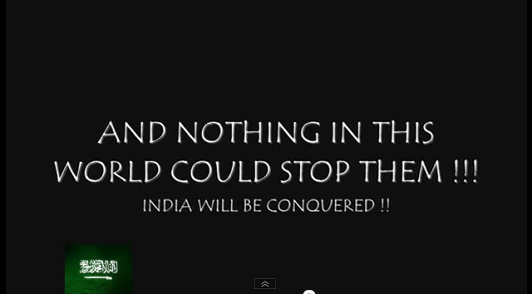
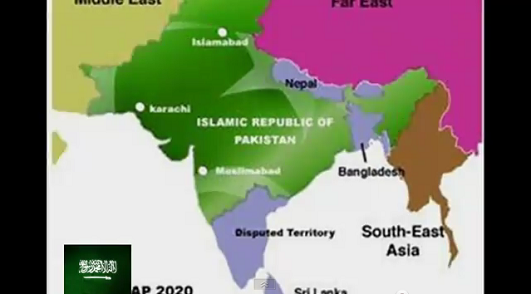
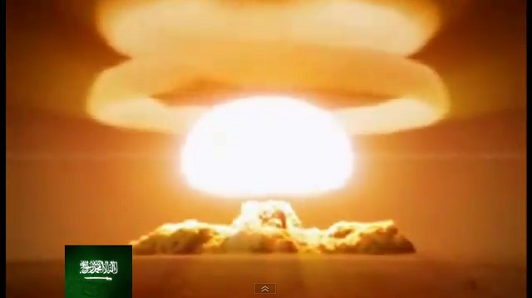
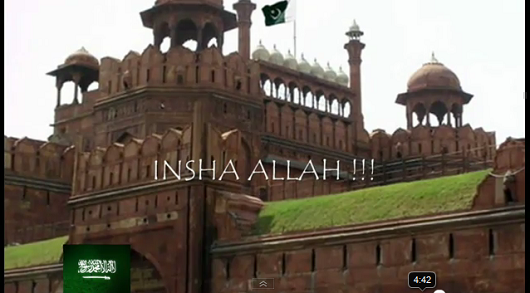
With that as background, I’d like to illustrate the emotional drive of the ghazwa idea, with screen shots from a video posted to YouTube in February of this year, titled Ghazwa-e-Hind (Prophecy) – Fall of India – Promised Victory. This section will take up quite a bit of screen space, but you can pretty much scroll on down and get the general idea, pausing where something seems a tad different or more interesting:

The video features stirring music throughout, presumably taken from Molossus (From “Batman Begins”) [2005] by Hans Zimmer & James Newton Howard — which we are invited to purchase on iTunes or AmazonMP3…

It opens with a rally, at which an Indian speaker is castigating Pakistan —

minus-1.png

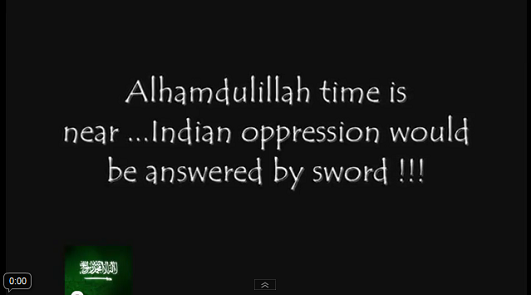
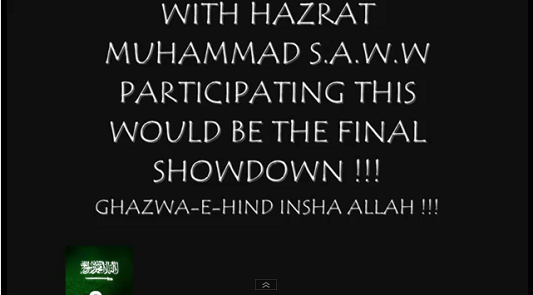
next up: two frames that give a textual expression of the hope involved —

ghazwa-00.png

ghazwa-00a.png

then, what we might call a “starting” map —

startmap.png

various evidences of military might —

ghazwa-00b.png

ghazwa-00c.png

ghazwa-00d.png

ghazwa-00e.png

another couple of text frames —

ghazwa-00f.png 

ghazwa-00g.png

some arguably more intense weaponry —

bb.png

cb-rocket-1.png

and no less intense special forces —

cb-rocket-2.png

then the hoped-for “close of play” map, book-ending the “opening” map above —

ghazwa-01.png

the ultimate threat —

ghazwa-02.png

and the flag of Pakistan flying over the Red Fort in Delhi —

ghazwa-03.png

4.

The warning: 

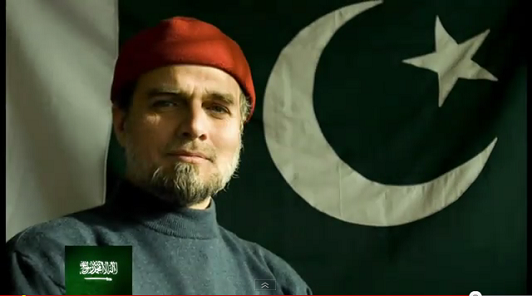
I have one final screen shot in the series, and it features Syed Zaid Hamid

ghazwa-04.png

the man who has been most actively stirring up public sentiment in Pakistan for the Ghazwa-e-Hind.

I will close with two of Hamid’s speeches, posted on YouTube, each of them containing a warning.  The first is in English, geopolitical in tone, and contains a warning to the US, Israel and India, that they should not attack Pakistan.

The second is addressed to the Hindus:

Such an invitation to convert is mandatory “when you meet your enemies’ before waging jihad, as stated in the hadith in Sahih Muslim, Book 19, 4294:

Invite them to (accept) Islam; if they respond to you, accept it from them and desist from fighting against them.

— and parallels bin Laden‘s Letter to America, in which UBL wrote:

The first thing that we are calling you to is Islam.

(a) The religion of the Unification of God; of freedom from associating partners with Him, and rejection of this; of complete love of Him, the Exalted; of complete submission to His Laws; and of the discarding of all the opinions, orders, theories and religions which contradict with the religion He sent down to His Prophet Muhammad (peace be upon him). Islam is the religion of all the prophets, and makes no distinction between them – peace be upon them all.

5.

The outline:

That’s the basic outline.

I hope to dig in deeper and provide more subtlety in future posts, but this topic is still pretty new to me — I first ran across it, somewhat tangentially, in the United States of Islam video which I began to discuss in October 2010, and which I may return to shortly.

I also wish to invite comment from others who have been looking into the Ghazwa for longer than I have.


Switch to our mobile site