zenpundit.com » al qaida

Archive for the ‘al qaida’ Category

Book Review: Architect of Global Jihad by Brynjar Lia

Thursday, August 18th, 2011

Architect of Global Jihad by Brynjar Lia

Architect of Global Jihad: The Life of al Qaida Strategist Abu Mus’ab al-Suri is Brynjar Lia’s definitive biography of the shadowy terror theorist, Islamist intellectual and sometime jihadi, Mustafa bin Abd al Qadir Sitt Maryam.

Sitt Maryam, who went by al-Suri in jihadi circles, was a red haired, fair-skinned Syrian renegade from the Muslim Brotherhood who was trained in military tactics and explosives in Saddam Hussein’s terrorist camps, passing on his skills to fellow “Arab Afghans” during and after the Soviet War. Attracted to secular military theory, guerrilla warfare tactics and strategy rather than theological disputes, hating the West but despising Salafist radicals, Lia’s Abu al-Suri is an isolated and anomalous figure in “the jihadi current” of the 1990’s and post-9/11 era.

“A born critic” with a grim and unsmiling demeanor who entangled himself in acrimonious personal feuds with leading jihadis, including Osama bin Laden, al-Suri failed to win many adherents to his insightful “system not organization” (nizam la tanzim) theory of jihad until his arrest caused his writings, especially his magnum opus The Global Islamic Resistance Call to go viral in the Islamist darknet.

A true intellectual, widely read in western literature and military writings, al-Suri crafted a stategy of jhad that adapted arguments of 4GW, “leaderless resistance” and classical Maoist insurgency to suit Islamist purposes and conditions while rejecting secret, hierarchical, organizations and al-Qaida’s “Tora Bora mentality” as historical failures. Self-radicalization and “sudden jihad syndrome” among alienated Western Muslims was the stuff from which al-Suri hoped to build a massively decentralized, open source, self-sustaining campaign of terrorism.

A hundred and forty some pages of text in Architect of Global Jihad are devoted exclusively to excerpts from al-Suri’s 1,600 page treatise on terrorism operations and strategy. He was a serious and determined opponent of Western civilization’s core values, despite having enjoyed long stretches of reasonably comfortable Western exile in Spain and “Londonistan” to such a degree that al-Suri was in no particular hurry to rejoin the jihad and even acquired the unenviable (and inaccurate) reputation of only being a “pen jihadi”.

Musab al-Suri, who is likely dead at the hands of Baathist jailers, is best described as an Islamist parallel to Vladimir Lenin before the Bolshevik Revolution. The similarities are striking, the irascible temperment, formidible intelligence, the frustrating politics of exiled revolutionary communities, the ideological marginalization both men endured as radicals in a community of already extreme activists and the embrace of terrorism (tactically in Lenin’s case, strategically in al-Suri’s). al-Suri and Lenin, despite wide ideological differences, as revolutionaries represent the psychological type Eric Hoffer termed “true believers” – pitiless, absolutely committed, intellectually rigid on matters of principle but tactically flexible and creative in terms of method.

Such men are dangerous, to themselves as well as to society.

Strong recommendation:

ADDENDUM:

Related posts on or including Abu Musab al-Suri

Lexington GreenAbu Musab al-Suri: Theorist of Modern Jihad and The Networked Jihad: Parasitic on Developed World Technology, Information, Ideas

Charles CameronA Terrorist’s Call to Global Jihad: Deciphering Abu Musab al-Suri’s Islamic Jihad Manifesto

John RobbSURI: nizam, la Tanzim (system, not organization) – Global Guerrillas

The Jamestown FoundationThe Jamestown Foundation: Al-Suri’s Adaptation of Fourth  , The Jamestown Foundation: Al-Suri’s Doctrines for Decentralized  and The Jamestown Foundation: Abu Mus’ab al-Suri and the Third

Jihadica Abu Mus`ab Suri: Architect of Global Jihad Neglected? and Training for the Lone Jihadi

The Hoover InstitutionThe Terror Fringe

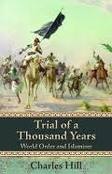
Trial of a Thousand Years, by Charles Hill—a review

Thursday, August 11th, 2011

 trial of thousand years

by J. Scott Shipman 

Trial of a Thousand Years, World Order and Islamism, by Charles Hill

Ambassador Charles Hill’s Grand Strategies, Literature, Statecraft, and World Order was the best book I read in 2010, so I had high expectations for this volume and was not disappointed. Ambassador Hill provides a 35,000-foot view of the relationships between the West and Islam in history focusing on the subtitle of his earlier work in the form of “world order.”

Unsurprisingly, as in Grand Strategies Hill goes back to the roots of modern order in the Treaty of Westphalia (1648). He provides a brief review of the world ushered in by the men who negotiated, and quotes another historian who said, “men who were laboring, each in his own way, for the termination of a terrible war. They had no idea of progress. The word “innovation” was anathema to them. The last thing on their minds was the creation of a new system of sovereign states…” Here we are 363 years later and “from the seeds sown at Westphalia” the system they set in place is has grown, but has been under siege many times from many fronts.

Westphalia was distinctive because it was “procedural, not substantive” and required a minimum number of procedures/practices to which to adhere and allowed disparate parties with different, “even mutually antagonistic, substantive doctrines and objectives” to work together. Hill points out four distinctions:

  • Religious arguments were not allowed in diplomacy.
  • The State was the fundamental entity.
  • Interstate/international norms and laws were encouraged, absent “divine sources” but based on mutually beneficial/positive agreements.
  • Use of professional military and diplomats with “its own set of protcols.” [Personal note: In another life, I was an arms control inspector enforcing the START I and INF Treaties—protocol was very serious and the true measure of the actual treaty language. There was also a strong and consistent application of reciprocity that made each party think before stretching protocol—this happened to my teams more than once.]

For Hill a central mission of the United States is the defense of the Westphalian world order. In less than 165 pages and six chapters, he outlines the origins of modern Western order and correspondingly covers Islamic order. From the beginning to the end Hill provides ample evidence of challenges to Westphalia, often from indigenous Western sources, but focusing mostly on our trials with Islam.

Hill sets the sources from whence the Western and Islamic world orders arose, where the West was grounded in Christianity, and the Islamic in the Caliphate. For two religions claiming Abrahamic roots, their worldviews were, and in many instances remain diametrically opposed. Central was the question of duality or unity. For the West, the State and religion were two complementary systems/powers—following the teaching of Christ ““Render unto Caesar the things which are Caesar’s, and unto God the things that are God’s” (St Matthew’s Gospel 22:21) For Islam there was no distinction, and the very thought was hateful to Islamists. Islam’s “unswerving devotion to monotheism” continues to this day among those groups and states using terror to upend existing world order.

I am sympathetic to Hill’s ideas; however recognize with globalization and the internet tweaks may be required. And I’ll take this segue to introduce an idea for consideration.

Westphalia’s removal of religion made trade possible among former religious enemies. Unambiguous rules for contracts and dispute resolution evolved. What if we could bridge the gap between Western jurisprudence and tribal, or non-Western legal systems? What if, instead of insisting our way or the highway we design a solution that would allow both sides to keep their respective legal processes and procedures, thereby opening untapped markets?

At least one person has already considered these alternatives. Michael Van Notten (1933-2002) was a practicing lawyer in the Netherlands and married into a Somali tribe. Van Notten used his legal training and insights gained as a member of his new family to design a method of contracting where tribal law and Western jurisprudence could peacefully and prosperously coexist. Van Notten recorded his ideas in a book called The Law of Somalis, A Stable Foundation for Economic Development in the Horn of Africa. I’ll not review this book, but wanted offer this as a teaser alternative.

After reviewing the history of the West and Islam, Hill identifies seven Clausewitzian centers of gravity for both: legal, military, the State, women, democracy, nuclear weapons, and values. Hill makes the distinction between the use of diplomacy by Islam and the Islamist (the fundamental variety). No surprises, to the Islamist a secular State is an “apostasy,” as is international law (Sharia being the single source), democracy and the rights of women.

Hill concludes, “Islamic civilization entered the international system under duress,” which he believes has contributed to the current situation of failing states and lagging economies that establish conditions where radicalized Islam can flourish. The radicalized elements reject the secular Westphalian world order, however Hill points out that some in Islam insist that sharia imposed by the state “cannot be the true law of Islam. It is not possible to apply sharia through the state; it can only be applied through acceptance by human beings (An-Na’im).” Another alternative is the Medina polity established by the Prophet (“later called the Pact—kitab—of Medina) “guaranteeing each tribe the right to follow its own religion and customs, imposing on all citizens rules designed to keep the overall peace, establishing a legal process by which the tribes settled purely internal matters themselves and ceded to Muhammad the authority to settle intertribal disputes…Although this document has been called the first written constitution, it was really more of a multiparty treaty” (Ansary).

Hill convincingly demonstrates that more often than not, rulers have co-opted Islam as a way to dominate the people (Iran comes to mind.). He quotes Professor L. Carl Brown of Princeton, “nothing exclusively “Islamic” about this Muslim attitude towards politics, any more than the politics of feudalism or of imperial Russia was distinctly “Christian.” It is the political legacy of Muslims, not the theology of Islam…”

For the Islamist, secularism is the booger man, but secularism in the Westphalian order has its own set of problems. Hill writes, “A new phenomena arose: wars motivated by religious convictions were replaced by wars driven by ideologies—surrogates for religion—each aimed to oppose, undermine, destroy and replace the Westphalian system. The greatest of these was international communism, the latest is international Islamism.”

In many respects, Trials is as good as Grand Strategies. Ambassador Hill is to be commended for his insight, courage, and conviction—this little book packs a big, enlightening punch. Strongest recommendation.

References you may find of interest (links to quoted authors above are links to the respective reference):

The Incoherence of the Philosophers, Abu Hamid Muhammed Al-Ghazali

The Crisis of Islamic Civilization, Ali A. Allawi

The Caliphate, Thomas W. Arnold

Sayyid Qutb and the Origins of Radical Islamism, John Calvert

Crimea: The Last Crusade, Orlando Figes —Figes’ The Whisperers was very good.

The Morality of Law, Lon L. Fuller

The Muqaddimah, Ibn Khaldun (Translated Franz Rosenthal)

The Clash of Empires: The Invention of China in Modern World Making, Lydia H. Liu

The Government of the Ottoman Empire in the time of Suleiman the Magnificent, Albert Lyber

Byzantine Civilization and The Fall of Constantinople, both by Steven Runciman

The First World War, Hew Strachan

Mozart and the Enlightenment; Truth, Virtue and Beauty in Mozart’s Operas Nicholas Till

Muslim Intellectual: A Study of Al-Ghazadi, W. Montgomery Watt

Dialectic of Enlightenment, Max Horkheimer and Theodor W. Adorno 


Reviews coming up shortly

Tuesday, August 2nd, 2011

[ by Charles Cameron — so many really good books, eh? ]

.

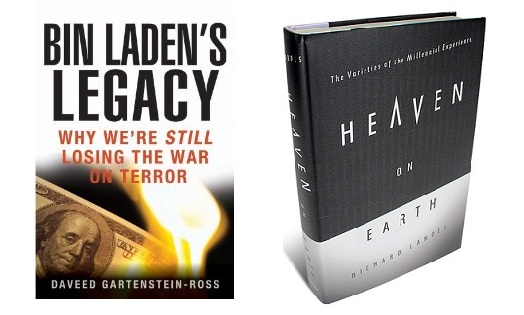
daveed-cover.jpg

Two very important books:

Daveed Gartenstein-Ross brings us up to speed on Al Qaeda by understanding what they say and do. Richard Landes gives a breathtakingly wide-angle view of the critical importance of apocalyptic — secular versions included.

Guest Post: John R Hall: “Norway’s cultural Christian apocalyptic crusader?”

Monday, July 25th, 2011

Blog-friend John R. Hall is a Professor of Sociology at the University of California – Davis, and the author of such books as Gone from the Promised Land: Jonestown in American Cultural History; Apocalypse Observed: Religious Movements and Violence in North America, Europe, and Japan with Philip D. Schuyler and Sylvaine Trinh; and Apocalypse: From Antiquity to the Empire of Modernity. His current research involves deploying a social phenomenology to retheorize modernity in relation to contemporary society.

David Ronfeldt suggested that John’s long and detailed remarks taking off from my own post, 2083 Graphics – a first look, deserved to be a post in its own right and not be lost in the comments section, and with Zen’s approval, I am delighted to present it here as Dr Hall’s first Zenpundit guest-post. — Charles Cameron

___________________________________________________________________________________________

I have just completed a very preliminary examination of the Norwegian manifesto posted just before the Oslo bombings. It is an astonishing and significant document, far from the incoherent ravings of a mad person, as I would wish it to be. And it is incredibly chilling in its ruthless rationality and relative coherence. Here, I offer some initial reflections. I have concentrated on the portions from page 717 forward, where the author details ideology, revolutionary strategy, and utopian vision of a future, federated Europe. Beginning on p. 1388, the author offers an autobiography and c.v. of Breivik, which presumably will be checked out by investigators and the media, plus a quite detailed account of his actions over the past several years. A number of important comparisons already have been made – to al Qaida and the Oklahoma City bombing, for example. But in many ways, if the perpetrator indeed acted alone, he is something of a piece with the Unabomber, who similarly combined ruthless action with a carefully elaborated manifesto. There are important difference, to be sure. In particular, the Unabomber worked to conceal his identity so that he could carry out multiple actions, and he operated out of an environmental left ideology rather than a Christian nationalism.

The latter part of the document depicts its account of pre-emptive war as a new mode of writing, exploring scenarios rather than writing fiction or history, thereby claiming to eliminate its usefulness to authorities seeking to use it as evidence when bringing charges against the author or a perpetrator of the acts it describes.

As others already have commented, the label of ‘Christian fundamentalist’ seems wrong, at least in conventional use of the term today. Certainly the author represents himself as a nationalist/European federalist conservative opposed to ‘cultural genocide’ of the Enlightenment West, and seemingly he proposes reinstitution of monarchy as more representative of a nation than democracy can be. Only very late in the missive, p. 1134, does he embrace Europe’s return to the traditional Catholic Church, for its apostolic succession of authority and its capacity to guide believers in matters of scripture. This development is to be coupled with a re-initation of patriarchy, developed in substantial detail (p. 1141ff.), and concern about ‘the ongoing genocide of the Nordic tribes’ and a discussion of its genetic basis and the dangers of miscegenation and sexual promiscuity (including a discussion of ‘erotic capital,’ leading to a frank discussion of the possibility that the state could ‘play an essential role in national reproduction’ (p. 1157ff.; quote, p. 1185). The treatise goes on to mention future education, economic, pollution-control, population-control, crime, cultural/anti-multicultural, deportation, and youth policies, as well as discussing financing an organization, categories of traitors (A, B, and C). In short, it is a comprehensive (in Mannheim’s terms) ‘utopian’ vision, i.e., one that could never be realized in the world as it is presently institutionalized.

Yet there is certainly a basis for recognizing the claims of a ‘Christian’ basis for the ideology, and a religious fundamentalism as well. This latter claim, I make in relation to Martin Riesebrodt’s important comparative study of U.S. Protestantism at the dawn of the twentieth century and Iranian fundamentalism 70 years later or so – both of them strongly based in an ideology of patriarchy, as is the Oslo killer’s manifesto (A Pious Passion, U. California Press, 1993).

Yet this is not simply ideological quasi-religious fundamentalism/nationalism. Rather, the utopian program has all the markings of an apocalyptic crusader, and more generally, the apocalyptic warring sect that I described in Apocalypse (Polity, 2009). The lever by which the author makes contact with Christianity (beyond its status as the cultural basis of European civilization, is a modern-day ‘PCCTS, Knights Templar’ struggle to initiate a European ‘civil war’ against ‘enablers’ – cultural marxists and multiculturalists who are ‘aiding and abetting’ cultural genocide, most significantly in efforts to accommodate Islam within Europe. The challenge, as the author sees it, seems to be to eliminate Islamic migration to Europe, assimilate or force emigration of Muslims, and to excise all Islamist or Arab influenced culture, art, and architecture from European countries. The Knights Templar, described as an ‘ancient Christian European military order,’ is being re-founded not by Christians alone, but by 12 individuals, including a ‘Christian atheist’ and a ‘Christian agnostic.’ Eventually, p. 1309, the manifesto is clear that its appeal is to ‘cultural Christians,’ although it invokes the Bible and Church crusading history, especially the work of Bernard de Clairvaux, to justify the contemporary initiative. One of many elements is the crucial proposal to engage in asymmetric warfare – a vein that is classically that of the apocalyptic warring sect, using a ‘clandestine cell organization,’ combining the rhetoric of ultimate belief in a cause with the cold, rational logic of how to operate. In considerable detail, the manifesto outlines a mode of operations that foreshadows the actions in and near Oslo, including the chilling note, page 886, that it will take ‘the SWAT team 10 – 40 minutes to reach you,’ and therefore, it is worthwhile to divide up the components of a planned action accordingly.Similarly, the author mentions, p. 995, ‘announcing your operation’ ‘only seconds before you initiate’ it, and suggests, p. 927, ‘hide a knife behind a smile,’ a recommendation, along with subsequent ones, that foreshadows the killer’s use of a police uniform and a story about helping to ensure the safety of the island camp participants before beginning to slay them – a technique that he used twice, in different places on the island.

In a variety of passages, the document offers a detailed handbook of asymmetric operations of war, including attacks and sabotage, and evaluation of a variety of targets, accompanied by a detailed catalogue of equipment, weapons (including bombs made from fertilizer – see esp. p. 1015), and armor, where to buy materials, and how to create weapons, detailed discussions of chemical, biological assaults, and attacks on nuclear reactors, as well as dietary recommendations, and an outline of a training regimen, recommendations concerning alliances with certain criminal networks [a theme that reprises the analysis of Eric Hobsbawm that I cited several weeks ago].

The author also announces that the apprehension of a Knights Templar is not the end of the operation: it ‘will mark the initiation of the propaganda phase’ (p. 948), and afterward, the task will be one of ‘countering the misinformation campaign’ (p. 1073), and comments on the use of trial opening and concluding statements for propaganda purposes (p. 1108-14). Alternatively, if you die, you will live on as a martyr in the memory of those carrying on the cause.

The scope of the publication is almost encyclopedic. It also includes historical analysis of how the past millennium of European history lead to the present crisis and need for re-formation of the Knights Templar, as well as a sketch of the umbrella organization, membership, military uniforms for dress occasions, medals, appropriate tombstones, a proposal for subsequent compensation (upon victory) for people who contribute to the resistance movement (a sort of rational-choice approach to mobilizing supporters), and on and on.

In short, the document envisions apocalyptic war as the means to reach a new European conservative/nationalist/Christian utopia. Yet unlike many other visions of apocalyptic war, this manifesto goes far toward detailing what that utopian world would look like. Even if, as it seems, this action is that of a lone individual, it is a dangerous development that we ignore at our peril.

John Hall

2083 Graphics — a first look

Sunday, July 24th, 2011

[ by Charles Cameron — index of graphics, first 800 or so pages of the “2083 European Declaration of Independence”, with some analysis ]

.

A great deal of work needs to be done on the 2083 European Declaration of Independence, and I thought a useful place to start would be a catalog of images.

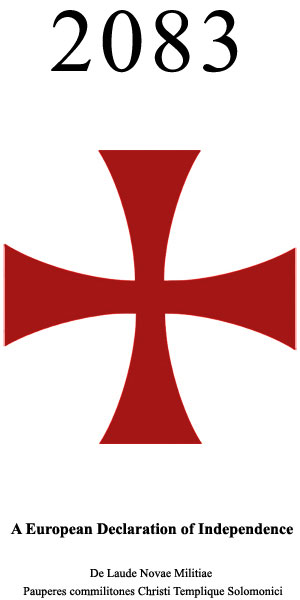
The document opens with a graphical title:

000-2083-cross-tp.jpg — title page —

That’s probably the largest single graphic in the entire work, and it puts the work squarely in the context of the Knights Templar — with e Templar cross and the full name of the order, “Pauperes commilitones Christi Templique Solomonic” or Poor Fellow-Soldiers of Christ and of the Temple of Solomon.  The Templars were a Western Christian chivalric order strongly associated with the Crusades — and the topic more recently of much historical, occult and fictional speculation.

The date 2083 is a date SFE (in the Science Fictional Era) as was 1984 before it — but it was almost certainly chosen for its echo of the 1683 Battle of Vienna, which is commonly taken to represent the turning back of the Ottomans by the Habsburgs, and thus the victory of Christendom over Islam.  Two maps show the Umayyad Conquests:

umayyad-conquests-p-228.jpg — p 228 —

and the Second Islamic Wave, turned back in Spain and at the gates of Vienna:

243-1683-second-islamic-wave-p-243.jpg — p 243 —

These can fruitfully be contrasted with a map of “tomorrow”:

demain-p-487.jpg — p 487 —

it being the author’s contention that France will be the first European country to fall to Islamic dhimmitude.  I suspect much the same is implied in this version of the French tricolore:

flag-face-p-781.jpg — p 781 —

There are some pointed attacks on leftist intellectuals:

033-academic-reform-p-33.jpg — p 33 —

and on media perceived as left-leaning, notably the BBC:

bbc-flag-w-crescent-p-384.jpg  — p 384

— that’s the Saudi flag mashed up with the BBC logo and star and crescent — and:

804-bbc-02-p-804.jpg  — p 804 —

giving both “ancient” and “modern” variants on the theme…

There are some strange items which I’ll drop in here for a breath of fresh air…

free-pluto-equal-gravity-for-all-planets-p-381.jpg  — p 381 —

which appears to be a commentary on the respective attractions of Venus and Mars, since it’s situated in a commentary on Feminism…

this really is a strangely mythic document… and…

global-warming-voidka-p-657.jpg

with its reference to “mind control agents” — and those whose minds have been controlled are clearly sheep:

wake-up-p-803.jpg — p 803 —

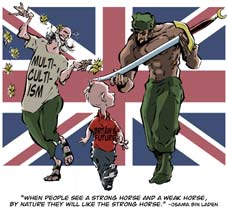
which may be the right moment to mention that the British, too, come in for a measure of contempt, via a quotation from none other than Osama bin Laden:

when-people-see-a-strong-horse-p-707.jpg  — p 707 —

“When people see a strong horse and a weak horse, by nature they will like the strong horse”.  Perhaps its unsurprising that the author is something of an admirer of bin Laden’s means, if not his ends.

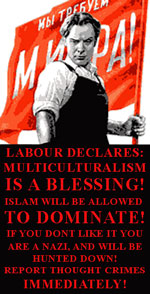
Of course, that’s largely the fault of the Labour party:

labour-declares-multiculturalism-is-a-blessing-p-373.jpg

But that’s probably enough for one post — in my next, I’ll consider how weak we are, what the jihadist strategy against us is, and how the new Templars hope to turn the tide

against:

worst-threats-to-mankind-p-674.jpg — p 674 —

the worst threats to mankind.


Switch to our mobile site