[ by Charles Cameron — Mullah Omar, the Prophet’s cloak in Kandahar, & the title “Amir al-Mu’minin” ]
.
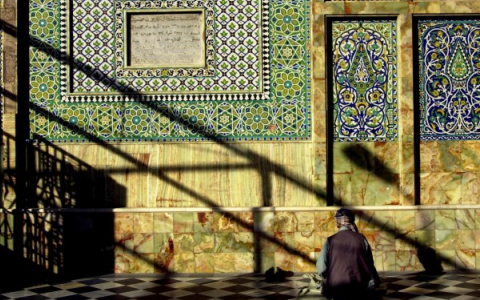
A man prays at the Shrine of the Cloak of the Prophet, Kandahar. Photo: Tomas Munita/AP
**
My latest for LapidoMedia begins:
ON THE FIRST anniversary of the death of US journalist James Wright Foley, the first US citizen to be killed by ISIS, it is timely to examine the credientials of the man who ordered it – the ‘caliph’ of the Islamic State, Abu Bakr al-Baghdadi.
Baghdadi’s claim not just to the title of caliph but to that of Amir al-Mu’minin or Commander of the Faithful, underpins obedience of all Muslims to his will.
To understand this, we need also to understand the impact of the recently announced death of Mullah Omar, the leader of the Taliban.
The cloak of responsibility
For jihadists and those who aspire to be jihadists, Mullah Omar’s death put to an end one of the two claims to the title of Amir al-Mu’minin.
This title is one normally accorded to a caliph, but while Mullah Mohammed Omar Mujahid did not proclaim himself caliph or attempt to establish a global caliphate, he did indeed lay the foundations of one by creating the Islamic Emirate of Afghanistan in 1996.
[ by Charles Cameron — I hav to say, the senseless death of Alan Henning makes me very sad ]
.
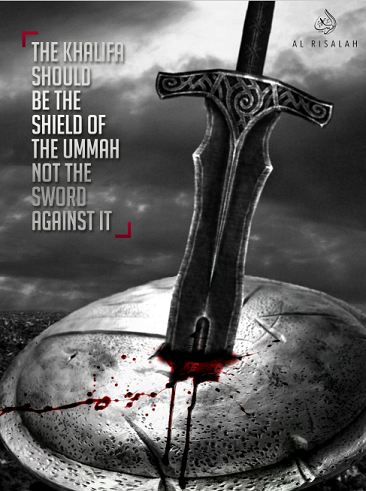
In the first issue of its magazine, al-Risalah, Jabhat al-Nusra attacks al-Baghdadi’s supposed caliphate.
The item that caught my eye, though, was a section in the article Khilafa One Year On titled The Murder of Alan Henning. We read:
Next, we have the murder of Alan Henning, a forty-seven year old British humanitarian aid worker in Syria, who was abducted by the ‘Islamic State’ and beheaded on camera. Although he was a disbeliever, we mention his case here because he was under the protection of the Muslims. Abu Salaam al-Britani, an aid worker who worked alongside Henning, pleaded to Baghdadi to have him released:
“I appeal and request in general to all of the members of ad-Dawlah al-Islamiyyah and specifically to Shaykh Abu Bakr al-Baghdadi and Abu ‘Ali al-Anbari to release Alan Henning as he had been given an Amana (security) from two sets of believing parties. Henceforth in the light of the Shari’ah he is considered a Mu’ahid and it is impermissible to harm him…”
I appeal and request in general to all of the members of ad-Dawlah l-Islamiyyah and specifically to Shaykh Abu Bakr al-Baghdadi and Abu ‘Ali al-Anbari to release Alan Henning as he had been given an Amana (security) from two sets of believing parties henceforth in the light of the Shari’ah he is considered a Mu’ahid and it is impermissible to harm him.
The first Amana was given by me and the rest of the brothers travelling in the aid convoy. We reassured and informed Alan he will be safe and not harmed as he is with a group of Muslims who are going deliver aid to the people of Syria.
The second Amana was given by indigenous people of ad-Dana they had sent several men to escort us once we entered Syria through the Bab al-Hawa border crossing. They assured us all we will be under their protection and escorted us to the town of ad-Dana.
I ask you by Allah to honour these covenants as our Lord said in the Qur’an
“O you who believe, honour your covenant (‘uqud)”
[Surat Al-M?’idah, Ayah 1]
The Prophet (peace and blessings of Allah be upon him) also said:
“If anyone kills a ‘Mu’ahid’ ‘i.e. a person guaranteed protection’ without a just cause, Allah will prevent him from even smelling the fragrance of Paradise”.
[Sahih Sunan an-Nasai No .4422].
The Prophet (peace and blessings of Allah be upon him) also said:
“On the Day of Judgment, I will be protesting against anyone who oppresses a ‘mu’ahid’ ‘i.e. a person guaranteed protection’, belittles him, charges him to do things beyond his ability, or extorts anything from him.
[Sahih Sunan Abi Dawud, No. 2626]
Any Muslims is entitled to give protection on their behalf, and that this type of protection can be given to the non-Muslim by any individual from the Muslims whether a male or a female, a nobleman or a poor, a righteous or an evil-doer.
Ash-Shaybani said in as-Siyar, vol.1, pg.175:
“The security covenants that a free Muslim man, whether virtuous or immoral, gives are binding to all the other Muslims because of the Hadith, “Muslims are equal in respect of blood. They are like one hand over against all those who are outside the community. The lowest of them is entitled to give protection on their behalf.” The meaning of “protection” is the security covenant whether it is temporary or permanent.
Zaynab, the daughter of the Messenger of Allah (peace be upon him), granted protection to her husband Abu al-‘As bin Rabi’ah, and the Prophet (saw) approved of her protection.
It was reported that Umm Hani said:
“I granted asylum to two non-Muslim relatives of mine, and then Ali bin Abi Talib (may Allah be pleased with him) came upon them to kill them. So I told him, you are not going to kill them unless you kill me first! Then, I locked my door on them and went to the Messenger of Allah (saw) and told him about what happened.
He (saw) said: “Ali is not allowed to kill them. We grant asylum and protection to the ones you have granted asylum and protection.”
Considering the powerful significance of Ali bin Abu Talib — born in the Kaaba, the son-in-law and cousin of the Prophet, distinguished at the Battle of Badr and subsequent battles, victor in his duel with Amru ibn Abd Wudd, fighter with the sword Zulfiqar of whom it was said, “There is no brave youth except Ali and there is no sword which renders service except Zulfiqar”, named “Lion of God” by the Prophet, fourth of the Rashidun Caliphs and also first Imam of the Shiites — this last is indeed a powerful citation.
[ by Charles Cameron — 3 Quarks Daily, Boston Apocalyptic conference, LapidoMedia, World Religions and Spirituality Project, Bellingcat, Loopcast, Pragati, Sembl ]
.
First, please vote!
. [ Note added: voting is now closed: my story received the fifth highest tally of votes out of 45 entries, and is now up for consideration by the 3QD editors in the next round — many, many thanks! ]
My story, War in Heaven, is in the running for the 3 Quarks Daily Arts & Literature Prize. 3 Quarks Daily is a great aggregator site, I’m honored to have made the cut so far, and would love to make it to the next level. My entry is #33 in the alphabetical list here, and votes can be cast at the bottom of the page. Networking for votes is all part of the game, so I’m hoping you’ll vote — & encourage your friends to go to that page & vote my entry up.
There’s even a Google Hangout video in which Atlantic Council Non-Resident Senior Fellow August Cole, who directs the Art of Future Warfare project, interviews the contest’s winner and finalists, myself included. August’s book, Ghost Fleet: A Novel of the Next World War, is in the running for next great Tom Clancy like techno-thriller.
You’ll find plenty of other good entries at the 3QD contest page, and daily at 3QD as well — as I say, it’s excellent in its own right, and one of the richest contributors of varied and interesting posts on my RSS feed.
**
Then, in no particular order — check ’em all out —
To my way of thinking, the critical thing to know about the Islamic State is its “apocalyptic, end-of-days strategic vision” as Martin Dempsey put it — and the implications of that statement, both in terms of strategy and of recruitment & morale. That’s what the Boston conference focused on, and that’s why I think it was no less significant for being sparsely attended. In a series of future blogs I hope to go over the videos of the various presentations and spell some of their implications out — Will McCants‘ book, The ISIS Apocalypse, is due out in September, and I’d like to have filled in some background by then.
Here, though, as I’m giving an update on my own doings, is my presentation — an attempt both to tie together some of the strands of the panel I was commenting on (but could barely hear, but that’s a tale or another day), and to express my sense of the importance of apoclyptic thinking, not merely as an intellectual exercise but as an emotional and indeed visceral relaity for those swept up in it:
The other speakers were Richard Landes, WIlliam McCants, Graeme Wood, Timothy Furnish, Cole Bunzel, Jeffrey Bale, David Cook, J.M. Berger, Itamar Marcus, Charles Jacobs, David Redles, Mia Bloom, Charles Strozier, Brenda Brasher and Paul Berman — quite a stellar crew.
**
My two latest pieces for LapidoMedia, where I’m currently editor:
YOU might not think that ‘what jihadis do in their spare time’ would be a topic of much interest, but it’s one that has been under-reported and is just now breaking into public awareness.
Much of the credit for this goes to Robyn Creswell and Bernard Haykel for their current New Yorker piece, Battle lines: Want to understand the jihadis? Read their poetry.
But behind Creswell and Haykel’s piece lurks a striking presentation given by the Norwegian terrorism analyst Thomas Hegghammer at St Andrews in April.
Hegghammer’s Wilkinson Memorial lecture was titled Why Terrorists Weep: The Socio-Cultural Practices of Jihadi Militants…
A CHINESE couple, dismayed by the Taliban’s destruction of Bamiyan’s two Buddha statues, has brought the larger of the statues back to life.
Locals and visitors can once again see the Bamiyan Buddha through the use of laser technology – this time not in stone but in light.
Carved into the great cliff face towering over the fertile valley of Bamiyan in Afghanistan, two Buddha statues stood for centuries.
In 2001 the Taliban dynamited the statues, built in the Sixth century in the Gandhara style, the larger of them standing 55 metres tall.
It was not the first attack against them.Lapido aims to provide (mostly secular) journalists with insight into the religious & spiritual values behind current events.
I stood there, atop the Bamiyan Buddha: it’s personal.
**
At the World Religions and Spirituality Project at Virginia Commonwealth University, I’m one of two Project Directors for the JIHADISM Project. We’re very much a work in progress, aiming to provide a resource for scholarship of religion as it relates to jihadism.
**
Justin Seitz made a post titled Analyzing Bin Ladin’s Bookshelf on Bellingcat, to which I responded, and we had a back-and-forth of emails &c.
Justin then gave our discussion a shoutout at The Loopcast —
— the immediate context starts around the 30 min mark, and runs to around 35 — and followed up with a second Bellingcat post, Analyzing Bin Ladin’s Bookshelf Part 2 — in which he quoted me again. Key here is his remark:
a human with domain expertise is always going to be in a better position to make judgement calls than any algorithm
Agreed — & many thanks, Justin!
Bellingcat — definitely an honor to get a shoutout there,
It’s a terrific feeling to see the next runner in a relay race take off from the handover… Cath is getting some high praise for her work on Sembl for the museum world, including the following:
Sembl incredibly succesfully mixes competitive and collaborative play, creativity and expression, and exploration and inspiration. It’s the sort of game you think about when you’re not playing it, and it’s the sort of game that helps you see the world in new ways.
Paul Callaghan
Writer, Game Developer, Lecturer at Unversity of East London
Meanwhile, I’m still quietly plugging away at some other aspects of the HipBone / Sembl project.
Radical Islamists invoke the Hadith (the oral traditions attributed to the Prophet Muhammad) to prophesize a great battle in India between true believers and unbelievers before the end-times. These references in the Hadith to the Ghazwa-e-Hind (Battle of India) infuse South Asia with importance as a battleground in the efforts to create an Islamic caliphate resembling the social order that existed at the time of the Prophet Muhammad and the Rightly Guided Caliphs (632-661 AD).
After discussing the Khorasan-to-Jerusalem and Euphrates-gold ahadith (the latter easily and often interpreted to refer to Middle Eastern oil, aka “black gold”), he turns to the Ghazwa traditions:
In one version of the Hadith, attributed to Thawban, a freed slave of the Prophet Muhammad, “[t]he Messenger of Allah said: ‘there are two groups of my Ummah whom Allah will free from the Fire: The group that invades India, and the group that will be with Isa bin Maryam, peace be upon him.’”4 Isa bin Maryam is the Quranic name of Jesus, whose return to earth alongside the Mahdi is held in Islamic tradition to be a seminal event of the end of time.
In another version, narrated by Abu Hurairah, “[t]he Messenger of Allah promised us that we would invade India. If I live to see that, I will sacrifice myself and my wealth. If I am killed, I will be one of the best of the martyrs, and if I come back, I will be Abu Hurairah Al-Muharrar.” Al-Muharrar translates as “the one freed from the fire of hell.”
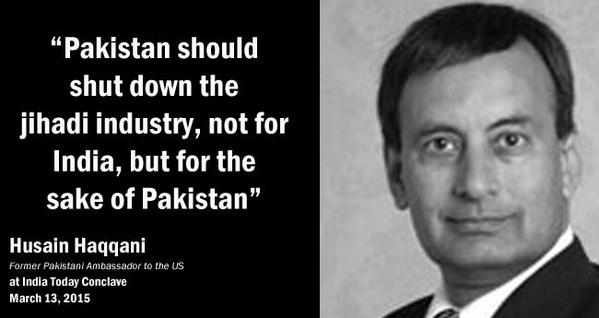
We hear relatively little about the Ghazwa-e-Hind narrative in the west, so Haqqani then offers some recent historical context:
Just as the prophecies of Khurasan became popular during the wars in Afghanistan, the Ghazwa-e-Hind divinations became a staple of the Islamist discourse after the launch of jihad in Indian-controlled parts of Kashmir in 1989. Throughout the 1990s, Pakistani official media also encouraged discussion of the Ghazwa-e-Hind Hadith to motivate jihadists. In fact, every major Pakistan-based jihadi group that launched terrorist attacks across the border claimed that their operations were part of the Battle for India promised by the Prophet. For these Pakistani groups, supported by Pakistan’s Inter-Services Intelligence agency, the target of jihad should be the modern state of India and its “occupation” of Kashmir.
**
This next para gave me pause and insight, quoting as it does a Deobandi source:
According to Maulana Waris Mazhari of the Darul Uloom Deoband seminary in Uttar Pradesh, India, the conflict between India and Pakistan over Kashmir was not jihad; the dream of establishing “Muslim hegemony throughout the entire world” was fanciful. “The term ghalba-e Islam, the establishment of the supremacy of Islam, used in the context of the Quran and the sayings of the Prophet (Hadith), refers not to any political project of Muslim domination,” Mazhari wrote, “but, rather, to the establishment of the superiority of Islam’s ideological and spiritual message.”
Haqqani then goes into considerably more detail on Mazhari‘s views, saying for instance:
Mazhari saw the Ghazwa-e-Hind Hadith as an instrument of propaganda in “the proxy war engaged in by Kashmir by powerful forces in Pakistan in the guise of a so-called Jihad,” which he and other Ulema consider “nothing but deceit.”
**
Haqqani next turns to the various contemporary jihadist interpretations of the Ghazwa, starting with the shifts occasioned by the defeat of the Taliban and the death of Osama bin Laden:
The defeat of the Taliban and the arrival of NATO forces in Afghanistan in 2001 shifted al-Qaeda’s major operations to Iraq and Yemen even though Osama bin Laden continued to hide in Pakistan. For some time, discussion of the epic battle for India diminished in the jihadi discourse while grand strategies for the expulsion of Western influence from the Middle East took center stage. The death of Osama bin Laden and the rise of ISIS, however, have revived global jihadist interest in Ghazwa-e-Hind.
and:
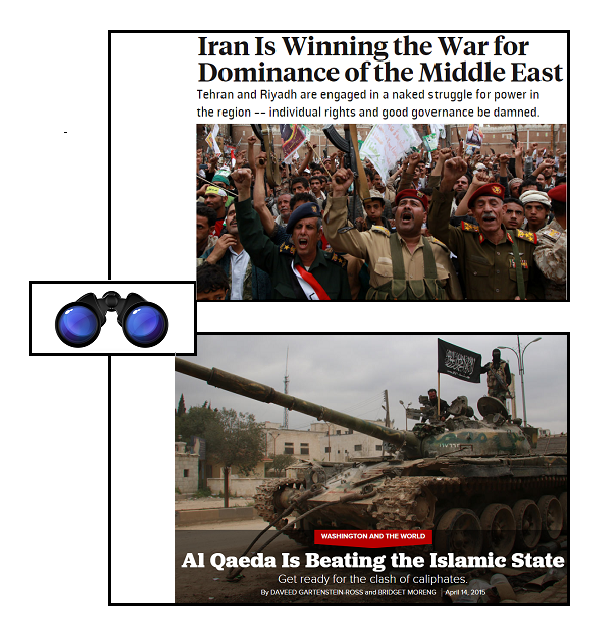
The recent revival of interest in the Ghazwa-e-Hind prophecy reflects rivalry between competing jihadi groups. Al-Qaeda, now led by Ayman al-Zawahiri, faces the prospect of extinction as its Arab cadres defect to ISIS, led by Baghdadi. Zawahiri has worked to build alliances with Pakistani jihadi groups and make inroads in India’s Muslim population because it helps him remain relevant in the face of ISIS.
As to that rivalry between AQ and IS, Haqqani concludes his piece:
Al-Qaeda appears to be attempting to maintain support among radical Islamists in the subcontinent by directing its ire at India. Its leaders have been active in Afghanistan and Pakistan since the 1980s anti-Soviet jihad and maintain close ties to the Pakistani-supported Afghan Taliban and Kashmiri jihadi groups. By focusing on India, al-Qaeda hopes to retain the support of Pakistan-backed groups, which interpret the Ghazwa-e-Hind Hadith to mean re-conquest of Hindu India without hitting Muslim Pakistan. Even in Zawahiri’s statement about AQIS, Pakistan was mentioned only as a country that needed to be brought under full Sharia rule while Hindu India was portrayed as the enemy of Islam.
ISIS, on the other hand, has accepted the allegiance of groups that are violently opposed to both the Republic of India and the Islamic Republic of Pakistan. ISIS affiliates appear to have opted for the alternative interpretation of Ghazwa-e-Hind, offered by groups such as the TTP, to pursue jihad in all parts of historic Hind. Indeed, in an ominous declaration, one South Asian ISIS member proclaimed, “[o]ur struggle is ongoing and Insha’Allah after defeating Pakistan Army, we won’t just stop in Pakistan rather we shall continue our advance into Kashmir and India until the laws of Allah are implemented globally and the whole world comes under the rule of one Muslim Khalifah.”
All in all, this is a fascinating and timely article, and I highly recommended it as a counterpoise to our usual concern with westward-facing jihad.
Zenpundit is a blog dedicated to exploring the intersections of foreign policy, history, military theory, national security,strategic thinking, futurism, cognition and a number of other esoteric pursuits.