zenpundit.com » creativity

Archive for the ‘creativity’ Category

Book Mini-Reviews to Clear a Boundless Bibliographic Backlog!

Friday, December 10th, 2010

I have too many books that I have read that I would like to review that, realistically, I will never get to post on in conventional fashion. A fair number belong with Summer Series which seems ridiculous as it is two weeks to Christmas! Therefore, brace yourselves, as I commence the first, and hopefully only, Mini-Reviews post:

Play: How It Shapes the Brain, Opens the Imagination, and Invigorates the Soul by Stuart Brown, MD

Dr. Stuart Brown, scientist and psychiatrist, has written a short tome on the nature and cognitive value of play. While there is plenty of child social development information and “pop”self-helpish type chapters, ZP readers wil gravitate to the chapters on play’s vital role in creaivity and innovation ( which are not the same thing), scientific discovery and work. Also of interest are the spectrum of “play personalities” and the “dark side of play”. Not an academic book but a reasonable read on a deceptively complex subject.

The Collapse of Complex Societies by Joseph Tainter

A superb academic book, previously featured and reviewed in the blogosphere by John Robb and Joseph Fouche, The Collapse of Complex Societies embarks upon a critical examination and partial de-bunking of theories that purport to explain the “sudden” fall of great empires, such as Rome or the vanishing of the Mayans. With caveats, Tainter settles on declining marginal returns from increasing societal investment in complexity as a rough proximate cause capable of subsuming a ” significant range of human behavior, and a number of social theories” under it’s rubric. Highly recommended.


The Bin Ladens: An Arabian Family in the American Century by Steve Coll

A biography of the Bin Laden family, this book does not come close to matching the impact or importance of Coll’s previous instant classic, Ghost Wars. There are many interesting trivialities about the divergences between the “religious and the hard Rock Cafe wings” of the Bin Laden families, and intriguing nuggets about political matters such as the 1979 takeover of the Grand Mosque and the connections between the Bin Ladens and elite figures inside the beltway but anyone looking for insight into Osama bin Laden will be disappointed. The most infamous member of Saudi Arabia’s dominant non-royal business clan is a subdued figure in this biography. Coll’s superior skills as a wordsmith and reporter manage to make the book a pleasant page turner.

The Death and Life of the Great American School System: How Testing and Choice Are Undermining Education by Diane Ravitch

Conservative education scholar and historian Diane Ravitch lays out the demise of the movement for high curricular standards in public education that she once championed and it’s transmogrification under NCLB into a punitive system that is slowly imposing an unprecedentedly narrow and dumbed down national curriculum focusing on basic math and reading skills, featuring gamed  test results, highly paid lawyer-consultant insiders and perverse incentives for public and charter schools alike. A depressing but important read.
WikiLeaks: Counterpoint at the State Department?

Wednesday, December 8th, 2010

[ by Charles Cameron ]

[ note: all links are to youtube videos ]

The pianist Glenn Gould is celebrated for his ability to bring the different and at times positively oppositional voices in a fugue by Bach to our attention, so that we follow each one separately while hearing all at the same time as a single whole. What is less known is that he liked to sit at a table in a truck stop and listen to the different conversations at the other tables and booths, mentally braiding their pale or brightly colored threads of human together into an analogous tapestry — one voice harmonizing with or conflicting against another, here a new subject introduced, there an echo of an earlier idea heard in a fresh context, with the murmurings of waitresses punctuated by the kaching! of the cash register, the hydraulic hiss of a door closing — conversation as counterpoint.

Organizations and individual alike, we all have different and at times dissonant voices, and strive to bring them to some kind of resolution. The many stakeholders debating an issue in town halls, blogs or letters to the editor, the many drives within each one of us, idealistic, hopeful, defeated, paralytic, angry, evasive, sluggish, vengeful, curious, alert, defiant, all have voices, all constitute an experience of polyphony, a “music of many voices”, in point counter point.

One of my interests is to find a way to score these many fugues, these musics of meaning.

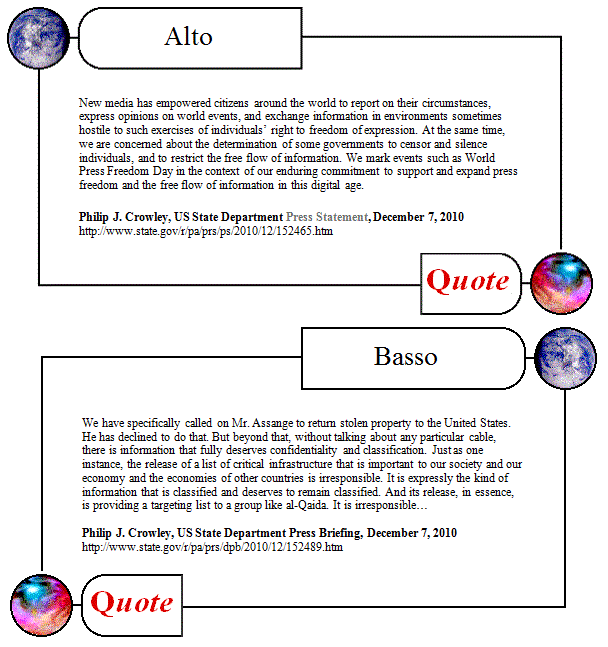
My DoubleQuotes, then, can be considered as two-part inventions, attempts to show the multiple tracking of the mind — whether of a single individual, as in this case, or of a group, a community, a world divided – so that something of the music begins to be visible, and some of the dissonances can move towards necessary resolution.

*

QUOwikileaks

*

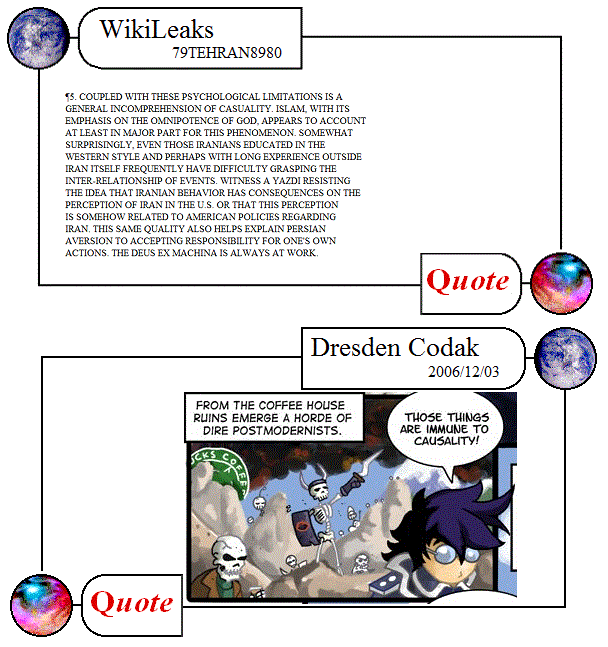
I believe there is unresolved irony between these two statements, made on the same day by Philip J Crowley, the US State Department’s Assistant Secretary, Bureau of Public Affairs – but each has its reasons, and there are arguments to be made for both transparency and opacity, diplomacy and publicity, secrets and revelations.

Between them lies the possibility I think of as a virtual music of ideas.

*

Bach published a series of two-part inventions, BWV 772–801, and wrote of them that he intended to offer them as an honest method

by which the amateurs of the keyboard – especially, however, those desirous of learning – are shown a clear way not only (1) to learn to play cleanly in two parts, but also, after further progress, (2) to handle three obligate parts correctly and well; and along with this not only to obtain good inventions (ideas) but to develop the same well; above all, however, to achieve a cantabile style in playing and at the same time acquire a strong foretaste of composition…

Later comes the Art of Fugue.

A DoubleQuote for Anders

Friday, December 3rd, 2010

[ by Charles Cameron ]

One of my hobbies is finding apposite quotes to juxtapose — I call them DoubleQuotes and think of them as twin pebbles dropped into the mind-pool for the pleasure of watching the ripples…

And I particulartly enjoy it when one of my DoubleQuotes manages to span different sensory streams — aural, visual, verbal, numerical, cinematic — as here, with text and image.

This one’s for Anders Sandberg.

QUOAcausal

I’d been carrying around the quote from WikiLeaks for a few days, but it was running across the Dresden Codak via Anders’ Andart blog today that gave me the second “dot” to connect with the first.

What the Dickens? Symbolic details in Inspire issue 3

Sunday, November 21st, 2010

by Charles Cameron
.
It’s easily missed. It’s part of the “small print” that most small-format paperbacks carry on the copyright page:

The sale of this book without its cover is unauthorized. If you purchased this book without a cover, you should be aware that it was reported to the publisher as “unsold and destroyed.” Neither the author nor the publisher has received payment for the sale of this “stripped book.”

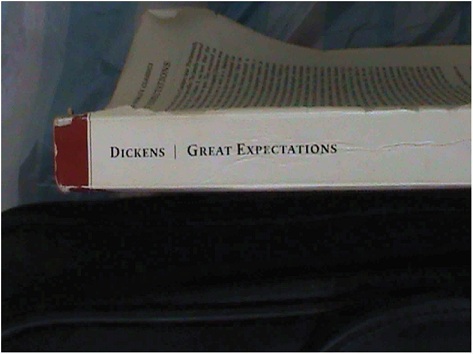
Here’s the picture that AQAP took of the copy of Dickens’ novel Great Expectations they inserted into one of their bombs recently – which they then published in issue 3 of their English language magazine Inspire:

Dickens

And here’s the explanation that accompanies that photo, in a piece titled “The Objectives if Operation Hemorrhage” by their “Head of the Foreign Operations Team”:

This current battle fought by the West is not an isolated battle but is a continuation of a long history of aggression by the West against the Muslim world. In order to revive and bring back this history we listed the names of Reynald Krak and Diego Diaz as the recipients of the packages. We got the former name from Reynald de Chatillon, the lord of Krak des Chevaliers who was one of the worst and most treacherous of the Crusade’s leaders. He fell into captivity and Salahuddeen personally beheaded him. The name we used for the second package was derived from that of Don Diego Deza, the Inquisitor General of the Spanish Inquisition after the fall of Granada who along with the Spanish monarchy supervised the extermination and expulsion of the Muslim presence on the Iberian Peninsula employing the most horrific methods of torture and done in the name of God and the Church. Today we are facing a coalition of Crusaders and Zionists and we in al Qaeda of the Arabian Peninsula will never forget Palestine. How can we forget it when our motto is: “Here we start and in al-Aqsa we meet”? So we listed the address of the “Congregation Or Chadash”, a Gay and Lesbian synagogue on our one of our packages. The second package was sent to “Congregation B’nai Zion”. Both synagogues are in Chicago, Obama’s city.
.
We were very optimistic about the outcome of this operation. That is why we dropped into one of the boxes a novel titled, Great Expectations.

They may not have read the book or seen the movie, as Ibn Siqilli comments at the link above, but they do have long memories and/or a taste for history, and they are indeed sending signals with small details like the fictitious names of their addressees.

*

This is in line with one of the basic premises of Islamic thought: that the world we inhabit is a world of ayat or symbols (the singular is ayah, and the word is also used to refer to the verses of the Qur’an, each of which is viewed as a symbolic utterance). Here, for instance, is a passage from Fazlun Khalid’s paper, Islam and the Environment, from the website of Jordan’s Royal Aal al-Bayt Institute for Islamic Thought:

The Qur’an refers to creation or the natural world as the signs (ayat) of Allah, the Creator, and this is also the name given to the verses contained in the Qur’an. Ayat means signs, symbols or proofs of the divine. As the Qur’an is proof of Allah so likewise is His creation. The Qur’an also speaks of signs within the self and as Nasr explains, “… when Muslim sages referred to the cosmic or ontological Qur’an … they saw upon the face of every creature letters and words from the cosmic Qur’an … they remained fully aware of the fact that the Qur’an refers to phenomena of nature and events within the soul of man as ayat … for them forms of nature were literally ayat Allah”. As the Qur’an says, “there are certainly signs (ayat) in the earth for people with certainty; and in yourselves. Do you not then see?” (Adh-Dhariat, 51:20, 21).

*

BTW, I don’t think Penguin (or, for that matter, Charles Dickens) got paid for that book… whatever their expectations may have been.

Metaphors as Catalyst and Scaffold

Friday, November 19th, 2010

Via John Hagel, a particularly interesting NYT article on the neroscience of metaphors. I have always considered metaphors and analogies to be a “spark” or a “catalyst” to insight but they appear to be potentially structural organizers or “signal switches” of information processing:

This Is Your Brain on Metaphors

….Symbols, metaphors, analogies, parables, synecdoche, figures of speech: we understand them. We understand that a captain wants more than just hands when he orders all of them on deck. We understand that Kafka’s “Metamorphosis” isn’t really about a cockroach. If we are of a certain theological ilk, we see bread and wine intertwined with body and blood. We grasp that the right piece of cloth can represent a nation and its values, and that setting fire to such a flag is a highly charged act. We can learn that a certain combination of sounds put together by Tchaikovsky represents Napoleon getting his butt kicked just outside Moscow. And that the name “Napoleon,” in this case, represents thousands and thousands of soldiers dying cold and hungry, far from home.

And we even understand that June isn’t literally busting out all over. It would seem that doing this would be hard enough to cause a brainstorm. So where did this facility with symbolism come from? It strikes me that the human brain has evolved a necessary shortcut for doing so, and with some major implications.

….This potential to manipulate behavior by exploiting the brain’s literal-metaphorical confusions about hygiene and health is also shown in a study by Mark Landau and Daniel Sullivan of the University of Kansas and Jeff Greenberg of the University of Arizona. Subjects either did or didn’t read an article about the health risks of airborne bacteria. All then read a history article that used imagery of a nation as a living organism with statements like, “Following the Civil War, the United States underwent a growth spurt.” Those who read about scary bacteria before thinking about the U.S. as an organism were then more likely to express negative views about immigration.

Another example of how the brain links the literal and the metaphorical comes from a study by Lawrence Williams of the University of Colorado and John Bargh of Yale. Volunteers would meet one of the experimenters, believing that they would be starting the experiment shortly. In reality, the experiment began when the experimenter, seemingly struggling with an armful of folders, asks the volunteer to briefly hold their coffee. As the key experimental manipulation, the coffee was either hot or iced. Subjects then read a description of some individual, and those who had held the warmer cup tended to rate the individual as having a warmer personality, with no change in ratings of other attributes.

From this simple associative effect are the conditions from which a “eureka” moment of insight can crystallize, as it did for Archimedes in his bath:

Effect—-> Association —-> Orientation ——> Insight ——> Extrapolation/Generalization

ADDENDUM:

Curtis has commented and expanded the discussion, though his comments seem to go into my akismet spam folder. Should be fixed now:

WOODA = C(OODA) + A(OODA) / 4GW & 5GW

There is the potential not only for insight but also for deception, whether the deceivers are others in our milieu or we ourselves (and our brains) may be deceivers….

True. Metaphors and analogies can crystallize insughts but they can also become powerfully attractive distorions of reality – sort of “anti-models” or  “false models”.

….As a model of what might be called metaphorization, these similarities make sense.  The OODA in all its forms, including the WOODA which includes World, represents a dynamic process of cycling (although perhaps not always uniform and unidirectional cycling) of information.  The focal point of the A-OODA, Observe above, is the abstract locus of observation:  New information received from without comes into contact (abstractly speaking!) with previously built understandings, or Mental Constructs, and relatively newer insights, or Conditional Constructs.  These diverse abstract observations have, to some extent, already prepared the mind for interpretation of new information and, these observations taken as whole create an opportunity for triangulation (of a sort.)  Using Mark Safranski’s terminology, after the information is Associated, it is Oriented through analysis and synthesis, Insights may form the basis of new hypotheses which may either be conditional (re-looped into further observation w/ outside information and previous understandings) or may be accepted as finalized understandings about what one has observed (Extrapolation/Generalization).

Hmmmm…. I have read that “insight” as a neurocognitive event tends to occur in two brain regions, the lateral inferior prefrontal cortex and the anterior cingulate cortex. The associative work of insight correlates with the former region but the “combinatory play” cited by Einstein and referenced , if I recall, by Charles and leading to new hypothesis correlates with the latter.  I am not a neuroscientist, so I am now wondering if insight is a distributed, parallel processing, brain function or if we are really talking about two separate cognitive effects – an “Insight 1” and “Insight 2”?

Anyone who cares to weigh in here, feel free…..


Switch to our mobile site