zenpundit.com » culture

Archive for the ‘culture’ Category

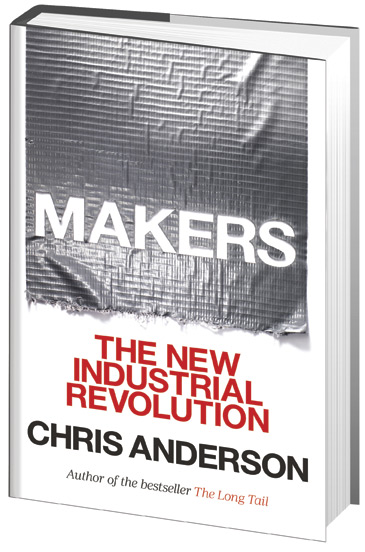
Book Mini-Review: Makers: the New Industrial Revolution by Chris Anderson

Wednesday, February 13th, 2013

Makers: The New Industrial Revolution by Chris Anderson 

This is a fun book  by the former editor-in-chief of WIRED , author of The Long Tail and the co-founder of 3D Robotics, Chris Anderson. Part pop culture, part tech-optimist futurism and all DIY business book, Anderson is preaching a revolution, one brought about by the intersection of 3D printing and open source “Maker movement” culture, that he believes will be bigger and more transformative to society than was the Web. One with the potential to change the “race to the bottom” economic logic of globalization by allowing manufacturing entrepreneurs to be smart, small, nimble and global by sharing bits and selling atoms.

Anderson writes:

Here’s the history of two decades of innovation in two sentences: The past ten years have been about discovering new ways to create, invent, and work together on the Web. The next ten years will be about applying those lessons to the real world.

This book is about the next ten years.

….Why? Because making things has gone digital: physical objects now begin as designs on screens, and those designs can be shared online as files…..once an industry goes digital in changes in profound ways, as we’ve seen in everything from retail to publishing. The biggest transformation, but in who’s doing it. Once things can be done on regular computers, they can be done by anyone. And that’s exactly what we’re seeing happening in manufacturing.

…..In short, the Maker Movement shares three characteristics,  all of which I’d argue are transformative:

1. People using digital desktop tools to create designs for new products and prototype them (“digital DIY”)

2. A cultural norm to share those designs and collaborate with others in online communities.

3. The use of common design file standards that allow anyone, if they desire, to send their designs to commercial manufacturing services to be produced in any number, just as easily as they can fabricate them on their desktop. This radically foreshortens the path from idea to entrepreneurship, just as the Web did in software, information, and content.

Nations whose entire strategy rests upon being the provider of cheapest labor per unit cost on all scales are going to be in jeopardy if local can innovate, customize and manufacture in near-real time response to customer demand. Creativity of designers and stigmergic /stochastic collaboration of communities rise in economic value relative to top-down, hierarchical production systems with long development lags and capital tied up betting on having large production runs.

Interesting, with potentially profound implications.

“Sin, Death, and Hell have set their Marks on Him”

Tuesday, February 5th, 2013

King Richard III 

The bones of Richard III, Shakespeare’s greatest villain and the last King of England to be killed in battle have been discovered and identified by DNA testing:

….There were cheers when Richard Buckley, lead archaeologist on the hunt for the king’s body, finally announced that the university team was convinced “beyond reasonable doubt” that it had found the last Plantagenet king, bent by scoliosis of the spine, and twisted further to fit into a hastily dug hole in Grey Friars church, which was slightly too small to hold his body.

But by then it was clear the evidence was overwhelming, as the scientists who carried out the DNA tests, those who created the computer-imaging technology to peer on to and into the bones in raking detail, the genealogists who found a distant descendant with matching DNA, and the academics who scoured contemporary texts for accounts of the king’s death and burial, outlined their findings.

….Richard died at Bosworth on 22 August 1485, the last English king to fall in battle, and the researchers revealed how for the first time. There was an audible intake of breath as a slide came up showing the base of his skull sliced off by one terrible blow, believed to be from a halberd, a fearsome medieval battle weapon with a razor-sharp iron axe blade weighing about two kilos, mounted on a wooden pole, which was swung at Richard at very close range. The blade probably penetrated several centimetres into his brain and, said the human bones expert Jo Appleby, he would have been unconscious at once and dead almost as soon.

The skull of Richard III

Injuries to the skeleton appear to confirm contemporary accounts that the king died in battle. Photograph: AFP/Getty Images

The injury appears to confirm contemporary accounts that he died in close combat in the thick of the battle and unhorsed – as in the great despairing cry Shakespeare gives him: “A horse! A horse! My kingdom for a horse!” 

Richard III, usurper and probable regicide of his nephew the boy King, was the last truly medieval King of England. Had Richard lived to rule, his reign would have been characterized by the same bloody uprisings and civil strife that marked the War of the Roses. England was fortunate in his successor who had bested him in battle, Henry Tudor who became King Henry VII was an energetic and far seeing monarch who restored a war-wracked and bankrupt England to peace and fiscal health and set the foundations of the modern United Kingdom and the future world-spanning British Empire. It was Henry who started the Royal Navy and curtailed the ability of the nobility to wage war as they pleased with large private armies, by taxing them for each man at arms, thus ending bastard feudalism ; recalcitrant rebels were executed and justices of the peace established in every shire to enforce the law of the realm rather than the corrupt whims of manorial courts.

Richard III has his devoted fans as well his detractors. Except for his impatient ruthlessness, Richard probably was little worse, morally speaking, than his fellow medieval monarchs in an age when brutality and the rule of the strong was the norm.  However, unlike the brilliant Henry, Richard would have done little to improve the situation and might have made life in England more savagely violent.

Recruitment, poetry and tears

Thursday, January 31st, 2013

[ by Charles Cameron — Hegghammer on testing and trusting as precursors to AQ recuitment ]
.

I’ve been having trouble finding any of the anasheed Ibn Siqilli was posting on his site, many of which have been taken down — but this one, found in a comment of his on Leah Farrall‘s site, has somehow survived:

Craftsmanship in search of emotion, in service to the jihad.

Thomas Hegghammer has a fascinating article out titled The recruiter’s dilemma: Signalling and rebel recruitment tactics from which I’ll only tease you with the bits of special interest to me, viz those that speak to religion (roughly, scripture and ritual), and culture (narrative, music and poetry).

**

First, matters clearly involving religious piety and its expressions:

At the same time, personal piety at the time of recruitment was certainly a necessary condition for joining. Failure to observe any of the basic rituals or engaging in sinful behaviour – by skipping prayers, smoking, or watching Hollywood films – would have constituted a very negative sign. Moreover, even at the far end of the piety spectrum there were small signs that distinguished the extremely pious from the very pious. These signs were not in material objects such as clothes, but rather in body language and habits. QAP martyrdom biographies would highlight the piety of some but not of others, which suggests some variation. Judging from texts and videos, the behaviours that were appreciated included reading the Qur’an at every available spare moment, weeping while reciting the Qur’an, frequent minor pilgrimages (umra) to Mecca, efforts to acquire religious knowledge, etc. However, to observe these signs, recruiters needed to already be in direct contact with the recruit.

Piety, however, was not enough. Recruiters would also need to see signs of ideological commitment of a more political nature, in particular approval of violent activism.

Particularly interesting to me here is the sentence, These signs were not in material objects such as clothes, but rather in body language and habits.

**

And then, culture…

To find out whether a person had really been abroad for jihad, recruiters would solicit signs of jihad experience, either by engaging the recruit in conversation, or if in a larger group, steer the conversation toward the topic of foreign jihad fronts. They would presumably look for displays of three types of knowledge, the combination of which would be very hard to acquire for a person who had not been to any of the major battlefronts.

The first was knowledge of people, places and events specific to the conflict in which the recruit claimed to have taken part. [ more … ]

The second type of distinctive knowledge was weapons expertise. [ more … ]

The third type was familiarity with ‘jihad culture’, a set of peculiar practices and artistic expressions that emerged in the Arab Afghan community in the 1980s and developed in subsequent jihad fronts. One important component was anashid, battle hymns sung a capella during training and socializing. A similar component was poetry. Arab fighters in Afghanistan, Bosnia and Chechnya would continuously compose new poems and recite them in the camps. Veterans would be familiar with at least part of this material and would share it during social gatherings in the kingdom. Yet another aspect of jihad culture was the telling of war stories from the time of the Prophet Muhammad and his immediate successors. While some of these stories were part of the basic religious education of most Saudis, it required extra effort to learn many or all of them, and to be able to cite them verbatim, as custom required. In the training camps and the trenches, such stories were told all the time (Nasiri, 2006), so jihad veterans typically knew many more such stories than the average Saudi.

Of course, non-veterans could acquire some of this knowledge if they wanted to, but to mimic jihad experience, impostors would need to emit large and consistent clusters of correct signs – a considerable challenge.

I’m reminded of Abdullah Azzam‘s book The signs of Ar-Rahmaan in the Jihad of Afghanistan, which I quoted in an earlier post Of war and miracle: the poetics, spirituality and narratives of jihad.

**

Here’s how bad we are at learning the local mores of the various war zones we keep dropping in on, in the words of FPRI’s Adam Garfinkle, in Mali: Understanding the Chessboard, posted recently:

As the article says, when the Tuareg rebellion in Mali gained steam after the denouement of the Libya caper, greatly stimulated by the return of heavily armed Tuareg brethren from that fight, these three Tuareg commanders defected to the rebels, bringing soldiers, vehicles, ammunition and more to the anti-government side. Anyone who was surprised by this is at the very least a terminal ignoramus. And anyone in the U.S. military who failed to understand the ethnic composition of the country’s politico-military cleavages, such that he let U.S. Special Forces training be lavished on Tuareg commanders, was clearly insufficiently trained to do his job. And believe me, that’s about as nice a way to put that as I can summon.

How do things like this (still) happen, after what we should have learned from years of dealing with Iraqis and Afghans and others on their home turf? I happen to know someone who teaches in the U.S. military education system, and this person happens to be a field-experienced Harvard Ph.D. in anthropology. This person tries very hard to clear away the thick fog created by the innocent Enlightenment universalism that pervades the American mind—the toxic fog that tries to convince us that all people, everywhere, are basically the same, have the same value hierarchies, the same habits of moral and tactical judgment, and mean the same things by roughly comparable translated words.

Now imagine how good we’d be at infiltration, getting the anasheed, poetry and stories right…

Mindlessness and Mindfulness

Tuesday, January 22nd, 2013

In the midst of writing a lengthy post, it may eventually become my longest, about Socrates.

There’s no assurance that volume will equate with importance – most likely, the opposite. The post began as a book review and then grew to two books, then I reversed course and started over; it has been unusually slow going because the subject matter has forced me to stop periodically and uncomfortably rethink my assumptions – and then pick up new books. In one sense, there’s no hurry. After all, Socrates will still be just as relevant or not when I finish blogging about him than when I began. On the other hand, the spirit of our times calls out for Socrates’ techne logon, his “craftsmanship of reason”, so I keep plugging away at it.

The flip side to this intense focus has been an increasing desire for a little mindless entertainment. So, I started watching Sons of Anarchy of my iPad, Season One. So far, It’s fun:

The theme and setting is interesting and the characters and plot are generally more credulity-stretching than even The Soprano’s in their twilight seasons, but Sons of Anarchy fills the bill in terms of entertainment.Boardwalk Empire, is also supposed to be very good, even better, but one at a time.

What do you use as a diversion?

Sow wind, reap whirlwind

Sunday, December 30th, 2012

[ by Charles Cameron — on blowback, in praise of a Gregory Johnsen post, and literacy ]
.

William Blake, The Lord Answering Job Out of the Whirlwind

.

ED Hirsch and Joseph F Kett‘s New Dictionary of Cultural Literacy doesn’t appear to have an entry for the phrase “For they have sown the wind, and they shall reap the whirlwind” which is straight out of the prophet Hosea and is now something of a proverb in the form “sow the wind, reap the whirlwind”. Hunh.

It’s an elegant phrase. The translators of the King James Bible were masterful in their singular ear for English, and no doubt Hosea‘s original Hebrew (Hosea 8.7) is no less pithy. Seed preceding harvest is about as basic a notion of cause resulting in effect as one can find in the lived world of agriculture, with the actual mechanism through which it comes to pass hidden in the “black box” between them where, as another biblical passage (John 12.24) puts it:

unless a kernel of wheat falls to the ground and dies, it remains only a single seed. But if it dies, it produces many seeds.

**

Sow the wind…

It doesn’t sound like much, does it? Put an airy nothing in the ground…

reap the whirlwind.

If you were within media reach of the devastation that Sandy caused to New York and New Jersey — or Haiti (yet again) for that matter — you know what reaping the whirlwind is about. And the proverb, with the prophet behind it, tells us we get it by sowing the wind.

Blowback.

**

Gregory Johnsen, in a recent Waq-al-Waq post, Sowing the Wind: Three years of strikes in Yemen, pulls together three recent news pieces on Yemen to give us a view from 30,000 feet — in which blowback is clearly visible as the “whirlwind” his title implies we are already beginning to reap.

This sort of “here’s how the weather system looks from above” picture comes from the juxtaposition of key quotes, and since that’s one of my specialties, I’ll present two quotes that Johnsen selected in my own format devised with just that sort of exercise in mind:

That first quote is from Letta Tayler in Foreign Policy, and the second from Sudarsan Raghavan in the Washington Post.

As Johnsen puts it:

This is clear: the US bombs, kills civilians and AQAP sends compensation – ie, helps out the families that have been killed – and takes advantage of the carnage the US has sown to reap more recruits.

This is at once all too sad, and at the same time all too predictable.

**

There’s plenty more in Johnsen’s post, obviously, and being a trawler for religious details, I myself was particularly amused, or maybe alarmed, by this sentence:

That opening strike in the US’ war against AQAP in Yemen was a disaster, a strike so bad that the Pentagon lawyer who authorized it famously said later: “if I were Catholic, I’d have to go to confession.”

Indeed, as I hope to show shortly in a review of his book, The Last Refuge: Yemen, al-Qaeda, and America’s War in Arabia, Johnsen has a great deal to tell us, and he tells it with the added grace of a real appreciation for the language he uses.

Which brings me to the reason why I singled this particular post for commendation, given that I read a number of insightful people on a number of interesting topics each day.

Gregory Johnsen is literate, lettered.

**

I can’t estimate for myself just how many people would know and recognize the Hosea quote, nor how many more would at least know the proverb “sow the wind, reap the whirlwind” well enough to recognize its first half and provide the second half from memory… That’s why I looked it up in Hirsch’s New Dictionary of Cultural Literacy. And when I didn’t find it there, I have to say I wasn’t surprised.

Way back in 19232, was it, TS Eliot was dropping snippets of already obscure (obsolete?) texts in English, Italian, Latin, and French — from Thomas Kyd‘s Spanish Tragedy, Dante‘s Purgatorio, the Pervigilium Veneris, and Gérard de Nerval‘s El Desdichado — into his poem The Waste Land, with the comment “these fragments I have shored against my ruins.”

As Eliot would note later in Burnt Norton, “Words strain, / Crack and sometimes break, under the burden, / Under the tension, slip, slide, perish, / Decay with imprecision, will not stay in place…”… And how much more so the myths, fables and proverbs made of them — myths, fables and proverbs which pass down the embodied wisdom of generations, as this proverb from Hosea passes down embodied wisdom about blowback — or negative positive feedback loops, as a latter-day Hosea might call them.

Johnsen is, precisely in this sense, literate, and in addition to the benefit his analysis brings, it’s a delight to read him for that very reason.

But there’s an even bigger issue here — the one Eliot was on about — the question of what happens when we lose the cultural underpinnings which, I’ll repeat, pass down the embodied wisdom of generations?

Johnsen speaks to the present, to Yemen, to the Yemeni people and to American politics. But in quoting that fragment of a proverb in his title, and expecting us to recognize it, he also speaks to memory, to culture, and to wisdom — wisdom, the capacity to act wisely — to which memory and culture are portals.

**

William Blake painted The Lord Answering Job Out of the Whirlwind, which I’ve placed at the top of this post, and it is said in Job 38.1, “the Lord answered Job out of the whirlwind”.

In a forthcoming post — how often have I posted those words, and how seldom do I manage to fullfil them? — I hope to address the other possibility, the one in which as I Kings 19 has it (verses 11-12):

And, behold, the Lord passed by, and a great and strong wind rent the mountains, and brake in pieces the rocks before the Lord; but the Lord was not in the wind: and after the wind an earthquake; but the Lord was not in the earthquake: And after the earthquake a fire; but the Lord was not in the fire: and after the fire a still small voice.

But the Lord was not in the wind — it might be nice if the evangelists of righteous doom would remember that verse, before they inform us that a hurricane like Sandy is simply God reproving Cuba, Haiti and the eastern seaboard of the United States!


Switch to our mobile site

