zenpundit.com » academia

Archive for the ‘academia’ Category

New Book: Mission Revolution by Jennifer Morrison Taw

Sunday, September 16th, 2012

Mission Revolution: The US Military and Stability Operations by Jennifer Morrison Taw

Columbia University Press just sent me a review copy of Mission Revolution: The US Military and Stability Operations by Jennifer Morrison Taw, an assistant professor of IR/Security Studies at Claremont McKenna College.  Taw has written a very timely book given the looming threat of sequestration – she has investigated and analyzed the institutional and strategic impact of the US having elevated MOOTW (military operations other than war) in 2005 to a DoD mission on par with war-fighting, terming the change a “Revolution”.

[ Parenthetical aside: I recall well Thomas Barnett loudly and persistently calling for the Pentagon to deal with MOOTW by enacting an institutional division of labor between a heavy-duty Leviathan force to handle winning wars and a constabulary System Administration force to win the peace, manage stability, defend the connectivity. Instead, in Iraq and Afghanistan we had one Leviathan force trying to shoehorn in both missions with a shortage of boots, a river of money and a new COIN doctrine. Soon, if budget cuts and force reduction are handled badly we could have one very expensive, poorly structured, force unable to do either mission.]

Thumbing through Mission Revolution, it is critical and well focused take on the spectrum of problems the US has faced in the past ten years trying to make a “whole of government” approach an effective reality in stability operations and counterinsurgency. Taw covers doctrine, training, bureaucratic politics, procurement, policy, grand strategy, mission creep, counterterrorism and foreign policy visions of the civilian leadership, all with generous footnoting.

I am looking forward to reading Mission Revolution and giving it a detailed, in-depth, review in the near future.

Bassford’s Dynamic Trinitarianism Part I.

Monday, September 10th, 2012


“Clausewitz wants us to accept the practical reality that these dynamic forces are ever-present and constantly interacting in the everyday world….”

I just finished reading a working paper by Professor Christopher Bassford he has posted at Clausewitz.com that I am strongly recommending to the readership (with a hat tip to Peter at SWJ Blog).

Tiptoe Through the Trinity, or, The Strange Persistence of Trinitarian Warfare

At 31 pages of analytic prose, diagrams and footnotes regarding the nature of  Carl von Clausewitz’s “fascinating” trinity; how Bassford thinks Michael Howard and Peter Paret got some important points in their translation of On War wrong ; the real meaning of Politik and on the perfidy of non-trinitarians – Bassford’s paper is not a quick read but a worthwhile one. I learned some important things about On War from reading this paper and had some uncertain speculations strengthened by Bassford’s expertise on Clausewitz and Clausewitzians.  I am not going to attempt a summary of so long and abstruse an argument, but I would instead like to highlight some of Bassford’s more valuable insights. There were also a couple of points where, in stretching to make analogies with other fields, I think Bassford may be going astray, as well as some commentary I might make regarding “non-state war”.

This paper will be more digestible if we blog the topics one at a time, in succession.

The most important part in the paper and I think most helpful to people who have not read On War many times was Bassford’s emphasis on the extremely dynamic nature of Clausewitz’s “fascinating” (his translation) trinity:

….in fact, the Trinity is the central concept in On War. I don’t mean “central” in the sense that, say, Jon Sumida applied in his conference paper*7 to Clausewitz’s concept of the inherent superiority of the defensive form of war. That is, I do not argue that the Trinity is Clausewitz’s “most important” concept, that the desire to convey it was his primary motivation in writing, or that all of his other insights flowed from this one. Rather, I mean simply that the Trinity is the concept that ties all of Clausewitz’s many ideas together and binds them into a meaningful whole.

….In any case, the role of the Trinity within the narrow confines of Book One, Chapter One ofOn War, which reflects Clausewitz’s most mature thinking, is crucial. That chapter must be read in terms of Clausewitz’s dialectical examination of the nature of war. That discussion is very carefully structured but (purposefully, I suspect) largely unmarked by clear dialectical road markers labeling thesis, antithesis, and synthesis,*8 or even by sections clearly devoted to one stage of the dialectic or another. The Trinity itself represents the synthesis of this dialectical process.

….The H/P translation then gives the impression that the Trinity is being offered simply as an alternative metaphor. In truth, Clausewitz has already ceased riffing on the chameleon imagery. He is actually switching to a whole new metaphor, with a new structure, new entailments, and new purposes. The chameleon metaphor pointed to changes in war’s appearance from case to case; the Trinity addresses the underlying forces that drive those changes.

….The second problem here is the choice of modifying adjective. It seems that no modern translator is prepared to render wunderliche in the military context as “wonderful,” “wondrous,” or “marvelous” (much less “queer,” “quaint,” or “eccentric,” all good dictionary definitions). H/P 1976 gives “remarkable,” a throw-away word of no particular significance. This was changed to “paradoxical” in the 1984 edition, but this word seems to have no relationship to wunderliche and carries inappropriately negative connotations. Clausewitz wants us to accept the practical reality that these dynamic forces are ever-present and constantly interacting in the everyday world. But he clearly found this shifting interaction really, really interesting—to the point of being mesmerized by it.

…..Clausewitz, in contrast, was skeptical (to put it mildly) of any positive doctrine that was not highly context-specific. The pursuit of such a doctrine was entirely alien to his approach to theory. His Trinity was descriptive, not prescriptive, and foretold the very opposite of balance. (Schwebe carries the connotation of dynamism, not equilibrium.) The message of this Trinity was that the relationships among his three elements were inherently unstable and shifting. What he actually said was that “the task … is to keep our theory [of war] floating among these three tendencies,” and not to try to set, or to count on, any fixed relationship among them.

….it is the infinite variability among the trinity’s factors and in their interaction that underlies Clausewitz’s insistence on the inherent unpredictability of war. It is a classic model of Chaos, in the modern scientific sense.

….In short, this last element of the Trinity represents concrete reality, i.e., everything outside of our own skull and its emotions and calculations.

…. Clausewitz’s Trinity is all-inclusive and universal, comprising the subjective and the objective; the unilateral and multilateral; the intellectual, the emotional, and the physical components that comprise the phenomenon of war in any human construct. Indeed, through the subtraction of a few adjectives that narrow its scope to war, it is easily expanded to encompass all of human experience. It is thus a profoundly realistic concept.  

What came across to me from Bassford’s essay is that the Clausewitzian trinity makes the most sense understood as a true trinity – three separate coexistent forces in unity – and not a mere triad, which would be a simple grouping of three forces. So while Bassford is probably right that Clausewitz had no mystical intentions whatsoever here, his contemporary readership, aristocratic, educated, army officers versed in Christian doctrine of the Holy Trinity, would have grasped the difference and that primordial violence and hatred, probability and chance and the pure reason of policy were in fusion and tension and not three entirely separated forces.

I particularly like Bassford’s analysis that the trinity was unstable and shifting which wars frequently do, sliding from disciplined and limited use of military force to unconstrained barbarism or “total war” and back again.

Harvey Mansfield on Elections and Democracy

Friday, August 31st, 2012

Professor Harvey C. Mansfield of Harvard University and a fellow at the Hoover Institution is famous for his scholarship on classical political philosophy (I often recommend his edition on Machiavelli’s Discourses on Livy) as well as his provocative commentary on social and political issues.  While I liked his take on Machiavelli, I warmed to him further when, after his book on manliness came out and some reporter asked Mansfield if it was “manly” to carry a gun? He answered to the effect, “Yes, but not as manly as carrying a sword”.

Mansfield has a new article out in Defining Ideas  on the nature of elections and democracy worth reading:

Are You Smarter Than a Freshman? 

….Machiavelli believes that human beings are divided into the few who want to rule and the many who do not care to rule themselves but do not want to be ruled by others either. Then those who want to rule must conceal their rule from the many they rule if they wish to succeed. How can they do this? Machiavelli went about conceiving a “new mode of ruling,” a hidden government that puts the people “under a dominion they do not see.” Government is hidden when it appears not to be imposed on you from above but when it comes from you, when it is self-imposed.

Machiavelli recounts a psychological truth about humans: “wounds and other evils that a man does upon himself spontaneously and by choice hurt much less than those that are done to you by someone else.” It sounds crazy to claim that it hurts less when you break your leg yourself than when someone or something else does it. But when you do it yourself, the hurt is less because it doesn’t include resentment against whoever or whatever did it to you.

A further step in the argument: The many, the common people, resent government because of the necessary hurts it imposes—as people say, death and taxes. Government demands sacrifices in return for the peace, comfort, and justice it provides. But government hurts less, and is even hidden from you, when it comes from you—when it comes from an election.

An election is not so much a positive choice, as you might suppose from Aristotle, as the purging of resentment against government and the humbling of the few who run for office. As we see in the contest between Obama and Romney, an election forces the rulers to seek our approval, our vote. It enables us to choose one, and perhaps more important, to deny the other. Partisanship often shows itself less in having your side win than in defeating the other side.

In this way, an election allows people to think that their government comes from them, when in fact it remains pretty much the same whether it’s Obama or Romney. The particular candidate may win or lose, but the class of “politicians” that we decry, the few who desire to rule, always wins. For their part, the people indulge in the luxury of throwing out the losing candidate, expressing their resentment against being governed, while (almost) incidentally electing the winner, who then governs in their name with their consent. 

A while back, I had an interesting discussion in the comment section with “SZR” , Duncan Kinder and LC Rees over Donald Kagan’s interpretation of the Athenian statesman and general Nicias.  Kagan’s version of Nicias was a man who feared “the resentment of being governed” of the Mob and who therefore flattered the people with his own modest pretense and that this apprehension led to the disasters that befell Athens in Sicily.  Pericles, too, comes in for criticism by Kagan who is unsympathetic to the advocacy that Thucydides showed toward the former’s defensive strategy.

I think as a rule, Machiavelli’s view of politics proves to win out wherever the system of government is not actively coercing politicians toward’s Aristotle’s ideals of governance. The gravity of the lowest moral common denominator exerts a strong pull in politics in the absence of a countervailing power.

New Books

Monday, August 27th, 2012


Kill Decision by Daniel Suarez 

The Rise of Rome by Anthony Everitt 

Just picked these up from two authors I very much like, though sadly, Everitt’s Hadrian also sits in my antilibrary waiting to be read. My normally manic reading pace took a major hit this past year due to my being ridiculously overscheduled and admittedly, underdisciplined, but I am hoping to cure that this fall. Despite an academic foundation in US-Soviet diplomatic history and economic history, I find myself frequently gravitating to classical antiquity these days. Everitt’s biography  Cicero was a masterpiece that overshadowed his sequel, Augustus. What I would like to see Anthony Everitt do, were I able to give him advice, is to write  a biography of the indomitiable  Cato the Younger, whom Everitt blamed most of all for the death of the Roman Republic.

I rarely have time for fiction anymore, but Daniel Suarez is on my very short list of authors next to Stephen Pressfield and William Gibson. Shlok did a nice review of Kill Decision here at ZP and at his own blog. As qa result I am kicking Kill Decision to the top of my book pile.


What eye and mind can reasonably absorb

Friday, August 24th, 2012

[ by Charles Cameron — visual thinking, graphical presentation, the magical number seven plus or minus two, human intelligence ]
.

Look:
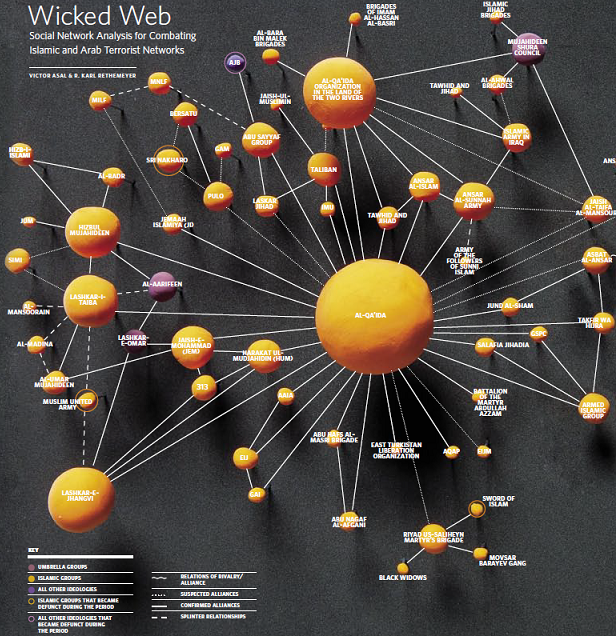
click image to download pdf & see pp 12-13 for closer, full-size look

Got it? That’s part of a double-page spread from the University of Maryland’s START Program report for 2011:

The National Consortium for the Study of Terrorism and Responses to Terrorism—better known as START – is a university-based research center committed to the scientific study of the causes and human consequences of terrorism in the United States and around the world.

Looking through the rest of the report, I’m tempted to say a snazzier, jazzier magazine I’ve seldom seen!

**

I maintain that’s far nicer to look at, but no more comprehensible than, this gorgeous and justly infamous power point slide:

click image for a closer, full size look

Got that one, too? That was a slide used to help GEN McChrystal understand that war he was fighting.

**

Watson and Crick introduced their 1953 paper in Nature, A Structure for Deoxyribose Nucleic Acid, with these words:

We wish to suggest a structure for the salt of deoxyribose nucleic acid (D.N.A.). This structure has novel features which are of considerable biological interest.

No less witty is the opening of George A. Miller‘s only somewhat less celebrated paper three years later in The Psychological Review, The Magical Number Seven, Plus or Minus Two: Some Limits on Our Capacity for Processing Information:

My problem is that I have been persecuted by an integer. For seven years this number has followed me around, has intruded in my most private data, and has assaulted me from the pages of our most public journals. This number assumes a variety of disguises, being sometimes a little larger and sometimes a little smaller than usual, but never changing so much as to be unrecognizable. The persistence with which this number plagues me is far more than a random accident. There is, to quote a famous senator, a design behind it, some pattern governing its appearances. Either there really is something unusual about the number or else I am suffering from delusions of persecution.

The gist of Miller’s piece (and by gist I explicitly mean the always misleading broad strokes version) is that we can usually manage to hold five to nine chunks of thought in mind at any given time, but that if we want to understand more than that, we need to “chunk” our thoughts in such a way that we think of “seven plus or minus two” items (Miller’s “magical number”) but can peer into any one of them and see it divided into lesser portions which we can also comprehend, in what I’ll call a tree > trunk > limb > branch > twig > leaf arrangement — always remembering that a tree may be part of a forest, and that sometimes ee just can’t see the forest for the trees…

Miller explains chunking succinctly thus:

It seems probable that even memorization can be studied in these terms. The process of memorizing may be simply the formation of chunks, or groups of items that go together, until there are few enough chunks so that we can recall all the items.

Neat, hunh? And he concludes, with another pleasant touch of wit:

And finally, what about the magical number seven? What about the seven wonders of the world, the seven seas, the seven deadly sins, the seven daughters of Atlas in the Pleiades, the seven ages of man, the seven levels of hell, the seven primary colors, the seven notes of the musical scale, and the seven days of the week? What about the seven-point rating scale, the seven categories for absolute judgment, the seven objects in the span of attention, and the seven digits in the span of immediate memory? For the present I propose to withhold judgment. Perhaps there is something deep and profound behind all these sevens, something just calling out for us to discover it. But I suspect that it is only a pernicious, Pythagorean coincidence.

**

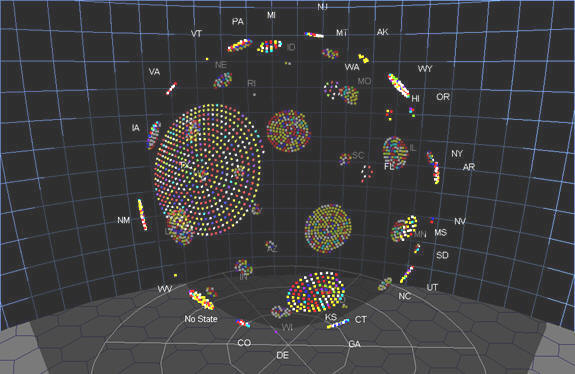
Of course there are high-node graphics programs like Starlight Analytics (from Future Point Systems via Battelle and the Pacific Northwest National Laboratory) which allow you to sample one of a cluster of very similar nodes, or to see where the outliers are and zero in on them…
or to focus in on only those nodes connected to one particular name or place on a map:
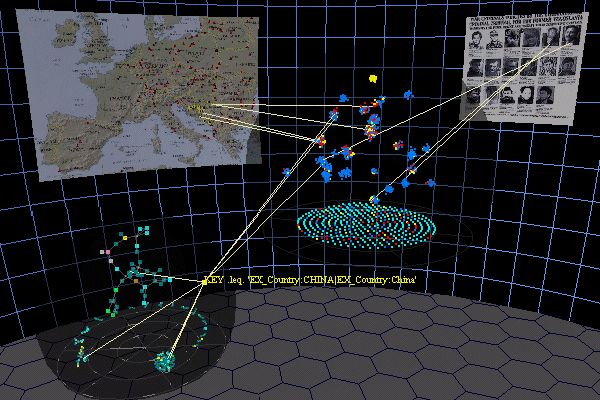
But can you find a file you’re looking for any faster by locating it somewhere in this graphic…
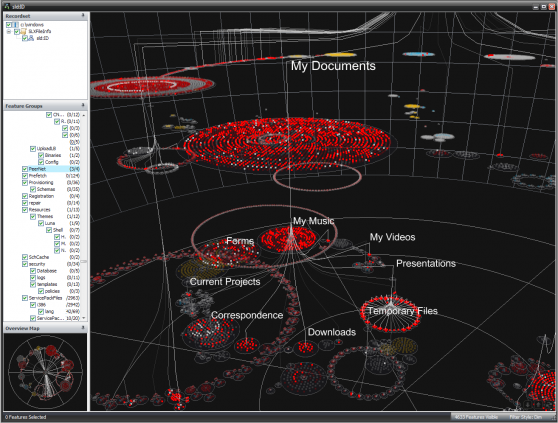
than by using your usual search methods?

So okay, high level analytics like Starlight may be useful for analysts who have the costly software and time to pinpoint and track and zoom and annotate and comprehend, become alarmed or calmed, and respond appropriately.

But people reading that glossy report from the START program? People trying to brief GEN McChrystal from a powerpoint slide?

Seven. Seven plus or minus is your number.

**

Once more, with feeling.

The moral of this tale is that graphical presentations of ideas to explain complexities should generally feature seven plus or minus two nodes, maximum, for eye and mind to consider at any one time, with perhaps an additional three or four that the eye can glide across to, forming a second chunk — thus delivering a maximum of 13 nodes without zooming in.

for the direct communication of major drivers in a complex situation — seven nodes plus or minus two is your optimal number.

**

Ah — but see, I forgot to show you the rest of that first image:

You can handle grasping the import of an image two parts, surely, can’t you?

Okay then — if you can, perhaps you can help me out…

Switch to our mobile site