zenpundit.com » warriors

Archive for the ‘warriors’ Category

D-DAY, June 6, 1944

Thursday, June 6th, 2013
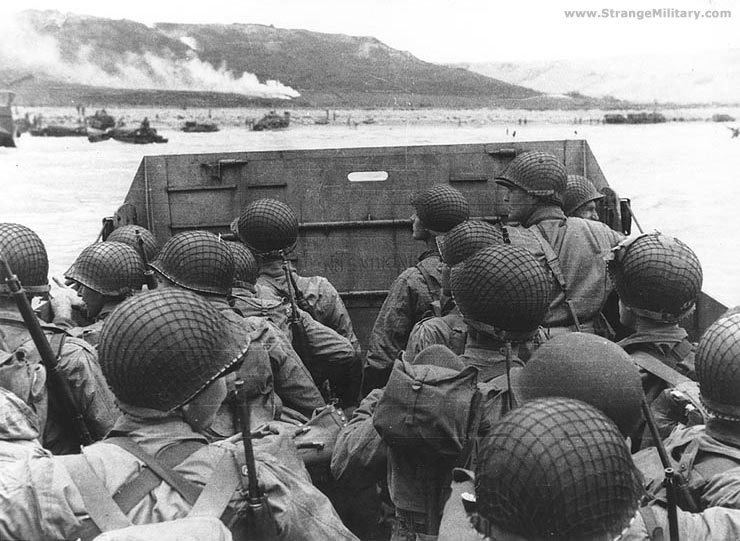
“Soldiers, Sailors and Airmen of the Allied Expeditionary Force! You are about to embark upon a great crusade, toward which we have striven these many months. The eyes of the world are upon you. The hopes and prayers of liberty loving people everywhere march with you. In company with our brave Allies and brothers in arms on other fronts, you will bring about the destruction of the German war machine, the elimination of Nazi tyranny over the oppressed peoples of Europe, and security for ourselves in a free world.

Your task will not be an easy one. Your enemy is well trained, well equipped and battle hardened, he will fight savagely.

But this is the year 1944! Much has happened since the Nazi triumphs of 1940-41. The United Nations have inflicted upon the Germans great defeats, in open battle, man to man. Our air offensive has seriously reduced their strength in the air and their capacity to wage war on the ground. Our home fronts have given us an overwhelming superiority in weapons and munitions of war, and placed at our disposal great reserves of trained fighting men. The tide has turned! The free men of the world are marching together to victory!

I have full confidence in your courage, devotion to duty and skill in battle. We will accept nothing less than full victory!

Good Luck! And let us all beseech the blessings of Almighty God upon this great and noble undertaking.

— Gen. Dwight D. Eisenhower “

Sixty-nine years ago over 9,000 American men, some hardly older than boys, laid down their lives on the beaches of Normandy in the greatest military operation in the history of the world. The white crosses stand row upon row in Colleville-sur-Mer,  in silent testimony of their supreme sacrifice.

Others who scrambled ashore on bloody Omaha Beach, or who climbed the rocky cliffs of Pointe du Hoc or who parachuted behind enemy lines with the 82nd and 101st Airborne lived to fight their away across France and across the Rhine into the heartland of Germany to break the power of the Third Reich forever. Others who survived the terrible ordeal of D-Day and fought on were not so lucky and did not come home.

The median age of WWII veterans now stands at 92. The “Greatest Generation” is receding into history in increasing numbers with each passing year but their deeds are destined to become legend.

….The men of Normandy had faith that what they were doing was right, faith that they fought for all humanity, faith that a just God would grant them mercy on this beachhead, or on the next. It was the deep knowledge – and pray God we have not lost it – that there is a profound moral difference between the use of force for liberation and the use of force for conquest. You were here to liberate, not to conquer, and so you and those others did not doubt your cause. And you were right not to doubt.

You all knew that some things are worth dying for. One’s country is worth dying for, and democracy is worth dying for, because it’s the most deeply honorable form of government ever devised by man. All of you loved liberty. All of you were willing to fight tyranny, and you knew the people of your countries were behind you.

The Americans who fought here that morning knew word of the invasion was spreading through the darkness back home. They fought – or felt in their hearts, though they couldn’t know in fact, that in Georgia they were filling the churches at 4:00 am. In Kansas they were kneeling on their porches and praying. And in Philadelphia they were ringing the Liberty Bell.

Something else helped the men of D-day; their rock-hard belief that Providence would have a great hand in the events that would unfold here; that God was an ally in this great cause. And so, the night before the invasion, when Colonel Wolverton asked his parachute troops to kneel with him in prayer, he told them: “Do not bow your heads, but look up so you can see God and ask His blessing in what we’re about to do.” Also, that night, General Matthew Ridgway on his cot, listening in the darkness for the promise God made to Joshua: “I will not fail thee nor forsake thee.”

…..Here, in this place where the West held together, let us make a vow to our dead. Let us show them by our actions that we understand what they died for. Let our actions say to them the words for which Matthew Ridgway listened: “I will not fail thee nor forsake thee.”

Strengthened by their courage and heartened by their value [valor] and borne by their memory, let us continue to stand for the ideals for which they lived and died.

Thank you very much, and God bless you all. ”

– Ronald Wilson Reagan, President of the United States, June 6, 1984

Two Readings, and If You Read It, Why Not Review It?

Thursday, May 23rd, 2013

[by J. Scott Shipman]

One Hundred Days, The Memoirs of the Falklands Battle Group Commander, Admiral Sandy Woodward

For professional reasons, many trusted colleagues have recommended One Hundred Days, and I finally finished it a few weeks ago. They reminded me the Falklands War “was the first modern anti-access/area-denial (A2/AD) war, pitting a joint expeditionary force against a regional power with modern land, air, and sea capabilities.” [sourced from Proceedings magazine, May 2012, by Commander Jim Griffin, U.S. Navy—strongly recommended] In other words, the scrap in the South Atlantic in 1982 was the last time a “modern” expeditionary force faced a credible adversary with modern capabilities. 

Admiral Woodward reminds that no one expected Argentina to invade the Falklands, and even if they did, no one expected the UK to respond with force (even the Royal Navy (RN) was surprised, and many had to find the islands on a map). Woodward departed with the two remaining UK carriers, the Hermes and Invincible which were already on the chopping block due to budget problems (sound familiar?). Fighting was such a distant memory for the RN, having not engaged in significant action since WWII, and Woodward recounts that many of his men had difficulty making the transition from “a sea-going job” to fighting, and possibly dying. I wondered as I read if the U.S. Navy has prepared/is prepared for this transition; and truly both officer and rates proved susceptible. The personal nature of Woodward’s account was bit of a surprise, but provides valued insight into the challenges and frequent frustrations faced by naval leaders.

Commander Griffin’s account in Proceedings referenced above has a very good list of lessons learned, and a few observations and questions are added for consideration:

  1. Naval warfare is war of attrition. Attrition can occur as a result of sinking or disabling an opponent. In the case of the Brits, many of their ships sustained non-fatal hits that, for practical purposes, removed the ship from any offensive or defensive action. Many of our enemies, while not sophisticated, understand and plan accordingly. As a result numbers are important; numbers of ships and weapons.
  2. In the age of the missile, response times were/are measured in seconds, so ships and aircraft will be lost…often, quickly.
  3. Are our systems susceptible to electro-magnetic interference (EMI)? 
  4. Could our ships navigate or fight without GPS or other satellite-dependent technologies?
  5. Can sailors onboard fix systems when they break (and they will break, see #6 below)? One RN ship had a contractor embarked who made the difference, which was blind luck. Over the last 20 years, the USN has tended towards “operators” over technicians.
  6. “Murphy” is alive and well. When things can fail (including technologies), they will, at the worst possible time.
  7. Is the theater commander in command? In the Falklands, Woodward had command of ships, but not submarines—which hampered the effectiveness of his battle group.
  8. Ship preservation (preventive maintenance) is often paid for in battle. At least two RN ships were unable to use weapons because of salt corrosion rendering missile hatches inoperable. This is engineering problem, too, to be sure, but also an example of how preventive maintenance can pay-off when it counts.
  9. Damage control training for all-hands; rigorous and often. RN sailors did a masterful job of saving several of their wounded ships.
  10. Anti-missile capabilities on logistic/support ships.
  11. Homefront politics and posturing provides fog in war as does the enemy. One curse of modern communications; having the White House Situation Room second-guessing/micromanaging the war.
  12. The press is often not your friend. On a couple of occasions, the BBC broadcast orders of battle and goals, and the Argentineans planned and acted accordingly.
  13. The motto of Captain John Coward, RN, of HMS Brilliant, “The essence of war is violence. Moderation in war is imbecility.”

Woodward’s book is the clearest account we have of naval warfare in the missile age. If it is not already, One Hundred Days should be required reading for every naval officer. Strongest recommendation.

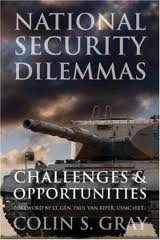
National Security Dilemmas, Challenges & Opportunities, Colin S. Gray

Colin Gray is no stranger to the readers of Zenpundit. I read this title over the Christmas break, and have returned to review with some frequency. In fact, my copy is so littered with underlining and marginalia, these periodic “reviews” can take a couple of hours. As the title suggests, Gray outlines the challenges and opportunities facing policymakers, and in so doing provides an accurate glimpse of our current state of political-military affairs. He encourages policymakers to reacquaint themselves with the importance of the concept of victory, and on how to successfully navigate a transition of our military from our previous focus of regular warfare to the realities introduced by enemies using irregular methods. Gray discusses “revolutions in military affairs (RMA)” and deterrence and the implications of both in our thinking and planning. Gray’s concluding section on preemption and preventative war is exceptionally well-presented.

For example, Gray’s section on Achieving Decisive Victory includes:

  1. Better armies tend to win.
  2. No magic formula for victory.
  3. Technology is not a panacea.
  4. The complexity of strategy and war is the mother of invention.
  5. Know your enemies.

This book is imminently quotable, so I’ll share a few with my highest recommendation.

The idea that strategy has an essence is deeply attractive. Strategy sounds incredibly rare and valuable, like something that could be bottled and sold. Unfortunately, American understanding of and sound practice in strategy is desperately rare. Strategic thinking and behavior are endangered activities in the United States. This is hardly a stunningly original insight. However, familiar though the criticism should be, it loses none of its bite for reason of longevity. Much as the U.S. defense community periodically is prodded by irregularist anxiety to worry about insurgency and terrorism, so from time to time it remembers the value of strategy. Though American defense professionals do not know what strategy is or how it works, they know that it is a matter of grave importance. The pattern has been one wherein a politician or a senior official with a personal interest has lit the fire of genuinely strategic discussion. The fire briefly flare brightly but then dies away for want of fuel. The fire is not fed, because there is not much demand for the heat and light of truly strategic argument in the United States. Although America is not quite a strategy-free environment, such a characterization would err in the right direction. (page 169 of paperback edition)

Since, inter alia, warfare is a competition in learning between imperfect military machines, fortunately one need only be good enough. (page 178; this is a personal favorite of mine)

There needs to be a continuous, albeit “unequal,” dialogue between civilian and soldier. War and warfare are permeated with political meaning, and consequences. A competent supreme command knows this and behaves accordingly. However, this relationship carries implications for civilian participation in military decisions in wartime that run contrary to the traditional American way in civil-military relations. If the strict instrumentality of force is not to be neglected, there has to be a constant dialogue between policymaker and soldier. Policy is a nonsense if the troops cannot perform “in the field,” while the troops may be so effective in action that policy is left gasping far behind unexpected opportunities by events. (page 179, emphasis added)

Gray’s National Security Dilemmas is a must read for policymakers and practitioners. [btw: it has been my custom to provide selected referenced works in book reviews. Gray’s bibliography is so excellent and comprehensive, I could not make a list that would do it justice.]

That said, I’ll close with more questions, and an apology: Does anyone read anymore? I’m rereading Manchester’s classic American Caesar after an absence of 30+ years, and I’d forgotten how much time both MacArthur the Elder and MacArthur the Younger (Douglas) spent reading. That said, how often do we see military leaders review the books they recommend? A reading list is one thing, explaining why the book made the cut another. With blogs, the internet, and social media, there are no barriers to entry. Recommendation to senior officers, including the General Officers and Flag Officers who post required reading lists: let your folks know why, write it down, explain it—the exercise will do you good, and give your subordinates insights into your thinking.

Now for the apology: there are four of us here at Zenpundit, but I’ve been the anchor man. This is my first post in too long, and I apologize to my colleagues and you, the reader. I’ve been on a tear reading naval stuff, mostly associated with my business endeavors. That said, I’ll endeavor to eat my own cooking and review what I read/have read with greater frequency.

Elkus on Mad Dogs and Military History

Friday, May 10th, 2013

Adam Elkus has a lengthy and meaty post at Abu Muqawama, inspired by General Mattis, one that you should really read in full:

The Mattis Book Club

….But while gaining an understanding of the nature of war is useful, there are a lot of things it won’t do. This becomes most apparent in the section of the email where Mattis makes specific claims. Mattis repeatedly states that nothing is new under the sun, makes comparisons across big temporal zones (Alexander the Great in Persian Iraq vs. 2004 iraq), and advances specific analytical arguments about military theories. He does so on the basis of a sweeping generalization that 5,000 years of warfare tells us in aggregate that war has not changed. While this makes for a rousing line, it is also a fairly problematic statement. How do we really know that the nature of war has not changed in 5,000 years?

We should recognize that this is an isolated quote, and strive to not take out of context what was a heartfelt letter to a colleague in need of guidance. But the argument itself—as the cumulative product of a process of self-education in the nature of warfare, does merit some critical analysis. It is part of a humanistic conception of war that stresses the unity of military experience across the ages, and puts the fighting man’s will first. What Mattis dashed off in an email has been repeated by others in journal articles, blog posts, essays, and books. The military historian Brian McAllister Linn, in his seminal study of the Army’s cultures, dubbed it the “heroic” style of war. Linn constrasts this humanistic style this with technocratic Managers, defensive Guardians, and other military tribes with differing values and approaches.

So what do we know about 5,000 years of constant violence?

Often times the answer is that it depends. As my Fuller and Liddell-Hart examples illustrate, the quality of historical accounts is extremely uneven. Military history as a modern discipline only started with Hans Delbruck, a civilian who did some basic math and discovered that many of the most prominent chroniclers of pre-modern warfare were flat-out wrong about ancient history’s greatest battles and campaigns. Anthropologists still argue today about the nature of violence in the evolutionary state of nature and whether it can be mapped to violence in settled states. Second, it may be true that war is war in the Clausewitzian sense. But while it is technically true that Alexander’s Iraqi opponents and Sadrist mobs are both humans seeking to use force to impose their will, this in and of itself is not very useful. There are fairly prominent shifts in the character of politics, the international system, techology, wealth, and society that matter too.  

What constitutes politics is a very important point.

Take for example, the Romans. There was a definite shift between the Early-Middle Republican eras and the Late Republic in elite politics and the socioeconomic conditions upon which Roman assumptions about war and the organization and supply of Legions rested.  Growing inequality of wealth was making it harder for Plebian citizens to afford to muster for a campaign, the need for longserving “professional” Legates to maintain “institutional memory” of the “arts of war” of the Legions expanded even as the highly coveted opportunities for Patricians to command decreased. These trends clashed with what the Romans liked to  believe about themselves and the friction between advocates of reforms (often necessary and practical) and the upholders of  centuries of honored tradition made Roman politics increasingly bitter, dysfunctional and subsequently lethal. The early Romans would have been horrified by Marius and Sulla, to say nothing of Antony and Octavian.

In the end, the politics of the Romans, along with their battlefield experiences, changed how they organized and manned their Legions, why and how they fought the wars as they did and continued to shape Roman warfare as long as the empire lasted. Julius Caesar would have been as startled by Late Antiquity’s semi-barbarian “Roman” Magister Militiums as his own career would have dismayed Decius Mus.

Adam goes on to have some useful things to say about the need for combining historical and quantitative  social science  methodologies and the limitations of each. Delbruck’s overstated skepticism of the ancients aside, sometimes we moderns do not count any better in war or politics – or at times,  even worse

Octavian Manea interviews MIT’s Roger D. Peterson

Friday, April 19th, 2013

Another installment of Octavian Manea’s excellent COIN interview series at SWJ. This one focuses on social science and varieties of insurgency:

Breaking Down “Hearts and Minds”: The Power of Individual Causal Mechanisms in an Insurgency 

….OM: In your research you pointed out to a spectrum of conceivable individual roles in an insurgency. What is the methodology behind this typology?

RDP: This methodology comes from my 2001 book (Resistance and Rebellion: Lessons from Eastern Europe) which focused on Lithuanian resistance to Soviets in the 1940’s. Insurgency is a complex phenomenon, especially in how violent organization and networks are created and sustained, and the methodology of that book involved breaking down this complexity into component parts and then building back up into a coherent whole. At the base of this process is the way individuals position themselves relative to the dramatic and violent events of insurgency. Most people may wish to remain neutral and just take care of their families but events push significant numbers of individuals into roles of unarmed support of insurgents, or local armed position of a militia, membership in a mobile non-local organization, or equivalent positions in support of the government.  Furthermore, individuals may move back and forth along this spectrum of roles. If one is skeptical of broad and vague theories at a high level of aggregation, as I am, then you need to get down and observe dynamics at a basic level. Observing movement along this spectrum of roles is one way to do that. 

…..Is it FM 3-24 and the whole contemporary Western COIN discourse too narrow, too much focused on rational, cost/benefit models of decision-making? Is it too restrictive when making this inventory of driving motivations or causal mechanisms?

RDP: I think there is a tendency in the Western academic analysis to focus on rational theories. Those theories are straightforward.  But they also might be too straightforward, too simple.  In Iraq, the coalition did not plan on the emotion of resentment stemming from a status reversal affecting Sunni calculations in the beginning stages of the conflict. We did not understand the revenge norms that exist in some of the places. We did not fully understand the social norms that helped to produce the tribal militias in Anbar province.  We did not understand the psychological mechanisms underlying the Sunni view of the new world they were living in. 

The last part is a curious lacuna.

The incompetence of the planning for the occupation of Iraq has been amply recorded – the high level disdain of General Tommy Franks and Secretary Rumsfeld for what befell the day after victory, the keeping of professional Arabists at arms length in preference for Beltway contractors and college kids with AEI connections, the haplessness of Jay Garner and the political obtuseness of Paul Bremer ad so on. This is not what I mean about lacuna.

I mean something more fundamental, in terms of understanding human nature as the root of political behavior and therefore political violence. We are all familiar with the Clausewitzian trinity (or should be) but less attention is paid to the motivational factors that make men decide to stand, fight and die or stand aside. Thucydides also had a trinity that did not attempt to capture the nature of war but rather explain why wars happened and it seems to me to be of particular use for evaluating the decision in small wars to pick up a gun or not, to side with the government or join the rebellion:

“Surely, Lacedaemonians, neither by the patriotism that we displayed at that crisis, nor by the wisdom of our counsels, do we merit our extreme unpopularity with the Hellenes, not at least unpopularity for our empire. That empire we acquired by no violent means, but because you were unwilling to prosecute to its conclusion the war against the barbarian, and because the allies attached themselves to us and spontaneously asked us to assume the command. And the nature of the case first compelled us to advance our empire to its present height; fear being our principal motive, though honour and interest afterwards came in. And at last, when almost all hated us, when some had already revolted and had been subdued, when you had ceased to be the friends that you once were, and had become objects of suspicion and dislike, it appeared no longer safe to give up our empire; especially as all who left us would fall to you. And no one can quarrel with a people for making, in matters of tremendous risk, the best provision that it can for its interest. 

Fear, honor and interest are ever present in “calculation” both by men and by the political communities they compose and the factions that threaten to tear them apart. All the more so in a defeated and broken country divided by ethnicity and sect where all parties were uneasily eyeing the conqueror. No special knowledge of Arab culture should have been required to anticipate that Iraqi men, if made desperate by uncertainty and circumstance, might have at least seen it in their interest to achieve some measure of security with the gun and to enact policies of carrots and sticks a priori to discourage that, before the insurgency gained critical mass.

Awareness of the universality of the Thucydidean trinity would not have in itself guaranteed success in Iraq but knowing it is a rudimentary minimum of political competence upon which you can at least build.

“Sin, Death, and Hell have set their Marks on Him”

Tuesday, February 5th, 2013

King Richard III 

The bones of Richard III, Shakespeare’s greatest villain and the last King of England to be killed in battle have been discovered and identified by DNA testing:

….There were cheers when Richard Buckley, lead archaeologist on the hunt for the king’s body, finally announced that the university team was convinced “beyond reasonable doubt” that it had found the last Plantagenet king, bent by scoliosis of the spine, and twisted further to fit into a hastily dug hole in Grey Friars church, which was slightly too small to hold his body.

But by then it was clear the evidence was overwhelming, as the scientists who carried out the DNA tests, those who created the computer-imaging technology to peer on to and into the bones in raking detail, the genealogists who found a distant descendant with matching DNA, and the academics who scoured contemporary texts for accounts of the king’s death and burial, outlined their findings.

….Richard died at Bosworth on 22 August 1485, the last English king to fall in battle, and the researchers revealed how for the first time. There was an audible intake of breath as a slide came up showing the base of his skull sliced off by one terrible blow, believed to be from a halberd, a fearsome medieval battle weapon with a razor-sharp iron axe blade weighing about two kilos, mounted on a wooden pole, which was swung at Richard at very close range. The blade probably penetrated several centimetres into his brain and, said the human bones expert Jo Appleby, he would have been unconscious at once and dead almost as soon.

The skull of Richard III

Injuries to the skeleton appear to confirm contemporary accounts that the king died in battle. Photograph: AFP/Getty Images

The injury appears to confirm contemporary accounts that he died in close combat in the thick of the battle and unhorsed – as in the great despairing cry Shakespeare gives him: “A horse! A horse! My kingdom for a horse!” 

Richard III, usurper and probable regicide of his nephew the boy King, was the last truly medieval King of England. Had Richard lived to rule, his reign would have been characterized by the same bloody uprisings and civil strife that marked the War of the Roses. England was fortunate in his successor who had bested him in battle, Henry Tudor who became King Henry VII was an energetic and far seeing monarch who restored a war-wracked and bankrupt England to peace and fiscal health and set the foundations of the modern United Kingdom and the future world-spanning British Empire. It was Henry who started the Royal Navy and curtailed the ability of the nobility to wage war as they pleased with large private armies, by taxing them for each man at arms, thus ending bastard feudalism ; recalcitrant rebels were executed and justices of the peace established in every shire to enforce the law of the realm rather than the corrupt whims of manorial courts.

Richard III has his devoted fans as well his detractors. Except for his impatient ruthlessness, Richard probably was little worse, morally speaking, than his fellow medieval monarchs in an age when brutality and the rule of the strong was the norm.  However, unlike the brilliant Henry, Richard would have done little to improve the situation and might have made life in England more savagely violent.


Switch to our mobile site