zenpundit.com » warriors

Archive for the ‘warriors’ Category

Summer Series 2010: Killing Rommel by Steven Pressfield

Sunday, October 3rd, 2010

Summer Series 2010: Reviewing the Books! continues……

Killing Rommel: A Novel by Steven Pressfield

As a rule, because of my academic  background and predisposition toward policy analysis,  I have a difficult time picking up a novel. Not because I dislike novels, but because with so many histories and “serious” policy books in my antilibrary demanding to be read, I feel guilty indulging myself in reading fiction.  Realizing that is mildly insane, I decided to shoot for a better balance in my reading this year between fiction and non-fiction and must report….that I have failed miserably. I’ve only read five novels so far in 10 months but one of the five that I read was Killing Rommel and I’m glad that I did!

I “met” the novelist Steven Pressfield online through the first iteration of his website, then a focus on the tribal aspects of the war in Afghanistan. We had some intriguing exchanges and I picked up his The War of Art, one of Steve’s few non-fiction works about becoming a professional writer ( or any creative professional) and defeating the internal psychological resistance that thwarts success and acheivement. I loved that book and read it straight through in one sitting, and later interviewed him about it. Knowing my interest in history and military affairs, Steve sent me a copy of his Killing Rommel and it sat in my antilibrary until this summer, where I read it during long stretches at poolside.

I found Killing Rommel to be a page turner.

Via a literary device, Killing Rommel is the story of  “Chap” – Major Richard Lawrence Chapman, DSO, MC. – and his mission as a member of “The Desert Rats”, The Long Range Desert Group of the British Army to find and kill the legendary commander of Afrika Korps, Field Marshal Erwin Johannes Eugen Rommel, “The Desert Fox”. In pursuit of his mission, “Chap” encounters an array of reverses, hazards and adventures in a manner of an ordinary, thoroughly decent, man rising above himself to master circumstances both physically heroic and morally agonizing, leaving the field with honor and humanity intact but free neither of doubt nor memory.

What makes “Chap” remarkable and identifiable as a character in his British ordinariness of an officer doing his duty to King and country, is the uncanny and unerring way Pressfield has reconstructed a British outlook specific to Chap’s time and class – that of the “respectable” upper middle class or younger sons of younger sons of gentry, for whom education and life was bounded by the traditions of the public school and military regiments to which family history was attached. It is a quality of “placedness” and sense of self that most Americans (other than scions of Andover and similar prep schools) cannot easily relate. Where you went was part of who you were and your whole outlook on life. Once established, Chap’s history consistently informs his actions and reactions as the plot progresses; Chap, in other words, “lived” an authentic life in Killing Rommel.

A second feature of Killing Rommel is Pressfield’s fidelity to historical realism. This is expressed both in his attention to details of military history and geographic setting and his willingness to grip war – even an unimpeachably “good” war as WWII – in all it’s moral ambiguity and unmediated violence on the human scale. It is disturbing to the reader that Rommel, the great enemy and objective of the mission, is an admirable man fighting for an evil cause; it is disturbing that dying Germans are not unrepentant Nazi beasts but are found to be men with families and lives, conscripts and volunteers, not unlike Chap and his comrades, who must persevere and fight for their lives but acknowledge these shades of gray.

Highly recommended.

Summer Series 2010: Koran, Kalashnikov and Laptop by Giustozzi

Wednesday, September 15th, 2010

Summer Series 2010: Reviewing the Books! has begun. This review was originally posted in July, 2010 and is being re-posted as part of Summer Series:

Koran, Kalashnikov and Laptop by Antonio Giustozzi

I just finished reading Koran, Kalashnikov and Laptop: The Neo-Taliban insurgency in Afghanistan by historian Antonio Giustozzi who has subsequently gone on to write in rapid succession, Decoding the New Taliban: Insights from the Afghan Field and Empires of Mud, which I intend to read as well. Giustozzi is doing something important with his study of the Neo-Taliban insurgency that twenty years ago, a professional historian would have eschewed: applying his his historical expertise and methodology in a disciplinary synthesis to understand a dynamic, emerging, phenomenon at the center of current policy.

At the outset, Giustozzi writes:

This book is written by a historian who is trying to understand contemporary developments making use of not just the historical method, but also drawing from other disciplines such as anthropology, political science and geography. As a result, this book combines an analysis of the development of the insurgency based on available information with my ongoing work, focused on identifying the root causes of the weakness of the Afghan state.
This is a useful investigative methodological approach. “Useful” in the sense that while adhering to scholarly standards, Giustozzi offers readers the benefit of his capacity as a professional historian to evaluate new information about the war with the Neo-Taliban, while orienting it in the appropriate cultural-historical context. Not all of the information dealt with is reliable; Giustozzi candidly explains the disputes around particular unverified claims or accusations before offering his educated guess where the truth may be or the probabilities involved in a fog of war and ethno-tribal animosities.

Koran, Kalashnikov and Laptop is an academic book with a fairly detached tone and heavily endnoted chapters, which Giustozzi divided in the following manner:

1. Sources of the insurgency

2. How and why the Taliban recruited

3. Organization of the Taliban

4. The Taliban’s strategy

5. Military tactics of the insurgency

6. The counter-insurgency effort

The chapters have a wealth of detail, bordering at times on minutia, on Afghanistan’s complex and personalized system of politics which help shed light on why the effort at providing effective governance, a key COIN tenet, is so difficult. One example:

“….Strengthened as it was by powerful connections in Kabul, Sher Mohammed’s ‘power bloc’ proved quite resilient. Some of the Kabul press reported ‘criticism’, by former and current government officials from Helmand, of Daoud, whose attempts to restrain and isolate the rogue militias and police forces of helmand were described in terms of collaborationism with the Taliban. Daoud reacted by accusing the local ‘drug mafia’ of plotting against him and tried to convince President Karzai to leave him in his post, but not even British Prime Minister Tony Blair’s efforts sufficed to save him. Karzai sacked Daoud in the autumn of 2006. His replacement, Asadullah Wafa, was widely seen as a weak figure who for several months even refused to deploy to Lashkargah.”

This example is a typical one for political life in the provinces. Karzai’s counterinsurgency strategy does not have much to do with ours, and is largely antithetical to it. What we call “corruption”, Karzai sees as buying loyalty; what we call good governance, Karzai views as destabilizing his regime. We are not on the same page with Hamid Karzai and perhaps not even in the same playbook.

Giustozzi is exceptionally well-informed about Afghanistan and the political and military nuances of the old Taliban and the Neo-Taliban insurgency and the structure of Koran, Kalashnikov and Laptop is clear and well-organized. Giustozzi is informed about COIN in this context but less so generally (in a minor glitch, he posits Mao as primarily waging guerrilla war against an Imperial Japan – Mao didn’t – which did not have much of a “technological edge” – which Japan certainly did over Chinese forces, Nationalist or Communist, for most of the war) but Giustozzi is not writing to add to COIN theory literature, as he specifically noted. What the reader will get from Giustozzi is a grasp of who the Neo-Taliban are as a fighting force and the convoluted, granular, social complexity of Afghan political life in which the US is attempting to wage a COIN war.

Koran, Kalashnikov and Laptop is strongly recommended.

Guest Post: Sean Meade Reviews The Illiad

Saturday, September 11th, 2010

The Illiad by Homer

Sean Meade, in addition to being my good friend, is the Web Editor for Aviation Week’s defense and space content and is the former longtime webmaster/editorial assistant/right-hand of Dr. Thomas P.M. Barnett. Sean blogs at ARES for Aviation Week and at his personal blog, Interact:

ON THE ILLIAD

by Sean Meade

What makes ‘The Iliad’ a classic? Why is it classic?

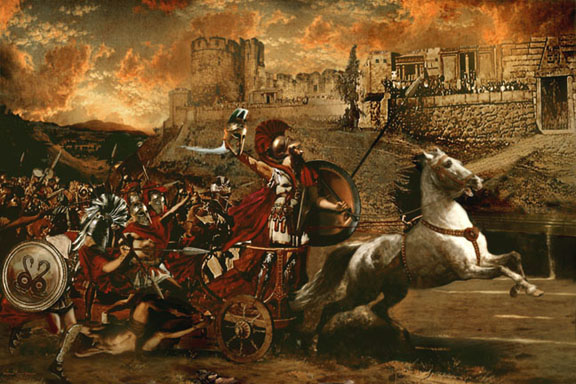
I think the primary answer is simple: it’s the characters. If you can hang tough through all of the idiosyncratic flourishes and ornaments and repetitions, the characters are compelling: Achilleus, his anger and character; the comparative nobility of Hektor and Patroklos (both of whom we know are doomed); the vagaries of the gods and their adolescent machinations; the supporting cast of Agamemnon, Menelaos the wronged, two very different men named Aias (Ajax), Diomedes, Aeneas, Odysseus, Nestor, Paris, Helen and Priam. Take these characters and others and mix them with an interesting story and you have a classic that reaches out to us from about the eighth century BC (when it was likely ‘composed’ (with heavy use of previous, oral sources) by Homer), maybe from as far back as the 12th century BC (maybe the original setting of what has come down to us as The Trojan War). ‘The Iliad’ still resonates with us today.

One reason ‘The Iliad’ can still move us is that Homer has done a masterful job of relating the ‘accidents’ of life. ‘Time and chance happen to all men’, and people who lived 3000 year ago couldn’t deceive themselves about their ability to control life the way we ‘modern’ people do. Human experience and emotions are often inscrutable. ‘Love’ (baldly called ‘lust’ by Homer) can easily destroy. When it occurs in the most influential levels of society, it can draw whole nations into its whirling vortex. Even the love between men in ‘The Iliad’ can seem illogical (no matter where you come down on the homosexuality question): why does noble Patroklos honor Achilleus literally to the death?

‘The Iliad’, of course, focuses a lot on war in ways that have become shockingly remote for most of us. Nothing is so susceptible to ‘luck’ as war. One ‘good’ soldier gets hit by stray friendly fire and dies instantly. Another ‘bad’ soldier comes through the whole war unscathed. Consider the hazards of love, life and war in ‘The Iliad’. Consider them in our own experience. It makes more sense than many theories to conclude that arbitrary and capricious gods can powerfully affect us.

My final guess (for the purposes of this mini-review) at why ‘The Iliad’ is a classic is that the poetry is timeless. This is, of course, nearly impossible to take in from one read-through in translation. My friend, Jason, listened to the abridged version and talked about its power. The commentators discuss it quite a bit, from what I can tell. Most of us (who aren’t going to pay the price to really test it) are going to have to take this on faith and rate it as we will. Poetry is a dying art, and poetry appreciation is probably in an even worse state.

I wonder what role foreknowledge plays in ‘The Iliad’. Many of us know the broad outline of the story going in. If we don’t, Homer spills it in short order. Does knowing Achilleus dies shortly after this episode in The Trojan War change our view of him? Do we cut him more slack? How does  knowing that Hektor and Patroklos die within the bounds of this story affect us? Or that Odysseus lives? Or that Agamemnon will be murdered in his bath by his wife (he had it coming ;-)?

Something else that stands out about ‘The Iliad’ is the graphic war imagery. Homer’s descriptions almost seem gratuitous when he goes into detail about how one soldier killed another, where the spear penetrated and where it came out, what muscles were severed, what happened to the bowels, teeth or brain. It’s probably distasteful to many of us in the 21st century, but I think we can just chalk that up to cultural differences.

My second big question is: what does ‘The Iliad’ mean? I’m very snobbish about exegesis, especially concerning the Bible (my training, as a former pastor), but including any suitably worthy literature (with concomitant training in British Lit and Analytic Philosophy). Exegesis, in principle, is simple: what was the author trying to communicate to the audience? (So why is good exegesis so hard to find? 😉 If we are to make any meaningful connection to the original work, this is where we have to begin. You can deploy your Reader Response Theory on ‘Twilight’ or some such drivel, but keep it off my Homer (I told you I’m a snob ;-).

We come to ‘The Iliad’ at a loss because Homer’s values are very different from ours. His presuppositions are vastly different from ours. I have touched on some of these already. The gods can show up at any time and throw any wrench in the works for almost any imaginable reason. We have to take the role of the gods seriously to take Homer seriously. What did their role say about the responsibility of people? Humans retain some responsibility, almost paradoxically. Helen isn’t completely off the hook for running away with Paris. Achilleus does not get a complete pass for his anger that causes the deaths of so many Achaean comrades. Agamemnon is not excused for his overbearing pride that contributed to the disagreement with Achilleus. And even noble Hektor faces bouts of inaction and cowardice for which he is not wholly exonerated.

Another value we find hard to understand is the ancient Greek concept of nobility. It’s just born there. If you’re a shepherd who’s not the natural-born son of King Priam and Queen Hekabe, that’s all you’ll ever be: a shepherd. The main characters are noble; many are first-generation half-deities and most (all?) have divinity in their bloodline somewhere. From our standpoint, Achilleus behaves like a monster, especially in his repeated attempted-desecration of Hektor’s body (the gods protect Hektor’s body and Achilleus’ ultimate honor by preserving Hektor’s corpse inviolate in almost the perfect proverbial deus ex machina). He’s sacrificed any claim to nobility as far as we’re concerned. Not so for Homer and the ancient Greeks; Achilleus retains his nobility, though it is clouded by sins. He receives partial pardons and rationalizations. From our perspective, we view him as maybe the original anti-hero. Homer’s view is much less ambivalent, and Achilleus gets away with things for which lesser men would go straight to Tartaros without passing ‘Go’. It’s a far cry from our 21st century Western concept of nobility and our love of ‘rags to riches’ fables. It’s only riches to riches here (though maybe no one knew through the rags that you were really rich).

So what is Homer’s message? The conclusion of my barely-better-than-cursory reading is: Given that nobility and greatness are natural, almost literally gifts of fate (the Fates); and that humans are subject to the whims of the gods; it is best to be brave and seek glory (within reason–with a glance forward to Aristotle’s middle-way ethic). How’s that going to help you with your job or family? Not much. It’s fodder for thinking about societal values and a long way from whether or not to stick it out in your mediocre, going-nowhere job. (It might possibly apply to whether or not you should run away with your neighbor’s spouse.)

For most of us, ‘The Iliad’ is probably a test in proper exegesis more than someplace we should or will go to look for meaning. But maybe that’s just my soap box 😉

Summer Series 2010: WAR by Sebastian Junger

Wednesday, September 8th, 2010

Summer Series 2010: Reviewing the Books! has begun. This review was originally posted in June, 2010 and is being re-posted as part of Summer Series:

WAR by Sebastian Junger

I just finished reading my courtesy review copy of WAR by journalist and author Sebastian Junger, on his firsthand observation of the war against the Taliban in the Korengal Valley, waged by the soldiers of the 2nd Platoon of Battle Company. I cannot say that I found WAR to be an enjoyable read – though Junger is a polished writer – a more accurate description is that WAR is powerful, thought-provoking, at times moving and, ultimately, a very disturbing account of the war in Afghanistan.

Junger, whose previous works include The Perfect Storm: A True Story of Men Against the Sea and Fire, was embedded along with photojournalist Tim Hetherington, with 2nd Platoon during their COIN campaign in Korengal, a mission that resulted in some of the bloodiest firefights and highest American casualties of the Afghan war and withdrawal from a rugged valley sometimes known as “Afghanistan’s Afghanistan”. The Korengalis, related to the people of Nuristan, are noted for their xenophobic hostility to outsiders, which was directed at times toward the Taliban as well as Americans. Junger reports that the US only succeeded in controling a quarter of Korengal and contesting roughly half of the six mile by six mile valley with the Taliban and local “accidental guerrillas”motivated by money, excitement, religious zeal or revenge to attack the Americans.
WAR is not an especially “political” or “policy” book discussing the war from some remove. Junger’s primary interest are the men of second platoon at Restrepo, an outpost dedicated to the memory of a valorous medic who had been killed. O’Byrne, Anderson, Stitcher (who has “INFIDEL” tattooed across his chest), Jones, Moreno, Bobby to name just a few soldiers Junger interviewed and witnessed how they lived in the moment. That moment could comprise the adrenaline high of combat, agonies of grief, anticipatory tension before the next ambush, the angst of boredome behind the wire and especially the iron bonds of brotherhood in a small unit tempered by fire.

What comes through in War, aside from the extremity of the terrain and the uncertainty of ever-present danger, men being shot without warning by the enemy, even in Restrepo, is how very few men are actually involved in combat. Battle Company is the vaunted “tip of the spear” but when only a few hundred men were taking a wildly disproportionate percentage of all combat contacts in a nation the size of Afghanistan ( Junger cites 20 %) the spear begins to look more like a tiny sewing needle connected to a Leviathan-like noncombatant-administrative tail, surreally outfitted with fast food courts.

There’s a peculairly granular quality to Junger’s WAR, the grittiness of the squalid conditions in which soldiers live, the depths of their physical sufferings and mental exhaustion, their primal fear of letting their comrades down in battle and being responsible for getting friends killed. There are also epiphanies of bravery and carrying the day against the odds, men living who but for chance would have died on some rock strewn hill and lusty celebration after the deaths of their enemies. The sort of politically incorrect, atavistic, jubilation that is culturally frowned upon by people who are comfortably safe and far away.

What disturbed me most about WAR was not just how few Americans are carrying the burden of the combat in Afghanistan but how disconnected these few soldiers and their sacrifices are from the rest of the military itself. Junger’s epilogue with O’Byrne, a fine soldier who is a major figure in the book, and his inability to readjust and shift from the battlefield to garrison or civilian life is deeply depressing. “The Army’s trying to kill me” O’Byrne declared, finding a momentary refuge in alcohol, but little help from the military bureaucracy.

Junger attempted to show the war in Korengal as seen from the perspective of the privates, NCO’s and junior officers of Battle Company who lived and died there, from his interviews and his own participation in their patrols as they came under fire or as they gingerly parleyed with Korengali elders in isolated villages. Eschewing theory or a historian’s search for causation, Junger attempts to let the soldiers words and actions drive the narrative.

Sebastian Junger’s WAR is raw and undecorated by sentiment.

Some New Additions…..

Tuesday, August 3rd, 2010

To the ominously increasing antilibrary and the waning summer reading bookpiles:


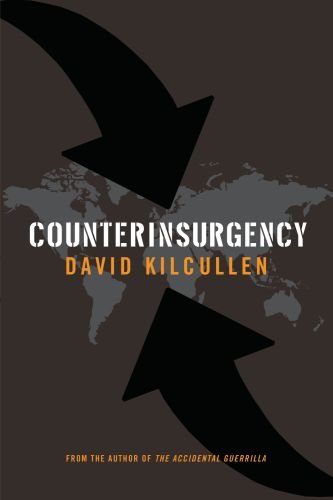
Counterinsurgency by David Kilcullen

The Grand Strategy of the Byzantine Empire by Edward Luttwak

Spook Country by William Gibson

Hope to start  a couple of these by the end of the month. A number of other books to be finished first.

I have a new decentralized reading strategy that seems to be helping me wad through books faster. Books that I am reading are distributed to be read in different places – one in my gym bag for the treadmill; one in my car in case there’s time to kill at an appointment or at a restaurant; one or two books downstairs to read on the couch or outside on the deck; one to take to the pool with the kids and four of five on my bedstand. There are also a store of books on my iPad, “just in case”.

The strategy allows me to concentrate on finishing several books – my “primary” reads – even as I steadily chip away at the rest and there are enough choices available to suit my mood on any given day so it doesn’t feel like I am doing a literary marathon. Books that I am focusing on, usually histories, strategic studies and social science works, I will mark up with marginalia and the others are just read without recourse to notation.

How do you handle your reading time?


Switch to our mobile site

