zenpundit.com » philosophy

Archive for the ‘philosophy’ Category

On bananas, cucumbers, tomatos and piano legs: an aside

Saturday, December 10th, 2011

[ by Charles Cameron, h/t Mike Few — bananas, cucumbers, tomatos and piano legs as sexual objects, reading the world as a book, Iraq recently, Shakespeare a while back, Robert Hooke ]
.

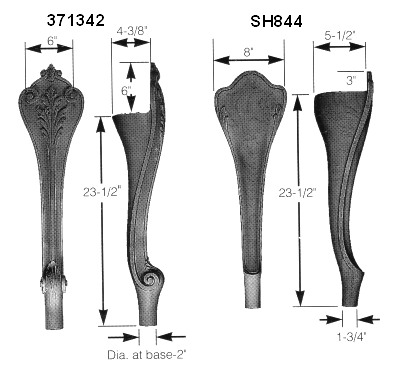
Louis XV grand piano legs, hard maple. Image credit: http://www.balaams-ass.com/grandlegs.htm

MikeF in a comment on my post, Let me put my banana in your fruitbasket, pointed us to his Small Wars Journal article The Break Point: AQIZ Establishes the ISI in Zaganiayh, in which he reports that the Mujahedeen Shura Council in Iraq passed out propaganda pamphlets providing “instruction on the proper actions of good Muslims” in preparation for the establishment of an Islamic State of Iraq. One example of “proper actions” given was as follows:

One cannot eat tomatoes and cucumbers together because one is male and the other is female. This action is immoral. Failure to comply will result in death.

Think long and hard on that one!

*

By way of light relief:

Frederick Marryat‘s 1839 book A Diary in America, in which he describes (as his title stipulates) American, not British, customs, seems to be the source of the idea that the (British, the urban legend having undergone a transatlantic metamorphosis here) Victorians covered the Legs (think: ankles, see diagram above) of their pianos for modesty’s sake.

Marryat, a credulous fellow as Matthew Sweet describes him in his Inventing the Victorians (p. xiii.), may well have been being teased when told this tale by his American friends. In any case, he reported that in an American girl’s school he visited, the head mistress “to preserve in their utmost purity the ideas of the young ladies under her charge” had “dressed all four limbs” of the school piano “in modest little trousers, with frills at the bottom of them!”

“Was this practice ever pursued, even in America?” Sweet asks sweetly, and answers himself: “Probably not.” And further, “whatever the case, the synecdochic relationship that now exists between Victorian sensibilities and the clothed piano leg is wholly fraudulent.”

Sweet is marvelous on this whole business, going on about it for pages. Most useful for my own purposes is his quotation from Richard Sennett‘s (1986) The Fall of Public Man, which argues:

that cultural change, leading to the covering of the piano legs, has its roots in the very notion that all phenomena speak, that human meanings are immanent in all phenomena.

*

And a tad more seriously…

Interestingly enough, that very notion is indeed to be found in Islam, where the Qur’an asserts that nature is to be read like a scripture. In the words of Seyyed Hossein Nasr:

The Quran refers constantly to the world of nature as well as to the human order. The sky and the mountains, the trees and animals in a sense participate in the Islamic revelation, through which the sacred quality of the cosmos and the natural order is reaffirmed. The sacred scripture of Islam refers to the phenomena of nature as ayat (“signs” or “portents”), the same term used for its verses and the signs that appear within the soul of human beings according to the famous verse: “We shall show our portents (ayat) upon the horizons and within themselves, until it be manifest unto them that it is the Truth” (41:53). Natural phenomena are not only phenomena in the current understanding of the term. They are signs that reveal a meaning beyond themselves. Nature is a book whose ayat are to be read like the ayat of the Quran; in fact, they can only be read thanks to the latter, for only revelation can unveil for fallen man the inner meaning of the cosmic text. Certain Muslim thinkers have referred to the cosmos as the “Quran of creation” or the “cosmic Quran” (al-Qur’an al-takwini), whereas the Quran that is read every day by Muslims is called the “recorded Quran” (al-Qur’an al-tadwini). The cosmos is the primordial revelation whose message is still written on the face of every mountain and tree leaf and is reflected through the light that shines from the sun, the moon, and the stars. But as far as Muslims are concerned, this message can only be read by virtue of the message revealed by “the recorded Quran.”

*

This view is not solely an Islamic one: Duke Senior, exiled to the Forest of Arden in Shakespeare‘s As You Like It (Act II Scene 1) declares:

And this our life: exempt from public haunt,
Finds tongues in trees, books in running brooks,
Sermons in stones, and good in everything.

And if Shakespeare be considered too worldly a source, here is Hugh of St. Victor (twelfth century):

For this whole visible world is a book written by the finger of God, that is, created by divine power … But just as some illiterate man who sees an open book looks at the figures but does not recognize the letters: just so the foolish natural man who does not perceive the things of God outwardly in these visible creatures the appearances but does not inwardly understand the reason. But he who is spiritual and can judge all things, while he considers outwardly the beauty of the work inwardly conceives how marvellous is the wisdom of the Creator.

More recently and less theologically, the scientist Robert Hooke (1635 – 1703), friend of Robert Boyle and discoverer of Hooke’s Law, wrote that in the interests of science it was:

much to be wisht for and indeavored that there might be made and kept in some Repository as full and compleat a Collection of all varieties of Natural Bodies as could be obtain’d, where an Inquirer might be able to have recourse, where he might peruse, and turn over, and spell, and read the Book of Nature, and observe the Orthography, Etymologia, Syntaxis, and Prosodia of Natures Grammar, and by which, as with a Dictionary, he might readily turn to and find the true Figures, Composition, Derivation, and Use of the Characters, Words, Phrases and Sentences of nature written with indelible, and most exact, and most expressive Letters, without which Books it will be very difficult to be thoroughly a Literatus in the Language and Sense of Nature.

*

All of which is to say that it may be unwise to read spiritual texts in too literal a manner.

Lex Talionis II: the matter of Israelis, Palestinians and more

Saturday, December 10th, 2011

[ by Charles Cameron — vendetta, vengeance, an eye for an eye, compensation, forgiveness, and the question of limits ]
.

I didn’t want this pair of events to slip by entirely unnoticed.

The first image above shows part of the “wanted” poster with which Rabbi Menachem Liebman offered a $100,000 reward to whoever would kill Huliad and Nidar Ramadan, recently released by Israeli authorities as part of the prisoner-swap for Gilad Shalit, who had previously been convicted of killing his own son, Shlomo Liebman, a settlement security guard.

The second, lower image is taken from the reciprocating offer of a $100,000 reward made by Dr Awad al-Qarni on Facebook, to whoever who would capture an(other) Israeli soldier.

These things tend to escalate.  According to this AllGov report, Prince Khaled bin Talal of Saudi Arabia commented that “Dr Awad al-Qarni said he was offering $100,000 to only take a prisoner but they [unnamed in the original Reuters report, but presumably Israelis] responded by offering $1 million to kill Awad al-Qarni” – and himself pledged an additional $900,000 to the bounty on the capture of Israeli soldiers, bringing the total to $1 million.

Accompanying this story on the AllGov site, appositely enough, was this illustrated quote from Mohandas Gandhi:

For those who have trouble killing Ramadan brothers or capturing Israeli soldiers, lesser rewards are also available in the United States: this article reports that a “$4,000 reward has been offered for the identity of the police officer who may have been responsible for the injuries sustained by former Iraq war veteran Scott Olsen” during the Oakland Occupy protests recently.

*

Juvenal wrote Semper et infirmi est animi exiguique voluptas Ultio — “revenge is the weak pleasure of a narrow mind”.

*

Let’s think about this for a moment.

Lex talionis is the law of limited retribution – one eye for one eye – found (following similar texts in the code of Hammurabi) in the Mosaic law, Exodus 21.23-25 requiring “life for life, eye for eye, tooth for tooth, hand for hand, foot for foot, burn for burn, wound for wound, bruise for bruise.”  The rabbis, however, commented that “inasmuch as the law seeks equity, its literal enforcement would frequently lead to gross inequity” [W Gunther Plaut, The Torah: A Modern Commentary, p 571. n. 6.] – and chose to interpret the text as mandating equivalent monetary compensation for value lost.

Tit for tat is a common expression of the same idea, and has also been used in a technical sense in strategies for the iterative playing of Prisoners Dilemma games referred to in my previous post.

Christ‘s injunction in Matthew 5.38-39 reads:

Ye have heard that it hath been said, An eye for an eye, and a tooth for a tooth: But I say unto you, That ye resist not evil: but whosoever shall smite thee on thy right cheek, turn to him the other also.

Similarly in the Qur’an, 41:34-35, Muslims are instructed:

Nor can goodness and Evil be equal. Repel (evil) with what is better: Then will he between whom and thee was hatred become as it were thy friend and intimate!

Joseph Smith, the first Mormon prophet, suggests in Journal of Discourses vol 2, pg 165-166 that such forbearance is appropriate the first time, but not thereafter:

Our enemies have prophesied that we would establish our religion by the sword; is it true? No, but if Missouri will not stay her cruel hand in her unhallowed persecutions against us, I restrain you not any longer: I say, in the name of Jesus Christ, by the authority of the Holy Priesthood, I this day turn the key that opens the heavens to restrain you no longer from this time forth. I will lead you to battle; and if you are not afraid to die, and feel disposed to spill your blood in your own defence, you will not offend me. Be not the aggressor—bear until they strike you on the one cheek; then offer the other and they will be sure to strike that then defend yourselves, and God will bear you off, and you shall stand forth clear before His tribunal.

The New Testament, however, suggests that this forbearance is not to be exercised only on the first occasion…  Thus in Matthew 18.21-22 we read:

Then came Peter to him, and said, Lord, how oft shall my brother sin against me, and I forgive him? till seven times? Jesus said to him, I say not to you, Until seven times: but, Until seventy times seven.

Also of interest is here the (possibly apocryphal) story of the Dalai Lama, who was asked how he would deal with a mosquito. “Brush it away,” he replied. “But what if it comes back?” “Brush it away again.” “But what if it comes back again?” “I crush it, and say ‘Come back as the Buddha!'”

For a detailed consideration of these issues in Islam, see Abdullah bin Hamid Ali‘s Islam and Turning the Other Cheek [.pdf], where this interesting discussion featuring the idea of forgiveness “seventy times” is also featured:

The Koran directs the Prophet — God’s mercy and peace be upon him — concerning the hypocrites, “Whether you ask for their forgiveness, or not, [their sin is unforgiveable]: if you ask seventy times for their forgiveness, Allah will not forgive them because they have rejected Allah and His messenger, and Allah guides not those who are perversely rebellious” (9: 80). After the death of the chief hypocrite, ‘Abd Allah ibn Ubayy, the Prophet — mercy and peace on him — saw no decisive prohibition in this verse against praying for hypocrites. This was, firstly, because outwardly the words give him a choice between asking forgiveness or not (Whether you ask for their forgiveness, or not…). Secondly, the verse mentions that God would not forgive even if he was to ask seventy times. His hope was that if he asked more than seventy times, it might be enough to secure forgiveness for Ibn Ubayy in spite of his open and insidious antagonism of the Prophet — mercy and peace on him. His companion, ‘Umar, contested this understanding of the Prophet’s — God’s mercy and peace be upon him. Later, the following verse was revealed confirming ‘Umar’s stance, “Nor do you ever pray for any of them that dies, nor stand at his grave; for they rejected Allah and His messenger, and died in a state of perverse rebellion” (9: 84)

*

Perhaps Koholeth (Ecclesiastes 3.1) should have the last word:

To every thing there is a season, and a time to every purpose under the heaven

On War as an Unfinished Symphony

Thursday, November 3rd, 2011

cvcforming.jpg

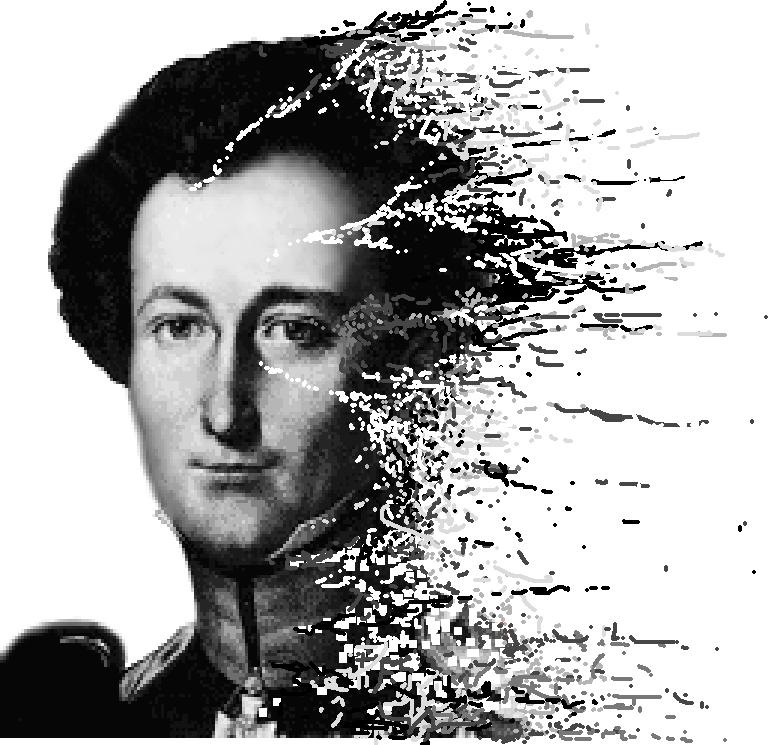
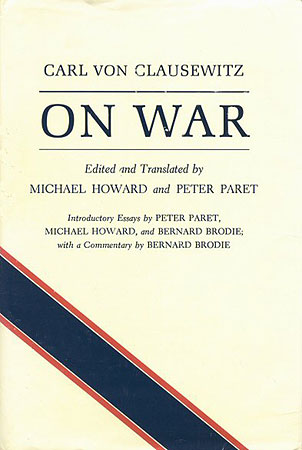
On War by Carl von Clausewitz has been the most influential book on strategy and war of all time.

We can say this because On War is the standard by which all other works of strategy are measured and only a few compared – notably Sun Tzu’s Art of War and The Peloponnesian War by Thucydides. The odd thing is that we can say this despite the fact that On War is more frequently shelved, cited or understood secondhand rather than read, even by military professionals. And furthermore, within the narrow demographic that reads Clausewitz seriously and critically, there can be heated dispute over what he meant, due to the difficulty of the text. Then there are the secondary effects, historical and military, of Clausewitz having been misunderstood, forgotten, ignored or at times, his strategic philosphy consciously rejected.

The shadow cast by On War is all the more remarkable given it’s circumstances of publication. Clausewitz died in 1831, at fifty-one, of cholera, having finally risen to a military post his talents merited. He had been writing On War since 1816 and it was far from completed or refined to his satisfaction and it is highly unlikely, in my view, that Clausewitz would have consented to it’s publication in the condition in which he left it. His determined and intellectually formidible widow, Marie von Clausewitz, further shaped the manuscript of On War, guided by her intimate knowledge of her husband’s ideas and was likely the best editor Clausewitz could have posthumously had.

Nevertheless, to my mind On War remains a magnificent unfinished symphony.

What would On War have looked like if Clausewitz had lived another twenty-five or thirty some years? Assuming continued good health, Clausewitz would have seen, perhaps commanded in, the First Schleswig War and at least studied the Crimean War from afar. He would have had another quarter-century of reading and mature reflection on his subject. Clausewitz, who had a keen understanding of history, would have also witnessed the grand European upheaval of liberal revolution in 1848 that rocked the Hohenzollern monarchy to it’s core. What new insights might Clausewitz have gleaned or expanded upon? Would his later chapters On War have evolved to equal the first?

Having outlived Marie (who died in 1836), would Clausewitz have become a deeply changed man?

What I find it difficult to believe is that Clausewitz, with his creatively driven and philosophically exacting mind,  would have been content to let the manuscript of On War rest where it stood in 1831. Or that we read today what Carl von Clausewitz ultimately intended.

Request for Information from the Readership

Thursday, October 27th, 2011

Need some help with a project at work. 

Looking to assemble a fast-and-dirty reading list for laymen that deals with the following topics:

Social intelligence, Emotional self-regulation, Emotion and learning, De-escalation of conflict, Attention, Self-Efficacy

Interested in both academic (for reference) and middlebrow (for distribution) titles, particularly those that contain interpersonal strategies and organizational culture angles. Links to journal or magazine articles or whatever else you deem useful will also be appreciated.

Fire away, the more the better.

R2P is the New COIN: Slaughter on Authority and International Law

Monday, September 26th, 2011

Part II.

This is the second part of  a series analyzing Anne-Marie Slaughter’s ideas about “Responsibility to Protect” doctrine, based on her Stanford Journal of International Law article, “Sovereignty and Power in a Networked World Order“, to better understand and critique the assumptions on which R2P rests. The topic will be Dr. Slaughter’s uses and conceptualization of “Authority” as it relates to international law and state sovereignty.

Slaughter is particularly concerned with sovereignty and redefining it in international law so that national sovereignty is in harmony with R2P and other au courant academic concepts of “global governance” that are outside the scope of this post. While much of Slaughter’s paper relates to description of empirical trends in the behavior of regulatory bodies in transnational and IGO networks or works of theory, for R2P or “new sovereignty” to be meaningful, it has to be expressed as a legal argument. Furthermore, that legal argument for R2P/new sovereignty must gain acceptance by being expressed by source(s) or forms that a majority of the international community regards as authoritative and binding.

To the unininitiated, international law as a field is something of an intellectual wonderland that bears little resemblance to how positive law functions judicially inside of a sovereign state. First, there is no Hobbesian global leviathan that can enforce international law. The UN is not the “parliament of man” and neither the World Court nor the International Criminal Court can directly compel sovereign states to do anything, and sovereigns retain considerable discretion of interpreting for themselves what international law means and requires them to do or not do. International law theory therefore bears greater resemblance, at times, to mediating theological disputes than it does to the kind of law cases people ordinarily encounter.

International law is most accurately described as a body of competing centers of legal authority that possess varying degrees of legitimacy and that attract voluntary compliance ftom state actors, including: binding international covenants, customary international law, precedent, rulings from internationally sanctioned institutions like the UNSC, the World Court, the WTO or the Red Cross and the consensus of government officials and experts in in international law. These do not all have equal authority or legitimacy – a clause in the Geneva Convention, a UNSC resolution or a concept like “diplomatic immunity” carries more legal weight in international law than an informal but common diplomatic practice or the opinion of a faction of law professors. The ambiguity and heterogeneous nature of international law leaves a lot of room for scholarly debate, litigation, for officials to “shop for opinions” and for ambitious ideologues to push novel theories as allegedly natural extensions of existing jurisprudence.

Slaughter’s legal justification for R2P and redefined sovereignty are in section II. where she leans primarily upon the authority of the ICISS ( International Commission on Intervention and State Sovereignty). As I am examining the ICISS section, I will break up the quoted text with comments:

….On the humanitarian side, Kofi Anana issued a challenge to all UN members at the opening of the General Assembly to “reach consensus – not only on the principle that massive and systematic violations of human rights must be checked, wherever they take place, but also on the ways of deciding what action is necessary, and when, and by whom.” In response to this challenge, the Canadian government, together with a group of major foundations, established the International Commission on Intervention and State Sovereignty (ICISS), headed by former Australian Foreign Minister Gareth Evans and Special Adviser to the UN Secretary General Mohamed Sahoun, and composed of a distinguished group of global diplomats, politicians, scholars and nongovernmental activists….

The ICISS has genuine, but very trivial, legal stature, having been brought into being by a single (!) member state of the UN and some very powerful and wealthy left-liberal American philanthropic foundations including the  Carnegie Corporation of New York, the William and Flora Hewlett Foundation, the John D. and Catherine T. MacArthur Foundation, the Rockefeller Foundation, and the Simons Foundation. The governments of the UK and Switzerland also gave financial support to the ICISS.  Politically, while the commissioners were prominent center-left statesmen, the ICISS advisory board tilted further to the international Left and toward elite “neoliberal” politicians. The ICISS was approximately as politically and philosophically balanced as would be an international small arms control commission composed entirely of members of the NRA.

The ICISS by itself is thin gruel in terms of legal authority, but has just enough substance to be legitimately served up on the table.  Once the foot was in the door, advocates for R2P were, over time, able to get it into the 2005 World Summit Outcome Document (again, relatively minor in itself, but an additional precedent) and, more substantially, into UNSC Resolution 1674. Much like sediment, a new theoretical concept has to lay down legal particulates in order to become a durable and freely recognized part of international law by sovereigns. That kind of autonomous judgment by sovereigns is something R2P advocates would like to sharply curtail.

….In December 2001 the ICISS issued an important and influential report, “The Responsibility to Protect“, which essentially called for updating the UN Charter to incorporate a new understanding of sovereignty.

Dr. Slaughter has a gift for understatement. “Incorporating a new understanding of sovereignty” means irrevocably changing national sovereignty as the term has been traditionally defined and understood. This is not exactly a minor ambition in international relations, which is one reason why I tend to regard Anne-Marie Slaughter as a revolutionary or radical IR theorist and not as a “neoconservative”, as she is sometimes accused of being by left-wing ideologues. Slaughter expounds further:

….The ICISS seeks to change the core meaning of UN membership from “the final symbol of independent sivereign statehood and thus the seal of acceptance into the community of nations” to recognition of a state as a responsible member of the community of nations.” Nations are free to choose or not not to sign the Charter: if they do, however, they must accept “the responsibilities of membership” flowing from their signature. According to the ICISS, “There is no transfer or dilution of state sovereignty. But there is a re-characterization involved: from sovereignty as control to sovereignty as responsibility in both internal functions and external duties.

[emphasis in original] 

That’s the kind of “re-characterization” that George Orwell’s Winston Smith regularly undertook in his job at the Ministry of Truth. To where or to whom does the political locus of control then move? Cui bono?( Hint: read Slaughter’s fifth section).

“Sovereignty as responsibility” implies duties or obligations rather than decision making power and, indeed, earlier in section II, Slaughter uses the phrase “conditional social contract” in the introductory paragraph. Slaughter’s ICISS derived social contract however is not Lockean in nature, formed by and with the consent of the governed, but is instead drawn by the state from the collective authority of the community of nations and sovereignty is manifested to the degree with which the state is interactive and interdependent and has “the capacity to participate in international institutions of all types”. A community not just of nations, but one that is extended and buttressed by being interwoven by transnational, quasi-independent, “governmental networks” of former and current politicians and bureaucrats

If you are thinking that this formula shifts political authority and power away from a state and the popular sovereignty of it’s citizens and toward a vaguely defined, supranational community, you would be absolutely correct. Drawing on the theories of Abram and Antonia Chayes, Slaughter, argues that the connectivity and interaction of the modern international system is such that “sovereignty as autonomy makes no sense”.

Such a position requires a healthy contempt for the consent of the governed as well as a childlike faith in the wisdom, integrity and basic competence of a superempowered technocratic elite.

To continue:

….Internally, a government has the responsibility to respect the dignity and basic rights of it’s citizens; externally, it has a responsibility to respect the sovereignty of other states.

Further, the ICISS places the responsibility to protect on both the state and on the international community as a whole. The ICISS insists that an individual state has the primary responsibility to protect individuals within it. However, where the state fails in that responsibility, a secondary responsibility falls on the international community acting through the United Nations. Thus, where a population is suffering serious harm, as a result of internal war, insurgency, repression or state failure, and the state in question is unwilling or unable to halt or avert it, the principle of non-intervention yields to the international responsibility to protect.

As Slaughter is redefining sovereignty as the “new sovereignty” of interactive capacity championed by Chayes and Chayes, “respecting the sovereignty of other states” probably does not mean “non-interference in the internal affairs of other states”. Interference (albeit not necessarily military intervention) might be the natural default position from using the premise of “sovereignty as responsibility” or as a “capacity to participate”. Hey, we aren’t intefering in your elections, your economy or your social system – we’re just “harmonizing” (Slaughter’s term) your laws and regulations and increasing your capacity to participate!

One wonders what aspects of American life that R2P advocates see as being most in need of international harmonization?  That’s a subject we can take up in future posts, but in terms of military intervention and R2P, a few comments in regard to international law as well as “capacity to participate”:

First, under current international law, the legitimate pretexts for military intervention largely revolve around the right of self-defense or disturbance of international peace, as recognized by the UNSC.  While this is a fairly narrow set of pretexts, in practice they are sufficiently flexible to address most scenarios of violent conflict without also justifying military aggression bent on conquest. What was lacking in Rwanda and the Balkans during the 1990’s were not legal rationales for military intervention but political will among the great powers to do so.  I see little evidence that R2P would carry greater moral or legal weight with state decision makers to compel them to undertake major military interventions out of altruism than does the Genocide Convention (which unlike R2P, as an international covenant, is an inarguably solid part of international law). Or, for that matter, the emotional pull of horrifying media imagery of dying children.

Secondly, by greatly broadening the scenarios under which military intervention is allowed under international law, R2P incentivizes such conduct primarily where doing so is inexpensive and will further national interests rather than in the worst cases, like Rwanda, where they are expensive and risky while yielding no tangible benefits. The global military capacity to intervene is finite and instead of doing triage, statesmen will go for the low-hanging fruit in a now much larger set of cases for potential intervention. If R2P were taken seriously, North Korea, Burma, Congo, Somalia, Syria and perhaps Yemen would be ahead in line for intervention before Libya. 

Thirdly, in terms of “capacity to participate”, the net global capacity for military intervention is overwhelmingly American and the logistical ability to sustain a major military intervention for more than a few weeks is a complete American monopoly. On pragmatic grounds, R2P will never work orchestrated in so lopsided a fashion of “America and some of the West vs. the Rest”. Nor will not be politically tolerated by either the American public or most of the world’s population. Or by Beijing’s steely-eyed rulers, who would have to bankroll this catalogue of expeditions because America no longer can afford to do so. Perhaps we can put “R2P” on our tin cup and get a better interest rate.

Even acting as benignly-intended peacekeepers, the potential scale of R2P vastly exceeds our will, our wallet and our welcome.

Switch to our mobile site