zenpundit.com » philosophy

Archive for the ‘philosophy’ Category

A Clausewitzian on “Cohesion”

Thursday, December 30th, 2010

Long time ZP readers are probably familiar with seydlitz89, a dedicated Clausewitzian and retired former military officer who comments here occasionally and blogs at Milpub regularly. I first read seydlitz89 at Dr. Chet Richards’ late, great, DNI site and seydlitz89 went on to participate in two extensive events at Chicago Boyz, the Clausewitz Roundtable and the Xenophon Roundtable and also had some of his more extensive writings featured on Clausewitz.com.

I would like to draw attention to one of those articles and seydlitz89’s focus on Clausewtz’s concept of “cohesion” and an implicit “theory of political development”. I am going to excerpt for my own purposes, but suggest that you read seydlitz89’s argument in full:

The Clausewitzian Concept of Cohesion as a Theory of Political Development

….The concept of cohesion comes up in various forms in On War and to lesser extent in Clausewitz’s other writings.   These forms of the overall concept include:

  • Cohesion as the moral (think tribalism, nationalism) and material (think constitution, institutions, shared views of how to define “civilization”) elements that make up the communal/social organizations of political communities, as exemplified in the three ideal types discussed below. Moral cohesion can be seen as the traditional communal values of a political community, what values and motivations guide people in their actions with family, friends and neighbours, whereas material cohesion are the modern cosmopolitan values associated with society or those social actions associated with institutions of various types. The two types exist is a certain state of constant stress and tension with modern values actually being destructive to the retention of traditional values (following Weber). Cohesion here is Clausewitz’s theory of politics which also includes the abstract concept of money. (Book VIII, Chapter 3B & the essay titled “Agitation”)
  • Cohesion provides the process behind which the center of gravities of both participants in a conventional war are formed. Lack of a center of gravity would indicate the inability to win decisively, which would include the target of conventional militaries committed to unconventional/guerrilla warfare. (Book VI, Chapter 27, Book VIII, Chapter 4)
  • Cohesion is the target of strategy in that tactical success is extended by strategic pursuit in order to expand the sphere of victory and bring about the disintegration of the enemy. Cohesion links the whole sequence of decisions (contingency) that allows the political purpose to be achieved through the means of the attained military goal, that is cohesion provides the chain of decisions/outcomes that unite political purpose with strategy and strategy with tactics, or vice versa. (Books II, IV, & Book VI Chapter 8)
  • Cohesion acts within the balance of power among various states – especially in terms of interests – with an aggressor having to contend with all the other states having an interest in maintaining the status quo. This would include the tendency for Clausewitz of a potential hegemon to fail in its attempt to dominate other peer states. (Book VI Chapter 6)
  • Cohesion can also be seen has having an influence in the varying states of balance, tension and movement through which all conflicts proceed. The cohesion (moral and material forces, willingness to take risks, soundness of the military aim in connection with the political purpose, etc) of each side being relatively equal while in balance, but increasing on one side during tension until a release of the tension (attack) and decreasing again during movement until balance is once again achieved or the conflict ends. (Book III, Chapter 18)
  • At the most abstract level the concept of cohesion could be seen as providing the unifying concept which maintains the various elements (the remarkable trinity and the operating principles) of Clausewitz’s general theory as part of a whole, the fields of attraction and tension that provide the general theory with its dynamic quality. (Book I Chapter 1)

Thus cohesion can be seen as a very broad concept, but for my purpose I am using only the first point listed above. 

and later:

….The third type of theory I wish to mention is what I refer to as Clausewitz’s theory of politics, or maybe more accurately, a theory of political development, which I see as inseparable from his concept of cohesion as I described in point one above in discussing the various forms of cohesion. 

For our purposes here we are interested in Clausewitz’s concept of cohesion as it pertains to this first point, the physical and moral cohesive elements of political communities, how cohesion acts in effect as a sliding scale of ever increasing (or deceasing) concentration, integration and organization of a political community. 

This is a very useful elucidation by seydlitz89, regardless if one favors Clausewitz or Sun Tzu or is altogether indifferent to military-strategic concerns and are more interested in broad questions of political philosophy and social policy.

Furthermore, I think Clausewitz’s speculations on cohesion were, like many of his systemic perceptions in On War, remarkably farsighted and intuitively rooted in a scientific reality that was unknown and untestable in his day. The conservative and eponymous scholar, Paul Johnson noted in his book Birth of the Modern that the 1820’s represented a time of great intellectual ferment when the arts, humanities and sciences were not yet compartmentalized, professionalized and estranged from one another. To paraphrase Johnson, it was still an era when a scientist like Faraday and an artist ( probably Harriet Jane Moore) could and did have a productive conversation about the properties of light in complete seriousness. As an intellectual, Clausewitz shared that zeitgeist.

In a military frame of reference,  the concept of “cohesion” brings to mind the Greek-Macedonian Phalanx as a representative example

but the phenomena appears not merely in military tactics or in human social relations but throughout the animal kingdom. Howard Bloom, the popular science writer using a sociobiological perspective, used “Spartanism” and “Phalanx” as metaphors for documented behaviors of creatures as disparate as bacteria, baboons and hard shell Baptists. “Groups under threat, constrict” Bloom wrote in Global Brain and this characteristic of cohesion appears to apply even when the groups are not sentient. Network theorists and scientists can explain collective behavior in terms of “strong” and “weak” ties, nodes and hubs and resilience, including emergent behavior of systems are not even alive.

Cohesion is an aspect of the natural world.
North Korea, Juche and “sacred war”

Monday, December 27th, 2010

[ by Charles Cameron ]

Okay, I am now clear that the correct translation of the Korean phrase that has sometimes been rendered “holy war” in recent news reports is in fact “sacred war”.

I’d been wondering just what an atheist state was doing threatening “holy” or “sacred” war…

*

Juche is the state philosophy of North Korea, and is considered to be the 10th largest religion in the world by the Adherents.com portal, ranking above Judaism, Baha’i, Jainism and Shinto. It developed out of Marxist-Leninism and has more recently incorporated Confucian elements.

Sunny Lee, writing in a 2007 article in Asia Times titled God forbid, religion in North Korea?, quotes Han Sung-joo, a former South Korean foreign minister, as saying “There is a deification and a religious emotional element [in juche] in the North. The twinned photos of Kim Il-sung and Kim Jong-il are everywhere. Every speech says Kim Il-sung is still alive. I think if I stayed another two weeks, I might even see Kim Il-sung. The country worships someone who is deceased, as if he were alive.”

One Christian site goes so far as to call Juche a “counterfeit Christianity:

Recognizing the power of Christianity, Kim wanted it to be directed at himself. So he took Christianity, removed God the Father, Jesus Christ and the Holy Spirit, set up himself, his wife and son as the new trinity, and called it Juche. At its core, Juche is a counterfeit Christianity that is deathly afraid of true version, and rightfully so.

I suppose a close comparison here would be with the cult which Robert Jay Lifton described in Revolutionary immortality: Mao Tse-tung and the Chinese cultural revolution.

*

In On Junche in Our Revolution, vol II (published in English, 1977), Kim Il Sung writes:

No military threat of the US imperialists, however, can frighten the Korean people. If, in the end, the US Imperialists and their stooges unleash a new war against the DPRK, in defiance of our people’s patient efforts to prevent a war and maintain peace and the unanimous condemnation of the peace-loving people of the world, the Korean people will rise as one in a sacred war to safeguard their beloved country and the revolutionary gains. They will completely annihilate the aggressors.

So the “sacred war” phrasing has been around for a while.

I hope to learn more — these in the meantime are some clues to be going on with…

2081

Sunday, December 19th, 2010

Long overdue yet exceedingly timely. From one of the great short stories of all time.

2081 Trailer from 2081 on Vimeo.

The WikiLeaks paradox

Friday, December 17th, 2010

[ by Charles Cameron ]

Since my “HipBone” analytical approach, like the HipBone Games which inspired it, is based on networks of linkages between one “representable” (concept, fact, quote, anecdote, sound, musical phrase, image, video clip, statistic, cultural form, person) and another, there’s a special place in my analytic thinking for those representables which are self-referential – the category that gave rise to Douglas Hofstadter’s celebrated book, Gödel, Escher, Bach.

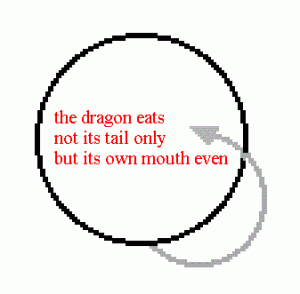
Indeed, I have a special glyph that I use in my games to notate ideas that are self-referential:

dragon eats

1

Okay, enough poetry for now.

The WikiLeaks business gives rise to one such self-referential puzzle – the one famously minted in classical times under the Latin tag: Quis custodiet ipsos custodes?

Just how you tend to interpret the tag in English may depend on whether you read “custodes” as “guards” or “watchmen” – who shall guard the guards, who shall oversee the overseers, who shall watch over the watchmen…

But what does this have to do with WikiLeaks?

2

Let me rephrase it: Who will leak the leakers?

I mean, if transparency is so universal a good, will Julian Assange drop his encryption and allow us all (IC and foreign equivalents included) to access WikiLeaks databases at any time, leaking whatever we think might be of interest without consulting him?

Or is the point that some opacity, some secrecy is good — and Julian Assange believes he knows which secrecy that is, and can be trusted to reveal that which should be revealed and keep secret that which should be kept secret?

3

Perhaps the WikiLeaks paradox is a koan, eh Zen?

Guest Post: Of Weaponry and Flags II.

Wednesday, October 27th, 2010

Charles Cameron is the regular guest-blogger at Zenpundit, and has also posted at Small Wars Journal, All Things Counterterrorism, for the Chicago Boyz Afghanistan 2050 roundtable and elsewhere.  Charles read Theology at Christ Church, Oxford, under AE Harvey, and was at one time a Principal Researcher with Boston University’s Center for Millennial Studies and the Senior Analyst with the Arlington Institute:

[Originally cross-posted at Chicago Boyz]

Of Weaponry and Flags II.

by Charles Cameron

YT in a comment on Zenpundit just pointed me to a quote from Virilio’s War and Cinema, Scott meanwhile suggested I might be interested in Meaning by Michael Polanyi – and between the two of them, I find myself wanting to make a trilogy of quotes that present the symbolic impact of flags from philosophical, psychological and neurological perspectives, thus (I hope) braiding together from somewhat disparate sources a simple, non-dualistic insight. From Michael Polanyi and Harry Prosch, Meaning, pp. 72-73:

The focal object in symbolization, in contrast to the focal object in identification, is of interest to us only because of its symbolic connection with the subsidiary clues through which it became a focal object. What bears upon the flag, as a word bears upon its meaning, is the integration of our whole existence as lived in our country. But this means that the meaning of the flag (the object of our focal attention) is what it is because we have put our whole existence into it. We have surrendered ourselves to that “piece of cloth” (which would be all the flag could be perceived to be were we to try to view it in the indication way of recognizing meaning). It is only by virtue of our surrender to it that this piece of cloth becomes a flag and therefore becomes a symbol of our country. Some of the subsidiaries, then, that bear upon the flag and give it meaning are our nation’s existence and our diffuse and boundless memories of our life in it. These, however, not only bear upon the flag as other subsidiary clues bear upon their focal objects, but they also, in our surrender to the flag, become embodied in it. The flag thus reflects back upon its subsidiaries, fusing our diffuse memories. We cannot use a straight arrow to express this feature in our diagram, since such an arrow pictures only a straight, one-directional bearing-upon. We must make the arrow loop, in symbolization, in order to express the way our perception of the focal object also carries us back toward (and so provides us with a perceptual embodiment of) those diffuse memories of our own lives (i.e., of ourselves) which bore upon the focal object to begin with. This is how the symbol can be said to “carry us away.” In surrendering ourselves, we, as selves, are picked up into the meaning of the symbol.

From Murray Stein, Jung’s map of the soul: an introduction, p 100:

Life itself may be sacrificed for images such as the flag or the cross and for ideas like nationalism, patriotism, and loyalty to one’s religion or country. Crusades and countless other irrational or impractical endeavors have been engaged in because the participants felt, “This makes my life meaningful! This is the most important thing I’ve ever done.” Images and ideas powerfully motivate the ego and generate values and meanings. Cognitions frequently override and dominate instincts. In contrast to the impact of the instincts on the psyche — when one feels driven by a physical need or y — the influence of archetypes leads to being caught up in big ideas and visions. Both affect the ego in a similar way dynamically, in that the ego is taken over, possessed, and driven.

And from Paul Virilio, War and cinema: the logistics of perception, pp. 5-6:

War can never break free from the magical spectacle because its very purpose is to produce that spectacle: to fell the enemy is not so much to capture as to ‘captivate’ him, to instil the fear of death before he actually dies. From Machiavelli to Vauban, from von Moltke to Churchill, at every decisive episode in the history of war, military theorists have underlined this truth: ‘The force of arms is not brute force but spiritual force.’ There is no war, then, without representation, no sophisticated weaponry without psychological mystification. Weapons are tools not just of destruction but also of perception – that is to say, stimulants that make themselves felt through chemical, neurological processes in the sense organs and central nervous system, affecting human reactions and even the perceptual identification and differentiation of objects

Might one identify the “stimulant” aspect (Virilio) as the one that drives those in the battlefield under fire, and thus also their memories and reflections, while strategists, as thinkers, will be more inclined to see the significance of the “archetypal” aspect (Murray, Jung)? Virilio (like Boyd) is concerned with speed — and it seems plausible to me that we have three “speeds of thought” – instinctive, considered and contemplative – corresponding in rough outline to Maslow’s hierarchy, the instinctive being bodily and immediate, the considered being logical and rapid, and the contemplative being symbolic and gradual. But there’s a curious loop at work here, because the symbolic / archetypal may take its time to work its way into conscious awareness – in some cases we refer to the end result as “maturity” or “wisdom” – but it’s also somehow very close to instinct, as Jung suggests in “On the Nature of the Psyche”, Collected Works VIII, para. 415:

Psychologically … the archetype as an image of instinct is a spiritual goal toward which the whole nature of man strives; it is the sea to which all rivers wend their way, the prize which the hero wrests from the fight with the dragon.

If anyone wants to follow up this particular line of thought, I’d recommend Jolande Jacobi’s Complex / Archetype / Symbol in the psychology of C. G. Jung, and for the interweaving of image, archetype and instinct, Andrew Samuels, Jung and the Post-Jungians Chapter 2, pp. 19 ff.


Switch to our mobile site

