zenpundit.com » Vietnam War

Archive for the ‘Vietnam War’ Category

All van Creveld, All the Time

Tuesday, June 28th, 2011

Darth Creveld explains the strategic dark side to SWJ

Michael Few pinged me regarding an interview Martin van Creveld gave to SWJ with the always interesting interlocuter, Octavian Manea:

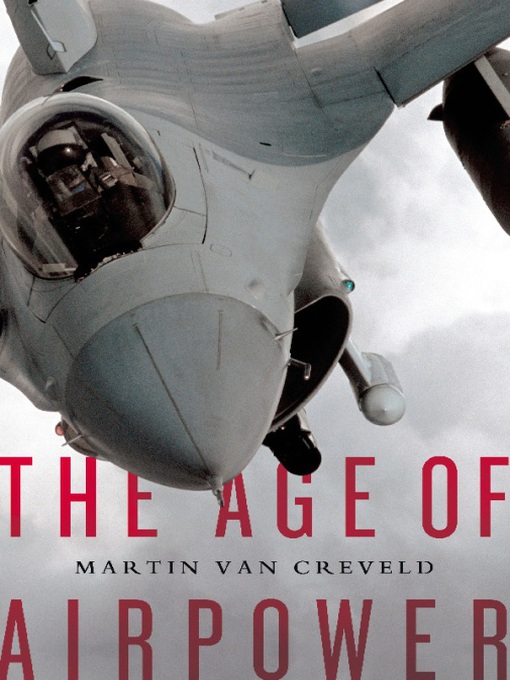
The Age of Airpower

Q: It is stated that Operations Rolling Thunder in Vietnam was the wrong way of using airpower in order to break the will of an opponent. Why? And which is the right way?

MvC: As Jesus once said, by their fruit will thou know them. Given the vast cost of Rolling Thunder, and the meager results it yielded, there can be no question that it was a foolish waste of resources. It was only made possible by the fact that it was carried out by the richest nation in history at the very peak of its economic power and psychological hubris.

The real question is, had the “gradual approach” been replaced by a short, sharp, all-out attack, would it have worked any better? To my mind the answer is almost certainly negative. Look at “Shock and Awe” as carried out both in Afghanistan and in Iraq. Both of these offensives employed weapons infinitely more sophisticated, and in many ways much more powerful, than the ones the Americans used in Vietnam almost forty years earlier (though some aircraft, notably the venerable B-52s, may well have taken part in both campaigns). Both depended their success, if indeed one can talk of success, on the presence of troops of the ground. Vietnam, though, was primarily a guerrilla war. Expanding ground operations into North Vietnam, as some in Washington DC demanded, would merely have made things even more difficult for the Americans.

Postscript: 

Adam has his take on the Infinity article.
More Books!

Friday, November 26th, 2010

Just picked up a few new reads…..


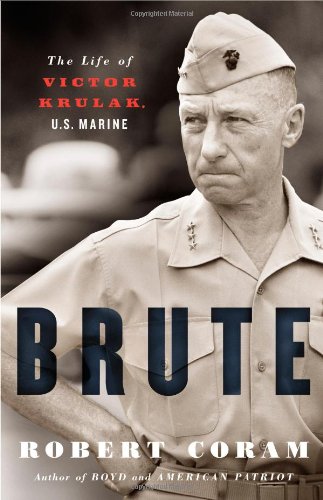
Brute: The Life of Victor Krulak, U.S. Marine by Robert Coram

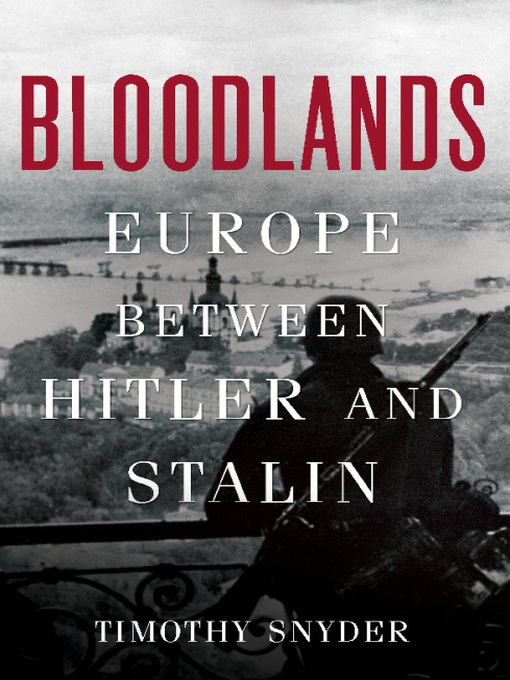
Bloodlands: Europe Between Hitler and Stalin by Timothy Snyder

Robert Coram, whom I had the pleasure of meeting at Boyd ’07, has a new biography of the legendary military visionary and Marine Lt. General Victor “Brute” Krulak, reviewed here by Max Boot and here by Tony Perry (Hat tip to Dr. Chet Richards). Having thumbed a few pages, Krulak appears a complicated man – gifted, dauntless and extremely driven but also possessed of a mean streak, edging at times toward petty cruelty.

Bloodlands I intend to read in a “Hitler-Stalin/Nazi-Soviet Comparison” series along with Richard Overy’s The Dictators: Hitler’s Germany, Stalin’s Russia, Robert Gellately’s Lenin, Stalin, and Hitler: The Age of Social Catastrophe , Richard J. Evans’ The Third Reich at War and Alan Bullock’s classic dual biography Hitler and Stalin: Parallel Lives.  I’d also recommend, for those with the stomach for historiographic commentary, Robert Conquest’s Reflections on a Ravaged Century and John Lukac’s The Hitler of History

CURRENTLY READING:

Human Face of War by Jim Storr

After reading approxmately a third of The Human Face of War by  Dr. Jim Storr, a retired Lt. Colonel, King’s Regiment and an instructor at the UK Defence Academy, I will say that if you are going to read only one book on modern military thought this year, it should be The Human Face of War. It’s that good.

Aside from a reflexive hostility toward John Boyd’s OODA Loop ( though not, strangely enough, toward the substantive epistemology advocated by Boyd that the diagram represented), Storr’s tome is an epistle of intellectual clarity on military theory that deserves to be widely read.

ADDENDUM:

NDU Press recommends, and I concur, this review of The Human Face of War by Col. Colonel Clinton J. Ancker III. Ancker, like Storr, is an expert on military doctrine, so it is a well-informed review by a professional peer.

Building the Antilibrary

Sunday, May 9th, 2010

New acquisitions….


Street Without Joy: The French Debacle In Indochina by Dr. Bernard Fall

The Human Factor: Inside the CIA’s Dysfunctional Intelligence Culture by “Ishmael Jones

Sadly, my effort to “stay on the wagon” and refrain from the purchase of books until I wade through some of my unread shelves is failing miserably. I also think this will be a COIN heavy year for the 2010 reading list.

ADDENDUM:

My colleague, Lexington Green, points to this fine review of The Human Factor by fellow Chicago Boyz blogger, James McCormick:

Mini-Book Review – Jones – The Human Factor

….Other reviews of this book have proclaimed Human Factor a rather boring recollection of examples of institutional ineptitude and better as a guidebook for potential employees than a useful description of the CIA but I feel this is in fact the most useful book on the CIA’s clandestine service since:

Orrin Deforest and David Chanoff, Slow Burn: The Rise and Bitter Fall of American Intelligence in Vietnam, Simon & Schuster, 1990, 294 pp.

David Atlee Phillips, The Night Watch: 25 Years of Peculiar Service, Atheneum, 1977, 309 pp.

which covered clandestine case officer activities, first person, in Vietnam and Latin America.

Like these two aforementioned titles, Human Factor focuses on the day-to-day challenges of being a covert case officer … the “teeth” in any intelligence organization. It is noteworthy that the Director of Central Intelligence has rarely, if ever, been one of those covert (non-State Department) officers. It’s as if your dentist was being overseen by experts in small-engine mechanics.

Ishmael recounts the minutiae of what reports he needed to write, the porous e-mail systems he had to manipulate, and the permissions he needed to gain. The timing and delays of decisions from Langley … the phrasing and terminology that was necessary to get anyone back in the US to allow any activity whatsoever. As a former stock broker, Jones was entirely comfortable with the challenges of “cold-calling” and dealing with “No” over and over again. But this wasn’t the case for his fellow trainees or for any of his superiors. At every turn, he was able to contrast his experience in the Marines (and military culture), and with Wall Street’s “make the call” ethos, with what he was experiencing as one of the most at-risk members of the Agency

Read the rest here.

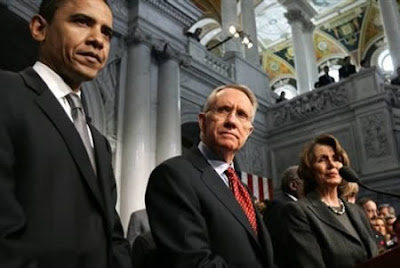
The Democratic Party Crack-Up over Afghanistan

Tuesday, October 13th, 2009


Some politics of foreign policy and war… 

An implicit theme of the “no drama” Obama administration is “You can trust Democrats with National Security“.

Until, of course, there is a roll call. Funding the Obama administration’s strategic policies in Afghanistan and Iraq are going to have to pass with Republican and Blue Dog Democrat votes as the graying, liberal,  Boomer Democrats in Congress relive ( for the 1000th vote) the one time they waved an anti-war sign on the quad back in ’69 after toking up a doobie in the dorm hall, and vote in a bloc against the leader of their party. Good. I hope they make an enormous media production out of it featuring the most extreme crazies in their caucus making abrasive, tone-deaf, comments on national television.

In 2010, the GOP ( if they have any political sense – a long shot at this juncture) may be running campaign commercials on how their Republican members stood solidly with the president against al Qaida when their Democratic counterparts did not.

The Suffering of Forgotten Allies

Tuesday, June 3rd, 2008

Sometimes, in the long run, you are better off to have been America’s enemy than America’s friend. Few peoples epitomize our poor track record in this regard than do the Montagnards of Vietnam, who still suffer persecution, repression and ethnic cleansing at the hands of Hanoi’s Communist government a generation after the end of the Vietnam War.

My friend Bruce Kesler, a veteran of Vietnam, has remained active on issues related to the consequences of the war and has brought to my attention the recent human rights report on Vietnam’s ongoing brutal campaign against the Montagnard people -“Vietnam’s Blueprint For Ethnic Cleansing.” . A campaign that sails along underneath the media radar.

Kesler writes at Democracy Project:

In hopes that the blogosphere will also send the message that anyone cares, I’m sending key excerpts to you. First, a brief definitional discussion may be needed to clarify the dimensions of the case.

Genocide is a term reserved for wholesale, purposeful, government-organized, technological extermination of an identified group, and is even reserved for specific types as laid out in Geneva Conventions. There’s justifiable discouragement of excessive use of the term as cheapening the scale and suffering of those subjected to it.

Ethnic cleansing is a term for grayer areas of such horrendous efforts, when the effort is not as whole-encompassing, or there’s lack of global opinion agreement that it rises to genocide.

….I think the Montagnard Foundation is hesitant to use the term genocide, to avoid being caught up in definitional arguments, but what you’ll read below certainly seems to be more than “mere” ethnic cleansing relocation of a group. There’s many specifics, footnoted, and photos.

… Examining the evidence collectively, a blueprint of ethnic cleansing emerges as these human rights violations, including official and spontaneous transmigration policies, large scale deforestation, abuse of family planning methods, religious persecution, land confiscation, torture and extrajudicial killing, have been directed against a specific race of indigenous peoples….

Vietnam is a poor but developing country that needs outside aid and especially, trade, if it is not to devolve into a satellite of China. Pressure for better treatment of the Montagnards by the U.S., Japan and the West can easily be applied if the will exists.


Switch to our mobile site